
Opening your dashboard
Class 7 Biology Chapter 2 Classification of Plants: Competency-Based Questions (CBQ)
40 questions on Chapter 2, each worked through on its own page with the AI tutor. Class 7 Biology, ICSE 2026-27.
40 questions
1–5 marks · Mixed difficulty
- 11 mark
Question 1
Cognitive domain: Application
After the harvest, jute farmers of West Bengal tie the cut jute stems into bundles and keep them under pond water for some days. When the bundles are taken out, the fibres come away from the stems easily and feel soft. What brings about this change ?
- 21 mark
Question 2
Cognitive domain: Analysis
Nikhil watched an amoeba in a drop of pond water under the microscope and drew it. He lettered its four pseudopodia P, Q, R and S.
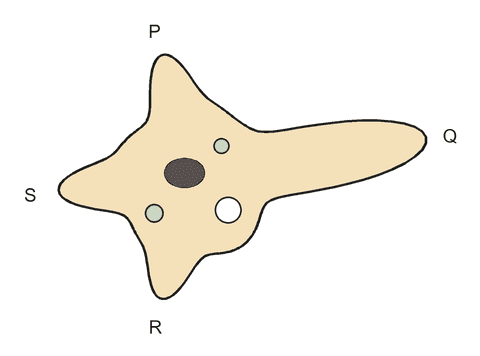
Towards which letter is the amoeba most likely moving ?
- 31 mark
Question 3
Cognitive domain: Application
In January, Tanvi visited Shimla. The apple trees in the orchards stood bare, without a single leaf. But the tall cedar (deodar) trees beside the road were green all over. Which statement best explains why the cedar trees were still green ?
- 41 mark
Question 4
Cognitive domain: Analysis
During an outbreak of illness in a town, a laboratory examined samples from four patients under a high powered microscope. The shape of the bacteria seen in each sample was noted.
Patient Shape of the bacteria seen 1 Spherical 2 Rod-shaped 3 Comma-shaped 4 Spiral-shaped Only one of the four patients has cholera. Which patient is it, and what is this form of bacteria called ?
- 51 mark
Question 5
Cognitive domain: Understanding
Assertion (A): In the bread mould, digestion of food takes place outside its body.
Reason (R): The hyphae secrete digestive juices into the bread, and the glucose formed is then absorbed through the body surface.
- 61 mark
Question 6
Cognitive domain: Analysis
Assertion (A): Mosses grow best on dry, sunny walls that never get wet.
Reason (R): Mosses need water to reproduce.
- 71 mark
Question 7
Cognitive domain: Application
A dairy farmer in Gujarat puts the dung of her cows into a closed gobar gas plant every day. She cooks the family's food on the gas that comes out of it, and spreads the left-over material on her fields.
The dung in the plant is decomposed by ______, and the left-over material is used in the fields as ______.
- 81 mark
Question 8
Cognitive domain: Understanding
Fatima watched a living amoeba under the microscope for a few minutes. She saw a small clear bubble near its edge. The bubble grew bigger slowly, then suddenly became small, and then began to grow again.
The bubble is the ______ vacuole, and each time it shrinks, the excess ______ collected in it is released into the surroundings.
- 91 mark
Question 9
Cognitive domain: Application
A botanist finds a new plant in a forest of the Western Ghats. After a careful study she places it in the group of ferns. A student who has never seen this plant, but has studied a garden fern, can at once say something about how it reproduces.
Like other ferns, the new plant will produce tiny ______ in small rounded bodies on the undersurface of its leaves, and it will not bear flowers and ______.
- 102 marks
Question 10
Cognitive domain: Evaluation
Dev says, "A bacterium and an amoeba are both made of just one cell, and both can be seen only under a microscope. So they should be placed in the same kingdom." Do you agree with Dev ? Justify your answer.
- 112 marks
Question 11
Cognitive domain: Application
During the monsoon, Mr Nair kept one pair of leather shoes in a closed, damp cupboard and another pair on a dry, airy shelf. After two weeks, the shoes in the cupboard had greenish-white, furry patches on them. The other pair was clean. What are the furry patches, and why did they appear only on the shoes in the cupboard ?
- 122 marks
Question 12
Cognitive domain: Understanding
A teacher showed two video clips of amoeba. In clip 1, an amoeba in fresh pond water pinched into two. In clip 2, a pond had dried up; when rain water filled it again, a round, thick-walled body broke open and many tiny amoebae came out of it. Name the method of reproduction seen in each clip, and explain why clip 2 gives many young ones while clip 1 gives only two.
- 135 marks
Question 13
Cognitive domain: Analysis
Case: An agriculture officer divided a field into three equal plots. No fertiliser or manure was added to any plot. Beans were grown in plot A, maize in plot B, and plot C was left empty. The amount of nitrates in the soil of each plot was measured before sowing and again after the harvest. When the plants were pulled out, small swollen structures were seen on the roots of the bean plants but not on the roots of the maize plants.
Plot Crop Nitrates before sowing (mg in 1 kg of soil) Nitrates after harvest (mg in 1 kg of soil) A Beans 20 32 B Maize 20 11 C No crop (left empty) 20 20 (a) Calculate the change in the amount of nitrates in each plot. Say whether it is a rise or a fall.
(b) Name the swollen structures on the roots of the bean plants and the bacteria that live in them. Explain how they account for the result of plot A.
(c) Why did the nitrates fall in plot B ? Why was plot C included in the study ?
(d) Next season the officer wants a good crop of maize without buying fertiliser. In which plot should the maize be sown ? Give a reason.
- 145 marks
Question 14
Cognitive domain: Evaluation
Case: Meera drew the key shown below for her class. By answering its questions with yes or no, a student should be able to place any living organism in one of the five kingdoms. She has numbered the kingdoms 1 to 5 instead of naming them.
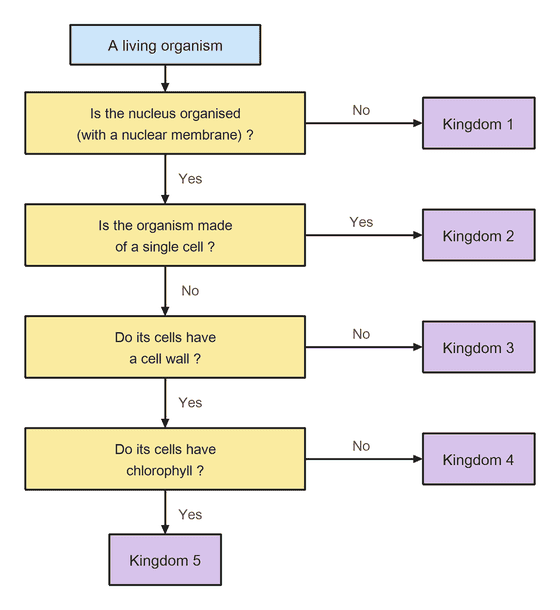
(a) Name the kingdoms that Meera means by the numbers 1 to 5.
(b) Test the key with bread mould and with Spirogyra. Write the answers you get at each question and the kingdom that each one reaches. Does the key work for them ?
(c) Now test the key with yeast. Which kingdom does the key give ? Is this correct ? Give a reason.
(d) Is Meera's key still a useful one ? Give your opinion with a reason.
- 155 marks
Question 15
Cognitive domain: Creativity
Case: The Nature Club of a school in Kerala wants to find out which groups of plants grow in the school campus — algae, mosses, ferns, gymnosperms, monocots and dicots. The members will go round the campus in pairs with a pencil and a record sheet. They must not uproot or damage any plant.
(a) Design the record sheet as a table. Choose the columns so that the features noted will be enough to decide the group of each plant.
(b) Fill in your sheet for three plants that the members are likely to find : a green velvety layer on a damp wall, a grass on the playground and a hibiscus (china rose) bush.
(c) The members cannot dig up roots or split seeds. Write two simple rules that will help them to tell a monocot from a dicot just by looking, and one rule to tell a fern from a flowering plant.
- 161 mark
Question 16
Cognitive domain: Analysis
In a quiz, Asha has to find the kingdom of an organism by asking the questions below in this order, and she stops as soon as an answer settles the kingdom.
- Is the nuclear material without a nuclear membrane ? If yes, the kingdom is Monera.
- Is the organism unicellular ? If yes, the kingdom is Protista.
- Does the organism have no cell wall ? If yes, the kingdom is Animalia.
- Does the organism have chlorophyll ? If yes, the kingdom is Plantae; if no, the kingdom is Fungi.
For some kingdoms she can stop after fewer questions than for others. Which two kingdoms need the greatest number of questions, and how many questions does each of them need ?
- 171 mark
Question 17
Cognitive domain: Understanding
Rakesh is making a model of a rod-shaped bacterium that has a capsule. He cuts four layers of coloured paper for the capsule, the cell wall, the cell membrane and the cytoplasm, and sticks them one inside the other. In which order should he place them, starting from the outermost layer ?
- 181 mark
Question 18
Cognitive domain: Analysis
Nandini collected two thread-like growths. G was a green, slimy mass floating in a sunlit pond. H was a white, cottony growth on a rotting guava kept on a shaded shelf. Under the microscope both looked like long, thin threads. Her teacher said that one of the two is an alga and the other is a fungus. Which finding tells Nandini which is which ?
- 191 mark
Question 19
Cognitive domain: Understanding
A student looked at a drop of pond water under a microscope and saw four kinds of single-celled organisms: Amoeba, Paramecium, Euglena and some diatoms. She wrote four statements about them. Which statement is correct ?
- 201 mark
Question 20
Cognitive domain: Application
The figure shows a bread mould growing on a slice of bread. Four parts are marked P, Q, R and S.
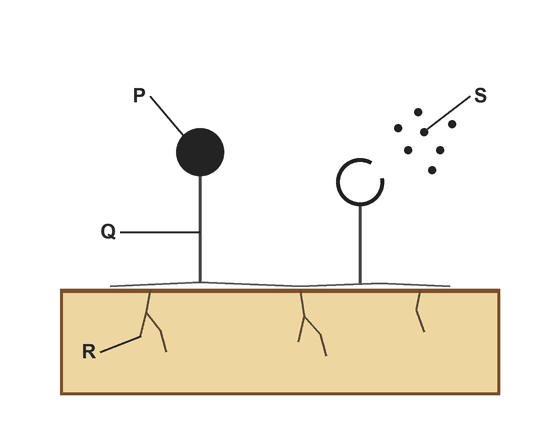
The hyphae of this mould give out digestive juices into the bread and absorb the sugar that is formed. Which row names the letter of the part that digests and absorbs the food, and the letter of the part that helps the mould to spread to a new slice of bread ?
- 211 mark
Question 21
Cognitive domain: Analysis
Assertion (A): Algae, mosses and ferns are all placed in the group of plants called cryptogams.
Reason (R): All of these plants live only in water.
- 221 mark
Question 22
Cognitive domain: Analysis
Assertion (A): A mango tree is a gymnosperm because it is a large tree.
Reason (R): Gymnosperms are mostly woody trees.
- 231 mark
Question 23
Cognitive domain: Application
A botanical garden in Darjeeling has a section with more than thirty kinds of cone-bearing gymnosperm trees. A guide has only ten minutes with a group of students and wants them to learn the main features of all the gymnosperms in the section. Which plan makes the best use of an advantage of classification ?
- 241 mark
Question 24
Cognitive domain: Application
A science book compares the sizes of some cells. Sizes are measured in micrometres (µm); one micrometre is one thousandth of a millimetre. (Hypothetical data.)
Cell Size (µm) Red blood cell (width) Yeast cell (width) Rod-shaped bacterium (length) Spherical bacterium (width) A red blood cell and a yeast cell are placed side by side. A row of spherical bacteria, touching one another, is laid along the same length. How many spherical bacteria are in the row ?
- 251 mark
Question 25
Cognitive domain: Evaluation
Naveen claims: "A plant that does not bear flowers cannot bear seeds." His teacher says that one of the following plants shows that his claim is wrong. Which one is it ?
- 262 marks
Question 26
Cognitive domain: Application
A family in Uttar Pradesh makes jamun vinegar at home. They pour jamun juice into a clean clay pot, add a little vinegar kept from the previous batch, cover the pot with a cloth, and leave it for some weeks. The juice slowly turns into sour vinegar.
(a) Name the bacteria that change the juice into vinegar, and name the acid that gives vinegar its sour taste.
(b) Why do they add a little vinegar from the previous batch ?
- 272 marks
Question 27
Cognitive domain: Application
A farmer grows mushrooms in a dark, closed shed. He spreads moist paddy straw on racks and puts mushroom spawn on it. After some days, mushrooms appear on the straw. There is no sunlight in the shed, and the mushrooms do not need any.
(a) Why can the mushrooms grow well without sunlight ?
(b) From what, and how, do the mushrooms get their food ?
- 282 marks
Question 28
Cognitive domain: Evaluation
Ria found long, green, slimy threads floating in a garden water tank. She said, "This is a tiny plant. It must have a root, a stem and leaves, but they are hidden under the water."
Is Ria right ? Say what part of her statement is correct and what part is wrong.
- 292 marks
Question 29
Cognitive domain: Analysis
Samir soaked pea seeds overnight. From of them he carefully removed both cotyledons, keeping only the tiny young plant (the embryo) that lies between them. He sowed the whole seeds in pot A and the embryos in pot B, using the same soil, light and watering for both pots. After ten days, pot A had healthy seedlings with green leaves, while pot B had only small, weak seedlings. (Hypothetical data.)
(a) What does this result tell you about the work of the cotyledons ?
(b) Predict how the cotyledons of a seedling from pot A will look if it is gently dug up on day ten. Give a reason.
- 302 marks
Question 30
Cognitive domain: Analysis
Bacterium X lives inside the body of a sick person and takes its food from the person. Bacterium Y lives in a heap of dead leaves in the soil and takes its food from them. Neither X nor Y can make its own food.
(a) What name is given to organisms that live on other living organisms, like X ?
(b) Why are both X and Y called heterotrophs, and why is Y not called the same as X ?
- 312 marks
Question 31
Cognitive domain: Understanding
Arun drew a bread mould as one long, upright thread with a round ball at its tip, and wrote "mycelium" under it.
What is the part that Arun has actually drawn ? What does the word mycelium really stand for ?
- 323 marks
Question 32
Cognitive domain: Analysis
After the rains, the Nature Club of a school found a green, velvety layer on a damp wall and a fern growing in a pot near the gate.
(a) Give one feature that is common to the green layer (a moss) and the fern.
(b) Give one difference between their roots.
(c) In the dry months, the green layer on the wall dried up and turned brown. Use your answer to (b) to explain why a moss on a wall dries up so easily in the dry season.
- 333 marks
Question 33
Cognitive domain: Evaluation
A student made a poster. It said, "Bacteria are germs. We must destroy every bacterium on the earth !"
Evaluate the poster. Give two reasons, from what you have learnt, why this aim would do more harm than good, and write one correct message that the poster should carry instead.
- 343 marks
Question 34
Cognitive domain: Understanding
The four events below take place in the life of a bread mould, but they are not in the right order.
(i) The sporangium bursts and the spores are blown into the air.
(ii) A spore lands on a moist, stale slice of bread and starts to grow.
(iii) Erect hyphae grow up from the mycelium, and rounded sporangia form at their tips.
(iv) Thread-like hyphae spread over the bread as a mycelium.
(a) Write the events in the correct order.
(b) Which structure holds the spores before they are released ?
(c) What will happen to a spore that lands on a dry, bare stone ? Give a reason.
- 353 marks
Question 35
Cognitive domain: Evaluation
A shopkeeper in Shimla sells packets of chilgoza (pine nuts) with the label "dry fruit". A student reads the label and says, "The edible nut is the seed of a pine tree, and a pine tree does not make fruits."
(a) To which group of plants does the pine tree belong ?
(b) Is the student right ? Explain where the seeds of a pine tree are found, and how this differs from a mango tree.
(c) Does this mean that the shopkeeper's label is wrong ? Give your view.
- 363 marks
Question 36
Cognitive domain: Creativity
Write a three-clue riddle whose answer is Kingdom Fungi, using only features you have learnt in this chapter. The clues must work like a key :
- clue 1 must fit at least four of the five kingdoms;
- clue 2 must leave three kingdoms;
- clue 3 must leave only Fungi.
After each clue, name the kingdoms that still fit.
- 375 marks
Question 37
Cognitive domain: Analysis
Case: A class studied how curd is made. Four bowls of lukewarm milk were prepared and left for six hours. The results are shown below. (Hypothetical data.)
Bowl What was added to the milk Where it was kept Result after 6 hours A A spoonful of curd Room (about ) Set into curd B A spoonful of curd Refrigerator Still liquid milk C Nothing Room (about ) Still liquid milk D A spoonful of curd that had been boiled and then cooled Room (about ) Still liquid milk (a) Which two bowls should be compared to show that the milk needs a spoonful of curd to set ? Say what the comparison shows.
(b) Which two bowls show that warmth is also needed ?
(c) Explain the result in bowl D.
(d) Bowl B is now taken out and kept at room temperature. What do you predict will happen, and why ?
- 385 marks
Question 38
Cognitive domain: Evaluation
Case: Rani cut two similar slices from the same loaf of bread. She sprinkled a little water on slice A and kept it in a warm cupboard. She left slice B dry on an open shelf. Every day she estimated the percentage of the top surface of each slice that was covered by mould. The graph shows her results; on day and day neither slice had any mould, so the two lines overlap there. (Hypothetical data.)
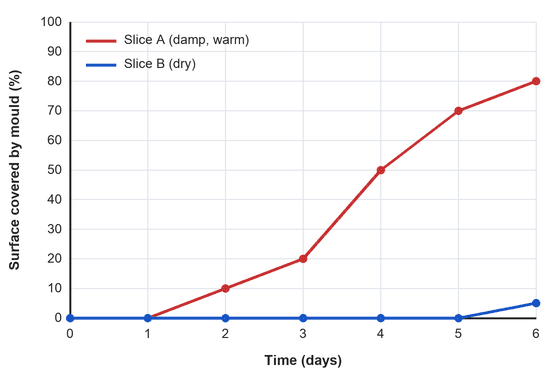
(a) Read from the graph the percentage of slice A covered on day and on day . By how many percentage points did it increase between these days ?
(b) During which day (from day to day ) did the mould spread fastest on slice A, and by how many percentage points ?
(c) Explain why the mould spread slowly at first and then much faster.
(d) Rani says, "Slice B stayed almost free of mould, so dry bread can never grow mould." Is this conclusion fully correct ?
- 394 marks
Question 39
Cognitive domain: Analysis
Case: The Nature Club made a register of specimens and sorted them into groups, as shown below. They called it "Our Plant Register". (Hypothetical data.)
Group Number of specimens Algae Fungi Mosses Ferns Gymnosperms Monocots Dicots (a) The algae, mosses and ferns are the cryptogams. Find how many specimens are cryptogams, and what percentage of the register this is.
(b) The gymnosperms, monocots and dicots are the phanerogams. Find how many phanerogams there are. What fraction of them have seeds enclosed in fruits ?
(c) The teacher says that one group does not belong in a plant register under the five-kingdom system. Name it, give a reason, and say how many specimens will remain.
- 404 marks
Question 40
Cognitive domain: Analysis
Case: Students collected water from three ponds and counted the single-celled organisms in drops of water under a microscope. The table gives the average number of each kind per set of drops. Pond 1 is in open sunlight, pond 2 is partly shaded, and pond 3 lies deep in the shade of a large tree. (Hypothetical data.)
Organism Pond 1 Pond 2 Pond 3 Amoeba Paramecium Euglena Diatoms (a) Euglena and diatoms are the plant-like protists. Which pond has the most plant-like protists ? Give the number.
(b) What percentage of all the organisms counted is plant-like in pond 1, and in pond 3 ?
(c) Explain the pattern that you see in the number of plant-like protists from pond 1 to pond 3.