
Opening your dashboard
Class 6 Physics Chapter 1: Matter Solutions
46 textbook questions with step-by-step answers, free to read, for ICSE 2026-27.
Get talked through Ch 1, not just shown the answer
Reading a finished solution is not the same as being able to do it. The AI tutor takes one question at a time and works it with you, in your own words, until you can.
- Ask it out loud, in your own words
- It gives you the next step, not the answer
- Stuck on part (ii)? Start there
46 questions with solutions
1–4 marks · Mixed difficulty
- 11 mark
Question 1
Choose the correct answer from the multiple choices given below.
The diameter of a molecule is approximately:
Solve with AIAnswer
(A) 1 cm
(B) 10 cm
- Correct
(C) m
(D) 1 m
Answer: (C) m
Concept: The molecules of matter are very small (about m across). There are spaces between them, called inter-molecular spaces. They attract one another; this pull is the inter-molecular force. And they are always moving.
Step 1 — Recall how small a molecule is.
Molecules are far too small to be seen, even with an ordinary microscope. A molecule is only about m to m across.
Step 2 — Write the number in full.
A negative power of ten is a very small number. Here m means one metre divided into ten thousand million equal parts.
Step 3 — Compare with the options.
Only m is this tiny. The other three options are sizes of everyday objects that we can see easily.
Watch out: The minus sign in makes it very small; would be a huge number.
Why the other options are wrong:
- (A) 1 cm: 1 cm is about the size of a small bead, which we can see easily.
- (B) 10 cm: 10 cm is about the width of a palm, far bigger than a molecule.
- (D) 1 m: 1 m is about the height of a table, not the size of a molecule.
Therefore, the diameter of a molecule is approximately m, option (C).
- 21 mark
Question 2
Choose the correct answer from the multiple choices given below.
The inter-molecular forces are strongest in :
Solve with AIAnswer
- Correct
(A) solids
(B) liquids
(C) gases
(D) both (A) and (B)
Answer: (A) solids
Concept: Going from a solid to a liquid to a gas, the inter-molecular spaces become larger and the inter-molecular forces become weaker.
Step 1 — Compare the forces in the three states.
The inter-molecular force is greatest in solids, weaker in liquids and negligible in gases.
Step 2 — Check with what we see.
The molecules of a solid are held so firmly that they stay at fixed positions, which is why a solid keeps its shape. So the force is strongest in solids.
Watch out: The word “strongest” means the greatest of the three, so only one state can have it.
Why the other options are wrong:
- (B) liquids: In liquids the force is weaker than in solids, which is why a liquid can flow.
- (C) gases: In gases the force is the weakest of all (negligible), so gas molecules move about freely.
- (D) both (A) and (B): The force is weaker in liquids than in solids, so the two states do not share the strongest force.
Therefore, the inter-molecular forces are strongest in solids, option (A).
- 31 mark
Question 3
Choose the correct answer from the multiple choices given below.
The molecules :
Solve with AIAnswer
(A) in solid, liquid and gas, move freely anywhere.
(B) in a solid, move freely within its boundary.
- Correct
(C) in a liquid, move within its boundary.
(D) in a gas, move only within its boundary.
Answer: (C) in a liquid, move within its boundary
Concept: In a liquid the molecules are less closely packed than in a solid and the inter-molecular forces are weaker. The molecules move about, but only within the boundary of the liquid, so a liquid has a definite volume but no definite shape.
Step 1 — Recall how liquid molecules move.
In a liquid the inter-molecular forces are weaker than in a solid, so the molecules are not fixed. They move about and slide over one another.
Step 2 — See where they can go.
The forces are still strong enough to keep the molecules together, so they stay inside the liquid. They move only within the boundary of the liquid.
Watch out: A liquid's molecules do move, but they cannot leave its boundary as gas molecules can.
Why the other options are wrong:
- (A) in solid, liquid and gas, move freely anywhere: Only gas molecules move freely anywhere; solid molecules stay at fixed positions, and liquid molecules stay within the liquid.
- (B) in a solid, move freely within its boundary: In a solid the molecules stay at fixed positions and only vibrate about them; they do not move about.
- (D) in a gas, move only within its boundary: A gas has no boundary of its own; its molecules spread into all the space available to them.
Therefore, in a liquid the molecules move within its boundary, option (C).
- 41 mark
Question 4
Choose the correct answer from the multiple choices given below.
Solids are :
Solve with AIAnswer
- Correct
(A) more dense
(B) less dense
(C) least dense
(D) highly compressible
Answer: (A) more dense
Concept: In a solid the molecules are very closely packed and the inter-molecular forces are the strongest. The molecules stay at fixed positions and only vibrate about them, so a solid has a definite shape and a definite volume.
Step 1 — Link packing with density.
Density tells how much mass is packed into each unit of volume. The closer the molecules are packed, the more mass there is in the same space.
Step 2 — Apply it to solids.
The molecules of a solid are the most closely packed, so solids are generally more dense than liquids and gases.
Watch out: This is the general rule; ice is a well-known exception, being a little less dense than water, which is why ice floats.
Why the other options are wrong:
- (B) less dense: Liquids are generally less dense than solids, because their molecules are less closely packed.
- (C) least dense: Gases are the least dense, because their molecules are far apart.
- (D) highly compressible: Solids can hardly be compressed at all; it is gases that are highly compressible.
Therefore, solids are more dense, option (A).
- 51 mark
Question 5
Choose the correct answer from the multiple choices given below.
The inter-molecular forces in liquids are :
Solve with AIAnswer
(A) as strong as in solids
(B) stronger than in solids
- Correct
(C) weaker than in solids
(D) weaker than in gases
Answer: (C) weaker than in solids
Concept: Going from a solid to a liquid to a gas, the inter-molecular spaces become larger and the inter-molecular forces become weaker.
Step 1 — Place liquids between the other two states.
The inter-molecular force is strongest in solids, weaker in liquids and negligible in gases.
Step 2 — Check with what we see.
A liquid flows and takes the shape of its vessel, so its molecules are held less firmly than those of a solid. Yet a liquid keeps its volume, so they are held more firmly than those of a gas.
Watch out: Liquids come in the middle: weaker than solids but stronger than gases.
Why the other options are wrong:
- (A) as strong as in solids: If the forces were as strong as in solids, a liquid would keep a definite shape and could not flow.
- (B) stronger than in solids: The forces in solids are the strongest, so the forces in liquids cannot be stronger.
- (D) weaker than in gases: The forces in gases are the weakest, so liquids have stronger forces than gases, not weaker.
Therefore, the inter-molecular forces in liquids are weaker than in solids, option (C).
- 61 mark
Question 6
Choose the correct answer from the multiple choices given below.
The diagram below shows the arrangement of molecules in three states of matter.
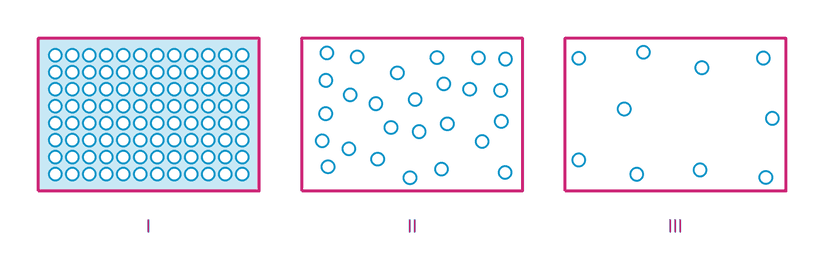
The arrangement of molecules in drinking water would look like.
Solve with AIAnswer
(A) I
- Correct
(B) II
(C) III
(D) all of these
Answer: (B) II
Concept: Matter exists in three states: solid, liquid and gas. Which state a substance is in depends on how closely its molecules are packed, how strongly they attract one another and how freely they move.
Step 1 — Name the state of drinking water.
Drinking water at room temperature is a liquid.
Step 2 — Recall the liquid arrangement.
In a liquid the molecules are less closely packed than in a solid and are not in a regular pattern. Yet they are not far apart as in a gas.
Step 3 — Pick the matching box.
Box I shows tightly packed rows, and box III shows a few molecules spread far apart. Box II shows molecules with small gaps between them and no regular pattern, which is the liquid arrangement.
Watch out: Match the state first (water is a liquid), then the arrangement; do not pick the most crowded box.
Note: in the printed figure the labels I, II and III sit a little to the left of their boxes. Each label belongs to the box just above it, so II is the middle box.
Why the other options are wrong:
- (A) I: Box I shows molecules very closely packed in a regular pattern, the arrangement in a solid such as ice.
- (C) III: Box III shows a few molecules far apart, the arrangement in a gas such as water vapour.
- (D) all of these: Drinking water is in only one state, the liquid state, so only one arrangement can fit it.
Therefore, the arrangement of molecules in drinking water looks like box II, option (B).
- 71 mark
Question 7
The following question is Assertion-Reason based. Choose the answer based on the codes given below.
Assertion (A) : A metal water tank does not change its shape when filled.
Reason (R) : Solids cannot be compressed under ordinary pressure.
Solve with AIAnswer
- Correct
(A) Both A and R are true and R is the correct explanation of A
(B) Both A and R are true and R is not the correct explanation of A
(C) A is true but R is false
(D) A is false but R is true
Answer: (A) Both A and R are true and R is the correct explanation of A
Concept: In a solid the molecules are very closely packed and the inter-molecular forces are the strongest. The molecules stay at fixed positions and only vibrate about them, so a solid has a definite shape and a definite volume.
Step 1 — Judge the Assertion.
A metal tank is a solid. It keeps the same shape whether it is empty or full of water, so the Assertion is true.
Step 2 — Judge the Reason.
The molecules of a solid are very closely packed, with almost no space between them. So a solid cannot be compressed under ordinary pressure, and the Reason is true.
Step 3 — Decide whether R explains A.
When the tank is filled, the water presses outwards on its walls. The walls are a solid whose closely packed molecules cannot be squeezed together, so they do not give way, and the tank keeps its shape. So R does explain A.
Note: one could argue that a tank keeps its shape mainly because a solid is rigid (its molecules are held at fixed positions), which R does not say; on that view the answer would be (B). Both the rigidity and the incompressibility come from the closely packed, firmly held molecules, so the book's answer (A) is kept.
Why the other options are wrong:
- (B): R does explain A here: the walls keep their shape because the solid metal cannot be squeezed.
- (C): R is a true statement: solids cannot be compressed under ordinary pressure.
- (D): A is a true statement: a metal tank keeps its shape when it is filled.
Therefore, both A and R are true and R is the correct explanation of A, option (A).
- 81 mark
Question 8
The following question is Assertion-Reason based. Choose the answer based on the codes given below.
Assertion (A) : Packing sand in a bag will double its volume.
Reason (R) : Solids have a definite shape, size and volume.
Solve with AIAnswer
(A) Both A and R are true and R is the correct explanation of A
(B) Both A and R are true and R is not the correct explanation of A
(C) A is true but R is false
- Correct
(D) A is false but R is true
Answer: (D) A is false but R is true
Concept: In a solid the molecules are very closely packed and the inter-molecular forces are the strongest. The molecules stay at fixed positions and only vibrate about them, so a solid has a definite shape and a definite volume.
Step 1 — Judge the Assertion.
Sand is a solid made of many small grains, and each grain has its own definite volume. Putting the sand into a bag only changes the shape of the heap; the grains do not grow. So the volume cannot double, and the Assertion is false.
Step 2 — Judge the Reason.
A solid has a definite shape, size and volume, so the Reason is true.
Step 3 — Choose the code.
A is false and R is true, which is code (4), shown as option (D).
Watch out: A heap of sand takes the shape of its bag because the separate grains slide; each grain is still a solid with its own volume.
Why the other options are wrong:
- (A): A is false, so A and R cannot both be true.
- (B): A is false, so A and R cannot both be true.
- (C): This code says A is true and R is false, the reverse of the truth.
Therefore, A is false but R is true, option (D).
- 91 mark
Question 9
Fill in the blanks :
All the molecules of a substance are ........
Solve with AIWritten solution
Solution:
Concept: Matter is anything that occupies space and has mass. All matter is made up of extremely small particles called molecules, and each molecule is made up of one or more atoms.
Step 1 — Recall what a substance is made of.
A pure substance, such as water or sugar, is made of only one kind of molecule.
Step 2 — Fill the blank.
So every molecule of water is exactly like every other molecule of water. A sugar molecule is different from a water molecule, but all sugar molecules are alike.
Therefore, all the molecules of a substance are identical.
- 101 mark
Question 10
Fill in the blanks :
The inter-molecular spacing is ........ in solids ........ in liquids and ........ in gases.
Solve with AIWritten solution
Solution:
Concept: Going from a solid to a liquid to a gas, the inter-molecular spaces become larger and the inter-molecular forces become weaker.
Step 1 — Start with solids.
In a solid the molecules are packed very closely, so the space between them is the least.
Step 2 — Go on to liquids and gases.
In a liquid the molecules are less closely packed, so the spacing is more. In a gas the molecules are far apart, so the spacing is still more.
Therefore, the inter-molecular spacing is least in solids, more in liquids and still more in gases.
- 111 mark
Question 11
Fill in the blanks :
The molecular motion in liquid and gas is in ........ path.
Solve with AIWritten solution
Solution:
Concept: The molecules of every substance are always moving. They keep colliding with one another, and every collision changes their direction, so each molecule follows a zig-zag path.
Step 1 — Recall how the molecules move.
In a liquid and in a gas the molecules move about in all directions and keep colliding with one another.
Step 2 — See the shape of the path.
Every collision changes a molecule's direction. So its path is made of short straight pieces pointing in different directions, which is a zig-zag path.
Step 3 — See it happen.
Very fine particles, such as the fat droplets in a drop of diluted milk seen under a microscope, are hit by the moving water molecules and jiggle about in the same zig-zag way.
Therefore, the molecular motion in liquid and gas is in zig-zag path.
- 121 mark
Question 12
Fill in the blanks :
In a solid, the molecules ........ but they remain at their fixed positions.
Solve with AIWritten solution
Solution:
Concept: In a solid the molecules are very closely packed and the inter-molecular forces are the strongest. The molecules stay at fixed positions and only vibrate about them, so a solid has a definite shape and a definite volume.
Step 1 — Recall what holds the molecules.
The molecules of a solid are held by the strongest inter-molecular forces, so they cannot move away from their places.
Step 2 — Say what they still do.
They are never at rest, though. Each molecule vibrates to and fro on either side of its fixed (mean) position.
Therefore, in a solid, the molecules vibrate (to and fro about their mean positions) but they remain at their fixed positions.
- 131 mark
Question 13
Fill in the blanks :
The inter-molecular forces are the weakest in ........
Solve with AIWritten solution
Solution:
Concept: Going from a solid to a liquid to a gas, the inter-molecular spaces become larger and the inter-molecular forces become weaker.
Step 1 — Compare the three states.
The inter-molecular force is strongest in solids, weaker in liquids and negligible in gases.
Step 2 — Link it with what gases do.
This is why gas molecules are free to move anywhere in the space available to them.
Therefore, the inter-molecular forces are the weakest in gases.
- 141 mark
Question 14
Fill in the blanks :
A solid exerts pressure ........
Solve with AIWritten solution
Solution:
Concept: In a solid the molecules are very closely packed and the inter-molecular forces are the strongest. The molecules stay at fixed positions and only vibrate about them, so a solid has a definite shape and a definite volume.
Step 1 — Find the cause of the pressure.
A solid resting on a surface presses on it because of its weight, and weight acts downwards.
Step 2 — Compare with liquids and gases.
A solid keeps its own shape, so it does not push out on the sides of a vessel. A liquid, by contrast, presses in all directions, and a gas presses on all the walls of its container.
Therefore, a solid exerts pressure downwards on its base (due to its weight).
- 151 mark
Question 15
Fill in the blanks :
Gases are ........ dense.
Solve with AIWritten solution
Solution:
Concept: In a gas the molecules are far apart and the inter-molecular forces are negligible. The molecules move freely through all the space available, so a gas has neither a definite shape nor a definite volume.
Step 1 — Link spacing with density.
Density is the mass packed into each unit of volume. The farther apart the molecules are, the less mass there is in the same space.
Step 2 — Apply it to gases.
The molecules of a gas lie much farther apart than in a liquid or a solid, so gases have the lowest density.
Therefore, gases are least dense.
- 161 mark
Question 16
Fill in the blanks :
Solids are ........ rigid.
Solve with AIWritten solution
Solution:
Concept: In a solid the molecules are very closely packed and the inter-molecular forces are the strongest. The molecules stay at fixed positions and only vibrate about them, so a solid has a definite shape and a definite volume.
Step 1 — Recall what rigid means.
A rigid body keeps its shape and does not bend or flow easily when a force acts on it.
Step 2 — Compare the three states.
The molecules of a solid are held firmly at fixed positions, so solids are the most rigid. Liquids are much less rigid, since they flow, and gases are not rigid at all.
Therefore, solids are most rigid.
- 171 mark
Question 17
Write true or false for the statement :
The molecules of each substance are identical.
Solve with AIWritten solution
Solution:
Concept: Matter is anything that occupies space and has mass. All matter is made up of extremely small particles called molecules, and each molecule is made up of one or more atoms.
Step 1 — Recall the rule for one substance.
A substance is made of only one kind of molecule. So all the molecules of water are alike, and all the molecules of sugar are alike.
Step 2 — Read the statement carefully.
The statement speaks of the molecules of each substance, that is, the molecules inside any one substance. These are identical, so the statement is true.
Step 3 — Keep it apart from a different idea.
The molecules of two different substances are not the same; a water molecule differs from a sugar molecule. The statement does not claim that they are.
Note: the book's answer list gives ‘False’ here. That would be right only for the statement ‘the molecules of all substances are the same as one another’. As worded, the statement matches the chapter's own rule that all the molecules of a substance are identical (its Q3(a)), so it is true.
Therefore, the statement is true: the molecules of each substance are identical.
- 181 mark
Question 18
Write true or false for the statement :
The inter-molecular forces are effective at all distances between the two molecules.
Solve with AIWritten solution
Solution:
Concept: The molecules of matter are very small (about m across). There are spaces between them, called inter-molecular spaces. They attract one another; this pull is the inter-molecular force. And they are always moving.
Step 1 — Recall when the force acts.
Inter-molecular forces are effective only when the molecules are very close to each other.
Step 2 — Check a far-apart case.
In a gas the molecules are far apart, and the force between them becomes negligible. So the force is not effective at all distances, and the statement is false.
Therefore, the statement is false. Correct statement: the inter-molecular forces are effective only when the molecules are very close to each other.
- 191 mark
Question 19
Write true or false for the statement :
The molecules in a substance are in random motion.
Solve with AIWritten solution
Solution:
Concept: The molecules of every substance are always moving. They keep colliding with one another, and every collision changes their direction, so each molecule follows a zig-zag path.
Step 1 — Recall whether molecules rest.
The molecules of matter are never at rest; they are always moving.
Step 2 — Describe the motion.
They move in all possible directions and keep changing direction after collisions, so their motion is random. So the statement is true.
Therefore, the statement is true: the molecules in a substance are in random motion.
- 201 mark
Question 20
Write true or false for the statement :
In a gas, the molecules can move anywhere in space.
Solve with AIWritten solution
Solution:
Concept: In a gas the molecules are far apart and the inter-molecular forces are negligible. The molecules move freely through all the space available, so a gas has neither a definite shape nor a definite volume.
Step 1 — Recall the force in a gas.
There is negligible force of attraction between the molecules of a gas.
Step 2 — See what this allows.
Nothing holds the molecules together, so they spread through the entire space available to them. So the statement is true.
Therefore, the statement is true: in a gas, the molecules can move anywhere in the space available.
- 211 mark
Question 21
Write true or false for the statement :
Liquids are less viscous than gases.
Solve with AIWritten solution
Solution:
Concept: Viscosity is the property of a liquid or a gas to oppose the motion of its layers over one another. The more viscous a substance, the more slowly it flows.
Step 1 — Compare a liquid with a gas.
Liquids such as water, oil and honey flow slowly compared with air, because their molecules attract one another more strongly. So liquids are more viscous than gases.
Step 2 — Judge the statement.
The statement says the opposite, so it is false.
Therefore, the statement is false. Correct statement: liquids are more viscous than gases.
- 221 mark
Question 22
Match the following columns :
Column A : A molecule is composed of
Choose from Column B :
Column B (i) does not exist free in nature. (ii) can vibrate only up to about m from their mean positions. (iii) atoms. (iv) are the three states of water. (v) occupy space Solve with AIWritten solution
Solution:
Concept: Matter is anything that occupies space and has mass. All matter is made up of extremely small particles called molecules, and each molecule is made up of one or more atoms.
Step 1 — Recall what makes up a molecule.
A molecule is built from one or more atoms of the same kind or of different kinds.
Step 2 — Pick the item from Column B.
For example, a water molecule is made of two hydrogen atoms and one oxygen atom. So the item that fits is (iii) atoms.
Therefore, a molecule is composed of matches (iii) atoms.
- 231 mark
Question 23
Match the following columns :
Column A : Ice, water and water vapour
Choose from Column B :
Column B (i) does not exist free in nature. (ii) can vibrate only up to about m from their mean positions. (iii) atoms. (iv) are the three states of water. (v) occupy space Solve with AIWritten solution
Solution:
Concept: Matter exists in three states: solid, liquid and gas. Which state a substance is in depends on how closely its molecules are packed, how strongly they attract one another and how freely they move.
Step 1 — Name the state of each.
Ice is the solid state of water, water is its liquid state, and water vapour (steam) is its gaseous state.
Step 2 — Pick the item from Column B.
So the three together are the three states of water, which is item (iv).
Therefore, ice, water and water vapour matches (iv) are the three states of water.
- 241 mark
Question 24
Match the following columns :
Column A : An atom
Choose from Column B :
Column B (i) does not exist free in nature. (ii) can vibrate only up to about m from their mean positions. (iii) atoms. (iv) are the three states of water. (v) occupy space Solve with AIWritten solution
Solution:
Concept: Matter is anything that occupies space and has mass. All matter is made up of extremely small particles called molecules, and each molecule is made up of one or more atoms.
Step 1 — Recall how atoms are found.
Most atoms do not stay alone. They join with other atoms to form molecules, and it is the molecules that exist freely.
Step 2 — Pick the item from Column B.
So the item that fits an atom is (i), does not exist free in nature.
Step 3 — Know the exception.
The atoms of a few gases, such as helium, neon and argon, do exist on their own. Each such atom is itself a molecule (a monoatomic molecule).
Therefore, an atom matches (i): most atoms do not exist free in nature.
- 251 mark
Question 25
Match the following columns :
Column A : Gases
Choose from Column B :
Column B (i) does not exist free in nature. (ii) can vibrate only up to about m from their mean positions. (iii) atoms. (iv) are the three states of water. (v) occupy space Solve with AIWritten solution
Solution:
Concept: Matter is anything that occupies space and has mass. All matter is made up of extremely small particles called molecules, and each molecule is made up of one or more atoms.
Step 1 — Recall a property of all matter.
Every kind of matter, including a gas, occupies space and has mass.
Step 2 — Pick the item from Column B.
For example, air fills a balloon and makes it swell. So the item that fits gases is (v), occupy space.
Therefore, gases matches (v) occupy space.
- 261 mark
Question 26
Match the following columns :
Column A : The molecules of a solid
Choose from Column B :
Column B (i) does not exist free in nature. (ii) can vibrate only up to about m from their mean positions. (iii) atoms. (iv) are the three states of water. (v) occupy space Solve with AIWritten solution
Solution:
Concept: In a solid the molecules are very closely packed and the inter-molecular forces are the strongest. The molecules stay at fixed positions and only vibrate about them, so a solid has a definite shape and a definite volume.
Step 1 — Recall how solid molecules move.
The molecules of a solid stay at fixed positions and only vibrate about them through very small distances.
Step 2 — Pick the item from Column B.
Item (ii) describes exactly this tiny vibration about the mean positions.
Therefore, the molecules of a solid matches (ii) can vibrate only up to about m from their mean positions.
- 273 marks
Question 27
Define matter. What is its composition ?
Solve with AIWritten solution
Solution:
Concept: Matter is anything that occupies space and has mass. All matter is made up of extremely small particles called molecules, and each molecule is made up of one or more atoms.
Step 1 — Define matter.
Matter is anything that occupies space and has mass. We can sense it with one or more of our senses. Air, water, sugar, sand, iron, wood, milk and oil are all examples of matter.
Step 2 — State what matter is made of.
Matter is made up of a very large number of extremely small particles called molecules. Each molecule is made of one or more atoms, of the same kind or of different kinds.
Step 3 — Describe the molecules.
These molecules have four main properties.
- They are very small, about m to m across.
- There are spaces between them (inter-molecular spaces).
- They attract one another (inter-molecular forces).
- They are always moving, in a random way.
Therefore, matter is anything that occupies space and has mass; it is composed of tiny particles called molecules, which are made of atoms.
- 282 marks
Question 28
Name the three states of matter.
Solve with AIWritten solution
Solution:
Concept: Matter exists in three states: solid, liquid and gas. Which state a substance is in depends on how closely its molecules are packed, how strongly they attract one another and how freely they move.
Step 1 — Name the three states.
Matter is found in three states.
- Solid, for example steel, ice and wood.
- Liquid, for example water, oil and milk.
- Gas, for example oxygen, steam and carbon dioxide.
Step 2 — See one substance in all three.
Water can exist in all three states: as ice (solid), as water (liquid) and as steam or water vapour (gas).
Therefore, the three states of matter are solid, liquid and gas.
- 292 marks
Question 29
What is a molecule ?
Solve with AIWritten solution
Solution:
Concept: Matter is anything that occupies space and has mass. All matter is made up of extremely small particles called molecules, and each molecule is made up of one or more atoms.
Step 1 — Define a molecule.
A molecule is the smallest particle of a substance which can exist freely by itself and still has all the properties of that substance.
Step 2 — Say what it is made of.
A molecule is made up of one or more atoms of the same kind or of different kinds. For example, a molecule of water is made of two hydrogen atoms and one oxygen atom, and it has the properties of water.
Step 3 — Say how small it is.
Molecules are so small, about m across, that they cannot be seen even with an ordinary microscope.
Therefore, a molecule is the smallest particle of a substance that can exist freely and has all the properties of that substance.
- 302 marks
Question 30
Mention one example each of a monoatomic and a diatomic molecule.
Solve with AIWritten solution
Solution:
Concept: Matter is anything that occupies space and has mass. All matter is made up of extremely small particles called molecules, and each molecule is made up of one or more atoms.
Step 1 — Read the prefixes.
“Mono” means one and “di” means two, so the words tell us how many atoms make up one molecule.
Step 2 — Give a monoatomic example.
In neon gas each molecule is a single atom, so neon is monoatomic. Helium and argon are other examples.
Step 3 — Give a diatomic example.
In hydrogen gas each molecule is made of two hydrogen atoms joined together, so hydrogen is diatomic. Oxygen and nitrogen are other examples.
Therefore, neon is an example of a monoatomic molecule and hydrogen of a diatomic molecule.
- 312 marks
Question 31
What do you mean by inter-molecular spacing ?
Solve with AIWritten solution
Solution:
Concept: The molecules of matter are very small (about m across). There are spaces between them, called inter-molecular spaces. They attract one another; this pull is the inter-molecular force. And they are always moving.
Step 1 — Define the term.
The space (gap) between the molecules of matter is called the inter-molecular spacing, or the inter-molecular space. Molecules do not fit together without gaps.
Step 2 — Compare the three states.
The spacing is least in solids, more in liquids and still more in gases.
Step 3 — Give an example.
When 50 mL of water and 50 mL of spirit (alcohol) are mixed, the mixture measures only about 96 mL to 97 mL, not 100 mL. Some molecules of one liquid fit into the spaces between the molecules of the other.
Therefore, inter-molecular spacing is the space (gap) between the molecules of matter; it is least in solids, more in liquids and most in gases.
- 322 marks
Question 32
What do you mean by inter-molecular forces ?
Solve with AIWritten solution
Solution:
Concept: The molecules of matter are very small (about m across). There are spaces between them, called inter-molecular spaces. They attract one another; this pull is the inter-molecular force. And they are always moving.
Step 1 — Define the term.
The force of attraction between the molecules of a substance is called the inter-molecular force. It holds the molecules of matter together.
Step 2 — Compare the three states.
It is strongest in solids, weaker in liquids and negligible in gases.
Step 3 — See that it depends on the substance.
The force also differs from one substance to another. A piece of chalk breaks easily, but an iron nail is very hard to break, because the molecules of iron hold one another much more strongly than those of chalk.
Therefore, inter-molecular force is the force of attraction between the molecules of a substance, which keeps them together.
- 333 marks
Question 33
What are the forces of cohesion and adhesion ?
Solve with AIWritten solution
Solution:
Concept: The force of attraction between molecules of the same substance is called cohesion. The force of attraction between molecules of two different substances is called adhesion.
Step 1 — Define cohesion.
The force of attraction between the molecules of the same substance is called the force of cohesion. An example is the force between one water molecule and another.
Step 2 — Define adhesion.
The force of attraction between the molecules of two different substances is called the force of adhesion. An example is the force between water molecules and glass molecules.
Step 3 — See the two forces compete.
Water wets glass and sticks to it, because the adhesion between water and glass is more than the cohesion between water molecules. Mercury does not wet glass, because the cohesion between mercury molecules is more than the adhesion between mercury and glass.
Watch out: The prefix “co-” (together, the same) helps to remember cohesion, and “ad-” (to something else) helps to remember adhesion.
Therefore, cohesion is the attraction between molecules of the same substance, and adhesion is the attraction between molecules of different substances.
- 342 marks
Question 34
State three characteristics of molecules of matter which determine its solid, liquid and gaseous state.
Solve with AIWritten solution
Solution:
Concept: Matter exists in three states: solid, liquid and gas. Which state a substance is in depends on how closely its molecules are packed, how strongly they attract one another and how freely they move.
Step 1 — First characteristic: the spacing.
The inter-molecular space is least in solids, more in liquids and most in gases.
Step 2 — Second characteristic: the force.
The inter-molecular force of attraction is strongest in solids, weaker in liquids and negligible in gases.
Step 3 — Third characteristic: the movement.
The movement of the molecules is only a vibration about fixed positions in solids, free movement within the boundary in liquids, and free movement anywhere in gases.
Therefore, the three characteristics are the inter-molecular space, the inter-molecular force of attraction and the movement of the molecules.
- 352 marks
Question 35
The molecules in a substance are in motion. What type of path do they follow ?
Solve with AIWritten solution
Solution:
Concept: The molecules of every substance are always moving. They keep colliding with one another, and every collision changes their direction, so each molecule follows a zig-zag path.
Step 1 — Recall how molecules move.
The molecules move randomly in all possible directions and keep colliding with one another.
Step 2 — See the shape of the path.
Each collision changes a molecule's direction. So its path is made of short straight pieces in different directions, which is a zig-zag path.
Step 3 — Give an example.
Smoke particles in air, seen under a microscope, jiggle about in a zig-zag way, because the moving air molecules keep hitting them unevenly from all sides.
Watch out: The specks of dust seen ‘dancing’ in a sunbeam are pushed mainly by air currents; they are far too big to be jiggled by single molecules.
Therefore, the molecules follow a zig-zag path.
- 362 marks
Question 36
Complete the following :
(a)
(b) ........ Gas
Solve with AIWritten solution
Solution:
Concept: A substance changes its state when it takes in or gives out heat. On heating, a solid melts into a liquid at its melting point, and a liquid boils into a gas at its boiling point. While the state is changing, the temperature stays constant.
Step 1 — Fill blank (a).
Heating a solid at its melting point changes it into a liquid. This change is called melting.
Step 2 — Fill blank (b).
Boiling changes a liquid into a gas at its boiling point, so the blank before the arrow is Liquid.
Therefore, the blanks are (a) Melting and (b) Liquid.
- 374 marks
Question 37
Describe a simple experiment to illustrate the existence of inter-molecular spacing.
Solve with AIWritten solution
Solution:
Concept: The molecules of matter are very small (about m across). There are spaces between them, called inter-molecular spaces. They attract one another; this pull is the inter-molecular force. And they are always moving.
Step 1 — Measure the two liquids.
Take two measuring cylinders. Pour exactly 50 mL of water into one and exactly 50 mL of spirit (alcohol) into the other, reading each level at the bottom of the meniscus with the eye level with it.
Step 2 — Mix them.
Pour the water into a clean 100 mL measuring cylinder. Then pour in all the spirit slowly and stir gently with a glass rod.
Step 3 — Read the new level.
Let the mixture settle and read its level in the same way.
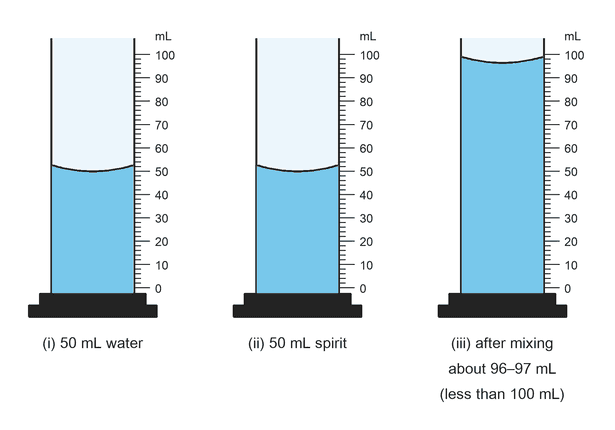
Step 4 — Observation.
The mixture measures only about 96 mL to 97 mL, although 50 mL + 50 mL of liquid were poured in. The total volume has become less than 100 mL.
Step 5 — Conclusion.
Some molecules of the spirit have fitted into the spaces between the water molecules, and some water molecules into the spaces between the spirit molecules. This shows that there are spaces between the molecules of matter, called inter-molecular spaces.
Watch out: Spirit catches fire easily, so do this away from any flame, with a teacher present.
Note: this idea is often shown by dissolving salt in water. The level then does rise, but by less than the salt's own volume: 20 g of salt in 100 mL of water gives about 107 mL, although the dry salt takes up about 9 cm³. So the salt version shows the same idea, only less clearly.
Therefore, mixing 50 mL of water with 50 mL of spirit gives less than 100 mL of mixture, which shows that there are spaces between molecules (inter-molecular spacing).
- 384 marks
Question 38
How do solids, liquids and gases differ in their following properties :
(a) Size (b) Shape (c) Density ?
Solve with AIWritten solution
Solution:
Concept: Matter exists in three states: solid, liquid and gas. Which state a substance is in depends on how closely its molecules are packed, how strongly they attract one another and how freely they move.
Step 1 — Compare the three states in a table.
The table sets the three properties side by side.
Property Solids Liquids Gases (a) Size (volume) Definite Definite Not definite; fills the whole container (b) Shape Definite Not definite; takes the shape of the container Not definite; takes the shape of the container (c) Density High Generally less than solids Very low (least) Step 2 — Explain the size.
A solid has a definite size: a definite length, area and volume. A liquid has a definite volume. A gas has no definite size, because it spreads to occupy all the volume available to it.
Step 3 — Explain the shape.
The molecules of a solid are held at fixed positions, so a solid has a definite shape. The molecules of liquids and gases can move about, so liquids and gases take the shape of the container in which they are kept.
Step 4 — Explain the density.
Solids have a high density because their molecules are tightly packed. Liquids usually have a lower density, because their molecules are less closely packed. Gases have a very low density, because their molecules lie far apart.
Watch out: The density rule is a general one; ice is a well-known exception, being a little less dense than water, so it floats.
Therefore, solids have a definite size and shape and a high density; liquids have a definite volume but no definite shape and a lower density; gases have no definite size or shape and the lowest density.
- 394 marks
Question 39
Describe a simple experiment to illustrate that molecules are not at rest, but they constantly move.
Solve with AIWritten solution
Solution:
Concept: The molecules of every substance are always moving. They keep colliding with one another, and every collision changes their direction, so each molecule follows a zig-zag path.
Step 1 — Prepare the sample.
Add one drop of milk to about a teaspoon of water and stir. Milk contains very tiny droplets of fat, about one-thousandth of a millimetre across.
Step 2 — Look through a microscope.
Put a drop of this diluted milk on a glass slide, cover it with a cover slip, and look at it through a microscope under high power, with a lamp lighting the slide.
Step 3 — Observation.
The tiny fat droplets keep jiggling about in a random manner. Each one follows a zig-zag path, and the movement never stops.
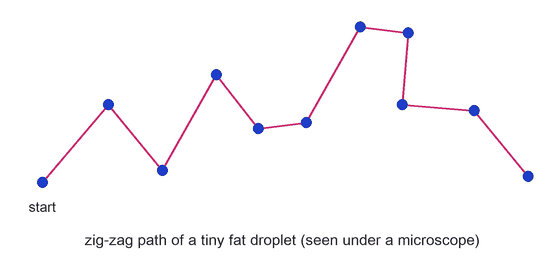
Step 4 — Explanation.
The water molecules around each droplet are always moving. They keep hitting the droplet from all sides, a few more on one side at one moment and on another side the next, so the droplet is pushed first one way and then another.
Step 5 — Conclusion.
The droplets move only because the molecules hitting them move. So the molecules of matter are not at rest; they are constantly moving.
Watch out: The droplets are not alive and nothing stirs them; their jiggling is caused only by the hits of the water molecules.
Note: this jiggling is called Brownian motion. It is sometimes described with lycopodium powder, but its grains (about 0.03 mm across) are so large that the jiggling from molecular hits is far too small to see; any drift they show comes mostly from currents in the water. Much smaller particles, such as the fat droplets of milk, show it clearly.
Therefore, tiny fat droplets in diluted milk, seen under a microscope, keep moving in a zig-zag path because moving water molecules hit them, which shows that molecules are constantly moving.
- 404 marks
Question 40
Write down five general properties of solids, liquids and gases.
Solve with AIWritten solution
Solution:
Concept: Matter exists in three states: solid, liquid and gas. Which state a substance is in depends on how closely its molecules are packed, how strongly they attract one another and how freely they move.
Step 1 — List five properties of solids.
Solids have these general properties.
- A solid has a definite shape and a definite size (length, area and volume).
- A solid can hardly be compressed.
- A solid cannot flow.
- A solid is generally highly dense and rigid.
- A solid resting on a surface presses downwards on its base, because of its weight.
Step 2 — List five properties of liquids.
Liquids have these general properties.
- A liquid has a definite volume but no definite shape; it takes the shape of its container.
- A liquid is almost incompressible.
- A liquid can flow from a higher level to a lower level.
- A liquid at rest has one free surface, at its top.
- A liquid exerts pressure in all directions.
Step 3 — List five properties of gases.
Gases have these general properties.
- A gas has neither a definite shape nor a definite volume; it takes the shape and volume of its container.
- A gas is highly compressible.
- A gas can flow.
- A gas spreads (diffuses) quickly into other gases.
- A gas exerts pressure on all the walls of its container.
Therefore, solids keep their shape and volume, liquids keep their volume but flow, and gases have neither a definite shape nor a definite volume and are highly compressible.
- 414 marks
Question 41
Give the molecular model for a solid and use it to explain why a solid has a definite volume and a definite shape.
Solve with AIWritten solution
Solution:
Concept: In a solid the molecules are very closely packed and the inter-molecular forces are the strongest. The molecules stay at fixed positions and only vibrate about them, so a solid has a definite shape and a definite volume.
Step 1 — Describe the molecular model of a solid.
The molecular model of a solid has three features.
- There is a strong force of attraction between the molecules.
- The molecules are very closely packed, so the inter-molecular space is negligible.
- The molecules are arranged in a definite way and are fixed at their positions. They only vibrate to and fro about their mean positions; they do not leave them.
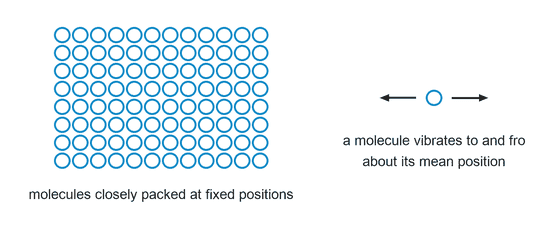
Step 2 — Explain the definite shape.
The molecules are held at fixed positions by strong forces and cannot move about. So the arrangement of the molecules, and with it the shape of the solid, stays the same.
Step 3 — Explain the definite volume.
The molecules are closely packed and do not leave their positions, so the distances between them stay the same. So the solid has a definite size and volume, and it can hardly be compressed.
Therefore, in a solid, strong forces hold closely packed molecules at fixed positions, so a solid has a definite shape and a definite volume.
- 424 marks
Question 42
Describe the molecular model for a liquid. How does it explain that a liquid has no definite shape, but has a definite volume ?
Solve with AIWritten solution
Solution:
Concept: In a liquid the molecules are less closely packed than in a solid and the inter-molecular forces are weaker. The molecules move about, but only within the boundary of the liquid, so a liquid has a definite volume but no definite shape.
Step 1 — Describe the molecular model of a liquid.
The molecular model of a liquid has three features.
- The attraction between the molecules is weaker than in a solid, so the molecules are loosely packed and are not fixed.
- The inter-molecular space is more than in a solid.
- The molecules move about randomly, sliding over one another, but only within the boundary of the liquid.
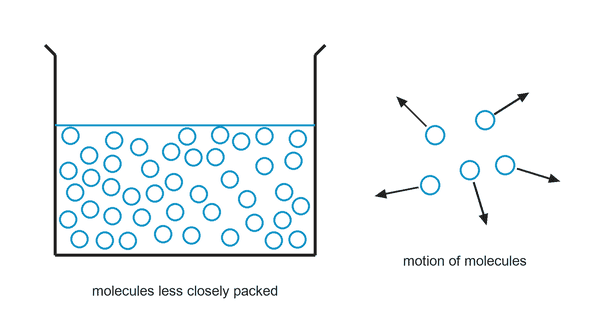
Step 2 — Explain why there is no definite shape.
The molecules are not fixed in position, so they can move over one another. So a liquid flows and takes the shape of the container in which it is kept.
Step 3 — Explain why the volume is definite.
The inter-molecular forces, though weaker than in a solid, are still strong enough to keep the molecules together inside the liquid. The molecules do not move far apart, so the volume of the liquid stays the same in any container.
Therefore, the molecules of a liquid can slide over one another, so it has no definite shape, but they are held together within its boundary, so it has a definite volume.
- 434 marks
Question 43
A gas has neither a definite volume nor a definite shape. Describe the molecular model to explain it.
Solve with AIWritten solution
Solution:
Concept: In a gas the molecules are far apart and the inter-molecular forces are negligible. The molecules move freely through all the space available, so a gas has neither a definite shape nor a definite volume.
Step 1 — Describe the molecular model of a gas.
The molecular model of a gas has four features.
- The molecules lie much farther apart than in a liquid or a solid, so a gas has a very low density.
- There is a negligible force of attraction between the molecules.
- The molecules are in constant random motion in all directions, moving freely in straight lines between one collision and the next.
- The moving molecules collide with one another and with the walls of the vessel; their hits on the walls produce the pressure of the gas.

Step 2 — Explain why there is no definite shape.
Almost no force holds the molecules together, so they do not stay at fixed positions. They move freely and take up the shape of whatever container holds them.
Step 3 — Explain why there is no definite volume.
The molecules do not stay within any boundary of their own. They spread out until they fill the whole space of the container, so a gas takes the volume of its container too. And because the molecules are far apart, a gas is easily compressed.
Therefore, the molecules of a gas are far apart, attract one another negligibly and move freely everywhere, so a gas has neither a definite volume nor a definite shape.
- 444 marks
Question 44
Distinguish between the three states of matter — solid, liquid and gas on the basis of their molecular models.
Solve with AIWritten solution
Solution:
Concept: Matter exists in three states: solid, liquid and gas. Which state a substance is in depends on how closely its molecules are packed, how strongly they attract one another and how freely they move.
Step 1 — Picture the three models.
The figure shows the arrangement of the molecules in the three states.
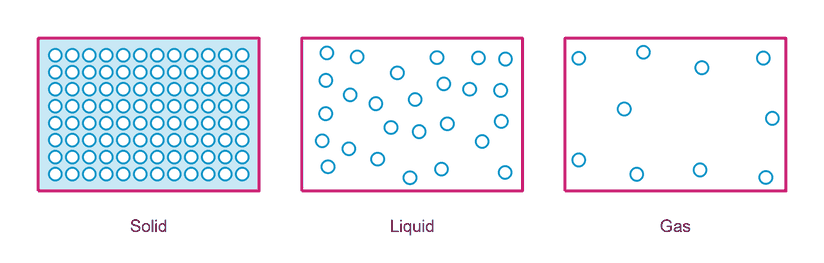
Step 2 — Compare the models in a table.
The table compares the packing, the spacing, the force and the motion of the molecules, and what each model leads to.
Basis Solid Liquid Gas Packing of molecules Very closely packed Less closely packed Far apart Inter-molecular space Least (negligible) More than in solids Very large (most) Inter-molecular force Strongest Weaker than in solids Negligible Motion of molecules Only vibrate about fixed positions Move about, but within the boundary of the liquid Move freely in all the space available Result Definite shape and definite volume Definite volume, no definite shape Neither definite shape nor definite volume Therefore, solids have closely packed, firmly held molecules that only vibrate; liquids have less closely packed molecules that move within the liquid; gases have far-apart molecules that move freely everywhere.
- 454 marks
Question 45
Distinguish between solids, liquids and gases on the basis of their following properties :
(a) compressibility (b) fluidity (c) rigidity (d) expansion on heating
Solve with AIWritten solution
Solution:
Concept: Going from a solid to a liquid to a gas, the inter-molecular spaces become larger and the inter-molecular forces become weaker.
Step 1 — Compare the four properties in a table.
The table sets the three states side by side.
Property Solids Liquids Gases (a) Compressibility Hardly compressible Almost incompressible Highly compressible (b) Fluidity Cannot flow Can flow Can flow (c) Rigidity Highly rigid Less rigid Not rigid (d) Expansion on heating Least More than solids Most Step 2 — Explain compressibility.
The molecules of a solid are closely packed, and those of a liquid nearly so, so there is hardly any space to squeeze them into. The molecules of a gas have large spaces between them, so a gas can be compressed easily.
Step 3 — Explain fluidity.
A solid cannot flow, because its molecules are fixed in position. The molecules of liquids and gases can move about, so both can flow.
Step 4 — Explain rigidity.
Solids are highly rigid because their molecules are held firmly at fixed places. Liquids are less rigid and gases are not rigid at all.
Step 5 — Explain expansion on heating.
For the same rise in temperature, a solid expands only a little, a liquid expands more, and a gas expands the most, because its molecules are held together the least.
Therefore, gases are the most compressible, liquids and gases flow, solids are the most rigid, and on heating gases expand the most and solids the least.
- 464 marks
Question 46
What do you mean by change of state of matter ? Explain :
(a) the change of a solid into a liquid at a constant temperature, and
(b) the change of a liquid into a gas at a constant temperature.
Solve with AIWritten solution
Solution:
Concept: A substance changes its state when it takes in or gives out heat. On heating, a solid melts into a liquid at its melting point, and a liquid boils into a gas at its boiling point. While the state is changing, the temperature stays constant.
Step 1 — Define change of state.
The change of a substance from one state to another, for example from a solid to a liquid or from a liquid to a gas, is called a change of state of matter. It happens when heat is given to (or taken from) the substance, and while it happens the temperature stays constant.
Step 2 — Explain (a): solid into liquid.
Changing a solid into a liquid by taking in heat at a fixed temperature is called melting (or fusion), and that temperature is the melting point.
The heat taken in makes the molecules vibrate more and more strongly. At the melting point they get enough energy to overcome the forces that hold them at fixed positions, and they begin to move about. So the solid turns into a liquid. For example, ice melts into water at 0 °C.
Step 3 — Explain (b): liquid into gas.
Changing a liquid into a gas by taking in heat at a fixed temperature is called boiling (or vaporisation), and that temperature is the boiling point.
The heat taken in gives the molecules so much energy that they break away from one another and move far apart. So the liquid turns into a gas. For example, water boils into steam at 100 °C at normal atmospheric pressure.
Watch out: During melting and boiling the heat taken in changes the state, not the temperature; the thermometer reading stays the same until the change is complete.
Therefore, a change of state is the change of a substance from one state to another; (a) melting turns a solid into a liquid at its melting point, and (b) boiling turns a liquid into a gas at its boiling point, the temperature staying constant in each.
What Class 6 Physics Ch 1 covers
The sections of the chapter, in the order the book takes them. Every question above comes from one of these.
- 01Matter: Its Meaning & Composition
- 02Composition of Matter
- 03Characteristics of Particles of Matter
- 04States of Matter
- 05Properties of Solids
- 06Properties of Liquids
More ways to study this chapter
The same chapter asked three other ways. Practise it, revise it, and see what the board has set on Ch 1 before.
Class 6 Physics Ch 1 questions students ask
How many questions are there in Class 6 Physics Ch 1?
46 questions. Every one is solved step by step on this page.
Are these Class 6 Physics solutions free?
Yes. Every question and its full working is free to read, with no account needed.
Can I download the Class 6 Physics Ch 1 solutions as a PDF?
There is no PDF to download. Every solution is on this page instead, which means it is searchable, always the current syllabus, and readable on a phone. Use your browser's print option if you want it on paper.