
Opening your dashboard
Class 6 Physics Chapter 1 Matter: Competency-Based Questions (CBQ)
40 questions on Chapter 1, each worked through on its own page with the AI tutor. Class 6 Physics, ICSE 2026-27.
40 questions
1–5 marks · Mixed difficulty
- 11 mark
Question 1
Competency: Understanding
A cube of sugar is crushed into powder, and the powder is ground again and again. Even the finest speck of the powder still tastes sweet.
Suppose the grinding could be carried on without any limit. Which is the smallest particle that would still be sugar and could exist by itself?
- 21 mark
Question 2
Competency: Application & Analysis
One small crystal of potassium permanganate is dissolved in 100 ml of water in beaker P. The solution is deep purple. Then:
- 10 ml of the solution from P is mixed with 90 ml of water in beaker Q,
- 10 ml of the solution from Q is mixed with 90 ml of water in beaker R,
- 10 ml of the solution from R is mixed with 90 ml of water in beaker S.
The solution in beaker S is very faint, but it is still pink.
What fraction of the particles of the crystal is present in the 100 ml of solution in beaker S, and what does this show?
- 31 mark
Question 3
Competency: Application
Water is falling slowly, drop by drop, from a leaking tap. A photograph taken with a fast camera shows that each small falling drop is nearly a round ball, and not a cube or a flat sheet.
Which property of liquids gives the small drop its round shape?
- 41 mark
Question 4
Competency: Understanding & Application
Air is blown into a round party balloon through its narrow mouth. The air enters at one place, yet the balloon swells out on all sides and its rubber skin becomes tight everywhere.
Which is the best explanation?
- 51 mark
Question 5
Competency: Analysis
Assertion (A): Dry sand poured from a bucket into a jar takes the shape of the jar, so sand should be classed as a liquid.
Reason (R): Each grain of sand has a definite shape and a definite volume of its own, which do not change when the sand is poured.
- 61 mark
Question 6
Competency: Understanding & Analysis
Assertion (A): Water is kept boiling in an open pan on a steady flame. A thermometer dipped in the boiling water goes on reading 100 °C, although the flame is still heating the water.
Reason (R): During boiling, the heat absorbed by the water is used by its molecules to move apart rapidly and change into gas, and not to raise the temperature.
- 72 marks
Question 7
Competency: Application
A science club makes models of molecules with coloured beads. One bead stands for one atom. The table shows four of the models.
Model Substance Beads in the model of one molecule 1 Neon 1 bead 2 Oxygen 2 beads of the same colour 3 Water 3 beads: 2 of one colour and 1 of another colour 4 Ammonia 4 beads: 3 of one colour and 1 of another colour (a) Classify each of the four molecules as monoatomic, diatomic or polyatomic.
(b) The club now wants to show 5 molecules of water. How many beads are needed in all? Should the 5 models look alike or different? Give a reason.
- 82 marks
Question 8
Competency: Understanding & Analysis
On a winter morning in a hill town, Kabir finds a sheet of ice on a tub of water kept outside. He breaks the ice and sees liquid water below it. His mother tells him that the air above the tub also contains some water, in the form of water vapour which cannot be seen.
(a) Are the molecules in the ice, in the liquid water and in the water vapour the same or different? Give a reason.
(b) Why then do ice and water vapour behave so differently? Compare them in any two of the properties of molecules which decide the state of a substance.
- 92 marks
Question 9
Competency: Application & Evaluation
A goldsmith hammers a small piece of gold into a thin, wide sheet. He draws another piece of gold into a long wire. Watching him, Anu says, "Gold changes its shape so easily. So gold is not rigid, and it should not be called a solid."
(a) Give two observations about a piece of gold which show that it is a solid.
(b) Is Anu's conclusion correct? Give a reason.
- 102 marks
Question 10
Competency: Analysis
Meena does two tests in a closed room in which the air is still.
Test 1: She opens a bottle of perfume at one end of the room. Her brother, standing 4 m away, gets the smell after 30 seconds.
Test 2: She gently puts a drop of blue ink at the bottom of a glass of still water. The blue colour takes 30 minutes to spread 4 cm up the water.
(a) In which test do the particles spread faster? Support your answer with the readings.
(b) Explain the difference, using the arrangement and movement of the molecules in a gas and in a liquid.
- 114 marks
Question 11
Competency: Application & Analysis
Case study: In the laboratory, a teacher takes a white solid X in a test tube and heats it gently and steadily. A thermometer kept in X is read every minute. The graph shows how the temperature of X changes with time. X is a solid at the start and a clear liquid at the end.
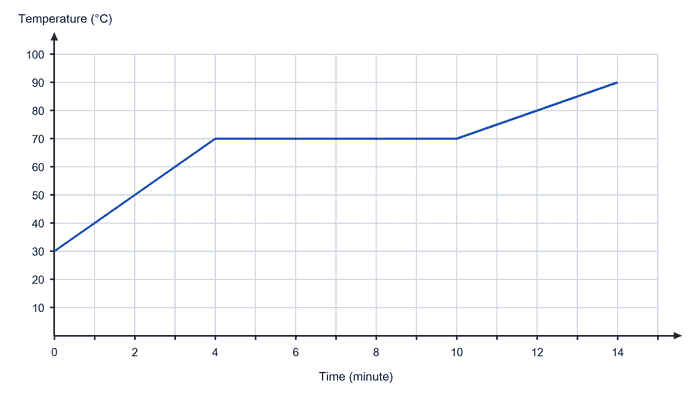
(a) From the graph, read the temperature of X at the start, and the melting point of X. Give a reason for your choice of the melting point.
(b) For how many minutes does the melting go on? In which state is X at 2 minutes, at 7 minutes and at 12 minutes?
(c) Heat is given to X all the time. Explain, using the molecules of X, why its temperature does not rise between the 4th minute and the 10th minute.
- 124 marks
Question 12
Competency: Analysis & Evaluation
Case study: Ravi takes two identical plastic syringes without needles. He fills syringe P with air and syringe Q with water, and closes the nozzle of each with a tight cap so that nothing can get out. He then pushes each plunger hard with his thumb, using the same push both times. The figure shows the two syringes before the push and during the push. The volume enclosed is read on the scale at the inner face of the plunger.

(a) Read from the figure the volume of the air and the volume of the water before the push and during the push. By how much does each volume decrease?
(b) Explain, using the molecules of a gas and of a liquid, why the two results are different.
(c) Ravi says, "The molecules of air were squeezed, so each molecule became smaller." Is he right? Also state what will happen to the plunger of syringe P when he takes his thumb away, and why.
- 134 marks
Question 13
Competency: Analysis
Case study: Sana measures volumes with a measuring cylinder and masses with an electronic balance. In trial 1 she mixes 50 ml of water with another 50 ml of water. In trial 2 she mixes 50 ml of water with 50 ml of spirit (alcohol) and shakes the mixture well. Nothing is spilt in either trial. Her readings are given in the table.
Trial Liquids mixed Total volume before mixing Volume after mixing Total mass before mixing Mass after mixing 1 Water + water 100 ml 100 ml 100 g 100 g 2 Water + spirit 100 ml 97 ml 90 g 90 g (a) For each trial, find the decrease in volume on mixing.
(b) Sana's friend says, "In trial 2, some of the liquid has been lost." Which readings show that no matter has been lost? Explain, using the particles of matter, why the volume has still become less.
(c) Why was it useful for Sana to do trial 1 as well?
- 144 marks
Question 14
Competency: Creation & Analysis
Honey leaves a tilted spoon slowly, but water runs off at once. You are given water, coconut oil and honey, a smooth steel tray, a teaspoon, a ruler, a few books and a stop-watch.
(a) Design a fair test to compare how easily the three liquids flow. State what you will measure and any two things you will keep the same for all three liquids.
(b) A student who did such a test noted the time each liquid took to run 10 cm down the sloping tray:
Liquid Water Coconut oil Honey Time (s) 1 6 45 Arrange the three liquids in increasing order of viscosity. Give a reason.
(c) What do the results suggest about the forces of attraction between the molecules in honey as compared with those in water?
- 154 marks
Question 15
Competency: Analysis & Evaluation
Case study: Dev holds up a glass bottle and says, "This bottle is empty. Air is nothing, because we cannot see it." To test this, his sister fits a funnel into the mouth of the bottle and seals the gap around the funnel with clay, so that it is airtight. She pours water into the funnel. Only a few drops go into the bottle; the rest of the water stays in the funnel.

She then makes a hole through the clay with a pencil. The water now runs into the bottle, and she can feel air coming out of the hole on her finger.
(a) What was in the bottle before the water was poured?
(b) Explain why the water stayed in the funnel at first, and why it ran into the bottle after the hole was made.
(c) Which property of matter does this test show for air? Which other property must air have before it can be called matter? Describe one observation that shows this second property. Hence judge Dev's statement.
- 161 mark
Question 16
Competency: Application
A shopkeeper packs 1 kg of iron nails into a small tin. In another shop, 1 kg of cotton wool is packed into a big sack, which is almost as large as a dustbin. When each package is placed on the same weighing balance, both show a mass of 1 kg. The mass of a body tells how much matter it contains.
Which statement about the two packages is correct?
- 171 mark
Question 17
Competency: Application
After a shower of rain, Arjun looks at his father's car. On the freshly waxed bonnet, the rainwater stands as small round beads that roll off when the car moves. On the clean glass windscreen, the same rainwater spreads out into a thin wet film.
Which statement compares the forces of attraction on the two surfaces correctly?
- 181 mark
Question 18
Competency: Application
A sheet of notebook paper is about 0.1 mm thick. A molecule is very small; take the diameter of one molecule as m, the largest size of a molecule that your book gives. Imagine that molecules could be placed in a straight line, touching each other, across the thickness of the sheet.
About how many molecules would be needed to cover the thickness of the paper?
- 191 mark
Question 19
Competency: Understanding
At a science fair, Meera keeps a stone, a half-filled bottle of water with its lid removed, and a balloon full of air on a table. A free surface is a surface of a substance that is not in contact with the vessel or the wall that holds it.
Her classmates are asked to say how many free surfaces the stone, the water and the air in a container can have. Which statement is correct?
- 201 mark
Question 20
Competency: Analysis
Assertion (A): In a kitchen, cooking gas flows through a rubber pipe from the cylinder to the burner.
Reason (R): A gas is highly compressible.
- 211 mark
Question 21
Competency: Application
Railway tracks are laid in long pieces of steel with small gaps between the ends of the neighbouring pieces. In the hot afternoons of summer, these gaps become narrower, and in cold winter nights they become wider.
Which statement gives the correct reason for leaving these gaps?
- 221 mark
Question 22
Competency: Analysis
Assertion (A): A bar of chocolate left on a steel plate in the hot afternoon sun becomes soft and melts, but the steel plate stays solid.
Reason (R): The particles of steel attract one another much more strongly than the particles of chocolate, so steel needs a far higher temperature, well above 1000 °C, to melt.
- 231 mark
Question 23
Competency: Analysis
A teacher gives the melting points and the boiling points of four substances. Spirit melts at a temperature far below 0 °C.
Substance Melting point Boiling point Candle wax 55 °C 370 °C Water 0 °C 100 °C Spirit far below 0 °C 78 °C Iron 1538 °C 2862 °C All four are heated to a temperature of 90 °C. What are the states of candle wax, water, spirit and iron, in this order, at 90 °C?
- 241 mark
Question 24
Competency: Evaluation
A party balloon is blown up, tied and left on the dashboard of a parked car in the afternoon sun. After an hour it bursts with a loud sound. Four students give different reasons.
Which explanation is the best?
- 251 mark
Question 25
Competency: Analysis
Rohan sorts some common substances into three columns of a chart. Room temperature is about 25 °C.
Solids Liquids Gases Iron Honey Steam Wax Glycerine Helium Sugar Dettol Oxygen Wood Ice Spirit Two of the entries are in the wrong column. Which two are they?
- 262 marks
Question 26
Competency: Understanding
Anu sees two bottles, A and B, on a shelf. Both hold clear, colourless liquids. Bottle A has water and bottle B has spirit. The two liquids look exactly alike.
(a) Are all the molecules of water in bottle A alike or different from one another?
(b) Are the molecules in bottle A the same as the molecules in bottle B? Give a reason, and name one property, other than how they look, that would tell the two liquids apart.
- 272 marks
Question 27
Competency: Understanding
Sneha holds a half-filled bottle of water upright on a table. She then tilts it to one side and looks at the top of the water through the glass.
(a) What does the top surface of the water look like in each position?
(b) Use the molecules of a liquid to explain why the top surface behaves in this way.
- 282 marks
Question 28
Competency: Application
Two identical plastic bottles stand upright. Each has a small hole in its side wall, close to the bottom. Into the first bottle Raj puts a heavy iron block that fits loosely inside. Into the second bottle he pours water, up to a height well above the hole. Nothing comes out of the hole of the first bottle, but a jet of water shoots out of the hole of the second bottle.
(a) In which direction does the iron block press on the bottle?
(b) Why does the water come out of the hole in the side wall?
- 292 marks
Question 29
Competency: Evaluation
On a cold winter morning in a hill town, Kavya finds that the coconut oil in a bottle has turned into a white solid block that does not flow. Her mother says, "The oil has gone bad, because a liquid has changed into a solid." Kavya puts the bottle in a bowl of warm water. After a few minutes the oil becomes a clear liquid again, which flows.
(a) Is the mother's statement correct? Give a reason.
(b) Name the change of state when the solid oil becomes liquid, and say what the oil must absorb for this change.
- 302 marks
Question 30
Competency: Analysis
The mass of 1000 cm of water at 100 °C is about 960 g. The mass of 1000 cm of steam at 100 °C is only about 0.6 g. (Values rounded.)
(a) How many times is the mass of the water more than the mass of the steam in the same volume?
(b) What does this tell about the spaces between the molecules of steam and of water?
- 312 marks
Question 31
Competency: Application
In a scooter, pressing the brake lever pushes on a special oil that fills a closed pipe, and this oil in turn pushes the brake pads against the wheel. The pipe is filled with oil and not with air.
(a) Which property of liquids is used in this arrangement?
(b) What would be felt at the lever, and why, if the pipe were full of air?
- 323 marks
Question 32
Competency: Application
Reema breaks a stick of chalk into two pieces and presses the broken ends tightly together. The pieces do not stick to each other. Then she places two small drops of oil close to each other on a steel plate. When the drops touch, they run together and make one bigger drop.
(a) Name the force of attraction between the molecules of the same substance.
(b) Explain why the oil drops join.
(c) Chalk is made of molecules which attract one another. Why do the two pieces not join?
- 333 marks
Question 33
Competency: Analysis
A candle is burning. Near the wick, the solid wax melts and forms a small pool of liquid wax. The liquid wax rises up the wick, where the heat of the flame changes it into a gas that burns with the flame.
(a) Name the state of the wax in the unburnt part of the candle, in the small pool and in the gas that burns.
(b) In which of these three states are the molecules of wax farthest apart?
(c) In which of the three states are the molecules held together by the strongest force of attraction? Say how they move in that state.
- 343 marks
Question 34
Competency: Understanding
Pooja reads in her book: "Plasma is the fourth state of matter. It is found at a very high temperature, when a gas occurs in the form of positive ions and free electrons." Her teacher adds that the very hot gas inside a bolt of lightning, and the matter in the Sun, are in this fourth state.
(a) Name the three common states of matter.
(b) How is a plasma different from an ordinary gas in what it is made of?
(c) Why do we not see plasma in a kitchen or a classroom?
- 353 marks
Question 35
Competency: Application
A pond skater is a small insect that runs over the surface of a pond without sinking into the water. A drop of water on a leaf also stays together and does not spread out into a thin sheet.
(a) Name the property of water which lets the insect stay on the surface.
(b) Name the force between the molecules of water which causes this property.
(c) A gas does not show this property. Give the reason.
- 363 marks
Question 36
Competency: Evaluation
Ria slowly warms a glass of tap water on a stove. Before the water starts to boil, tiny bubbles appear on the inner wall of the glass. Ria says, "Water has no empty space in it. So no air can be dissolved in water, and the fish in a pond cannot get any oxygen from the water."
(a) What do the tiny bubbles show about the water?
(b) Is Ria's statement correct? Give a reason, using a characteristic of the particles of matter.
(c) Name one more everyday observation that shows the same characteristic of the particles of matter.
- 374 marks
Question 37
Competency: Analysis
Case study: Aman puts a drop of blue ink gently into three identical beakers, each holding 200 mL of still water, and does not stir them. The water in the first beaker is at 10 °C, in the second at 30 °C and in the third at 60 °C. He notes the time that the blue colour takes to spread through the whole of the water. (Hypothetical data.)
Beaker 1 2 3 Temperature of water (°C) 10 30 60 Time for the colour to spread (minutes) 50 30 10 (a) In which beaker does the colour spread fastest, and in which is it slowest?
(b) Explain these results using the molecules of water.
(c) Name two things that Aman must keep the same in all three beakers, and predict whether the time at 45 °C would be less than 10 minutes, between 10 and 30 minutes, or more than 30 minutes.
- 384 marks
Question 38
Competency: Evaluation
Case study: In the school laboratory, Imran heats 100 mL of two clear, colourless liquids, P and Q, in two beakers on two identical electric hot plates, with his teacher beside him, because spirit vapour catches fire easily. One liquid is water and the other is spirit. Both liquids start at 30 °C. He reads the thermometer in each beaker every minute for 14 minutes, and the graph shows his readings. The hot plates are switched on at the same moment, and Imran does not add any more liquid while he is heating. (Hypothetical data.)
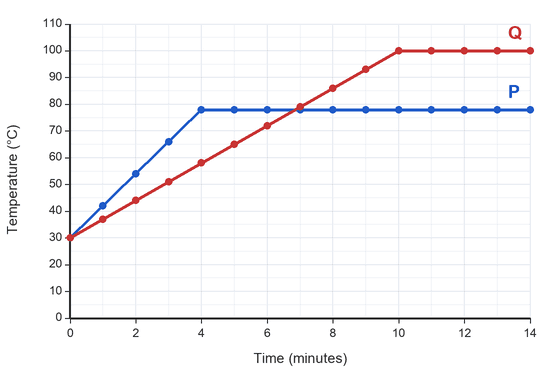
(a) Which liquid is water? Give a reason from the graph.
(b) At the 7th minute the thermometers read 78 °C in P and 79 °C in Q. Which liquid is boiling at that time? Explain.
(c) Imran says, "Q started to boil later than P, so Q has the lower boiling point." Is he correct? Give a reason.
- 395 marks
Question 39
Competency: Creativity
The science club plans a 'Guess the state' game. A player is given an unknown sample in a closed transparent box and may handle the box but not open it. By asking only yes-or-no questions about how the sample behaves, the player must decide whether it is a solid, a liquid or a gas. The club wants the game to need as few questions as possible, so that even a younger child can play it quickly and fairly.
(a) Write the smallest set of yes-or-no questions that will separate a solid, a liquid and a gas, in the order in which they should be asked.
(b) Use your questions on an iron spoon, cooking oil and helium gas sealed in the box, and say what the player would decide each time.
(c) A student suggests the question, "Can the sample be poured?" Give one example of a solid for which this question would mislead the player, and say what is better to ask.
- 405 marks
Question 40
Competency: Analysis
Case study: Neha pumps air into a flat football with a small hand pump. The ball swells into a round shape, but it is still soft. She now puts it on a very sensitive balance, which reads to 0.1 g, and goes on pumping. After every 20 strokes she takes the pump away and reads the balance. (Hypothetical data.) The ball now stays the same size but becomes harder.
Number of strokes 0 20 40 60 Mass of the football (g) 410.0 411.2 412.4 413.6 (a) Find the increase in the mass of the ball after 60 strokes.
(b) What does this show about air? Which observation made before the readings shows that air occupies space?
(c) Predict the reading of the balance after 80 strokes, with the working.