
Opening your dashboard
Class 6 Physics Chapter 1 Matter: Practice Questions
40 questions on Chapter 1, each worked through on its own page with the AI tutor. Class 6 Physics, ICSE 2026-27.
40 questions
1–5 marks · Mixed difficulty
- 11 mark
Question 1
Bloom's level: Remember
Matter is anything which :
- 21 mark
Question 2
Bloom's level: Remember
The Indian philosopher who was perhaps the first to suggest that all matter is made up of extremely small particles called anu and parmanu was :
- 31 mark
Question 3
Bloom's level: Understand
One drop of blue ink is put into a full bucket of water and stirred. The whole bucket of water turns light blue. This shows that one drop of ink :
- 41 mark
Question 4
Bloom's level: Apply
Mohan sprays a room freshener in one corner of a closed room. Within a minute, his sister sitting in the opposite corner can smell it. Which characteristic of particles of matter does this show best ?
- 51 mark
Question 5
Bloom's level: Remember
Which of the following is not one of the three properties which decide whether a substance is a solid, a liquid or a gas ?
- 61 mark
Question 6
Bloom's level: Apply
250 ml of juice is poured from a tall, narrow jug into a wide, shallow bowl. In the bowl, the juice will :
- 71 mark
Question 7
Bloom's level: Analyse
A student tests three substances P, Q and R and records :
Test P Q R Keeps its own shape ? Yes No No Can be compressed easily ? No No Yes Has a free surface ? Yes Only one (at the top) None Which conclusion is correct ?
- 81 mark
Question 8
Bloom's level: Evaluate
A beaker of crushed ice is heated slowly on a small flame. Riya says, "While the ice is melting, its temperature will keep rising, because heat is being given to it." Which is the best judgement of Riya's statement ?
- 91 mark
Question 9
Bloom's level: Understand
A rubber band changes its shape when it is stretched, but returns to its original shape when it is released. A rubber band is treated as :
- 101 mark
Question 10
Bloom's level: Understand
Read the Assertion (A) and the Reason (R) and choose the correct option.
Assertion (A): It is easier to move our hand through water than through glycerine.
Reason (R): The force of attraction between the particles of glycerine is stronger than that between the particles of water.
- 111 mark
Question 11
Bloom's level: Understand
Read the Assertion (A) and the Reason (R) and choose the correct option.
Assertion (A): A liquid can flow from a higher level to a lower level.
Reason (R): The molecules of a liquid are fixed at their positions and can only vibrate.
- 121 mark
Question 12
Bloom's level: Analyse
Read the Assertion (A) and the Reason (R) and choose the correct option.
Assertion (A): All the molecules of sugar are identical.
Reason (R): The molecules of different substances are different.
- 132 marks
Question 13
Bloom's level: Understand
A block of wood, a glass of milk and the air in a room look very different from one another, yet all three are called matter.
(a) Why are all three called matter ?
(b) Name the state of each of them.
- 142 marks
Question 14
Bloom's level: Apply
Using the definition of matter, decide whether each of the following is matter or not. Give a reason in each case.
(a) the air inside a football
(b) the sound of a school bell
(c) sunlight
(d) a drop of oil
- 152 marks
Question 15
Bloom's level: Understand
Give one difference between an atom and a molecule. Name one molecule that is made up of more than two atoms.
- 162 marks
Question 16
Bloom's level: Apply
Asha pours 100 mL of water into a measuring cylinder. She adds 10 g of common salt, whose crystals take up about 4.6 cm, and stirs until all the salt dissolves. The water level rises, but only to about 103 mL, not to 104.6 mL, although nothing is spilt. Explain her observation.
- 172 marks
Question 17
Bloom's level: Apply
Classify each of the following as a solid, a liquid or a gas, and write one property that helped you decide :
candle wax, kerosene, helium in a balloon, a steel spoon, honey, steam from a kettle
- 182 marks
Question 18
Bloom's level: Evaluate
Rohit squeezes a bath sponge and it becomes much smaller. He says, "This proves that solids can be compressed easily." Do you agree ? Justify your answer.
- 192 marks
Question 19
Bloom's level: Apply
A small steel cylinder can hold enough oxygen gas to fill a whole room. Which property of gases makes this possible ? Explain it using the molecules of a gas.
- 201 mark
Question 20
Bloom's level: Remember
Fill in the blanks : Ice changes into water at ........ and this change is called ........ . Water changes into steam at ........ and this change is called ........ .
- 212 marks
Question 21
Bloom's level: Analyse
1000 ml each of three substances X, Y and Z are heated so that their temperature rises by the same amount. The increase in volume is :
Substance X Y Z Increase in volume (in ml) 34 0.5 2 (a) Which of them is a solid, which a liquid and which a gas ? Give a reason.
(b) How many times as much does X expand as Z ?
- 222 marks
Question 22
Bloom's level: Understand
Each statement below is wrong. Rewrite it correctly.
(a) The molecules of a substance are at rest.
(b) The inter-molecular space is the largest in solids.
(c) A molecule is about 1 mm in size.
(d) The inter-molecular forces are the strongest in gases.
- 234 marks
Question 23
Bloom's level: Apply
Case study: In the school laboratory, Meera looks at a drop of diluted milk under a microscope. She sees tiny fat droplets moving about in a zig-zag way, although nothing is stirring the drop. At home, her mother lights an incense stick in one corner of a room, and soon its smell is noticed all over the room. Later, Meera finds it easy to break a stick of chalk, but she cannot break the handle of a steel spoon of about the same thickness.
(a) Why do the fat droplets move in a zig-zag way ?
(b) How does the smell of the incense reach every part of the room ?
(c) Why is the chalk easier to break than the steel handle ? What does this tell you about the force between particles of different substances ?
- 244 marks
Question 24
Bloom's level: Analyse
A steel ball is dropped into three tall jars filled with water, cooking oil and honey. The time it takes to fall through 20 cm of each liquid is :
Liquid Water Cooking oil Honey Time (in second) 0.4 1.5 12 (a) Arrange the three liquids in increasing order of viscosity. Give a reason from the data.
(b) In which liquid is the force of attraction between the particles the strongest ? Explain.
(c) If the same ball were dropped through 20 cm of air, would it take more or less than 0.4 s ? Give a reason.
- 255 marks
Question 25
Bloom's level: Analyse
Some crushed ice is heated steadily in a beaker and its temperature is noted every minute :
Time (in minute) 0 1 2 3 4 5 6 7 8 9 10 11 12 13 Temperature (in °C) -10 -5 0 0 0 0 15 30 45 60 75 90 100 100 (a) Between which minutes does the temperature stay at 0°C ? What change of state is taking place then ?
(b) What is the state of the substance at the 8th minute ?
(c) At what temperature does the water start to boil ? What will its temperature be at the 15th minute if heating continues and some water is still left ?
(d) Heat is being given all the time from the 2nd to the 5th minute. Why does the temperature not rise ?
- 264 marks
Question 26
Bloom's level: Evaluate
A student made this table comparing solids, liquids and gases. Check each row, say whether it is correct, and correct any mistake.
Property Solids Liquids Gases Compressibility Highly compressible Negligibly compressible Not compressible Diffusion Slow Fast Very fast Number of free surfaces One Any number None Rigidity Highly rigid Less rigid Not rigid - 274 marks
Question 27
Bloom's level: Create
Plan a 'matter hunt' in your kitchen.
(a) Make a table with three columns - Solids, Liquids, Gases - and put at least three kitchen items in each column.
(b) Design three simple tests (one test for each property: shape, flow and compression) that a friend could use to check the state of any item, and say what result each state gives.
(c) Name one kitchen item that is found in two different states, and say how it changes from one to the other.
- 284 marks
Question 28
Bloom's level: Apply
Case study: Arjun pumps air into the flat tyre of his bicycle. After many strokes of the pump, the tyre becomes hard. That evening, there is a small leak in the cooking gas pipe in the kitchen, and the smell of the gas is noticed in the next room within a short time.
(a) Why can so much air be pushed into the tyre ?
(b) Why does the tyre become hard and keep its round shape from all sides ?
(c) Why does the smell of the leaking gas spread so quickly to the next room ?
- 294 marks
Question 29
Bloom's level: Create
You are given a tray with raised edges and about 40 marbles. Design a model to show the arrangement and motion of molecules in a solid, a liquid and a gas.
(a) How will you arrange the marbles and move the tray to show a solid ?
(b) What will you change to show a liquid ?
(c) What will you change to show a gas ?
(d) State one way in which your model is not like real molecules.
- 304 marks
Question 30
Bloom's level: Apply
Case study: At a birthday party, Kabir puts a few ice cubes into a glass of soda water. Bubbles of carbon dioxide gas rise and escape from the top of the drink. After some time, the ice cubes become smaller and the drink becomes colder.
(a) Name the three states of matter seen in the glass, with one example of each.
(b) What happens to the ice cubes, and what is this change called ? Does the ice absorb or give out heat ?
(c) The bubbles always rise and leave through the top, and the drink takes the shape of the glass. Which property of liquids and which property of gases do these show ?
- 311 mark
Question 31
The smallest particle of a substance which can exist freely by itself and has all the properties of that substance is called :
- 321 mark
Question 32
Some oil is poured from a bottle into a bowl. Which of the following is correct for the oil ?
- 331 mark
Question 33
The change of a substance from the liquid state to the gaseous state at a fixed temperature, on absorbing heat, is called :
- 341 mark
Question 34
Fill in the blank :
The force of attraction between the molecules of two different substances is called the force of .............. .
- 351 mark
Question 35
Write true or false :
A gas has a definite volume but no definite shape.
- 362 marks
Question 36
Name the state of matter in which :
(a) the molecules are farthest apart,
(b) the molecules only vibrate about their fixed positions.
Give one example of a substance in each of these two states.
- 372 marks
Question 37
Give reasons for the following :
(a) A stone can be picked up between two fingers, but water cannot.
(b) Air can be squeezed into a smaller space, but a piece of iron cannot.
- 384 marks
Question 38
(a) What is meant by inter-molecular force ? In which state of matter is it the strongest ?
(b) It is easier to break a stick of chalk than an iron nail of the same thickness. What does this tell us about the inter-molecular forces in chalk and in iron ?
(c) A clean glass rod dipped in water comes out wet, but a glass rod dipped in mercury comes out dry. Explain these two observations, using the terms cohesion and adhesion.
- 394 marks
Question 39
The figure shows the arrangement of molecules in three substances P, Q and R, each kept in a closed box.
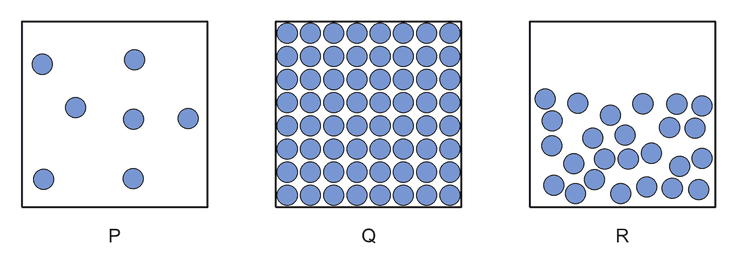
(a) Which of P, Q and R is a solid, which is a liquid and which is a gas ?
(b) Which of the three substances can be compressed most easily ? Give a reason from the figure.
(c) Complete the table for the three substances.
Property P Q R Shape (definite / not definite) Volume (definite / not definite) - 404 marks
Question 40
(a) What is meant by the melting point of a solid ?
(b) Some ice at 0 °C is heated steadily in a beaker until all of it has changed into steam. Name the two changes of state that take place, in the order in which they occur, and write the temperature at which each takes place.
(c) Explain, in terms of molecules, how a solid changes into a liquid when it is heated.