
Question 444 marksMedium
Distinguish between the three states of matter — solid, liquid and gas on the basis of their molecular models.
Confirming your payment
Sign up now and get 250 free tokens.
Matter · Question 44 of 46
Distinguish between the three states of matter — solid, liquid and gas on the basis of their molecular models.
Solution:
Concept: Matter exists in three states: solid, liquid and gas. Which state a substance is in depends on how closely its molecules are packed, how strongly they attract one another and how freely they move.
Step 1 — Picture the three models.
The figure shows the arrangement of the molecules in the three states.
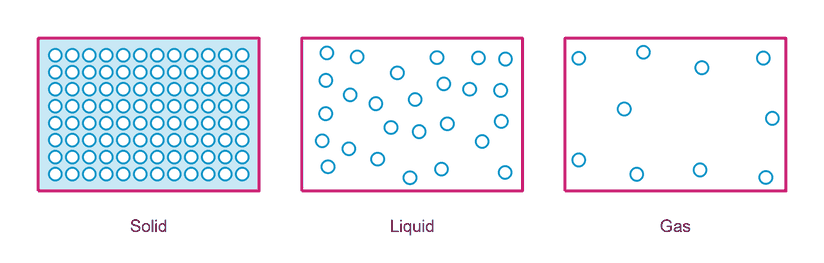
Step 2 — Compare the models in a table.
The table compares the packing, the spacing, the force and the motion of the molecules, and what each model leads to.
| Basis | Solid | Liquid | Gas |
|---|---|---|---|
| Packing of molecules | Very closely packed | Less closely packed | Far apart |
| Inter-molecular space | Least (negligible) | More than in solids | Very large (most) |
| Inter-molecular force | Strongest | Weaker than in solids | Negligible |
| Motion of molecules | Only vibrate about fixed positions | Move about, but within the boundary of the liquid | Move freely in all the space available |
| Result | Definite shape and definite volume | Definite volume, no definite shape | Neither definite shape nor definite volume |
Therefore, solids have closely packed, firmly held molecules that only vibrate; liquids have less closely packed molecules that move within the liquid; gases have far-apart molecules that move freely everywhere.