
Opening your dashboard
Class 6 Maths Chapter 16: Quadrilaterals Solutions
44 textbook questions with step-by-step answers, free to read, for ICSE 2026-27.
Get talked through Ch 16, not just shown the answer
Reading a finished solution is not the same as being able to do it. The AI tutor takes one question at a time and works it with you, in your own words, until you can.
- Ask it out loud, in your own words
- It gives you the next step, not the answer
- Stuck on part (ii)? Start there
44 questions with solutions
1–3 marks · Easy difficulty
- 13 marks
Question 1
Two angles of a quadrilateral are 89° and 113°. If the other two angles are equal, find the equal angles.
Solve with AIWritten solution
Solution:
Concept: The four angles of every quadrilateral add up to 360° (a diagonal splits it into two triangles, and 2 × 180° = 360°).
Given: Two angles are 89° and 113°, and the other two are equal.
Step 1 — Find the sum of the two equal angles.
The four angles add up to 360°, so the two equal angles share what is left after 89° and 113°.
Step 2 — Share it equally.
The two angles are equal, so each is half of 158°.
Watch out: 158° is the sum of the two equal angles; each one is half of it.
Therefore, each of the equal angles is 79°.
- 23 marks
Question 2
Two angles of a quadrilateral are 68° and 76°. If the other two angles are in the ratio 5 : 7, find the measure of each of them.
Solve with AIWritten solution
Solution:
Concept: The four angles of every quadrilateral add up to 360° (a diagonal splits it into two triangles, and 2 × 180° = 360°). Angles in a given ratio are written as the ratio numbers times a common multiplier, and their known total gives the multiplier.
Given: Two angles are 68° and 76°; the other two are in the ratio 5 : 7.
Step 1 — Find what is left for the two angles.
The four angles add up to 360°.
Step 2 — Share 216° in the ratio 5 : 7.
We write the two angles as and .
Step 3 — Find each angle.
We multiply the multiplier by each ratio number.
Watch out: Share only the 216° that is left, not the whole 360°.
Therefore, the two angles are 90° and 126°.
- 33 marks
Question 3
Angles of a quadrilateral are , , and . Find :
(i) the value of x.
(ii) each angle of the quadrilateral.
Solve with AIWritten solution
Solution:
Concept: The four angles of every quadrilateral add up to 360° (a diagonal splits it into two triangles, and 2 × 180° = 360°).
Step 1 — Write the angle sum.
The four angles add up to 360°. We open the brackets and collect the like terms.
Step 2 — Find each angle.
We put into each angle.
Watch out: Multiply every term inside a bracket: 5(x + 2) is 5x + 10, not 5x + 2.
Check: 64° + 90° + 92° + 114° = 360°.
Therefore, (i) x = 16; (ii) the angles are 64°, 90°, 92° and 114°.
- 43 marks
Question 4
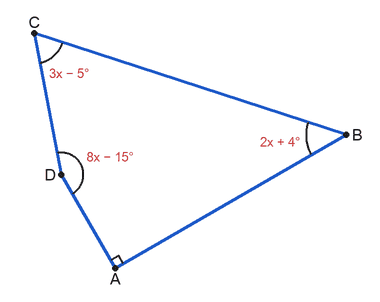
Use the information given in the following figure to find :
(i) x.
(ii) ∠B and ∠C.
 Solve with AI
Written solution
Solution:
Concept: The four angles of every quadrilateral add up to 360° (a diagonal splits it into two triangles, and 2 × 180° = 360°).
Given: The square at A (90°), and the angles 2x + 4° at B, 3x − 5° at C and 8x − 15° at D.
Step 1 — Write the angle sum.
The square at A shows ∠A = 90°. The four angles add up to 360°.
Step 2 — Find ∠B and ∠C.
We put into the two angles.
Watch out: The right angle at A is shown only by the square; include its 90° in the sum.
Check: With x = 22°, ∠D works out to 161°, and the four angles add up to 360°:
Therefore, (i) x = 22°; (ii) ∠B = 48° and ∠C = 61°.
- 53 marks
Question 5
In quadrilateral ABCD, side AB is parallel to side DC.
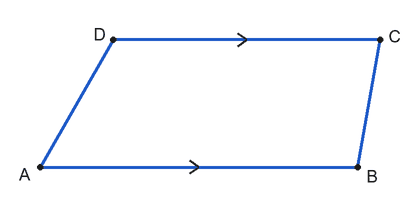
If ∠A : ∠D = 1 : 2 and ∠C : ∠B = 4 : 5.
Calculate each angle of the quadrilateral.
Solve with AIWritten solution
Solution:
Concept: When a line (a transversal) cuts two parallel lines, the co-interior angles (the two angles between the parallel lines on the same side of the transversal) add up to 180°. The converse also holds: if co-interior angles add up to 180°, the two lines are parallel. Angles in a given ratio are written as the ratio numbers times a common multiplier, and their known total gives the multiplier.
Given: AB ∥ DC, ∠A : ∠D = 1 : 2 and ∠C : ∠B = 4 : 5.
Step 1 — Use the parallel sides.
AB ∥ DC and AD cuts both, so ∠A and ∠D are co-interior angles: they add up to 180°. In the same way BC cuts both, so ∠B + ∠C = 180°.
Step 2 — Find ∠A and ∠D.
We write ∠A = and ∠D = (ratio 1 : 2).
So ∠A is 60°, and ∠D is twice it.
Step 3 — Find ∠C and ∠B.
We write ∠C = and ∠B = (ratio 4 : 5).
So ∠C and ∠B are 4 and 5 times 20°.
Watch out: Pair the angles along each non-parallel side (A with D, B with C), not A with B.
Therefore, ∠A = 60°, ∠B = 100°, ∠C = 80° and ∠D = 120°.
- 63 marks
Question 6
From the following figure find,
(i) x
(ii) ∠ABC
(iii) ∠ACD
 Solve with AI
Written solution
Solution:
Concept: The four angles of every quadrilateral add up to 360° (a diagonal splits it into two triangles, and 2 × 180° = 360°). The three angles of a triangle add up to 180°.
Step 1 — Read the figure.
The diagonal AC splits ∠A into 48° and , so ∠A = 48° + x. The angles at D and B are each, and the arc marked covers the whole angle at C.
Step 2 — Use the angle sum.
The four angles of ABCD add up to 360°.
Step 3 — Find ∠ABC.
The angle at B is .
Step 4 — Find ∠ACD.
In triangle ACD, ∠DAC is 48° and ∠D (marked 4x) is 104°, like ∠B. The three angles add up to 180°.
Watch out: The angle of ABCD at A is the whole 48° + x, not just x.
Check: The whole angle at C is 3x and ∠ACD is 28°, so ∠ACB is the rest of ∠C.
The angles of triangle ABC then add up to 180°:
Therefore, (i) x = 26°; (ii) ∠ABC = 104°; (iii) ∠ACD = 28°.
- 73 marks
Question 7
In quadrilateral ABCD, ∠C = 64°, ∠D = ∠C − 8°; ∠A = and ∠B = .

Calculate ∠A.
Solve with AIWritten solution
Solution:
Concept: The four angles of every quadrilateral add up to 360° (a diagonal splits it into two triangles, and 2 × 180° = 360°).
Given: In quadrilateral ABCD, ∠C is 64°, ∠D is 8° less than ∠C, ∠A is 5(a + 2)° and ∠B is 2(2a + 7)°.
Step 1 — Find ∠D.
The angle D is 8° less than ∠C, which is given as 64°.
Step 2 — Use the angle sum.
The four angles add up to 360°. We open the brackets and collect the like terms.
Step 3 — Find ∠A.
We put into ∠A.
Watch out: A = 24 is not the answer; the question asks for ∠A = 5(a + 2)°.
Check: With a = 24, ∠B works out to 110°, and the four angles add up to 360°:
Therefore, ∠A = 130°.
- 83 marks
Question 8
In the given figure :
b = 2a + 15° and
c = 3a + 5°,
find the values of b and c.
 Solve with AI
Written solution
Solution:
Concept: The four angles of every quadrilateral add up to 360° (a diagonal splits it into two triangles, and 2 × 180° = 360°).
Given: The angles of the figure are a, b, c and 70°, with b = 2a + 15° and c = 3a + 5°.
Step 1 — Use the angle sum.
The four angles of the quadrilateral, , , and 70°, add up to 360°. We put in and .
Step 2 — Find b and c.
We put into each.
Watch out: Find a first; the question asks for b and c, not a.
Therefore, b = 105° and c = 140°.
- 93 marks
Question 9
Three angles of a quadrilateral are equal. If the fourth angle is 69°, find the measure of equal angles.
Solve with AIWritten solution
Solution:
Concept: The four angles of every quadrilateral add up to 360° (a diagonal splits it into two triangles, and 2 × 180° = 360°).
Given: Three angles are equal and the fourth is 69°.
Step 1 — Name the equal angles.
We call each of the three equal angles .
Step 2 — Use the angle sum.
The four angles add up to 360°.
Watch out: Subtract 69° first, then share 291° among the THREE equal angles.
Therefore, each of the three equal angles is 97°.
- 103 marks
Question 10
In quadrilateral PQRS, ∠P : ∠Q : ∠R : ∠S = 3 : 4 : 6 : 7. Calculate each angle of the quadrilateral and then prove that PQ and SR are parallel to each other.
Is PS also parallel to QR ?
Solve with AIWritten solution
Solution:
Concept: The four angles of every quadrilateral add up to 360° (a diagonal splits it into two triangles, and 2 × 180° = 360°). Angles in a given ratio are written as the ratio numbers times a common multiplier, and their known total gives the multiplier. When a line (a transversal) cuts two parallel lines, the co-interior angles (the two angles between the parallel lines on the same side of the transversal) add up to 180°. The converse also holds: if co-interior angles add up to 180°, the two lines are parallel.
Step 1 — Find the angles.
We write the angles as , , and ; they add up to 360°.
We multiply 18° by each ratio number.
Step 2 — Prove PQ ∥ SR.
Side PS cuts PQ and SR, and ∠P and ∠S are co-interior angles between them.
Co-interior angles that add up to 180° mean the lines are parallel, so PQ ∥ SR.
Step 3 — Test PS and QR.
Side PQ cuts PS and QR, and ∠P and ∠Q are co-interior angles between them.
126° is not 180°, so PS is not parallel to QR.
Watch out: For PQ and SR the co-interior angles are at P and S (along PS), not at P and Q.
Therefore, ∠P = 54°, ∠Q = 72°, ∠R = 108° and ∠S = 126°; PQ ∥ SR, and PS is not parallel to QR.
- 113 marks
Question 11
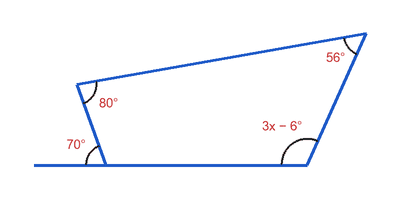
Use the information given in the following figure to find the value of x.
 Solve with AI
Written solution
Solution:
Concept: The four angles of every quadrilateral add up to 360° (a diagonal splits it into two triangles, and 2 × 180° = 360°). An exterior angle and the interior angle next to it add up to 180°.
Step 1 — Find the interior angle at the bottom left.
The base is produced at the left, so the 70° outside and the interior angle there form a linear pair.
Step 2 — Use the angle sum.
The four interior angles, 80°, 56°, 110° and , add up to 360°.
Watch out: 70° is outside the quadrilateral; use the interior angle 110° in the sum.
Check: With x = 40°, the angle 3x − 6° works out to 114°, and the four interior angles add up to 360°:
Therefore, x = 40°.
- 123 marks
Question 12
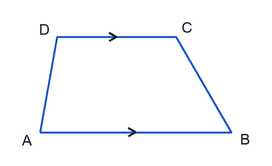
The following figure shows a quadrilateral in which sides AB and DC are parallel.
If ∠A : ∠D = 4 : 5, ∠B =
and ∠C = , find each angle of the quadrilateral ABCD.
 Solve with AI
Written solution
Solution:
Concept: When a line (a transversal) cuts two parallel lines, the co-interior angles (the two angles between the parallel lines on the same side of the transversal) add up to 180°. The converse also holds: if co-interior angles add up to 180°, the two lines are parallel. Angles in a given ratio are written as the ratio numbers times a common multiplier, and their known total gives the multiplier.
Given: AB ∥ DC, ∠A : ∠D is 4 : 5, ∠B is (3x − 15)° and ∠C is (4x + 20)°.
Step 1 — Find ∠A and ∠D.
AB ∥ DC and AD cuts both, so ∠A and ∠D add up to 180°. We write ∠A as and ∠D as .
So ∠A and ∠D are 4 and 5 times 20°.
Step 2 — Find x.
BC also cuts both parallel sides, so ∠B + ∠C = 180°.
Step 3 — Find ∠B and ∠C.
We put into each angle.
Watch out: The 4 : 5 ratio shares 180° (∠A + ∠D), not 360°.
Therefore, ∠A = 80°, ∠B = 60°, ∠C = 120° and ∠D = 100°.
- 133 marks
Question 13
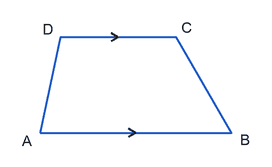
In a trapezium ABCD, side AB is parallel to side DC. If ∠A = 78° and ∠C = 120°, find angles B and D.
 Solve with AI
Written solution
Solution:
Concept: When a line (a transversal) cuts two parallel lines, the co-interior angles (the two angles between the parallel lines on the same side of the transversal) add up to 180°. The converse also holds: if co-interior angles add up to 180°, the two lines are parallel.
Given: AB ∥ DC, ∠A = 78° and ∠C = 120°.
Step 1 — Find ∠D.
AB ∥ DC and AD cuts both, so ∠A and ∠D are co-interior angles.
Step 2 — Find ∠B.
BC also cuts both parallel sides, so ∠B and ∠C are co-interior angles.
Watch out: ∠A pairs with ∠D (both on side AD), and ∠C with ∠B; ∠A and ∠C are not co-interior.
Therefore, ∠B = 60° and ∠D = 102°.
- 143 marks
Question 14
In a trapezium ABCD, side AB is parallel to side DC.
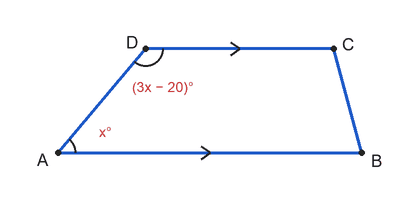
If ∠A = x° and ∠D = ; find the value of x.
Solve with AIWritten solution
Solution:
Concept: When a line (a transversal) cuts two parallel lines, the co-interior angles (the two angles between the parallel lines on the same side of the transversal) add up to 180°. The converse also holds: if co-interior angles add up to 180°, the two lines are parallel.
Given: AB ∥ DC, ∠A = x° and ∠D = (3x − 20)°.
Step 1 — Use the co-interior angles.
AB ∥ DC and AD cuts both, so ∠A + ∠D = 180°.
Watch out: Add 20 to both sides before dividing by 4.
Check: With x = 50, ∠A is 50° and ∠D is 130°, and these co-interior angles add up to 180°.
Therefore, x = 50.
- 153 marks
Question 15
The angles A, B, C and D of a trapezium ABCD are in the ratio 3 : 4 : 5 : 6, i.e. ∠A : ∠B : ∠C : ∠D = 3 : 4 : 5 : 6. Find all the angles of the trapezium. Also, name the two sides of this trapezium which are parallel to each other. Give reason for your answer.
Solve with AIWritten solution
Solution:
Concept: The four angles of every quadrilateral add up to 360° (a diagonal splits it into two triangles, and 2 × 180° = 360°). When a line (a transversal) cuts two parallel lines, the co-interior angles (the two angles between the parallel lines on the same side of the transversal) add up to 180°. The converse also holds: if co-interior angles add up to 180°, the two lines are parallel. Angles in a given ratio are written as the ratio numbers times a common multiplier, and their known total gives the multiplier.
Step 1 — Find the angles.
We write the angles as , , and ; they add up to 360°.
Multiplying 20° by each ratio number gives ∠A = 60°, ∠B = 80°, ∠C = 100° and ∠D = 120°.
Step 2 — Find the parallel sides.
Side AD cuts AB and DC, and ∠A and ∠D are co-interior angles between them.
They add up to 180°, so AB ∥ DC. (The other pair, ∠A + ∠B = 140°, is not 180°, so AD is not parallel to BC.)
Watch out: Test the co-interior pairs along a side (A with D, A with B), not opposite angles such as A and C.
Therefore, ∠A = 60°, ∠B = 80°, ∠C = 100° and ∠D = 120°; AB is parallel to DC, because the co-interior angles A and D add up to 180°.
- 163 marks
Question 16
In an isosceles trapezium, one pair of opposite sides are ................. to each other and the other pair of opposite sides are ................ to each other.
Solve with AIWritten solution
Solution:
Concept: A trapezium is a quadrilateral with a pair of parallel opposite sides. In an isosceles trapezium the two non-parallel sides are equal, the two angles on each parallel side are equal, and the diagonals are equal.
Step 1 — Recall the trapezium.
A trapezium has one pair of opposite sides parallel, so the first blank is “parallel”.
Step 2 — Recall what isosceles adds.
In an isosceles trapezium the other two sides (the non-parallel ones) are equal, so the second blank is “equal”.
Therefore, one pair of opposite sides are parallel to each other and the other pair of opposite sides are equal to each other.
- 173 marks
Question 17
Two diagonals of an isosceles trapezium are x cm and (3x − 8) cm. Find the value of x.
Solve with AIWritten solution
Solution:
Concept: A trapezium is a quadrilateral with a pair of parallel opposite sides. In an isosceles trapezium the two non-parallel sides are equal, the two angles on each parallel side are equal, and the diagonals are equal.
Given: The diagonals are x cm and (3x − 8) cm.
Step 1 — Equate the diagonals.
The diagonals of an isosceles trapezium are equal.
Watch out: Move x to the left and 8 to the right before dividing.
Check: Both diagonals are then 4 cm, since 3 × 4 − 8 = 4.
Therefore, x = 4.
- 183 marks
Question 18
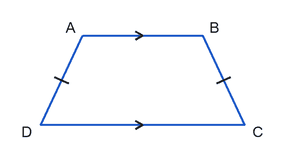
Angle A of an isosceles trapezium ABCD is 115°; find the angles B, C and D.
 Solve with AI
Written solution
Solution:
Concept: A trapezium is a quadrilateral with a pair of parallel opposite sides. In an isosceles trapezium the two non-parallel sides are equal, the two angles on each parallel side are equal, and the diagonals are equal. When a line (a transversal) cuts two parallel lines, the co-interior angles (the two angles between the parallel lines on the same side of the transversal) add up to 180°. The converse also holds: if co-interior angles add up to 180°, the two lines are parallel.
Given: The trapezium ABCD is isosceles (AD = BC, AB ∥ DC) and ∠A is 115°.
Step 1 — Find ∠B.
AB is a parallel side, and the two angles on each parallel side of an isosceles trapezium are equal.
So ∠B equals ∠A: it is 115°.
Step 2 — Find ∠D.
AB ∥ DC and AD cuts both, so ∠A and ∠D are co-interior angles.
Step 3 — Find ∠C.
The angles C and D are the two angles on the parallel side DC, so they are equal: ∠C = 65°.
Watch out: The angle D is not equal to ∠A; ∠D and ∠A are co-interior, so they add up to 180°.
Check: 115° + 115° + 65° + 65° = 360°.
Therefore, ∠B = 115°, ∠C = 65° and ∠D = 65°.
- 193 marks
Question 19
Two opposite angles of a parallelogram are 100° each. Find the other two opposite angles.
Solve with AIWritten solution
Solution:
Concept: In a parallelogram both pairs of opposite sides are parallel and equal, opposite angles are equal, adjacent angles add up to 180°, and the diagonals bisect each other.
Given: Two opposite angles are 100° each.
Step 1 — Use adjacent angles.
Each of the other two angles is next to an angle of 100°, and adjacent angles of a parallelogram add up to 180°.
Check: 100° + 100° + 80° + 80° = 360°.
Therefore, each of the other two opposite angles is 80°.
- 203 marks
Question 20
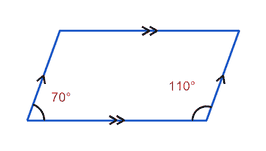
Two adjacent angles of a parallelogram are 70° and 110° respectively. Find the other two angles.
 Solve with AI
Written solution
Solution:
Concept: In a parallelogram both pairs of opposite sides are parallel and equal, opposite angles are equal, adjacent angles add up to 180°, and the diagonals bisect each other.
Given: Two adjacent angles are 70° and 110°.
Step 1 — Use opposite angles.
Opposite angles of a parallelogram are equal. The angle opposite the 70° angle is 70°, and the angle opposite the 110° angle is 110°.
Check: 70° + 110° + 70° + 110° = 360°.
Therefore, the other two angles are 70° and 110°.
- 213 marks
Question 21
The angles A, B, C and D of a quadrilateral are in the ratio 2 : 3 : 2 : 3. Show that this quadrilateral is a parallelogram.
Solve with AIWritten solution
Solution:
Concept: The four angles of every quadrilateral add up to 360° (a diagonal splits it into two triangles, and 2 × 180° = 360°). When a line (a transversal) cuts two parallel lines, the co-interior angles (the two angles between the parallel lines on the same side of the transversal) add up to 180°. The converse also holds: if co-interior angles add up to 180°, the two lines are parallel.
Given: The angles A, B, C and D are in the ratio 2 : 3 : 2 : 3.
Step 1 — Find the angles.
We write the angles as , , and ; they add up to 360°.
Multiplying 36° by each ratio number gives ∠A = 72°, ∠B = 108°, ∠C = 72° and ∠D = 108°.
Step 2 — Test the sides AD and BC.
Side AB cuts AD and BC, and ∠A and ∠B are co-interior angles between them.
So AD ∥ BC.
Step 3 — Test the sides AB and DC.
Side AD cuts AB and DC, and ∠A and ∠D are co-interior angles between them.
So AB ∥ DC.
Step 4 — Conclude.
Both pairs of opposite sides are parallel, so ABCD is a parallelogram. (Its opposite angles are also equal: ∠A = ∠C and ∠B = ∠D.)
Therefore, ∠A and ∠C are 72°, ∠B and ∠D are 108°; both pairs of opposite sides are parallel, so ABCD is a parallelogram.
- 223 marks
Question 22
In a parallelogram ABCD, its diagonals AC and BD intersect each other at point O.
If AC = 12 cm and BD = 9 cm; find the lengths of OA and OD.
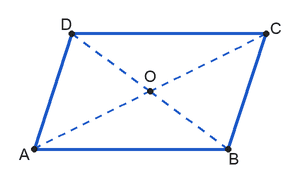 Solve with AI
Written solution
Solution:
Concept: In a parallelogram both pairs of opposite sides are parallel and equal, opposite angles are equal, adjacent angles add up to 180°, and the diagonals bisect each other.
Given: AC = 12 cm and BD = 9 cm.
Step 1 — Find OA.
The diagonals bisect each other, so O is the mid-point of AC.
Step 2 — Find OD.
O is also the mid-point of BD.
Watch out: The diagonals of a parallelogram bisect each other but need not be equal, so OA and OD differ.
Therefore, OA = 6 cm and OD = 4.5 cm.
- 233 marks
Question 23
In parallelogram ABCD, its diagonals intersect at point O.
If OA = 6 cm and OB = 7·5 cm, find the lengths of AC and BD.
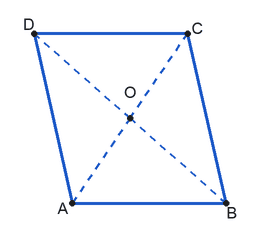 Solve with AI
Written solution
Solution:
Concept: In a parallelogram both pairs of opposite sides are parallel and equal, opposite angles are equal, adjacent angles add up to 180°, and the diagonals bisect each other.
Given: OA = 6 cm and OB = 7.5 cm.
Step 1 — Find AC.
The diagonals bisect each other, so AC is twice OA.
Step 2 — Find BD.
In the same way BD is twice OB.
Watch out: OA is only half of AC, so double it.
Therefore, AC = 12 cm and BD = 15 cm.
- 243 marks
Question 24
In a parallelogram ABCD, ∠A = 90°
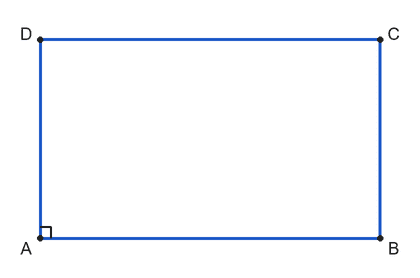
(i) what is the measure of angle B ?
(ii) write the special name of the parallelogram.
Solve with AIWritten solution
Solution:
Concept: In a parallelogram both pairs of opposite sides are parallel and equal, opposite angles are equal, adjacent angles add up to 180°, and the diagonals bisect each other. A rectangle is a parallelogram with every angle 90°; its diagonals are equal. A rhombus is a parallelogram with all four sides equal; its diagonals cut each other at right angles. A square is both: all sides equal and every angle 90°, with equal diagonals that cut at right angles.
Given: ABCD is a parallelogram with ∠A = 90°.
Step 1 — Part (i).
The angles A and B are adjacent angles of the parallelogram, so they add up to 180°.
Step 2 — Part (ii).
Opposite angles are equal, so ∠C equals ∠A (90°) and ∠D equals ∠B (90°). A parallelogram with every angle 90° is a rectangle.
Therefore, (i) ∠B = 90°; (ii) the parallelogram is a rectangle.
- 253 marks
Question 25
One diagonal of a rectangle is 18 cm. What is the length of its other diagonal ?
Solve with AIWritten solution
Solution:
Concept: A rectangle is a parallelogram with every angle 90°; its diagonals are equal. A rhombus is a parallelogram with all four sides equal; its diagonals cut each other at right angles. A square is both: all sides equal and every angle 90°, with equal diagonals that cut at right angles.
Given: One diagonal is 18 cm.
Step 1 — Use the property.
The two diagonals of a rectangle are equal, so the other diagonal is also 18 cm.
Therefore, the other diagonal is also 18 cm.
- 263 marks
Question 26
Each angle of a quadrilateral is x + 5°. Find :
(i) the value of x.
(ii) each angle of the quadrilateral.
Give the special name of the quadrilateral taken.
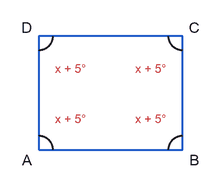 Solve with AI
Written solution
Solution:
Concept: The four angles of every quadrilateral add up to 360° (a diagonal splits it into two triangles, and 2 × 180° = 360°). A rectangle is a parallelogram with every angle 90°; its diagonals are equal. A rhombus is a parallelogram with all four sides equal; its diagonals cut each other at right angles. A square is both: all sides equal and every angle 90°, with equal diagonals that cut at right angles.
Given: Each angle is x + 5°.
Step 1 — Use the angle sum.
All four angles are , and they add up to 360°.
Step 2 — Name the quadrilateral.
Each angle is . A quadrilateral with every angle 90° is a rectangle.
Watch out: The question asks for x AND for each angle; each angle is x + 5°, so add the 5° back to 85°.
Therefore, (i) x = 85°; (ii) each angle is 90°; the quadrilateral is a rectangle.
- 273 marks
Question 27
If three angles of a quadrilateral are 90° each, show that the given quadrilateral is a rectangle.
Solve with AIWritten solution
Solution:
Concept: The four angles of every quadrilateral add up to 360° (a diagonal splits it into two triangles, and 2 × 180° = 360°). When a line (a transversal) cuts two parallel lines, the co-interior angles (the two angles between the parallel lines on the same side of the transversal) add up to 180°. The converse also holds: if co-interior angles add up to 180°, the two lines are parallel. A rectangle is a parallelogram with every angle 90°; its diagonals are equal. A rhombus is a parallelogram with all four sides equal; its diagonals cut each other at right angles. A square is both: all sides equal and every angle 90°, with equal diagonals that cut at right angles.
Given: Three angles are 90° each.
Step 1 — Find the fourth angle.
The four angles add up to 360°.
Step 2 — Show the sides are parallel.
Call the quadrilateral ABCD. Then ∠A + ∠B = 180°, and these are co-interior angles on AB, so AD ∥ BC. Also ∠A + ∠D = 180°, so AB ∥ DC.
Step 3 — Conclude.
Both pairs of opposite sides are parallel, so ABCD is a parallelogram, and every angle of it is 90°. Such a parallelogram is a rectangle.
Watch out: Show the fourth angle is 90° too; three right angles alone are not the whole proof.
Therefore, every angle is 90°, so the quadrilateral is a rectangle.
- 283 marks
Question 28
The diagonals of a rhombus are 6 cm and 8 cm. State the type of angles these diagonals make when they intersect.
Solve with AIWritten solution
Solution:
Concept: A rectangle is a parallelogram with every angle 90°; its diagonals are equal. A rhombus is a parallelogram with all four sides equal; its diagonals cut each other at right angles. A square is both: all sides equal and every angle 90°, with equal diagonals that cut at right angles.
Given: The diagonals are 6 cm and 8 cm.
Step 1 — Use the property.
The diagonals of every rhombus bisect each other at right angles, whatever their lengths. So these diagonals, 6 cm and 8 cm, meet at right angles.
Watch out: The lengths 6 cm and 8 cm are not needed to answer this.
Therefore, the diagonals make right angles (90°) where they intersect.
- 293 marks
Question 29
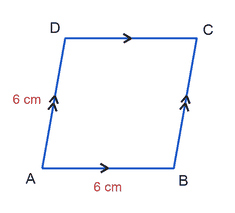
Write, giving reason, the name of the figure drawn alongside. Under what condition will this figure be a square ?
 Solve with AI
Written solution
Solution:
Concept: In a parallelogram both pairs of opposite sides are parallel and equal, opposite angles are equal, adjacent angles add up to 180°, and the diagonals bisect each other. A rectangle is a parallelogram with every angle 90°; its diagonals are equal. A rhombus is a parallelogram with all four sides equal; its diagonals cut each other at right angles. A square is both: all sides equal and every angle 90°, with equal diagonals that cut at right angles.
Given: AB and AD are both 6 cm, AB ∥ DC and AD ∥ BC.
Step 1 — Read the arrows.
The arrow marks show AB ∥ DC and AD ∥ BC, so both pairs of opposite sides are parallel: the figure is a parallelogram.
Step 2 — Use the lengths.
In a parallelogram opposite sides are equal, so DC equals AB and BC equals AD: each is 6 cm. All four sides are 6 cm, so the figure is a rhombus.
Step 3 — Condition for a square.
A rhombus becomes a square when its angles are right angles. If any one angle is 90°, its neighbours are 180° − 90° = 90° and the opposite angle equals it, so all four are 90°.
Watch out: Two equal ADJACENT sides make every side equal; two equal opposite sides would not.
Therefore, the figure is a rhombus, because all four of its sides are equal; it will be a square when any one of its angles is 90°.
- 303 marks
Question 30
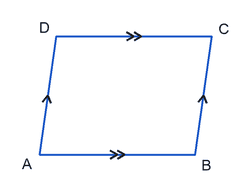
Write two conditions that will make the adjoining figure a square
 Solve with AI
Written solution
Solution:
Concept: In a parallelogram both pairs of opposite sides are parallel and equal, opposite angles are equal, adjacent angles add up to 180°, and the diagonals bisect each other. A rectangle is a parallelogram with every angle 90°; its diagonals are equal. A rhombus is a parallelogram with all four sides equal; its diagonals cut each other at right angles. A square is both: all sides equal and every angle 90°, with equal diagonals that cut at right angles.
Step 1 — Read the figure.
The arrow marks show both pairs of opposite sides parallel, so the figure is a parallelogram.
Step 2 — What a square needs.
A square is a parallelogram with all sides equal and every angle 90°. A parallelogram with two adjacent sides equal has all four sides equal, and one with one angle of 90° has all four angles 90°.
Therefore, the two conditions are: (1) all the sides are equal (two adjacent sides equal is enough), and (2) any one angle is 90°.
- 311 mark
Question 31
Three angles of a quadrilateral are 94°, 106° and 60°. The fourth angle is :
Solve with AIAnswer
(A) 60°
(B) 80°
- Correct
(C) 100°
(D) 120°
Answer: (C) 100°
Concept: The four angles of every quadrilateral add up to 360° (a diagonal splits it into two triangles, and 2 × 180° = 360°).
Step 1 — Use the angle sum.
The fourth angle is what is left of 360° after the three given angles.
Why the other options are wrong:
- (A) 60°: With 60° the four angles would add up to 320°, not 360°.
- (B) 80°: With 80° the four angles would add up to 340°, not 360°.
- (D) 120°: With 120° the four angles would add up to 380°, not 360°.
Therefore, the fourth angle is 100°, option (C).
- 321 mark
Question 32
Two angles of a quadrilateral are 100° each and the other two angles are also equal. Each of these two equal angles is :
Solve with AIAnswer
(A) 100°
- Correct
(B) 80°
(C) 120°
(D) 90°
Answer: (B) 80°
Concept: The four angles of every quadrilateral add up to 360° (a diagonal splits it into two triangles, and 2 × 180° = 360°).
Step 1 — Find the sum of the equal angles.
The two angles of 100° take 200° of the 360°.
Step 2 — Share it equally.
The two angles are equal.
Watch out: 160° is the sum of the two equal angles; each is half of it.
Why the other options are wrong:
- (A) 100°: Four angles of 100° would add up to 400°, not 360°.
- (C) 120°: Two angles of 120° with the two of 100° would add up to 440°.
- (D) 90°: Two angles of 90° with the two of 100° would add up to 380°.
Therefore, each of the two equal angles is 80°, option (B).
- 331 mark
Question 33
Number of pairs of adjacent angles, a quadrilateral has :
Solve with AIAnswer
(A) 6
- Correct
(B) 4
(C) 3
(D) 1
Answer: (B) 4
Concept: Two angles of a quadrilateral are adjacent if they share a side, and opposite if they do not.
Step 1 — List the pairs.
In quadrilateral ABCD, two angles are adjacent when they are at the two ends of one side. Each of the 4 sides gives one pair: (∠A, ∠B), (∠B, ∠C), (∠C, ∠D) and (∠D, ∠A).
Watch out: The last pair, ∠D and ∠A, closes the loop round the quadrilateral.
Why the other options are wrong:
- (A) 6: 6 counts every pair of the four angles, including the two opposite pairs (∠A, ∠C) and (∠B, ∠D).
- (C) 3: 3 misses the pair (∠D, ∠A) on side DA.
- (D) 1: There is a pair on each of the 4 sides, not just one.
Therefore, a quadrilateral has 4 pairs of adjacent angles, option (B).
- 341 mark
Question 34
A quadrilateral has :
Solve with AIAnswer
- Correct
(A) 2-diagonals
(B) 4-diagonals
(C) 3-diagonals
(D) no diagonal
Answer: (A) 2-diagonals
Concept: A diagonal of a quadrilateral is a line segment joining two opposite vertices.
Step 1 — List the diagonals.
A diagonal joins two opposite (non-adjacent) vertices. In ABCD these are AC and BD.
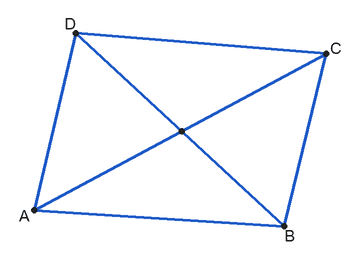
Watch out: Each diagonal joins two vertices, so counting from every vertex counts it twice.
Why the other options are wrong:
- (B) 4-diagonals: 4 counts each diagonal twice, once from each of its two ends.
- (C) 3-diagonals: The four vertices make only two pairs of opposite vertices, so there cannot be 3 diagonals.
- (D) no diagonal: Every quadrilateral has two diagonals, AC and BD.
Therefore, a quadrilateral has 2 diagonals, option (A).
- 351 mark
Question 35
The pairs of opposite angles of quadrilateral is :
Solve with AIAnswer
(A) 4
(B) 1
- Correct
(C) 2
(D) 3
Answer: (C) 2
Concept: Two angles of a quadrilateral are adjacent if they share a side, and opposite if they do not.
Step 1 — List the pairs.
Two angles are opposite when they do not share a side. In ABCD the opposite pairs are ∠A with ∠C, and ∠B with ∠D.
Watch out: 4 is the number of pairs of ADJACENT angles, not opposite ones.
Note: Choosing 4 is a slip: it counts the pairs of adjacent angles; the four angles make only two opposite pairs.
Why the other options are wrong:
- (A) 4: 4 is the number of pairs of adjacent angles.
- (B) 1: One pair (∠A, ∠C) is not all: ∠B and ∠D make a second pair.
- (D) 3: Four angles split into opposite pairs make exactly two pairs, not three.
Therefore, a quadrilateral has 2 pairs of opposite angles, option (C).
- 361 mark
Question 36
In a parallelogram, the opposite sides are :
Solve with AIAnswer
(A) equal
(B) parallel
(C) neither equal nor parallel
- Correct
(D) equal and parallel.
Answer: (D) equal and parallel.
Concept: In a parallelogram both pairs of opposite sides are parallel and equal, opposite angles are equal, adjacent angles add up to 180°, and the diagonals bisect each other.
Step 1 — Recall the property.
In parallelogram ABCD, AB ∥ DC and AB = DC, and AD ∥ BC and AD = BC. So the opposite sides are equal and parallel.
Why the other options are wrong:
- (A) equal: They are equal, but they are also parallel; (D) gives both facts.
- (B) parallel: They are parallel, but they are also equal; (D) gives both facts.
- (C) neither equal nor parallel: They are both equal and parallel, so “neither” is false.
Therefore, the opposite sides of a parallelogram are equal and parallel, option (D).
- 371 mark
Question 37
The given figure shows an isosceles trapezium ABCD. Then :
 Solve with AI
Answer
(A) DC = AB
(B) ∠A + ∠B = 180°
(C) ∠C + ∠D = 180°
- Correct
(D) none of these
Answer: (D) none of these
Concept: A trapezium is a quadrilateral with a pair of parallel opposite sides. In an isosceles trapezium the two non-parallel sides are equal, the two angles on each parallel side are equal, and the diagonals are equal. When a line (a transversal) cuts two parallel lines, the co-interior angles (the two angles between the parallel lines on the same side of the transversal) add up to 180°. The converse also holds: if co-interior angles add up to 180°, the two lines are parallel.
Step 1 — Find the co-interior pairs.
DC ∥ AB. Side AD cuts them, so ∠A + ∠D = 180°; side BC cuts them, so ∠B + ∠C = 180°.
Step 2 — Test each option.
The parallel sides of a trapezium have different lengths, so DC ≠ AB. ∠A and ∠B are the two equal acute angles on AB, so their sum is less than 180°; ∠C and ∠D are the two equal obtuse angles on DC, so their sum is more than 180°. None of (A), (B), (C) holds.
Watch out: The angles A and B are on the same parallel side; they are not co-interior angles.
Why the other options are wrong:
- (A): DC and AB are the parallel sides; if they were equal, ABCD would be a parallelogram, not a trapezium.
- (B): ∠A and ∠B are equal acute angles, so they add up to less than 180°.
- (C): ∠C and ∠D are equal obtuse angles, so they add up to more than 180°.
Therefore, none of the three statements is true, option (D).
- 381 mark
Question 38
The diagonals of a quadrilateral are equal, the quadrilateral is :
Solve with AIAnswer
(A) trapezium
(B) parallelogram
(C) rhombus
- Correct
(D) none of these
Answer: (D) none of these
Concept: A rectangle is a parallelogram with every angle 90°; its diagonals are equal. A rhombus is a parallelogram with all four sides equal; its diagonals cut each other at right angles. A square is both: all sides equal and every angle 90°, with equal diagonals that cut at right angles. The diagonals of an isosceles trapezium are also equal.
Step 1 — Think of examples.
A rectangle, a square and an isosceles trapezium all have equal diagonals. Quadrilaterals with equal diagonals and no parallel sides at all can also be drawn.
Step 2 — Decide.
So equal diagonals alone do not tell us that the quadrilateral is a trapezium, a parallelogram or a rhombus. The answer is “none of these”.
Watch out: A property that several shapes share does not name one shape.
Why the other options are wrong:
- (A) trapezium: Equal diagonals do not force a pair of parallel sides, and a rectangle with equal diagonals is a parallelogram.
- (B) parallelogram: Equal diagonals do not make a quadrilateral a parallelogram: an isosceles trapezium has them too.
- (C) rhombus: A rhombus has equal diagonals only when it is a square; a rectangle that is not a square has equal diagonals but is not a rhombus.
Therefore, the quadrilateral need not be any of the three, option (D).
- 391 mark
Question 39
In parallelogram ABCD, diagonal AC is equal to diagonal BD and ∠AOB = 90°, ABCD is :
 Solve with AI
Answer
(A) parallelogram
(B) rectangle
(C) rhombus
- Correct
(D) square
Answer: (D) square
Concept: A rectangle is a parallelogram with every angle 90°; its diagonals are equal. A rhombus is a parallelogram with all four sides equal; its diagonals cut each other at right angles. A square is both: all sides equal and every angle 90°, with equal diagonals that cut at right angles.
Step 1 — Use the equal diagonals.
A parallelogram whose diagonals are equal is a rectangle.
Step 2 — Use the right angle at O.
A parallelogram whose diagonals cut at right angles (∠AOB = 90°) is a rhombus.
Step 3 — Combine.
ABCD is both a rectangle and a rhombus, so it is a square.
Watch out: Use BOTH facts; each one alone gives only a rectangle or only a rhombus.
Why the other options are wrong:
- (A) parallelogram: ABCD is a parallelogram, but that name ignores both given facts; the most exact name is square.
- (B) rectangle: Equal diagonals make it a rectangle, but the right angle at O also makes it a rhombus, so it is a square.
- (C) rhombus: The right angle at O makes it a rhombus, but equal diagonals also make it a rectangle, so it is a square.
Therefore, ABCD is a square, option (D).
- 401 mark
Question 40
The diagonals of a parallelogram are perpendicular to each other, the parallelogram is a :
Solve with AIAnswer
(A) rectangle
- Correct
(B) rhombus
(C) square
(D) none of these
Answer: (B) rhombus
Concept: A rectangle is a parallelogram with every angle 90°; its diagonals are equal. A rhombus is a parallelogram with all four sides equal; its diagonals cut each other at right angles. A square is both: all sides equal and every angle 90°, with equal diagonals that cut at right angles.
Step 1 — Use the property.
In a parallelogram the diagonals bisect each other. If they also cut at right angles, each diagonal is the perpendicular bisector of the other, so all four sides are equal: the parallelogram is a rhombus.
Watch out: A square also has perpendicular diagonals, but it needs equal diagonals as well.
Why the other options are wrong:
- (A) rectangle: A rectangle's diagonals are perpendicular only when it is a square, so “rectangle” does not follow.
- (C) square: Perpendicular diagonals alone give a rhombus; it is a square only if the diagonals are also equal.
- (D) none of these: Rhombus, option (B), is correct, so “none of these” is wrong.
Therefore, the parallelogram is a rhombus, option (B).
- 411 mark
Question 41
Choose your answer based on the codes given below :
(1) A is true, R is false. (2) A is false, R is true. (3) Both A and R are true. (4) Both A and R are false.
Assertion (A) : In a quadrilateral ABCD, ∠A + ∠B = 180° ⇒ ABCD is trapezium.
Reason (R) : Quadrilateral ABCD is a rohombus if either AB//DC or AD//BC.
 Solve with AI
Answer
- Correct
(A) (1) A is true, R is false.
(B) (2) A is false, R is true.
(C) (3) Both A and R are true.
(D) (4) Both A and R are false.
Answer: (A) (1) A is true, R is false.
Concept: In an Assertion–Reason item we judge A and R separately and then choose the code that matches both verdicts. When a line (a transversal) cuts two parallel lines, the co-interior angles (the two angles between the parallel lines on the same side of the transversal) add up to 180°. The converse also holds: if co-interior angles add up to 180°, the two lines are parallel. A trapezium is a quadrilateral with a pair of parallel opposite sides. In an isosceles trapezium the two non-parallel sides are equal, the two angles on each parallel side are equal, and the diagonals are equal.
Step 1 — Judge the Assertion.
The angles A and B are at the two ends of side AB, so they are co-interior angles made by AB with AD and BC. They add up to 180°, so AD ∥ BC. A quadrilateral with a pair of parallel sides is a trapezium, so A is true.
Step 2 — Judge the Reason.
One pair of parallel sides makes only a trapezium. A rhombus needs both pairs of opposite sides parallel and all four sides equal, so R is false.
Step 3 — Choose the code.
A is true and R is false. This matches code (1).
Watch out: The sum ∠A + ∠B = 180° makes AD ∥ BC (the sides AB cuts), not AB ∥ DC.
Note: Calling A false is a slip: ∠A + ∠B = 180° makes AD parallel to BC, so ABCD is a trapezium.
Why the other options are wrong:
- (B): Code (2) has the verdicts the other way round: A is true and R is false.
- (C): Code (3) says R is true, but one pair of parallel sides does not make a rhombus.
- (D): Code (4) says A is false, but ∠A + ∠B = 180° does make AD ∥ BC, so ABCD is a trapezium.
Therefore, A is true and R is false, option (A).
- 421 mark
Question 42
Choose your answer based on the codes given below :
(1) A is true, R is false. (2) A is false, R is true. (3) Both A and R are true. (4) Both A and R are false.
Assertion (A) : The diagonals of a parallelogram are equal, the parallelogram is a square.
Reason (R) : If the diagonals are equal and intersect each other at 90°, the parallelogram is a square.
Solve with AIAnswer
(A) (1) A is true, R is false.
- Correct
(B) (2) A is false, R is true.
(C) (3) Both A and R are true.
(D) (4) Both A and R are false.
Answer: (B) (2) A is false, R is true.
Concept: In an Assertion–Reason item we judge A and R separately and then choose the code that matches both verdicts. A rectangle is a parallelogram with every angle 90°; its diagonals are equal. A rhombus is a parallelogram with all four sides equal; its diagonals cut each other at right angles. A square is both: all sides equal and every angle 90°, with equal diagonals that cut at right angles.
Step 1 — Judge the Assertion.
Equal diagonals make a parallelogram a rectangle, not always a square. For example, a rectangle 6 cm by 3 cm has two equal diagonals but is not a square. So A is false.
Step 2 — Judge the Reason.
Equal diagonals make it a rectangle, and diagonals that cut at 90° make it a rhombus. Both together make it a square, so R is true.
Step 3 — Choose the code.
A is false and R is true. This matches code (2).
Watch out: Equal diagonals alone give a rectangle; a square needs the right angle between the diagonals as well.
Why the other options are wrong:
- (A): Code (1) has the verdicts the other way round: A is false and R is true.
- (C): Code (3) says A is true, but a 6 cm by 3 cm rectangle has equal diagonals and is not a square.
- (D): Code (4) says R is false, but equal diagonals meeting at 90° do make a parallelogram a square.
Therefore, A is false and R is true, option (B).
- 431 mark
Question 43
Statement 1 : All the four sides of a quadrilateral are equal, it is a square.
Statement 2 : When all the sides and the diagonals of a quadrilateral are equal, the quadrilateral is a square :
Which of the following options is correct?
Solve with AIAnswer
(A) Both the statements are true.
(B) Both the statements are false.
(C) Statement 1 is true, and statement 2 is false.
- Correct
(D) Statement 1 is false, and statement 2 is true.
Answer: (D) Statement 1 is false, and statement 2 is true.
Concept: A rectangle is a parallelogram with every angle 90°; its diagonals are equal. A rhombus is a parallelogram with all four sides equal; its diagonals cut each other at right angles. A square is both: all sides equal and every angle 90°, with equal diagonals that cut at right angles.
Step 1 — Judge statement 1.
Four equal sides make a rhombus. A rhombus with angles 60° and 120° has four equal sides but is not a square, so statement 1 is false.

Step 2 — Judge statement 2.
Four equal sides make a rhombus, and a rhombus with equal diagonals has every angle 90°. So it is a square, and statement 2 is true.
Watch out: Equal sides alone allow a “pushed-over” square, a rhombus with no right angle.
Why the other options are wrong:
- (A): Statement 1 is false: a rhombus with angles 60° and 120° has four equal sides but is not a square.
- (B): Statement 2 is true: equal sides and equal diagonals together make a square.
- (C): This reverses the verdicts: statement 1 is false and statement 2 is true.
Therefore, statement 1 is false and statement 2 is true, option (D).
- 441 mark
Question 44
Statement 1 : A parallelogram is a trapezium.
Statement 2 : A quadrilateral, with atleast two sides parallel, is trapezium.
Which of the following options is correct?
Solve with AIAnswer
- Correct
(A) Both the statements are true.
(B) Both the statements are false.
(C) Statement 1 is true, and statement 2 is false.
(D) Statement 1 is false, and statement 2 is true.
Answer: (A) Both the statements are true.
Concept: A trapezium is a quadrilateral with a pair of parallel opposite sides. In an isosceles trapezium the two non-parallel sides are equal, the two angles on each parallel side are equal, and the diagonals are equal. Here the pair of parallel sides is “at least one pair”, as statement 2 says.
Step 1 — Judge statement 2.
Statement 2 defines a trapezium as a quadrilateral with at least one pair of parallel sides (“at least two sides parallel”). This is the definition the question uses, so statement 2 is true.
Step 2 — Judge statement 1.
A parallelogram has two pairs of parallel sides, so it has at least one pair. By statement 2's definition it is a trapezium, and statement 1 is true.
Note: Under the other common definition, a trapezium has exactly one pair of parallel sides; on that reading a parallelogram is not a trapezium and statement 1 would be false. This question follows statement 2's “at least” definition.
Why the other options are wrong:
- (B): Statement 2 is the definition this question uses, so it is true, and statement 1 follows from it.
- (C): Statement 2 is true here: it is the definition being used.
- (D): Under statement 2's definition a parallelogram has parallel sides, so statement 1 is true.
Therefore, both the statements are true, option (A).
What Class 6 Maths Ch 16 covers
The sections of the chapter, in the order the book takes them. Every question above comes from one of these.
- 01Interior and Exterior of a Quadrilateral
- 02Trapezium
- 03Parallelogram
- 04Rectangle
- 05Rhombus
- 06Square
More ways to study this chapter
The same chapter asked three other ways. Practise it, revise it, and see what the board has set on Ch 16 before.
Class 6 Maths Ch 16 questions students ask
How many questions are there in Class 6 Maths Ch 16?
44 questions. Every one is solved step by step on this page.
Are these Class 6 Maths solutions free?
Yes. Every question and its full working is free to read, with no account needed.
Can I download the Class 6 Maths Ch 16 solutions as a PDF?
There is no PDF to download. Every solution is on this page instead, which means it is searchable, always the current syllabus, and readable on a phone. Use your browser's print option if you want it on paper.