
Question 293 marksEasy
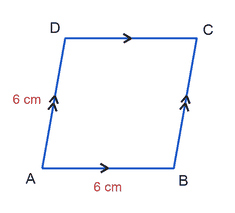
Write, giving reason, the name of the figure drawn alongside. Under what condition will this figure be a square ?
Confirming your payment
Sign up now and get 250 free tokens.
Quadrilaterals · Question 29 of 44
Write, giving reason, the name of the figure drawn alongside. Under what condition will this figure be a square ?
Solution:
Concept: In a parallelogram both pairs of opposite sides are parallel and equal, opposite angles are equal, adjacent angles add up to 180°, and the diagonals bisect each other. A rectangle is a parallelogram with every angle 90°; its diagonals are equal. A rhombus is a parallelogram with all four sides equal; its diagonals cut each other at right angles. A square is both: all sides equal and every angle 90°, with equal diagonals that cut at right angles.
Given: AB and AD are both 6 cm, AB ∥ DC and AD ∥ BC.
Step 1 — Read the arrows.
The arrow marks show AB ∥ DC and AD ∥ BC, so both pairs of opposite sides are parallel: the figure is a parallelogram.
Step 2 — Use the lengths.
In a parallelogram opposite sides are equal, so DC equals AB and BC equals AD: each is 6 cm. All four sides are 6 cm, so the figure is a rhombus.
Step 3 — Condition for a square.
A rhombus becomes a square when its angles are right angles. If any one angle is 90°, its neighbours are 180° − 90° = 90° and the opposite angle equals it, so all four are 90°.
Watch out: Two equal ADJACENT sides make every side equal; two equal opposite sides would not.
Therefore, the figure is a rhombus, because all four of its sides are equal; it will be a square when any one of its angles is 90°.