
Opening your dashboard
Class 6 Maths Chapter 16 Quadrilaterals: Practice Questions
41 questions on Chapter 16, each worked through on its own page with the AI tutor. Class 6 Maths, ICSE 2026-27.
41 questions
1–5 marks · Mixed difficulty
- 11 mark
Question 1
Bloom's level: Remember
A quadrilateral in which each angle is less than is called :
- 21 mark
Question 2
Bloom's level: Remember
A quadrilateral in which every angle is is always a :
- 31 mark
Question 3
Bloom's level: Apply
In quadrilateral ABCD, ∠A ∠B and ∠C ∠D.
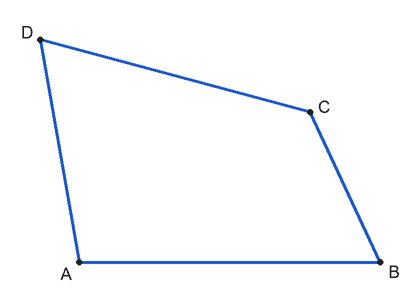
Then ∠D is :
- 41 mark
Question 4
Bloom's level: Understand
In parallelogram PQRS, which of the following is not always true?
- 51 mark
Question 5
Bloom's level: Apply
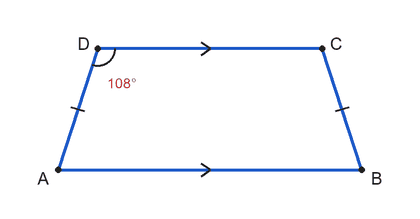
ABCD is an isosceles trapezium in which AB ∥ DC and AD = BC. If ∠D , then ∠B is :
- 61 mark
Question 6
Bloom's level: Understand
Which of the following is always a square?
- 71 mark
Question 7
Bloom's level: Apply
In rhombus ABCD, ∠ABC .
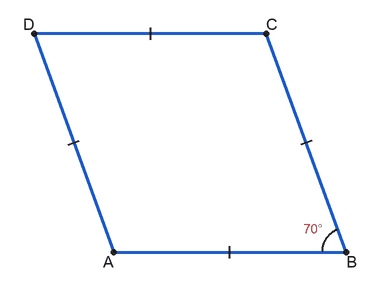
The diagonal BD makes with side AB an angle ∠ABD equal to :
- 81 mark
Question 8
Bloom's level: Apply
The diagonals of rectangle ABCD meet at O.
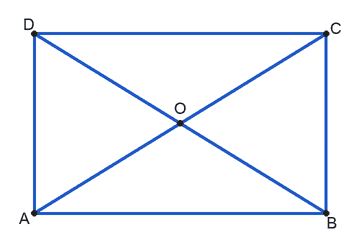
If AC cm, then OB is :
- 91 mark
Question 9
Bloom's level: Understand
The sum of the interior angles of any quadrilateral is because :
- 101 mark
Question 10
Bloom's level: Understand
Assertion (A) : If one angle of a parallelogram is , then the parallelogram is a rectangle.
Reason (R) : Adjacent angles of a parallelogram are supplementary, and its opposite angles are equal.
- 111 mark
Question 11
Bloom's level: Evaluate
Assertion (A) : Every rhombus is a square.
Reason (R) : All four sides of a rhombus are equal.
- 121 mark
Question 12
Bloom's level: Evaluate
Assertion (A) : In a trapezium ABCD with AB ∥ DC, ∠A ∠D .
Reason (R) : In every trapezium, the two non-parallel sides are equal.
- 132 marks
Question 13
Bloom's level: Remember
Define a quadrilateral. For quadrilateral PQRS, name :
(i) its two diagonals
(ii) its two pairs of opposite sides
(iii) a pair of opposite angles
- 142 marks
Question 14
Bloom's level: Remember
Define a parallelogram and state any three of its properties.
- 152 marks
Question 15
Bloom's level: Apply
In a quadrilateral, the second angle is more than the first, the third is less than twice the first, and the fourth is more than the first. Taking the first angle as , find and the largest angle of the quadrilateral.
- 162 marks
Question 16
Bloom's level: Understand
Explain why every square is a rectangle, but every rectangle is not a square.
- 172 marks
Question 17
Bloom's level: Apply
In parallelogram ABCD, ∠A and ∠B .

Find and all four angles of the parallelogram.
- 182 marks
Question 18
Bloom's level: Apply
The diagonals of rectangle PQRS meet at O.
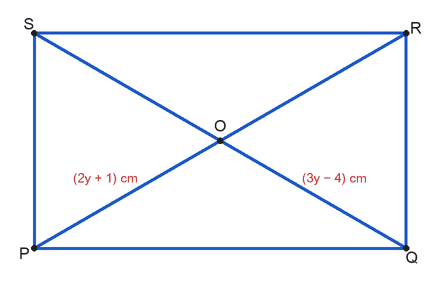
If OP cm and OQ cm, find and the length of each diagonal.
- 192 marks
Question 19
Bloom's level: Evaluate
Kabir measured the four angles of a quadrilateral as , , and . Can his measurements all be correct? Justify your answer.
- 202 marks
Question 20
Bloom's level: Apply
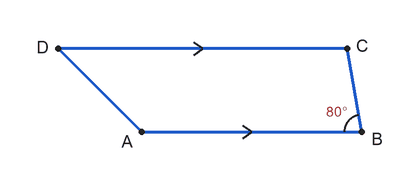
In trapezium ABCD, AB ∥ DC and ∠A is three times ∠D. Find ∠A and ∠D. If ∠B , find ∠C.
- 212 marks
Question 21
Bloom's level: Understand
What is meant by the interior and the exterior of a quadrilateral? Where does a point that lies on side AB of quadrilateral ABCD belong?
- 222 marks
Question 22
Bloom's level: Understand
Name the quadrilateral described in each case :
(i) All sides are equal and every angle is .
(ii) Exactly one pair of opposite sides is parallel.
(iii) Both pairs of opposite sides are parallel, no angle is and adjacent sides are unequal.
(iv) Every angle is and adjacent sides are unequal.
- 234 marks
Question 23
Bloom's level: Apply
In the given figure, PQRS is a rhombus whose diagonals PR and QS meet at O, and ∠PQS .
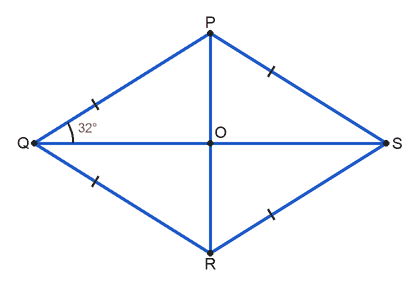
Find, giving reasons :
(i) ∠POQ
(ii) ∠PQR
(iii) ∠QPS and ∠QPO
(iv) ∠QRS
- 244 marks
Question 24
Bloom's level: Analyse
(a) The angles of a quadrilateral, taken in order, are in the ratio . Find the angles. Is the quadrilateral convex or concave? Give a reason.
(b) Rehan claims that the angles of another quadrilateral are in the ratio . Find these angles and decide what kind of quadrilateral it must be.
- 255 marks
Question 25
Bloom's level: Analyse
Case study: A park is in the shape of a parallelogram ABCD with AB m, BC m and ∠A . Two straight paths run along the diagonals AC and BD and cross at a fountain O. The path AC is m long and the path BD is m long.

(a) Find the lengths of CD and DA, and the length of fencing needed to go once around the park.
(b) Find ∠B, ∠C and ∠D.
(c) Find AO and BO. The gardener says the fountain is the same distance from gate A as from gate B. Is he right? Explain.
- 265 marks
Question 26
Bloom's level: Analyse
Case study: A carpenter makes a wooden picture frame ABCD. He measures AB DC cm and BC AD cm. To check whether the corners are right angles, he measures the diagonals and finds AC cm and BD cm.
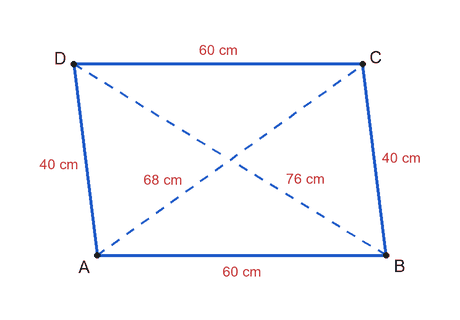
(a) Which property of a rectangle does the frame already satisfy?
(b) Is the frame a rectangle? Give a reason based on its diagonals.
(c) He adjusts the frame until both diagonals are cm long and every corner is . The diagonals now meet at O. Find OA, OB, OC and OD, and name the type of AOB according to its sides.
- 273 marks
Question 27
Bloom's level: Create
A craft teacher gives each student a 60 cm length of wire to bend into a quadrilateral, using the whole wire. Design :
(a) a square
(b) a rectangle that is not a square
(c) a rhombus that is not a square
Give the side lengths (and, where needed, the angles) of each design, and check that each uses exactly 60 cm.
- 284 marks
Question 28
Bloom's level: Create
Construct a "family chart" for the quadrilaterals of this chapter — trapezium, parallelogram, rectangle, rhombus and square — starting from "quadrilateral". On each link, write the condition that must be added to move from one figure to the next.
- 294 marks
Question 29
Bloom's level: Analyse
ABCD is a rhombus in which ∠DAB and ∠ABC .
(a) Find .
(b) Find all four angles of ABCD.
(c) What special name can be given to ABCD? Give a reason. What angle does the diagonal AC make with side AB?
- 304 marks
Question 30
Bloom's level: Analyse
The angles ∠A, ∠B, ∠C and ∠D of four quadrilaterals ABCD are given below. For each, decide which pairs of opposite sides must be parallel, and name the quadrilateral as parallelogram, trapezium or rectangle.
∠A ∠B ∠C ∠D (i) (ii) (iii) (iv) - 313 marks
Question 31
Two angles of a quadrilateral are and . The other two angles are in the ratio . Find the remaining angles.
- 321 mark
Question 32
ABCD is an isosceles trapezium in which and . If and , then is :

- 331 mark
Question 33
The diagonals and of a parallelogram meet at .

If cm, cm and cm, the perimeter of triangle is :
- 341 mark
Question 34
The diagonals and of a rectangle meet at and .
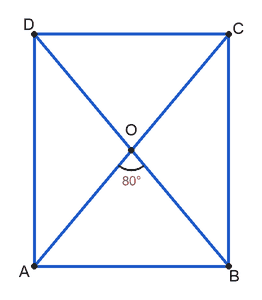
Then is :
- 352 marks
Question 35
The diagonals and of a square meet at , and cm.
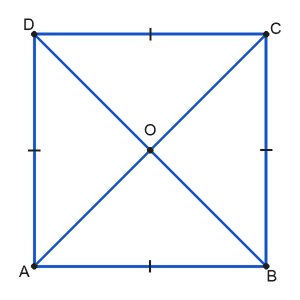
(a) Write the measure of .
(b) Find the length of , and name the kind of triangle is.
- 362 marks
Question 36
In trapezium , , and .

Find the value of and the measures of and .
- 372 marks
Question 37
In the figure, is a quadrilateral and , , , are four points.

Name the point(s) which lie (a) in the interior of , (b) in the exterior of , (c) on the quadrilateral itself.
- 382 marks
Question 38
In parallelogram , and .
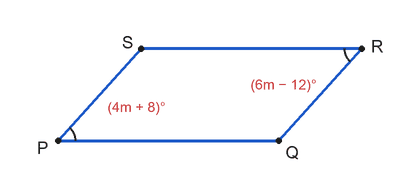
Find and the measures of all four angles of the parallelogram.
- 394 marks
Question 39
The diagonals and of a rectangle meet at .
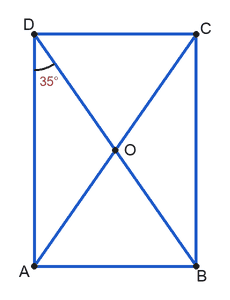
(a) If cm and cm, find and the length of .
(b) If , find .
(c) Hence find .
- 404 marks
Question 40
(a) Copy the table and write Yes or No in each empty box.
Property Parallelogram Rectangle Rhombus Square All four sides are always equal Diagonals are always equal Diagonals always cut at right angles Every angle is always Diagonals always bisect each other (b) Name the quadrilateral which has : (i) all sides equal and one angle ; (ii) opposite sides equal and parallel, adjacent sides unequal and the diagonals equal.
- 414 marks
Question 41
In rhombus , and . The diagonals and meet at .
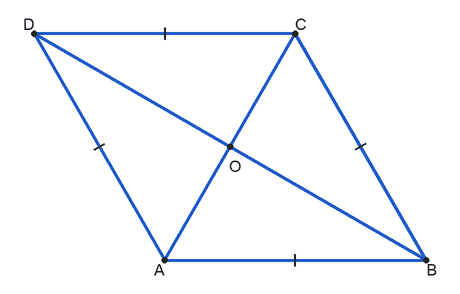
(a) Find and all four angles of the rhombus.
(b) Write and .
(c) Find from triangle , and say what it shows about the diagonals.