
Opening your dashboard
Class 6 Maths Chapter 16 Quadrilaterals: Competency-Based Questions (CBQ)
40 questions on Chapter 16, each worked through on its own page with the AI tutor. Class 6 Maths, ICSE 2026-27.
40 questions
1–5 marks · Mixed difficulty
- 11 mark
Question 1
Competency: Understanding
A kite-maker cuts a piece of paper with four straight edges. All four edges are equal in length, but its corners are not right angles.
The shape of the paper is a
- 21 mark
Question 2
Competency: Application
A surveyor measures three corners of a four-sided plot of land. The angles are , and .
The angle at the fourth corner is
- 31 mark
Question 3
Competency: Analysis
A floor tile is in the shape of a parallelogram. One of its angles is .
The four angles of the tile, taken in order, are
- 41 mark
Question 4
Competency: Application
Rani folds a square handkerchief along one of its diagonals.

The angle between the fold line and a side of the handkerchief is
- 51 mark
Question 5
Competency: Evaluation
Assertion (A): A quadrilateral can have four obtuse angles.
Reason (R): The four angles inside any quadrilateral together make exactly four right angles.
- 61 mark
Question 6
Competency: Analysis
A playground has four straight sides. Its two diagonals are equal and bisect each other, but they do not cross at right angles.
The playground is a
- 72 marks
Question 7
Competency: Application
The front of a cloth bag is a trapezium ABCD in which AB is parallel to DC. and .
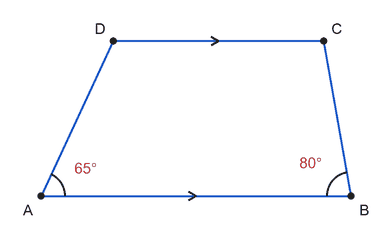
Find and . Give a reason.
- 82 marks
Question 8
Competency: Evaluation
Arun says, "The diagonals of a rhombus are equal."
Is his statement always true, sometimes true or never true? Justify your answer.
- 92 marks
Question 9
Competency: Analysis
The side view of a lampshade is an isosceles trapezium ABCD. AB is parallel to DC, and AD BC. and the diagonal AC is 34 cm long.
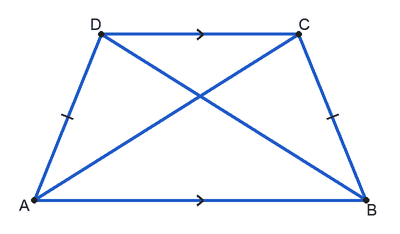
Find the other three angles of the trapezium and the length of the diagonal BD. Give reasons.
- 102 marks
Question 10
Competency: Application
A field is in the shape of a parallelogram ABCD. Its sides are AB m, DC m and BC m.
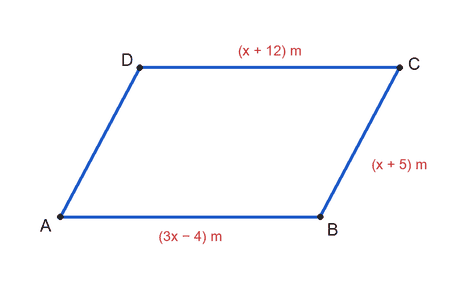
Find . Then find the length of fencing needed to go once around the field.
- 113 marks
Question 11
Competency: Analysis
A gardener makes four flower beds, each with four straight sides. He notes down what he finds on measuring them.
Bed Pairs of parallel sides All sides equal? All angles ? P two pairs no yes Q two pairs yes no R only one pair no no S two pairs yes yes (a) Name the shape of each bed.
(b) In which beds are the two diagonals equal for sure?
(c) In which beds do the diagonals cross each other at right angles?
- 123 marks
Question 12
Competency: Creativity
Make a "Who am I?" riddle card about one of these quadrilaterals: trapezium, parallelogram, rectangle, rhombus or square.
(a) Write three clues about the sides, angles or diagonals of your quadrilateral.
(b) Your clues must be chosen so that no single clue is enough to name the quadrilateral. For each clue, name another quadrilateral from the list that also fits it.
(c) Explain why all three clues together fit only your quadrilateral.
- 133 marks
Question 13
Competency: Analysis & Evaluation
A tile-maker makes rhombus-shaped tiles. One angle of each tile is . Tiles fit around a point on the floor, without a gap, only when the angles meeting at the point add up to .
(a) Find the other three angles of a tile.
(b) Three workers say how the tiles can meet at a point.
Asha: "Three tiles, each with a corner at the point."
Ben: "Five tiles, each with a corner at the point."
Chitra: "Two corners and two corners at the point."
Check each statement. Who is right?
- 145 marks
Question 14
Competency: Analysis & Evaluation
Case study — The school gate
The school gate is a rectangle ABCD. Two straight iron strips are fixed along its diagonals AC and BD. They cross at O. The strip AC is 5 m long and .
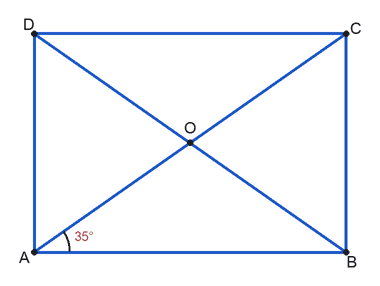
(a) Find the lengths BD, OA and OB. Give reasons.
(b) What kind of triangle is OAB according to its sides? Find and .
(c) Find and . Kavya says, "Triangle OBC is an equilateral triangle." Is she right for this gate? Justify.
- 154 marks
Question 15
Competency: Application & Analysis
Case study — The paper kite
Imran makes a paper kite in the shape of a rhombus ABCD. Each side is 30 cm long and . Two thin sticks are fixed along the diagonals AC and BD. They cross at O.
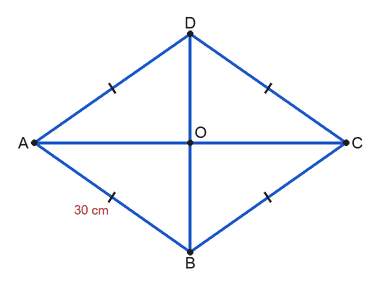
(a) A coloured tape is pasted all along the border of the kite. Find the length of the tape.
(b) Find the four angles of the kite.
(c) Find , and . Give reasons.
- 161 mark
Question 16
Competency: Understanding
A tailor has a square piece of cloth ABCD. He cuts it along both of its diagonals, AC and BD, which meet at O.
The four pieces of cloth that he gets are
- 171 mark
Question 17
Competency: Application
The side face of a wooden jewellery box is an isosceles trapezium. Its two parallel sides are 12 cm and 20 cm long, and each of its two slanting sides is 5 cm long. (Hypothetical data.)
A strip of gold paper is stuck along the whole boundary of this face. The length of the strip is
- 181 mark
Question 18
Competency: Analysis
Four wooden strips are joined by hinges at their ends to make a rectangular frame ABCD, with AB = DC and AD = BC. Rohan pushes the top edge DC sideways, so the frame leans over and no corner is a right angle any more. The lengths of the strips do not change.
Which property of the frame is lost when it leans over?
- 191 mark
Question 19
Competency: Analysis
A shop sells quadrilateral frames W, X, Y and Z. A worker measures the diagonals of each frame and records what he finds. (Hypothetical data.)
Frame Diagonals bisect each other? Diagonals are equal? Diagonals cross at right angles? W Yes No No X Yes Yes No Y Yes No Yes Z Yes Yes Yes A customer wants a frame that is a rhombus but not a square. She should buy frame
- 201 mark
Question 20
Competency: Evaluation
Assertion (A): The two diagonals of an isosceles trapezium are equal.
Reason (R): The two diagonals of a parallelogram bisect each other.
- 211 mark
Question 21
Competency: Evaluation
Assertion (A): A quadrilateral whose four angles are all equal must be a square.
Reason (R): The four angles of a quadrilateral add up to , so four equal angles are each.
- 221 mark
Question 22
Competency: Application
The slanting bars of a sliding iron gate form parallelograms. In one of these parallelograms, two neighbouring angles are in the ratio .
The smaller of these two angles is
- 231 mark
Question 23
Competency: Analysis
In the rhombus ABCD, the diagonal BD is exactly as long as each side of the rhombus, as shown in the figure.
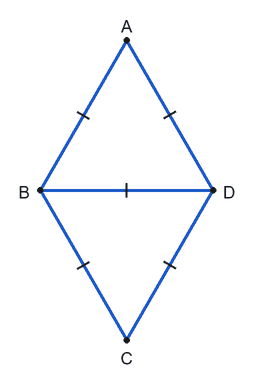
The measure of is
- 241 mark
Question 24
Competency: Analysis
Look at these four statements about a rhombus.
Statement 1: All four sides are equal.
Statement 2: The two diagonals are equal.
Statement 3: The two diagonals cross each other at right angles.
Statement 4: Opposite angles are equal.
How many of these statements are true for every rhombus?
- 251 mark
Question 25
Competency: Application
Four pegs are fixed at the corners of a plot of land shaped like a convex quadrilateral, so each of its four angles is less than . A rope is stretched between every two of the four pegs, so there are 6 ropes in all.
How many of these ropes pass through the interior of the plot?
- 262 marks
Question 26
Competency: Evaluation
Meera says, "In a trapezium ABCD with AB parallel to DC, if , then AD is at right angles to both AB and DC."
Is Meera right? Give a reason.
- 272 marks
Question 27
Competency: Application
A brass strip 84 cm long goes exactly once round the edge of a name plate ABCD, which is shaped like a parallelogram. The sides of the plate are in the ratio . (Hypothetical data.)
Find the lengths of all four sides of the name plate.
- 282 marks
Question 28
Competency: Analysis
Four lists give the lengths, in cm, of the sides AB, BC, CD and DA, taken in this order, of four quadrilaterals.
List AB BC CD DA (i) 8 5 8 5 (ii) 9 9 6 6 (iii) 7 7 7 7 (iv) 10 6 10 7 Which lists can be the sides of a parallelogram? Which of them can be the sides of a rhombus? Give reasons.
- 292 marks
Question 29
Competency: Application & Analysis
A rhombus-shaped wire frame ABCD has each side 15 cm long and . Anil presses it gently until becomes . He does not change any of the four wire strips.
(a) Name the new shape. Give a reason.
(b) Find the perimeter of the frame before and after the pressing.
- 302 marks
Question 30
Competency: Analysis
ABCD is a rectangle, and its diagonals AC and BD meet at O. They cut the rectangle into four triangles AOB, BOC, COD and DOA.
(a) Name the pairs of these triangles that always have equal perimeters.
(b) When will all four triangles have equal perimeters? Give a reason.
- 312 marks
Question 31
Competency: Application
Two identical triangular pieces of card, each with sides 5 cm, 7 cm and 9 cm, are joined along their 9 cm edges, with no gap or overlap, to make a four-sided shape. The second piece is the first piece turned round half a turn, so the two 5 cm sides are opposite to each other. (Hypothetical data.)
(a) Name the four-sided shape.
(b) Find its perimeter.
- 323 marks
Question 32
Competency: Analysis & Application
ABCD is a rectangle whose diagonals AC and BD meet at O, as shown. The triangle AOB is equilateral and cm. (Hypothetical data.)

Find (a) AB, (b) , (c) .
- 333 marks
Question 33
Competency: Evaluation
A carpenter makes hinged frames from wooden strips. He has three plans. (Hypothetical data.)
Plan P: four strips, each 30 cm long.
Plan Q: two strips of 40 cm and two strips of 25 cm, with the equal strips opposite each other.
Plan R: two strips of 40 cm and two strips of 25 cm, with the two 40 cm strips next to each other.
(a) For each plan, say which of the shapes parallelogram, rectangle, rhombus and square the frame can be made into by changing its angles.
(b) A customer wants a frame whose two diagonals are equal and which is not a square. Which plan should he use? What must the carpenter check?
- 343 marks
Question 34
Competency: Creativity
Make up an "odd one out" puzzle using four quadrilaterals chosen from these: trapezium, isosceles trapezium, parallelogram, rectangle, rhombus and square.
(a) Name your four shapes.
(b) State one property of the diagonals that three of the shapes have and the odd one out does not.
(c) Explain why the three shapes have this property and why the odd one out does not.
- 353 marks
Question 35
Competency: Analysis
For a treasure hunt, Sana cuts an arrowhead ABCD out of card, as shown in the figure. Its corner C points inwards, towards A. She measures , and , each measured inside the card. (Hypothetical data.)

(a) Find the angle of the arrowhead at C, measured inside the card.
(b) Is ABCD a convex or a concave quadrilateral? Give a reason.
(c) Sana joins A to C and B to D with straight pencil lines. Which of these two diagonals lies in the interior of the card, and which lies in the exterior?
- 363 marks
Question 36
Competency: Analysis
A straight water pipe PQ is laid across a plot ABCD. The points P and Q are outside the plot, and M and N are two points on the pipe, as shown.
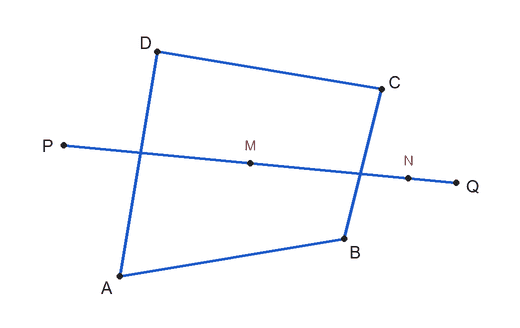
(a) Name the two sides of the plot that the pipe crosses.
(b) Say whether each of the points P, M, N and Q is in the interior or in the exterior of the plot.
(c) The pipe meets the side DA at a point X. Is X in the interior, in the exterior, or on the quadrilateral? Give a reason.
- 374 marks
Question 37
Competency: Application & Analysis
Case study — The folding gate
The caretaker of a school has a folding iron gate at the cycle stand. Its frame ABCD is a parallelogram with cm and cm. When the gate is pushed open or shut, the angle at A changes but the lengths of the strips do not change. The table shows in four positions of the gate. (Hypothetical data.)
Position 1 2 3 4 (a) In position 3, find , and .
(b) Complete the row for in the table.
(c) In which position is the frame a rectangle? What do you know about its diagonals? Can the frame ever become a rhombus? Give a reason.
- 384 marks
Question 38
Competency: Analysis & Application
Case study — The corner plot
A surveyor has been asked by the village panchayat to find the corner angles of a four-sided plot ABCD. He cannot measure the corners directly, so he marks the straight line AC across the plot, which divides it into two triangular parts, and measures the angles next to this line. (Hypothetical data.)
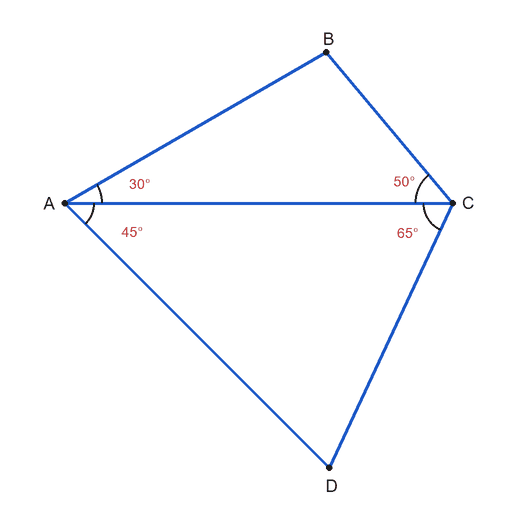
He finds , , and .
(a) Find and .
(b) Find and . Add up the four angles of ABCD.
(c) Is ABCD a parallelogram? Give a reason.
- 395 marks
Question 39
Competency: Analysis & Evaluation
Case study — Marking the room
A mason marks a rectangular room on the ground with four pegs A, B, C and D joined by string. To check that ABCD is truly a rectangle, he knows three tests.
Test 1: opposite sides are equal, and .
Test 2: the two diagonals AC and BD are equal.
Test 3: the two diagonals bisect each other.
(a) For each test, name a quadrilateral that passes that test but is not a rectangle.
(b) Which pairs of tests, used together, make sure that the shape is a rectangle?
(c) Explain why a pair that you did not choose in (b) is not enough.
- 405 marks
Question 40
Competency: Analysis & Evaluation
Case study — Tiles from the factory
A tile factory makes four kinds of four-sided tiles, T1, T2, T3 and T4. At the end of the day the checker measures the sides AB, BC, CD and DA, and the diagonals AC and BD of one tile of each kind, and writes the lengths in cm. (Hypothetical data.)
Tile AB BC CD DA AC BD T1 15 15 15 15 21.2 21.2 T2 20 12 20 12 23.3 23.3 T3 14 14 14 14 14 24.2 T4 20 12 20 12 19.5 26.6 (a) Name the shape of each tile as exactly as you can.
(b) A customer orders rectangular tiles that are not squares. Which tile should be sent?
(c) A worker says that T4 is a rectangle because its opposite sides are equal. Use the table to explain why he is wrong.