
Opening your dashboard
Class 6 Maths Chapter 15: Triangles Solutions
23 textbook questions with step-by-step answers, free to read, for ICSE 2026-27.
Get talked through Ch 15, not just shown the answer
Reading a finished solution is not the same as being able to do it. The AI tutor takes one question at a time and works it with you, in your own words, until you can.
- Ask it out loud, in your own words
- It gives you the next step, not the answer
- Stuck on part (ii)? Start there
23 questions with solutions
1–3 marks · Easy difficulty
- 13 marks
Question 1
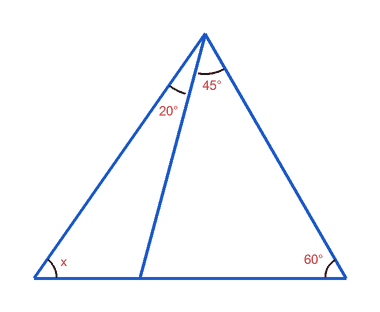
In each of the following, find the marked unknown angles :
(i)

(ii)

(iii)
 Solve with AI
Written solution
Solution:
Concept: The three angles of every triangle add up to 180° (the angle sum property of a triangle).
Step 1 — Part (i).
The three angles of the triangle are 70°, 72° and . We subtract the two known angles from 180°.
Step 2 — Part (ii): the upper triangle.
The diagonal splits the quadrilateral into two triangles. The upper triangle has the angles 50°, 80° and .
Step 3 — Part (ii): the lower triangle.
The lower triangle has the angles 40°, 45° and .
Step 4 — Part (iii): the top angle.
The line from the top vertex splits the angle there into 20° and 45°. So the whole angle at the top of the big triangle is their sum.
Step 5 — Part (iii): find x.
The big triangle has the angles , 60° and 65°.
Watch out: In part (iii) use the whole top angle, 20° + 45° = 65°, not just one of its two parts.
Therefore, (i) z = 38°; (ii) a = 95° and b = 50°; (iii) x = 55°.
- 23 marks
Question 2
Can a triangle have the following angles ?
(i) 55°, 55° and 80° (ii) 33°, 74° and 73° (iii) 85°, 95° and 22°
A triangle can have the given angles if the sum of these angles is 180°.
Solve with AIWritten solution
Solution:
Concept: The three angles of every triangle add up to 180° (the angle sum property of a triangle).
Step 1 — Part (i).
We add the three angles and compare the sum with 180°.
The sum is 190°, not 180°, so no triangle can have these angles.
Step 2 — Part (ii).
We add the three angles and compare the sum with 180°.
The sum is exactly 180°, so a triangle can have these angles.
Step 3 — Part (iii).
We add the three angles and compare the sum with 180°.
The sum is 202°, not 180°, so no triangle can have these angles.
Watch out: The sum must be exactly 180°; a sum that is a little more or less is not enough.
Therefore, (i) No (the sum is 190°); (ii) Yes (the sum is 180°); (iii) No (the sum is 202°).
- 33 marks
Question 3
Find x, if the angles of a triangle are :
(i) x°, x°, x° (ii) x°, 2x°, 2x° (iii) 2x°, 4x°, 6x°
Solve with AIWritten solution
Solution:
Concept: The three angles of every triangle add up to 180° (the angle sum property of a triangle). We collect the like terms and then divide.
Step 1 — Part (i).
The three angles , and add up to 180°.
Step 2 — Part (ii).
The three angles , and add up to 180°.
Step 3 — Part (iii).
The three angles , and add up to 180°.
Watch out: Add all the coefficients first (for example 2 + 4 + 6 = 12) before dividing 180 by them.
Therefore, (i) x = 60; (ii) x = 36; (iii) x = 15.
- 43 marks
Question 4
One angle of a right-angled triangle is 70°. Find the other acute angle.
Solve with AIWritten solution
Solution:
Concept: The three angles of every triangle add up to 180° (the angle sum property of a triangle). In a right-angled triangle the two acute angles add up to 90°.
Step 1 — Name the angles.
A right-angled triangle has one angle of 90°. The given 70° is one of the other two angles.
Step 2 — Use the angle sum.
We subtract the two known angles from 180°.
It is less than 90°, so it is the other acute angle.
Watch out: Subtract the right angle too; 180° − 70° = 110° is not the answer.
Therefore, the other acute angle is 20°.
- 53 marks
Question 5
In Δ ABC, ∠A = ∠B = 62°; find ∠C.
Solve with AIWritten solution
Solution:
Concept: The three angles of every triangle add up to 180° (the angle sum property of a triangle).
Given: In triangle ABC, ∠A and ∠B are both 62°.
Step 1 — Use the angle sum.
The angle C is what is left of 180° after ∠A and ∠B, which are 62° each.
Watch out: Both ∠A and ∠B are 62°, so subtract 62° twice.
Therefore, ∠C = 56°.
- 63 marks
Question 6
In Δ ABC, ∠B = ∠C and ∠A = 100°; find ∠B.
Solve with AIWritten solution
Solution:
Concept: The three angles of every triangle add up to 180° (the angle sum property of a triangle).
Given: In triangle ABC, ∠B = ∠C and ∠A = 100°.
Step 1 — Find ∠B + ∠C.
The three angles add up to 180°, and ∠A = 100°.
Step 2 — Share it equally.
The angles B and C are equal, so each is half of 80°.
Watch out: 80° is the sum of ∠B and ∠C; each of them is half of it.
Therefore, ∠B = 40°.
- 73 marks
Question 7
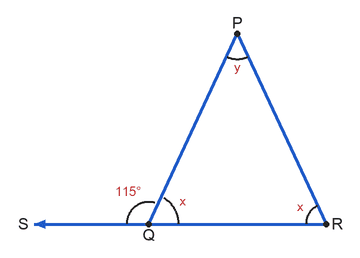
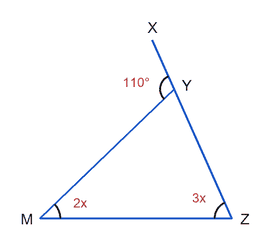
Find, giving reasons, the unknown marked angles in each triangle drawn below :
(i)

(ii)
(iii)
 Solve with AI
Written solution
Solution:
Concept: When one side of a triangle is produced, the angle formed outside the triangle is an exterior angle. It equals the sum of the two interior opposite angles (the angles at the other two vertices). The exterior angle and the interior angle next to it lie on a straight line, so together they make 180° (a linear pair). The three angles of every triangle add up to 180° (the angle sum property of a triangle).
Step 1 — Part (i).
BC is produced to D, so ∠ACD = 110° is an exterior angle of triangle ABC. It equals the sum of the interior opposite angles, at A and 30° at B.
Step 2 — Part (ii): find x.
S, Q and R lie on one straight line, so the 115° angle and at Q form a linear pair.
Step 3 — Part (ii): find y.
The angles at Q and R are both marked , so each is 65°. Now we use the angle sum of triangle PQR.
Step 4 — Part (iii).
ZY is produced to X, so ∠XYM = 110° is an exterior angle of triangle MYZ. It equals the sum of the interior opposite angles, at M and at Z.
Step 5 — Part (iii): the two angles.
We put into each marked angle.
Watch out: An exterior angle equals the sum of the two FAR interior angles, not of all three, and not of the angle next to it.
Check: In part (iii) the interior angle at Y makes a linear pair with 110°, so it is 70°. The three angles of triangle MYZ then add up to 180°:
Therefore, (i) x = 80°; (ii) x = 65° and y = 50°; (iii) x = 22°, so 2x = 44° and 3x = 66°.
- 83 marks
Question 8
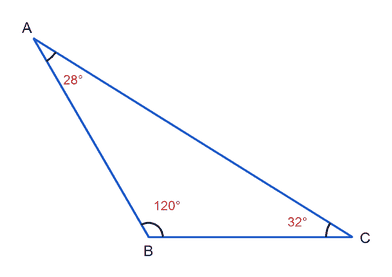
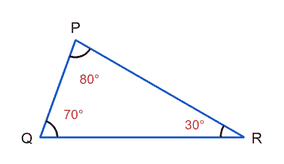
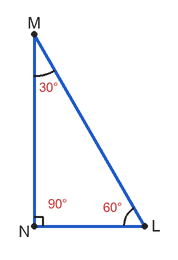
Classify the following triangles according to the measures of their angles :
(i)
(ii)
(iii)
 Solve with AI
Written solution
Solution:
Concept: By its angles, a triangle is acute-angled if all three angles are less than 90°, right-angled if one angle is exactly 90°, and obtuse-angled if one angle is more than 90°.
Step 1 — Part (i).
The angles are 28°, 120° and 32°. Here ∠B = 120° is more than 90°, so the triangle is obtuse-angled.
Step 2 — Part (ii).
The angles are 80°, 70° and 30°. Here all three angles are less than 90°, so the triangle is acute-angled.
Step 3 — Part (iii).
The angles are 30°, 90° and 60°. Here ∠N = 90° (marked with a square), so the triangle is right-angled.
Watch out: One obtuse angle is enough to make a triangle obtuse-angled; a triangle can never have two.
Therefore, (i) obtuse-angled triangle; (ii) acute-angled triangle; (iii) right-angled triangle.
- 93 marks
Question 9
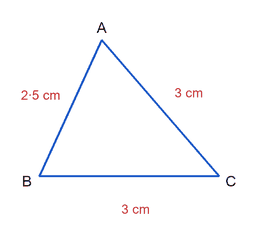
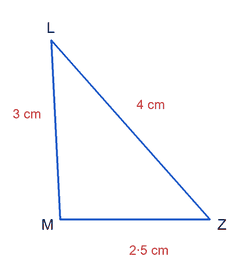
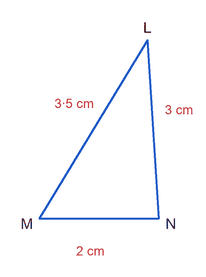
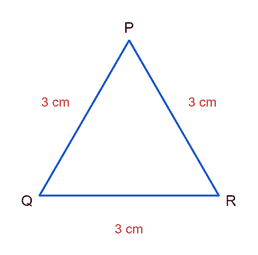
Classify the following triangles according to the lengths of their sides :
(i)
(ii)
(iii)
(iv)
 Solve with AI
Written solution
Solution:
Concept: By its sides, a triangle is equilateral if all three sides are equal, isosceles if (at least) two sides are equal, and scalene if no two sides are equal.
Step 1 — Part (i).
The sides are 2.5 cm, 3 cm and 3 cm. Here two sides are equal, so the triangle is isosceles.
Step 2 — Part (ii).
The sides are 3 cm, 2.5 cm and 4 cm. Here no two sides are equal, so the triangle is scalene.
Step 3 — Part (iii).
The sides are 3.5 cm, 2 cm and 3 cm. Here no two sides are equal, so the triangle is scalene.
Step 4 — Part (iv).
The sides are 3 cm, 3 cm and 3 cm. Here all three sides are equal, so the triangle is equilateral.
Watch out: Compare the lengths written on the sides, not how the sides look in the drawing.
Therefore, (i) isosceles triangle; (ii) scalene triangle; (iii) scalene triangle; (iv) equilateral triangle.
- 101 mark
Question 10
Exterior angle of a triangle is equal to :
Solve with AIAnswer
(A) sum of the two opposite adjacent angles
(B) sum of the two interior opposite angles
(C) adjacent interior angle
- Correct
(D) both (A) and (B)
Answer: (D) both (A) and (B)
Concept: When one side of a triangle is produced, the angle formed outside the triangle is an exterior angle. It equals the sum of the two interior opposite angles (the angles at the other two vertices). The exterior angle and the interior angle next to it lie on a straight line, so together they make 180° (a linear pair).
Step 1 — State the property.
Produce side BC of triangle ABC to D. The exterior angle ∠ACD equals the sum of the two interior opposite angles, ∠A and ∠B.
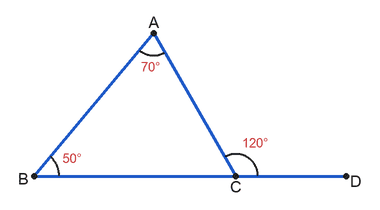
Step 2 — Read options (A) and (B).
Option (B) states this property in words. Option (A) also speaks of the two opposite angles, the same ∠A and ∠B, so as the question intends it says the same thing as (B).
Step 3 — Choose the option.
Both (A) and (B) describe the exterior angle correctly, so the answer is (D).
Watch out: The interior angle NEXT to the exterior angle is not part of the sum; it makes 180° with the exterior angle.
Note: Read word for word, “opposite adjacent angles” contradicts itself, because the only interior angle adjacent to ∠ACD is ∠ACB, and ∠ACD + ∠ACB = 180°. On that strict reading only (B) is correct; the answer (D) reads (A) as the two opposite angles, as the question intends.
Why the other options are wrong:
- (A): Option (A), as intended, is correct, but it is only one of the two correct statements; (D) names both.
- (B): Option (B) is correct, but (A) says the same thing, so the option that names both, (D), is the full answer.
- (C): The adjacent interior angle and the exterior angle together make 180°; they are equal only when each is 90°.
Therefore, the exterior angle equals the sum of the two interior opposite angles, option (D).
- 111 mark
Question 11
In a right angled triangle, the other two angles are always :
Solve with AIAnswer
(A) obtuse angles
(B) equal acute angles
- Correct
(C) acute angles
(D) Both (B) and (C)
Answer: (C) acute angles
Concept: The three angles of every triangle add up to 180° (the angle sum property of a triangle). An acute angle is less than 90°; an obtuse angle is more than 90°.
Step 1 — Find the sum of the other two angles.
One angle is 90°, so the other two share what is left of 180°.
Step 2 — Decide their type.
Each of the two angles is more than 0° and together they make 90°, so each is less than 90°. Both are acute. They need not be equal: 30° and 60° also add up to 90°.
Watch out: The word “always” means in every right-angled triangle, so one example with unequal angles rules out “equal”.
Why the other options are wrong:
- (A) obtuse angles: An obtuse angle alone is more than 90°, but the two angles together make only 90°.
- (B) equal acute angles: They are equal (45° each) only in a right isosceles triangle; in a 30°–60°–90° triangle they differ.
- (D) Both (B) and (C): This needs (B) to be always true as well, and it is not.
Therefore, the other two angles are always acute, option (C).
- 121 mark
Question 12
The angles of a triangle are in the ratio 2 : 3 : 4. The largest angle is :
Solve with AIAnswer
(A) 40°
(B) 60°
- Correct
(C) 80°
(D) 180°
Answer: (C) 80°
Concept: The three angles of every triangle add up to 180° (the angle sum property of a triangle). Angles in a ratio are written as the ratio numbers times a common multiplier.
Step 1 — Write the angles.
In the ratio 2 : 3 : 4 the angles are , and , and they add up to 180°.
Step 2 — Find the largest angle.
The largest angle goes with the largest ratio number, 4.
Watch out: X = 20° is only the multiplier; the largest angle is 4x.
Why the other options are wrong:
- (A) 40°: 40° is 2x, the smallest angle.
- (B) 60°: 60° is 3x, the middle angle.
- (D) 180°: 180° is the sum of all three angles, not one of them.
Therefore, the largest angle is 80°, option (C).
- 131 mark
Question 13
The angles of a triangle are 50°, 70° and x°. The value of x is :
Solve with AIAnswer
- Correct
(A) 60°
(B) 120°
(C) 100°
(D) 50°
Answer: (A) 60°
Concept: The three angles of every triangle add up to 180° (the angle sum property of a triangle).
Step 1 — Use the angle sum.
The unknown angle is what is left of 180° after 50° and 70°.
Why the other options are wrong:
- (B) 120°: 120° is 50° + 70°; with it the three angles would add up to 240°.
- (C) 100°: With 100° the three angles would add up to 220°, not 180°.
- (D) 50°: With 50° the three angles would add up to 170°, not 180°.
Therefore, x = 60, option (A).
- 141 mark
Question 14
The value of x is :
 Solve with AI
Answer
(A) 70°
- Correct
(B) 55°
(C) 35°
(D) 40°
Answer: (B) 55°
Concept: When one side of a triangle is produced, the angle formed outside the triangle is an exterior angle. It equals the sum of the two interior opposite angles (the angles at the other two vertices). The exterior angle and the interior angle next to it lie on a straight line, so together they make 180° (a linear pair).
Step 1 — Use the exterior angle.
BC is produced to D, so the 110° at C is an exterior angle of triangle ABC. It equals the sum of the interior opposite angles, which are both marked .
Watch out: The angle x is at A and at B; the 70° inside the triangle at C is not x.
Note: Choosing 35° is a slip: two angles of 35° add up to only 70°, not to the 110° shown.
Why the other options are wrong:
- (A) 70°: 70° is ∠ACB, the interior angle next to the 110°; with x = 70° the exterior angle would be 140°.
- (C) 35°: Two angles of 35° add up to only 70°, not to the 110° shown.
- (D) 40°: Two angles of 40° add up to only 80°, not to the 110° shown.
Therefore, x = 55°, option (B).
- 151 mark
Question 15
On extending each side of a triangle, on both the sides the number of exterior angles formed is :
Solve with AIAnswer
(A) 3
- Correct
(B) 6
(C) 4
(D) 9
Answer: (B) 6
Concept: When one side of a triangle is produced, the angle formed outside the triangle is an exterior angle. It equals the sum of the two interior opposite angles (the angles at the other two vertices). The exterior angle and the interior angle next to it lie on a straight line, so together they make 180° (a linear pair).
Step 1 — Count at one vertex.
At each vertex two sides meet. Producing each of them beyond the vertex gives one exterior angle, so each vertex has 2 exterior angles.
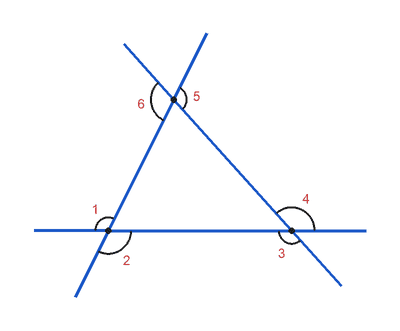
Step 2 — Count for the triangle.
The triangle has 3 vertices.
Watch out: Producing a side at BOTH ends gives a second exterior angle at every vertex.
Why the other options are wrong:
- (A) 3: 3 is the count when each side is produced in one direction only (one exterior angle at each vertex).
- (C) 4: 4 does not fit: there are 2 exterior angles at each of the 3 vertices.
- (D) 9: 9 would need 3 exterior angles at each vertex, but only the 2 sides meeting there can be produced.
Therefore, 6 exterior angles are formed, option (B).
- 161 mark
Question 16
The value of x is :
 Solve with AI
Answer
- Correct
(A) 30°
(B) 45°
(C) 60°
(D) none of these
Answer: (A) 30°
Concept: The three angles of every triangle add up to 180° (the angle sum property of a triangle).
Step 1 — Use the angle sum.
The angles of triangle ABC are at A, 60° at B and at C.
Watch out: Collect 3x and x into 4x, and move the 60° across before dividing.
Why the other options are wrong:
- (B) 45°: With x = 45° the angles would be 135°, 60° and 45°, which add up to 240°.
- (C) 60°: With x = 60° the angles would be 180°, 60° and 60°, which add up to 300°.
- (D) none of these: The correct value, 30°, is one of the options.
Therefore, x = 30°, option (A).
- 171 mark
Question 17
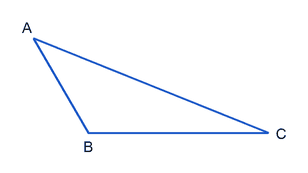
The given triangle is :
 Solve with AI
Answer
(A) acute angled triangle
(B) right angled triangle
- Correct
(C) obtuse angled triangle
(D) isosceles triangle
Answer: (C) obtuse angled triangle
Concept: By its angles, a triangle is acute-angled if all three angles are less than 90°, right-angled if one angle is exactly 90°, and obtuse-angled if one angle is more than 90°.
Step 1 — Look at the largest angle.
The angle at B opens wider than a right angle, so it is more than 90°: it is obtuse.
Step 2 — Classify.
A triangle with one obtuse angle is obtuse-angled.
Watch out: An obtuse-angled triangle has exactly one obtuse angle; the other two are acute.
Why the other options are wrong:
- (A) acute angled triangle: An acute-angled triangle needs all three angles less than 90°, but ∠B is more than 90°.
- (B) right angled triangle: No angle is marked as a right angle, and ∠B is wider than 90°.
- (D) isosceles triangle: No two sides are marked equal, so the figure does not show an isosceles triangle.
Therefore, the triangle is obtuse-angled, option (C).
- 181 mark
Question 18
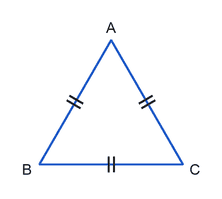
The measure of angle BAC is :
 Solve with AI
Answer
(A) 120°
- Correct
(B) 60°
(C) 45°
(D) 75°
Answer: (B) 60°
Concept: The three angles of every triangle add up to 180° (the angle sum property of a triangle). Sides with the same mark are equal; in an equilateral triangle all angles are equal.
Step 1 — Read the marks.
All three sides carry the same mark, so they are equal and the triangle is equilateral.
Step 2 — Find each angle.
The three angles of an equilateral triangle are equal and add up to 180°.
Why the other options are wrong:
- (A) 120°: 120° is the exterior angle of an equilateral triangle (180° − 60°), not ∠BAC.
- (C) 45°: Three equal angles of 45° would add up to only 135°.
- (D) 75°: Three equal angles of 75° would add up to 225°.
Therefore, ∠BAC = 60°, option (B).
- 191 mark
Question 19
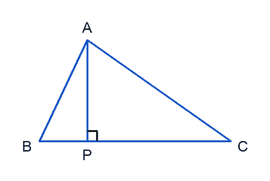
In the given figure, AP is :
 Solve with AI
Answer
(A) median
(B) bisector of angle BAC
(C) bisector of side BC
- Correct
(D) altitude
Answer: (D) altitude
Concept: An altitude of a triangle is the perpendicular from a vertex to the opposite side. A median joins a vertex to the mid-point of the opposite side.
Step 1 — Read the figure.
The small square at P shows that AP is perpendicular to BC.
Step 2 — Name the line.
A line from a vertex perpendicular to the opposite side is an altitude, so AP is an altitude.
Why the other options are wrong:
- (A) median: A median ends at the mid-point of BC, but BP and PC are not marked equal (P is nearer B).
- (B) bisector of angle BAC: ∠BAP and ∠PAC are not marked equal, and in the figure ∠PAC is much wider.
- (C) bisector of side BC: A bisector of BC would cut it into two equal parts, but P is not shown as its mid-point.
Therefore, AP is an altitude, option (D).
- 201 mark
Question 20
Statement 1 : In the given figure, P is mid-point of side BC, then AP is a median of triangle ABC.

Statement 2 : Every triangle has three sides so three medians. For this reason, BQ and CR are also medians of ΔABC.
Which of the following options is correct?
Solve with AIAnswer
- Correct
(A) Both the statements are true.
(B) Both the statements are false.
(C) Statement 1 is true, and statement 2 is false.
(D) Statement 1 is false, and statement 2 is true.
Answer: (A) Both the statements are true.
Concept: A median of a triangle joins a vertex to the mid-point of the opposite side. Every triangle has three medians.
Step 1 — Judge statement 1.
P is the mid-point of BC (the two marks show BP = PC), and AP joins vertex A to it. So AP is a median, and statement 1 is true.
Step 2 — Judge statement 2.
A triangle has one median from each of its three vertices. Taking Q and R as the mid-points of CA and AB, BQ and CR are the other two medians, so statement 2 is true.
Note: The figure does not show Q and R. Statement 2 is true when Q and R are the mid-points of CA and AB, as it intends; for any other points on those sides, BQ and CR would not be medians.
Why the other options are wrong:
- (B): Statement 1 is true: AP joins A to the mid-point P of the opposite side.
- (C): Statement 2 is true as well: there is a median from each of the three vertices.
- (D): Statement 1 is true, not false.
Therefore, both the statements are true, option (A).
- 211 mark
Question 21
Statement 1 : In the given figure, AP is altitude corresponding to side BC and CR is altitude corresponding to side AB then BQ is altitude corresponding to side AC.
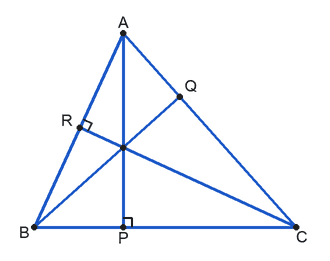
Statement 2 : Altitude of a triangle intersect each other at the same point.
Which of the following options is correct?
Solve with AIAnswer
- Correct
(A) Both the statements are true.
(B) Both the statements are false.
(C) Statement 1 is true, and statement 2 is false.
(D) Statement 1 is false, and statement 2 is true.
Answer: (A) Both the statements are true.
Concept: An altitude of a triangle is the perpendicular from a vertex to the opposite side. The three altitudes of a triangle meet at one point.
Step 1 — Judge statement 2.
The three altitudes of every triangle pass through one point, so statement 2 is true.
Step 2 — Judge statement 1.
AP and CR are altitudes, and BQ passes through the point where they meet. By statement 2 the third altitude, from B, must pass through that point too, so BQ is the altitude on side AC. Statement 1 is true.
Why the other options are wrong:
- (B): Statement 2 is a true property: the three altitudes of every triangle meet at one point.
- (C): Statement 2 is true, not false.
- (D): Statement 1 is true: BQ goes through the meeting point of the other two altitudes.
Therefore, both the statements are true, option (A).
- 221 mark
Question 22
Choose your answer based on the codes given below :
(1) A is true, R is false. (2) A is false, R is true. (3) Both A and R are true. (4) Both A and R are false.
Assertion (A) : As shown in the given figure, sides AB, BC and CA are extended to get the exterior angles x, y and z then ∠x + ∠y + ∠z = 360°
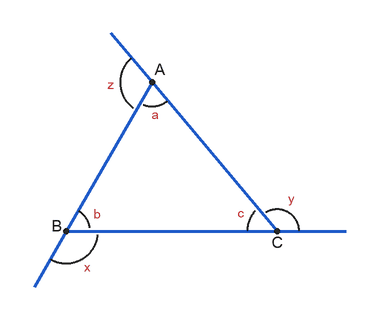
Reason (R) : ∠x + ∠y + ∠z = (a + c) + (a + b) + (b + c) = 2(a + b + c) = 2 × 180°
Solve with AIAnswer
(A) (1) A is true, R is false.
(B) (2) A is false, R is true.
- Correct
(C) (3) Both A and R are true.
(D) (4) Both A and R are false.
Answer: (C) (3) Both A and R are true.
Concept: In an Assertion–Reason item we judge A and R separately and then choose the code that matches both verdicts. When one side of a triangle is produced, the angle formed outside the triangle is an exterior angle. It equals the sum of the two interior opposite angles (the angles at the other two vertices). The exterior angle and the interior angle next to it lie on a straight line, so together they make 180° (a linear pair). The three angles of every triangle add up to 180° (the angle sum property of a triangle).
Step 1 — Judge the Reason.
Each exterior angle equals the sum of its two interior opposite angles: at B equals , at C equals , and at A equals . Adding them, and using :
Every line of R is correct, so R is true.
Step 2 — Judge the Assertion.
R shows that the three exterior angles add up to 360°, so A is true.
Step 3 — Choose the code.
A is true and R is true. This matches code (3).
Why the other options are wrong:
- (A): Code (1) says R is false, but each bracket in R is an exterior angle written as the sum of its two interior opposite angles.
- (B): Code (2) says A is false, but the working in R proves that x + y + z = 360°.
- (D): Code (4) says both are false, but both are true.
Therefore, both A and R are true, option (C).
- 231 mark
Question 23
Choose your answer based on the codes given below :
(1) A is true, R is false. (2) A is false, R is true. (3) Both A and R are true. (4) Both A and R are false.
Assertion (A) : Every isosceles triangle is eqilateral but every equilateral triangle is not necessarity isosceles.
Reason (R) : A triangle with atleast two sides equal is an isosceles triangle.
Solve with AIAnswer
(A) (1) A is true, R is false.
- Correct
(B) (2) A is false, R is true.
(C) (3) Both A and R are true.
(D) (4) Both A and R are false.
Answer: (B) (2) A is false, R is true.
Concept: In an Assertion–Reason item we judge A and R separately and then choose the code that matches both verdicts. By its sides, a triangle is equilateral if all three sides are equal, isosceles if (at least) two sides are equal, and scalene if no two sides are equal.
Step 1 — Judge the Reason.
R is the definition of an isosceles triangle, so R is true.
Step 2 — Judge the Assertion.
By R, an equilateral triangle (three equal sides) certainly has two equal sides, so every equilateral triangle IS isosceles. Also, a triangle with sides 5 cm, 5 cm and 3 cm is isosceles but not equilateral. Both parts of A are false, so A is false.
Step 3 — Choose the code.
A is false and R is true. This matches code (2).
Watch out: A turns the true statement round: every equilateral triangle is isosceles, not the other way.
Note: Choosing code (3) is a slip: by the Reason's own definition every equilateral triangle is isosceles, which is the opposite of what A says.
Why the other options are wrong:
- (A): Code (1) has the verdicts the other way round: A is false and R is true.
- (C): Code (3) says A is true, but a triangle with sides 5 cm, 5 cm and 3 cm is isosceles and not equilateral.
- (D): Code (4) says R is false, but R is the definition of an isosceles triangle.
Therefore, A is false and R is true, option (B).
What Class 6 Maths Ch 15 covers
The sections of the chapter, in the order the book takes them. Every question above comes from one of these.
- 01Triangle
- 02Vertex
- 03Angles (Interior Angles) of a Triangle
- 04Exterior Angle of a Triangle
- 05Types of Triangles According to Angles
- 06Types of Triangles According to Sides
- 07Altitude and Median of a Triangle
More ways to study this chapter
The same chapter asked three other ways. Practise it, revise it, and see what the board has set on Ch 15 before.
Class 6 Maths Ch 15 questions students ask
How many questions are there in Class 6 Maths Ch 15?
23 questions. Every one is solved step by step on this page.
Are these Class 6 Maths solutions free?
Yes. Every question and its full working is free to read, with no account needed.
Can I download the Class 6 Maths Ch 15 solutions as a PDF?
There is no PDF to download. Every solution is on this page instead, which means it is searchable, always the current syllabus, and readable on a phone. Use your browser's print option if you want it on paper.