
Question 101 markMCQEasy
Exterior angle of a triangle is equal to :
Confirming your payment
Sign up now and get 250 free tokens.
Triangles · Question 10 of 23
Exterior angle of a triangle is equal to :
(A) sum of the two opposite adjacent angles
(B) sum of the two interior opposite angles
(C) adjacent interior angle
(D) both (A) and (B)
Answer: (D) both (A) and (B)
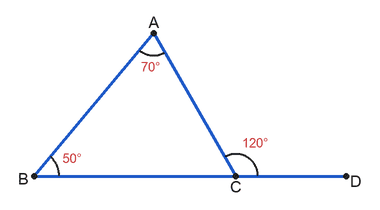
Concept: When one side of a triangle is produced, the angle formed outside the triangle is an exterior angle. It equals the sum of the two interior opposite angles (the angles at the other two vertices). The exterior angle and the interior angle next to it lie on a straight line, so together they make 180° (a linear pair).
Step 1 — State the property.
Produce side BC of triangle ABC to D. The exterior angle ∠ACD equals the sum of the two interior opposite angles, ∠A and ∠B.
Step 2 — Read options (A) and (B).
Option (B) states this property in words. Option (A) also speaks of the two opposite angles, the same ∠A and ∠B, so as the question intends it says the same thing as (B).
Step 3 — Choose the option.
Both (A) and (B) describe the exterior angle correctly, so the answer is (D).
Watch out: The interior angle NEXT to the exterior angle is not part of the sum; it makes 180° with the exterior angle.
Note: Read word for word, “opposite adjacent angles” contradicts itself, because the only interior angle adjacent to ∠ACD is ∠ACB, and ∠ACD + ∠ACB = 180°. On that strict reading only (B) is correct; the answer (D) reads (A) as the two opposite angles, as the question intends.
Why the other options are wrong:
Therefore, the exterior angle equals the sum of the two interior opposite angles, option (D).