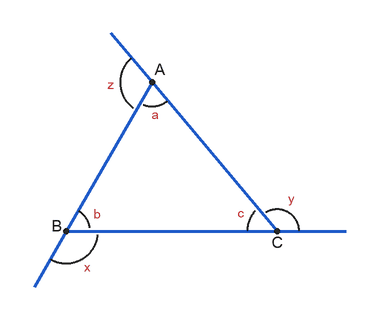
Answer: (C) (3) Both A and R are true.
Concept: In an Assertion–Reason item we judge A and R separately and then choose the code that matches both verdicts. When one side of a triangle is produced, the angle formed outside the triangle is an exterior angle. It equals the sum of the two interior opposite angles (the angles at the other two vertices). The exterior angle and the interior angle next to it lie on a straight line, so together they make 180° (a linear pair). The three angles of every triangle add up to 180° (the angle sum property of a triangle).
Step 1 — Judge the Reason.
Each exterior angle equals the sum of its two interior opposite angles: x at B equals a+c, y at C equals a+b, and z at A equals b+c. Adding them, and using a+b+c=180°:
x+y+z=(a+c)+(a+b)+(b+c)=2(a+b+c)=2×180∘=360∘
Every line of R is correct, so R is true.
Step 2 — Judge the Assertion.
R shows that the three exterior angles add up to 360°, so A is true.
Step 3 — Choose the code.
A is true and R is true. This matches code (3).
Why the other options are wrong:
- (A): Code (1) says R is false, but each bracket in R is an exterior angle written as the sum of its two interior opposite angles.
- (B): Code (2) says A is false, but the working in R proves that x + y + z = 360°.
- (D): Code (4) says both are false, but both are true.
Therefore, both A and R are true, option (C).