
Opening your dashboard
Class 6 Maths Chapter 15 Triangles: Practice Questions
45 questions on Chapter 15, each worked through on its own page with the AI tutor. Class 6 Maths, ICSE 2026-27.
45 questions
1–5 marks · Mixed difficulty
- 11 mark
Question 1
Bloom's level: Remember
The point where two sides of a triangle meet is called :
- 21 mark
Question 2
Bloom's level: Remember
The point where the three medians of a triangle meet is called the :
- 31 mark
Question 3
Bloom's level: Apply
Two angles of a triangle are and . The third angle is :
- 41 mark
Question 4
Bloom's level: Understand
The greatest number of obtuse angles a triangle can have is :
- 51 mark
Question 5
Bloom's level: Apply
An exterior angle of a triangle is and one of its interior opposite angles is . The other interior opposite angle is :
- 61 mark
Question 6
Bloom's level: Understand
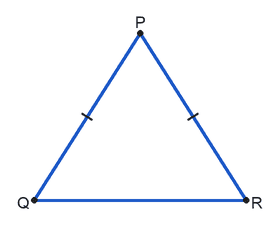
In PQR, PQ = PR. Then :
- 71 mark
Question 7
Bloom's level: Apply
In a triangle, the second angle is three times the first angle, and the third angle is five times the first angle. Such a triangle is :
- 81 mark
Question 8
Bloom's level: Apply
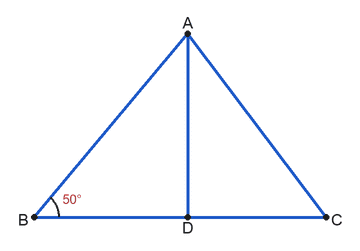
In ABC, AD is the altitude from A to BC, and ∠B . Then ∠BAD is :
- 91 mark
Question 9
Bloom's level: Understand
Three points A, B and C are joined by the line segments AB, BC and CA. These form a triangle only if :
- 101 mark
Question 10
Bloom's level: Understand
Assertion (A) : A triangle cannot have two right angles.
Reason (R) : The sum of the interior angles of a triangle is .
- 111 mark
Question 11
Bloom's level: Evaluate
Assertion (A) : An exterior angle of a triangle is always greater than each of its two interior opposite angles.
Reason (R) : An exterior angle of a triangle is equal to the difference of its two interior opposite angles.
- 121 mark
Question 12
Bloom's level: Evaluate
Assertion (A) : A triangle with angles , and is an acute-angled triangle, because two of its angles are acute.
Reason (R) : Every triangle has at least two acute angles.
- 132 marks
Question 13
Bloom's level: Remember
Define a triangle. For LMN, write its three sides and its three angles.

- 142 marks
Question 14
Bloom's level: Remember
What is an exterior angle of a triangle? State its relation with (i) its adjacent interior angle and (ii) its two interior opposite angles.
- 152 marks
Question 15
Bloom's level: Apply
In PQR, ∠P is twice ∠Q and ∠R .
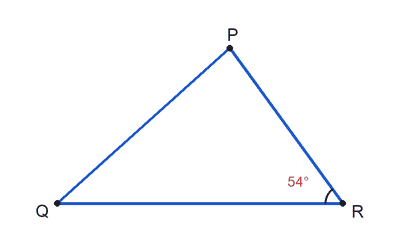
Find ∠P and ∠Q.
- 162 marks
Question 16
Bloom's level: Understand
Classify each triangle according to its sides :
(i) sides cm, cm and cm
(ii) sides cm, cm and cm
(iii) sides cm, cm and cm
Which of these triangles has all three angles equal?
- 172 marks
Question 17
Bloom's level: Apply
In ABC, side BC is produced to D. If the exterior angle ∠ACD and ∠A ∠B, find ∠A, ∠B and ∠ACB.

- 182 marks
Question 18
Bloom's level: Apply
The angles of a triangle are , and . Find and the three angles, and classify the triangle according to its angles.
- 192 marks
Question 19
Bloom's level: Evaluate
Arjun says, "In every triangle, the altitude and the median drawn from the same vertex are the same line segment." Is he right? Justify your answer.
- 202 marks
Question 20
Bloom's level: Understand
Distinguish between an altitude and a median of a triangle. How many altitudes and how many medians does a triangle have?
- 212 marks
Question 21
Bloom's level: Analyse
In ABC, ∠A ∠B and ∠B ∠C .
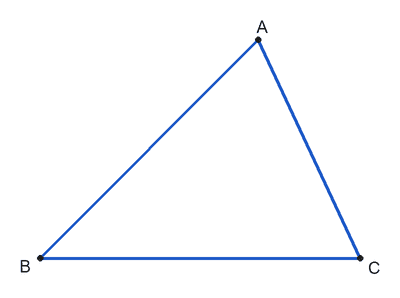
Find all three angles of the triangle.
- 222 marks
Question 22
Bloom's level: Understand
A triangle is the closed figure with the least number of sides. Explain why a closed figure cannot be made with only two line segments.
- 234 marks
Question 23
Bloom's level: Apply
In the given figure, side BC of ABC is produced to D.

(a) Form an equation in and solve it.
(b) Find ∠A, ∠B, ∠ACD and ∠ACB.
(c) Classify ABC according to its angles.
- 244 marks
Question 24
Bloom's level: Analyse
In the given figure, D is a point on side BC of ABC, and AD is joined. ∠B , ∠C and ∠ADB .

(a) How many triangles are there in the figure? Name them.
(b) Find ∠BAD, ∠ADC and ∠DAC.
(c) Find ∠BAC and classify each of the triangles ABC, ABD and ADC according to its angles.
- 255 marks
Question 25
Bloom's level: Analyse
Case study: A carpenter makes a triangular roof frame PQR in which the two sloping beams PQ and PR are of equal length, and the angle at the top, ∠P, is . A wooden strut PM joins P to M, the mid-point of the base beam QR.
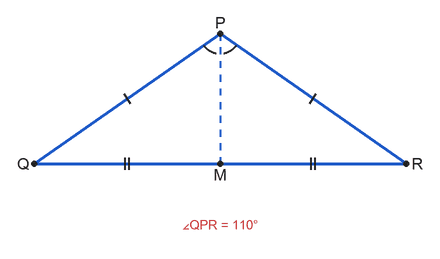
(a) Classify PQR according to its sides and according to its angles.
(b) Find ∠Q and ∠R.
(c) Is PM a median of PQR? Given that ∠PMQ , is PM also an altitude? Find ∠QPM.
- 265 marks
Question 26
Bloom's level: Apply
Case study: A geometry box has two set squares. The first has angles , and ; the second has angles , and .
(a) Classify each set square according to its angles and according to its sides. Give a reason for the sides.
(b) Riya places the corner of one set square next to the corner of the other, so that they share a vertex and one edge. What angle do the two outer edges make? Name its type.
(c) Which two corners should she place together in this way to get an angle of ? Name the type of this angle.
- 273 marks
Question 27
Bloom's level: Create
Frame the three angles of a triangle as expressions in (each with a different coefficient of ) such that, when you solve for , the triangle turns out to be right-angled. Solve your problem and show the triangle is right-angled.
- 284 marks
Question 28
Bloom's level: Create
Make a table giving one possible set of three angles for each of the following triangles :
(i) an acute-angled isosceles triangle
(ii) a right-angled isosceles triangle
(iii) an obtuse-angled scalene triangle
(iv) an obtuse-angled isosceles triangle
Then explain why an equilateral triangle can never be right-angled or obtuse-angled.
- 293 marks
Question 29
Bloom's level: Analyse
Four points A, B, C and D are marked on a plane so that no three of them are collinear.
(a) How many different triangles can be drawn having their vertices among these points? Name them.
(b) Which triangles have D as a vertex?
(c) If a fifth point E is added (still no three collinear), how many triangles can be formed in all?
- 303 marks
Question 30
Bloom's level: Analyse
In ABC, side BC is produced to D. The exterior angle ∠ACD is , and the two interior opposite angles are equal.

(a) Find all three angles of ABC.
(b) Classify ABC according to its angles and according to its sides.
(c) Explain why every exterior angle of an equilateral triangle is .
- 311 mark
Question 31
State whether the following statement is true or false. Give a reason.
If two angles of a triangle are acute, then it is called an acute-angled triangle.
- 321 mark
Question 32
State whether the following statement is true or false. Give a reason.
A triangle is formed by joining collinear points.
- 333 marks
Question 33
Find the missing angle in the given triangle ABC.

- 343 marks
Question 34
The three angles of a triangle are in the ratio . Find all the angles of the triangle.
- 353 marks
Question 35
In the given figure, triangle ABC is right-angled at A and side AC is produced to D. Find the missing angles and .

- 361 mark
Question 36
Which of the following sets of side lengths forms a scalene triangle ?
- 371 mark
Question 37
In a right-angled triangle, one acute angle is twice the other acute angle. The smaller acute angle is :
- 381 mark
Question 38
An exterior angle of a triangle is . Its two interior opposite angles are in the ratio . The larger of these two angles is :
- 392 marks
Question 39
In the triangle , cm, cm and cm.
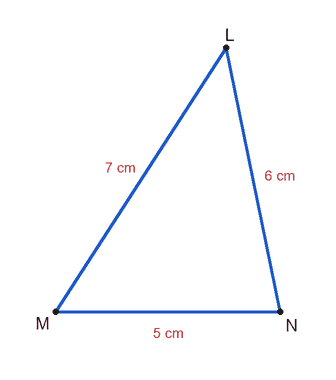
(a) Name the three vertices, the three sides and the three angles of the triangle.
(b) Find the perimeter of the triangle.
- 402 marks
Question 40
Two angles of a triangle are given. Find the third angle and say whether the triangle is acute-angled, right-angled or obtuse-angled :
(a) and
(b) and
(c) and
- 412 marks
Question 41
(a) An isosceles triangle has perimeter 34 cm and each of its two equal sides is 12 cm long. Find the length of the third side.
(b) An equilateral triangle has perimeter 27 cm. Find the length of each side.
- 422 marks
Question 42
In , cm and is the mid-point of . The point lies on so that .
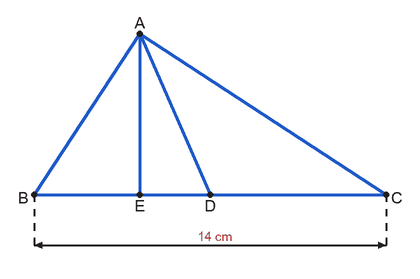
(a) What is the line segment called ? Find the length of .
(b) What is the line segment called ? Write the measure of .
- 433 marks
Question 43
The angles of a triangle are in the ratio .
(a) Find the value of one part of the ratio.
(b) Find the three angles.
(c) Is the triangle acute-angled, right-angled or obtuse-angled ?
- 444 marks
Question 44
In the figure, the side of is produced to and the side is produced to . and the exterior angle .
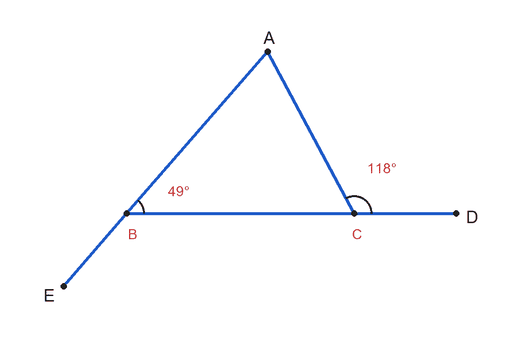
(a) Find .
(b) Find .
(c) Find the exterior angle , and check it in two different ways.
- 453 marks
Question 45
In the figure, cm, is the mid-point of and . and .
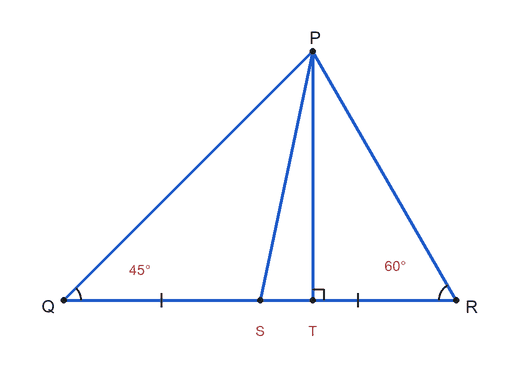
(a) Name the median and the altitude of that are drawn from , and find the length of .
(b) Find .
(c) Find and use it to find .