
Opening your dashboard
Class 6 Chemistry Chapter 5: Pure Substances and Mixtures; Separation of Mixtures Solutions
40 textbook questions with step-by-step answers, free to read, for ICSE 2026-27.
Get talked through Ch 5, not just shown the answer
Reading a finished solution is not the same as being able to do it. The AI tutor takes one question at a time and works it with you, in your own words, until you can.
- Ask it out loud, in your own words
- It gives you the next step, not the answer
- Stuck on part (ii)? Start there
40 questions with solutions
1–5 marks · Mixed difficulty
- 11 mark
Question 1
A mixture of mustard oil and water forms:
Solve with AIAnswer
(A) a compound
(B) a homogeneous mixture
(C) an alloy
- Correct
(D) a heterogeneous mixture
Answer: (D) a heterogeneous mixture
Concept: In a homogeneous mixture the components are spread evenly and cannot be seen separately; in a heterogeneous mixture they are not spread evenly and can be seen separately.
Step 1 — See what happens when the two liquids are mixed.
Mustard oil does not dissolve in water. Being lighter than water, the oil rises and forms a separate layer on top, however well the two are shaken.
Step 2 — Decide the type of mixture.
Because the two layers can be seen separately and the oil is not spread evenly through the water, the mixture is heterogeneous.
Watch out: A liquid mixed with a liquid is not always homogeneous; it is homogeneous only when the liquids mix completely, like alcohol and water.
Why the other options are wrong:
- (A) a compound: This would need a chemical change forming a new substance; oil and water only lie together unchanged.
- (B) a homogeneous mixture: This is wrong because two separate layers are seen, while a homogeneous mixture looks the same throughout.
- (C) an alloy: This is a mixture of metals (or of a metal and a non-metal), and neither oil nor water is a metal.
Therefore, a mixture of mustard oil and water forms a heterogeneous mixture, option (D).
- 21 mark
Question 2
A heterogeneous mixture is :
Solve with AIAnswer
(A) made up of only one kind of atoms
(B) made up of only one kind of molecules
- Correct
(C) made up of different kinds of atoms and molecules.
(D) one that looks uniform.
Answer: (C) made up of different kinds of atoms and molecules.
Concept: A pure substance has only one kind of particle: one kind of atom (an element) or one kind of molecule (a compound). A mixture always contains two or more substances.
Step 1 — Recall what any mixture contains.
Since a mixture is made of two or more substances, it is made up of different kinds of atoms and molecules.
Step 2 — Add what makes it heterogeneous.
In a heterogeneous mixture these different particles are not spread evenly, so the parts can be seen separately.
Why the other options are wrong:
- (A) made up of only one kind of atoms: This describes an element, which is a pure substance and not a mixture.
- (B) made up of only one kind of molecules: This describes a pure substance such as a compound (for example sugar), not a mixture.
- (D) one that looks uniform: This describes a homogeneous mixture; a heterogeneous mixture does not look uniform.
Therefore, a heterogeneous mixture is made up of different kinds of atoms and molecules, option (C).
- 31 mark
Question 3
An example of a homogeneous mixture is :
Solve with AIAnswer
(A) distilled water
- Correct
(B) tap water
(C) sand and water
(D) sawdust and water
Answer: (B) tap water
Concept: In a homogeneous mixture the components are spread evenly and cannot be seen separately; in a heterogeneous mixture they are not spread evenly and can be seen separately.
Step 1 — See what tap water contains.
Tap water is not pure water. It has small amounts of salts and air dissolved in it.
Step 2 — Decide the type of mixture.
The dissolved salts and air are spread evenly and cannot be seen, so tap water is a homogeneous mixture, even though it looks like a pure liquid.
Watch out: Looking clear does not make a liquid pure; tap water is clear but is still a mixture.
Why the other options are wrong:
- (A) distilled water: This is pure water, a compound with nothing dissolved in it, so it is not a mixture at all.
- (C) sand and water: This is heterogeneous, because sand does not dissolve and settles at the bottom.
- (D) sawdust and water: This is heterogeneous, because sawdust does not dissolve and floats on the water.
Therefore, tap water is an example of a homogeneous mixture, option (B).
- 41 mark
Question 4
Which among the following is a set containing only mixtures ?
Solve with AIAnswer
(A) gold, common salt, water, alloy
- Correct
(B) alloy, ink, honey, icecream
(C) alloy, mercury, air, sea water
(D) milk, duralumin, brass, silver.
Answer: (B) alloy, ink, honey, icecream
Concept: Elements (such as gold, mercury and silver) and compounds (such as common salt and water) are pure substances. Only a set in which every item is a mixture is correct.
Step 1 — Check each item of set (B).
An alloy is a mixture of metals; ink is a dye or pigment mixed in a liquid; honey is a mixture of sugars and water; ice-cream is a mixture of milk, sugar, flavour and air.
Step 2 — Conclude.
All four items in set (B) are mixtures, so (B) is the set containing only mixtures.
Watch out: One pure substance in a set is enough to make the whole set wrong.
Why the other options are wrong:
- (A) gold, common salt, water, alloy: This set contains gold (an element) and common salt and water (compounds).
- (C) alloy, mercury, air, sea water: This set contains mercury, which is an element.
- (D) milk, duralumin, brass, silver: This set contains silver, which is an element.
Therefore, the set containing only mixtures is alloy, ink, honey, ice-cream, option (B).
- 51 mark
Question 5
Copper is not a part of the alloy :
Solve with AIAnswer
(A) brass
(B) bronze
- Correct
(C) steel
(D) duralumin
Answer: (C) steel
Concept: An alloy is a homogeneous mixture of two or more metals, or of a metal and a non-metal. To answer, recall the components of each alloy.
Step 1 — List the components.
Brass is copper and zinc. Bronze is mainly copper and tin. Duralumin is mostly aluminium with some copper and a little magnesium and manganese. Steel is iron with a little carbon.
Step 2 — Find the alloy without copper.
Only steel has no copper in it.
Why the other options are wrong:
- (A) brass: This alloy is made of copper and zinc, so copper is a part of it.
- (B) bronze: This alloy is made mainly of copper and tin, so copper is a part of it.
- (D) duralumin: This alloy contains about 4% copper along with aluminium, so copper is a part of it.
Therefore, copper is not a part of steel, option (C).
- 61 mark
Question 6
Which of the following is not a mixture?
Solve with AIAnswer
(A) Sugar solution
(B) Tap water
(C) Milk
- Correct
(D) Distilled water
Answer: (D) Distilled water
Concept: A pure substance contains only one kind of particle. Distilled water is pure water: a compound of hydrogen and oxygen in a fixed ratio, with nothing dissolved in it.
Step 1 — See how distilled water is made.
In distillation, water is boiled and the steam is cooled back into water. The dissolved salts and air are left behind, so only pure water is collected.
Step 2 — Conclude.
Distilled water is a pure substance, so it is not a mixture. The other three each contain two or more substances.
Why the other options are wrong:
- (A) Sugar solution: This is a homogeneous mixture of sugar dissolved in water.
- (B) Tap water: This contains dissolved salts and air, so it is a homogeneous mixture.
- (C) Milk: This is a mixture of water, fat, proteins, milk sugar and other substances.
Therefore, distilled water is not a mixture, option (D).
- 71 mark
Question 7
Which of the following is a mixture ?
Solve with AIAnswer
(A) Sugar
- Correct
(B) Honey
(C) Common salt
(D) Iron sulphide
Answer: (B) Honey
Concept: Some mixtures look like pure substances. Honey looks uniform, but it is a homogeneous mixture of sugars, water and small amounts of other substances.
Step 1 — Check each option.
Sugar and common salt are compounds with fixed formulae. Iron sulphide is a compound formed when iron and sulphur combine on heating.
Step 2 — Pick the mixture.
Honey has no fixed composition (it varies with the flowers the bees visit), so it is a mixture.
Why the other options are wrong:
- (A) Sugar: This is a compound, a pure substance with a fixed composition.
- (C) Common salt: This is the compound sodium chloride, a pure substance.
- (D) Iron sulphide: This is a compound formed when iron and sulphur combine chemically on heating.
Therefore, honey is a mixture, option (B).
- 85 marks
Question 8
Identify the mixtures and compounds from the following list :
Air, water, sugar, salt, milk, tea, alcohol, honey, soil, glucose.
Solve with AIWritten solution
Solution:
Concept: A compound is a pure substance with a fixed composition and a chemical formula. A mixture has no fixed composition and no formula.
Step 1 — Sort out the mixtures.
Air is a mixture of gases; milk is water with fat, proteins and sugar; tea is water with substances from the tea leaves, milk and sugar; honey is sugars and water; soil is sand, clay, humus, water and air. None of these has a fixed composition.
Step 2 — Sort out the compounds.
Water, sugar, salt (sodium chloride), alcohol (pure ethanol) and glucose each have a fixed composition and a formula. For example, water is and glucose is .
Step 3 — Write the two lists.
The table gives the final grouping.
Mixtures Compounds air, milk, tea, honey, soil water, sugar, salt, alcohol, glucose Watch out: Here 'alcohol' means pure alcohol; alcohol mixed with water would be a mixture.
Therefore, the mixtures are air, milk, tea, honey and soil, and the compounds are water, sugar, salt, alcohol and glucose.
- 95 marks
Question 9
Select homogeneous and heterogeneous mixtures from the following :
Salt solution, petrol and water, sand and charcoal, alcohol and water, air dissolved in water, air, sea water, fruit juices, mist, brass.
Solve with AIWritten solution
Solution:
Concept: In a homogeneous mixture the components are spread evenly and cannot be seen separately; in a heterogeneous mixture they are not spread evenly and can be seen separately.
Step 1 — Find the homogeneous mixtures.
In salt solution, alcohol and water, air dissolved in water, air, sea water and clear fruit juice, the parts mix completely and cannot be seen separately. Brass is a solid solution of zinc in copper, so it is also homogeneous.
Step 2 — Find the heterogeneous mixtures.
Petrol floats on water as a separate layer; sand and charcoal grains can be seen side by side; mist is tiny droplets of water floating in air, which can be seen as a haze.
Step 3 — Write the two lists.
The table gives the final grouping.
Homogeneous mixtures Heterogeneous mixtures salt solution, alcohol and water, air dissolved in water, air, sea water, fruit juices, brass petrol and water, sand and charcoal, mist Watch out: Fruit juice is taken as homogeneous here, as in the chapter; a juice with pulp floating in it is heterogeneous, because the bits of pulp can be seen.
Therefore, salt solution, alcohol and water, air dissolved in water, air, sea water, fruit juices and brass are homogeneous, while petrol and water, sand and charcoal, and mist are heterogeneous.
- 103 marks
Question 10
Select the odd one out from the following:
(a) Salt solution, sugar solution, water and alcohol, sand and water
(b) Chalk and sand, water and petrol, iron and sulphur, salt and water
(c) Gold, iron sulphide, milk, water
Solve with AIWritten solution
Solution:
Concept: To find the odd one out, decide what three of the items have in common; the fourth item is the one that does not share it.
Step 1 — (a) Salt solution, sugar solution, water and alcohol, sand and water.
The first three are homogeneous mixtures, because the salt, the sugar and the alcohol mix completely with water. Sand does not dissolve and settles, so sand and water is heterogeneous and is the odd one out.
Step 2 — (b) Chalk and sand, water and petrol, iron and sulphur, salt and water.
The first three are heterogeneous mixtures, whose parts can be seen separately. Salt dissolves completely, so salt and water is homogeneous and is the odd one out.
Step 3 — (c) Gold, iron sulphide, milk, water.
Gold is an element, and iron sulphide and water are compounds, so all three are pure substances. Milk is a mixture, so it is the odd one out.
Therefore, the odd ones out are (a) sand and water, (b) salt and water and (c) milk.
- 115 marks
Question 11
Give two examples for each of the following types of mixtures.
(a) solid-solid
(b) solid-liquid
(c) liquid-gas
(d) gas-gas
Solve with AIWritten solution
Solution:
Concept: A mixture can be named by the physical states (solid, liquid or gas) of the substances in it.
Step 1 — (a) Solid-solid.
Both parts are solids, as in brass (copper and zinc) and sand and iron filings.
Step 2 — (b) Solid-liquid.
A solid is mixed with a liquid, as in salt solution (salt in water) and sand and water.
Step 3 — (c) Liquid-gas.
A liquid and a gas are mixed, as in mist (water droplets in air) and soda water (carbon dioxide dissolved in water).
Step 4 — (d) Gas-gas.
Both parts are gases, as in air (nitrogen, oxygen, carbon dioxide and other gases) and biogas (mainly methane and carbon dioxide).
Therefore, (a) brass, sand and iron filings; (b) salt solution, sand and water; (c) mist, soda water; (d) air, biogas.
- 125 marks
Question 12
Name the components present in the following mixtures :
(a) Brass
(b) Duralumin
(c) Tap water
(d) Bronze
Solve with AIWritten solution
Solution:
Concept: Alloys are homogeneous mixtures of metals (or of a metal and a non-metal); tap water is a solution of salts and air in water.
Step 1 — (a) Brass.
Brass is made by melting copper and zinc together.
Step 2 — (b) Duralumin.
Duralumin is mostly aluminium, with some copper and a little magnesium and manganese; it is light but strong.
Step 3 — (c) Tap water.
Tap water is water with small amounts of dissolved salts and dissolved air.
Step 4 — (d) Bronze.
Bronze is mainly copper and tin; the chapter also lists a little zinc.
Therefore, brass is copper and zinc; duralumin is aluminium, copper, magnesium and manganese; tap water is water, dissolved salts and dissolved air; bronze is copper and tin (with a little zinc).
- 135 marks
Question 13
Define the following with an example for each:
(a) Pure substance
(b) Impure substance
(c) Alloy
(d) Solution
(e) Heterogeneous mixture
(f) Homogeneous mixture
Solve with AIWritten solution
Solution:
Concept: Pure substances (elements and compounds) contain one kind of particle; mixtures (impure substances) contain two or more substances.
Step 1 — (a) Pure substance.
A pure substance is a homogeneous substance made of only one kind of atoms or molecules, with a definite set of properties. Example: gold (an element) or sugar (a compound).
Step 2 — (b) Impure substance.
An impure substance is one in which other substances are also present, in small or large amounts; that is, it is a mixture. Example: air or milk.
Step 3 — (c) Alloy.
An alloy is a homogeneous mixture of two or more metals, or of a metal and a non-metal, usually made by melting them together. Example: brass (copper and zinc) or steel (iron and carbon).
Step 4 — (d) Solution.
A solution is a homogeneous mixture of a solute dissolved in a solvent (such as water). Example: sugar solution, in which sugar is the solute and water is the solvent.
Step 5 — (e) Heterogeneous mixture.
A heterogeneous mixture is one whose parts are not spread evenly and can be seen separately. Example: sand and water.
Step 6 — (f) Homogeneous mixture.
A homogeneous mixture is one whose parts are spread evenly throughout and cannot be seen separately. Example: salt solution.
Therefore, a pure substance has one kind of particle, an impure substance is a mixture, an alloy is a mixture of metals, a solution is a solute in a solvent, and mixtures are heterogeneous or homogeneous by whether their parts can be seen separately.
- 142 marks
Question 14
Give one difference between pure substances and mixtures.
Solve with AIWritten solution
Solution:
Concept: The main way to tell a pure substance from a mixture is to look at its composition (what it is made of, and in what proportion).
Step 1 — Compare the composition.
The table compares the two.
Pure substance Mixture It has a fixed (definite) composition: one kind of atoms or molecules. It has no fixed composition: its parts can be mixed in any proportion. Step 2 — Check with examples.
Pure water is always hydrogen and oxygen in the same ratio by mass, but salt water can have a little or a lot of salt dissolved in it.
Therefore, a pure substance has a fixed composition, while a mixture has no fixed composition.
- 152 marks
Question 15
What do you observe when a magnet is brought near a mixture of iron and sulphur ?
Solve with AIWritten solution
Solution:
Concept: In a mixture each component keeps its own properties. Iron is attracted by a magnet; sulphur is not.
Step 1 — Describe what is seen.
When a magnet is brought near (or moved over) the mixture, the grey iron filings are attracted and stick to the magnet, while the yellow sulphur powder is left behind.
Step 2 — Explain why.
Iron and sulphur are only mixed, not combined, so the iron is still magnetic. This is why the two can be separated by magnetic separation.
Watch out: If iron and sulphur are first heated together, they form iron sulphide, a compound that a magnet does not attract.
Therefore, the iron filings are attracted by the magnet and the sulphur is left behind.
- 165 marks
Question 16
Give reasons :
(a) Why do sugar and water retain their individual properties in a sugar solution?
(b) Why do petrol and water form a heterogeneous mixture ?
(c) Why does sulphur dissolve when carbon disulphide is added to a mixture of iron and sulphur but not when it is added to iron sulphide ?
Solve with AIWritten solution
Solution:
Concept: In a mixture the components do not combine chemically, so each keeps its own properties. In a compound the elements have combined to form a new substance with new properties.
Step 1 — (a) Sugar and water keep their properties.
Sugar solution is a mixture. Sugar and water are only mixed; they do not react, and no new substance is formed. So the solution tastes sweet like sugar and flows like water, and both can be got back (the sugar by evaporating the water).
Step 2 — (b) Petrol and water form a heterogeneous mixture.
Petrol does not dissolve in water. Being lighter, it floats as a separate layer on top, so the two parts are not spread evenly and can be seen separately. Such a mixture is heterogeneous.
Step 3 — (c) Carbon disulphide with the mixture and with iron sulphide.
In the mixture, sulphur is present as free sulphur and keeps its property of dissolving in carbon disulphide, so it dissolves. In iron sulphide, iron and sulphur have combined chemically:
Iron sulphide is a new substance with its own properties; it does not dissolve in carbon disulphide, so nothing dissolves.
Watch out: Carbon disulphide is poisonous and catches fire very easily, so this is shown only as a teacher's demonstration in a fume cupboard.
Therefore, sugar and water keep their properties because they do not react, petrol and water stay as separate layers, and sulphur dissolves from the mixture but not from the compound iron sulphide.
- 175 marks
Question 17
State :
(a) Four differences between compounds and mixtures.
(b) Three differences between water and air.
Solve with AIWritten solution
Solution:
Concept: A compound is a pure substance formed by chemical combination; a mixture is formed by simply mixing. Water is a compound and air is a mixture.
Step 1 — (a) Four differences between compounds and mixtures.
The table lists four differences.
Compound Mixture It is a pure substance. It is an impure substance. It has a fixed composition: its elements combine in a definite ratio by mass. It has no fixed composition: its parts can be mixed in any ratio. Its properties differ from those of the elements in it. It keeps the properties of its parts. Its parts can be separated only by chemical methods. Its parts can be separated by simple physical methods. Step 2 — (b) Three differences between water and air.
The table lists three differences.
Water Air Water is a compound. Air is a mixture. It is always hydrogen and oxygen in a fixed ratio by mass (1 : 8). Its gases are not in a fixed ratio: the amounts of water vapour, carbon dioxide and dust vary from place to place. Its properties are quite different from those of hydrogen and oxygen. It keeps the properties of its gases (its oxygen still supports burning). Therefore, compounds are pure, fixed in composition, new in properties and separable only chemically, unlike mixtures; water is a compound of fixed composition and air is a mixture whose gases keep their properties.
- 185 marks
Question 18
(a) Define ‘mixture’.
(b) List four characteristics of a mixture.
Solve with AIWritten solution
Solution:
Concept: A mixture is formed by physically mixing pure substances, without any chemical change.
Step 1 — (a) Define a mixture.
Mixtures are impure substances formed by mixing two or more pure substances (elements and/or compounds) in any proportion, such that they do not undergo any chemical change and keep their own properties. Example: air.
Step 2 — (b) List four characteristics.
Every mixture shows these four features.
- A mixture has no fixed composition; its parts can be present in any proportion.
- Its parts keep their own properties.
- A mixture has no fixed melting point or boiling point; it melts or boils over a range of temperatures.
- Its parts can be separated by simple physical methods such as filtration, evaporation or a magnet.
Therefore, a mixture is two or more substances mixed in any proportion without chemical change, and it has no fixed composition, keeps its parts' properties, has no fixed melting or boiling point and can be separated physically.
- 191 mark
Question 19
The process of adding a chemical substance to help the suspended solid particles to deposit as sediment faster is called :
Solve with AIAnswer
- Correct
(A) loading
(B) sedimentation
(C) decantation
(D) filtration
Answer: (A) loading
Concept: Very fine clay particles in water settle very slowly. Adding a chemical such as alum makes them clump together into heavier lumps that settle faster. This is called loading.
Step 1 — Recall what alum does.
When alum is added to muddy water, the fine particles stick together and sink quickly to the bottom as sediment.
Step 2 — Name the process.
Adding a chemical to make suspended particles settle faster is loading.
Watch out: Sedimentation also gives a sediment, but it happens on its own, without any chemical being added.
Why the other options are wrong:
- (B) sedimentation: This is the settling of heavy particles on their own; no chemical is added to speed it up.
- (C) decantation: This is pouring off the clear liquid after the particles have settled; it adds nothing.
- (D) filtration: This is passing the mixture through a filter to hold back the solid; no chemical is added.
Therefore, the process is called loading, option (A).
- 201 mark
Question 20
Salt is separated from sea water by :
Solve with AIAnswer
- Correct
(A) evaporation
(B) sublimation
(C) magnetic separation
(D) filtration
Answer: (A) evaporation
Concept: Evaporation separates a solid that is dissolved in a liquid: the liquid turns into vapour and the solid is left behind.
Step 1 — See where the salt is.
Salt is dissolved in sea water, so it cannot be picked out, filtered or pulled out by a magnet.
Step 2 — Name the method.
Sea water is let into shallow beds; the sun's heat evaporates the water and the salt is left behind.
Why the other options are wrong:
- (B) sublimation: This is for solids that change straight into vapour on heating; common salt does not sublime.
- (C) magnetic separation: This works only for magnetic substances such as iron; salt is not magnetic.
- (D) filtration: This cannot work, because dissolved salt passes through a filter along with the water.
Therefore, salt is separated from sea water by evaporation, option (A).
- 211 mark
Question 21
A gas dissolved in a liquid can be separated by :
Solve with AIAnswer
(A) filtration
- Correct
(B) boiling
(C) using magnet
(D) sublimation
Answer: (B) boiling
Concept: Gases dissolve less in hot water than in cold water, so a dissolved gas escapes when the liquid is heated or boiled.
Step 1 — Recall an everyday example.
When water is heated, tiny bubbles of dissolved air rise and escape even before the water boils.
Step 2 — Name the method.
So a gas dissolved in a liquid is separated by boiling (heating) the liquid.
Why the other options are wrong:
- (A) filtration: This holds back undissolved solids only; a dissolved gas passes through a filter with the liquid.
- (C) using magnet: This attracts only magnetic substances such as iron; gases are not pulled out by a magnet.
- (D) sublimation: This is used for solids that change straight into vapour, not for gases in a liquid.
Therefore, a gas dissolved in a liquid is separated by boiling, option (B).
- 221 mark
Question 22
Camphor can be separated from a mixture of sand and camphor by :
Solve with AIAnswer
(A) filtration
(B) evaporation
- Correct
(C) sublimation
(D) winnowing
Answer: (C) sublimation
Concept: Sublimation is the change of a solid straight into vapour on heating. Camphor sublimes, and its vapour turns back into solid on a cool surface; sand does not.
Step 1 — Heat the mixture.
On gentle heating the camphor turns into vapour and leaves the sand behind.
Step 2 — Collect the camphor.
The vapour cools on a cold surface (such as an inverted funnel) and becomes solid camphor again, so the two are separated by sublimation.
Why the other options are wrong:
- (A) filtration: This separates an insoluble solid from a liquid; here both parts are solids and no liquid is present.
- (B) evaporation: This separates a solid dissolved in a liquid; there is no liquid in this mixture.
- (D) winnowing: This uses wind to blow light husk away from heavier grain; camphor and sand differ in subliming, not mainly in weight, so winnowing is not the method used.
Therefore, camphor is separated from sand by sublimation, option (C).
- 231 mark
Question 23
A separating funnel is used to separate :
Solve with AIAnswer
(A) miscible liquids
(B) sugar solution
(C) chalk powder and water
- Correct
(D) immiscible liquids
Answer: (D) immiscible liquids
Concept: Immiscible liquids (such as oil and water) do not mix and form two separate layers. A separating funnel has a tap at the bottom, so the lower layer can be run out while the upper layer stays behind.
Step 1 — See what the funnel needs.
The funnel can only work when the liquids form two layers with a clear boundary.
Step 2 — Match with the options.
Only immiscible liquids form such layers, so the separating funnel is used for them.
Why the other options are wrong:
- (A) miscible liquids: This is wrong because miscible liquids mix completely and form no layers, so the tap cannot separate them.
- (B) sugar solution: This is a homogeneous solution with no layers; the sugar is got back by evaporation.
- (C) chalk powder and water: This is an insoluble solid in a liquid, which is separated by filtration or by sedimentation and decantation.
Therefore, a separating funnel is used to separate immiscible liquids, option (D).
- 241 mark
Question 24
Assertion (A): Mixtures cannot be represented by any chemical symbol or formula.
Reason (R): Mixtures neither have a uniform composition nor definite properties.
Solve with AIAnswer
- Correct
(A) Both A and R are true and R is the correct explanation of A.
(B) Both A and R are true but R is not the correct explanation of A.
(C) A is true but R is false.
(D) A is false but R is true.
Answer: (A) Both A and R are true and R is the correct explanation of A.
Concept: A chemical formula shows a fixed composition. A mixture can be made in any proportion, so it has no fixed composition and no single set of properties. Judge the Assertion (A) first, then the Reason (R), and only then decide whether R explains A.
Step 1 — Judge the Assertion.
Air, salt water and soil have no formula, because their parts can be present in any amount. A is true.
Step 2 — Judge the Reason.
A mixture does not have a fixed composition from sample to sample, and its properties change with the amounts mixed (more salt makes salt water saltier). R is true.
Step 3 — Decide whether R explains A.
A formula can be written only for a fixed composition. Because mixtures have none, no formula can be written, so R explains A.
Watch out: Here 'uniform composition' means the same composition every time; one sample of a homogeneous mixture is uniform throughout, but another sample can have different amounts of its parts.
Why the other options are wrong:
- (B): This is wrong because R gives the very reason why no formula can be written, so R does explain A.
- (C): This is wrong because R is true: mixtures have no fixed composition and no fixed properties.
- (D): This is wrong because A is true: mixtures such as air have no chemical formula.
Therefore, both A and R are true and R is the correct explanation of A, option (A).
- 251 mark
Question 25
Assertion (A): The process in which a solid on heating directly changes into its vapour, without changing into the liquid state is called sublimation.
Reason (R): Camphor and iodine can sublime.
Solve with AIAnswer
(A) Both A and R are true and R is the correct explanation of A.
- Correct
(B) Both A and R are true but R is not the correct explanation of A.
(C) A is true but R is false.
(D) A is false but R is true.
Answer: (B) Both A and R are true but R is not the correct explanation of A.
Concept: Sublimation is the change of a solid straight into vapour on heating, without first melting. Judge the Assertion (A) first, then the Reason (R), and only then decide whether R explains A.
Step 1 — Judge the Assertion.
This is exactly the definition of sublimation. A is true.
Step 2 — Judge the Reason.
Camphor and iodine both change straight from solid to vapour on heating. R is true.
Step 3 — Decide whether R explains A.
R only names two examples of substances that sublime. Giving examples does not explain what the process is or why it gets that name, so R is not the explanation of A.
Watch out: A true Reason is not always an explanation; ask whether R answers 'why' for A.
Why the other options are wrong:
- (A): This is wrong because examples of subliming substances do not explain the definition.
- (C): This is wrong because R is true: camphor and iodine do sublime.
- (D): This is wrong because A is true: it is the definition of sublimation.
Therefore, both A and R are true but R is not the correct explanation of A, option (B).
- 261 mark
Question 26
Assertion (A): Air retains the properties of its constituent gases.
Reason (R): Air is a mixture.
Solve with AIAnswer
- Correct
(A) Both A and R are true and R is the correct explanation of A.
(B) Both A and R are true but R is not the correct explanation of A.
(C) A is true but R is false.
(D) A is false but R is true.
Answer: (A) Both A and R are true and R is the correct explanation of A.
Concept: In a mixture the parts do not combine chemically, so each keeps its own properties. Judge the Assertion (A) first, then the Reason (R), and only then decide whether R explains A.
Step 1 — Judge the Assertion.
In air, oxygen still supports burning and carbon dioxide still turns lime water milky, just as each gas does on its own. A is true.
Step 2 — Judge the Reason.
Air is a mixture of nitrogen, oxygen, carbon dioxide, water vapour and other gases. R is true.
Step 3 — Decide whether R explains A.
It is because air is a mixture, with no chemical combination, that its gases keep their properties. So R explains A.
Why the other options are wrong:
- (B): This is wrong because being a mixture is exactly why air keeps the properties of its gases.
- (C): This is wrong because R is true: air is a mixture.
- (D): This is wrong because A is true: the gases of air keep their own properties.
Therefore, both A and R are true and R is the correct explanation of A, option (A).
- 271 mark
Question 27
Assertion (A): The insoluble solid from a solid-liquid heterogeneous mixture can be separated by filtration.
Reason (R): The substance left on the filter paper after filtration is called a filtrate.
Solve with AIAnswer
(A) Both A and R are true and R is the correct explanation of A.
(B) Both A and R are true but R is not the correct explanation of A.
- Correct
(C) A is true but R is false.
(D) A is false but R is true.
Answer: (C) A is true but R is false.
Concept: In filtration the solid left on the filter paper is the residue, and the clear liquid that passes through is the filtrate. Judge the Assertion (A) first, then the Reason (R), and only then decide whether R explains A.
Step 1 — Judge the Assertion.
An insoluble solid (such as chalk in water) is held back by filter paper while the liquid passes through. A is true.
Step 2 — Judge the Reason.
The substance left on the filter paper is called the residue, not the filtrate. R is false.
Step 3 — Decide the option.
A is true and R is false.
Watch out: Remember 'filtrate' as the liquid that has been filtered, which passes through the paper.
Why the other options are wrong:
- (A): This is wrong because R is false, so it cannot explain A.
- (B): This is wrong because R is false, so A and R are not both true.
- (D): This is wrong because A is true: filtration does separate an insoluble solid from a liquid.
Therefore, A is true but R is false, option (C).
- 285 marks
Question 28
Fill in the blanks :
(a) The substances that make a mixture are called its ________ or ________ .
(b) ________ is a process to separate solids dissolved in liquids.
(c) Mist is a ________ mixture of droplets of water and air.
(d) Clay is separated from water by the method of ________ .
(e) When cereals are washed before cooking, water is separated from the cereals by ________ .
(f) ________ is a process to obtain a very pure form of a solid dissolved in a liquid.
(g) Ammonium chloride can be separated from common salt by the method of ________ .
(h) The solid particles which remain on the filter paper are called ________ and the liquid which passes through it is called ________
(i) The process of transferring the clear liquid above the solid particles which settle at the bottom of the container is known as ________ .
(j) ________ is a method used for the separation of an insoluble solid from a solid-liquid mixture.
Solve with AIWritten solution
Solution:
Concept: Each blank uses a term for the parts of a mixture or the name of a separation method from the chapter.
Step 1 — (a) to (c): parts and types of mixtures.
The substances that make up a mixture are its components or constituents. Evaporation separates solids dissolved in liquids. Mist is a heterogeneous mixture of droplets of water and air.
Step 2 — (d) and (e): settling and pouring.
Clay is separated from water by filtration (or by loading with alum and then decantation). When cereals are washed, the water is poured off by decantation.
Step 3 — (f) and (g): pure solids.
Crystallisation gives a very pure form of a solid dissolved in a liquid. Ammonium chloride is separated from common salt by sublimation.
Ammonium chloride only appears to sublime: on heating it splits into ammonia and hydrogen chloride gases, which join again into the white solid on the cool part of the apparatus. It is still separated by this method.
Step 4 — (h) to (j): filtering and decanting.
The solid left on the filter paper is the residue and the liquid that passes through is the filtrate. Pouring off the clear liquid above the settled solid is decantation. Filtration separates an insoluble solid from a solid-liquid mixture.
Therefore, the blanks are (a) components, constituents; (b) evaporation; (c) heterogeneous; (d) filtration; (e) decantation; (f) crystallisation; (g) sublimation; (h) residue, filtrate; (i) decantation; (j) filtration.
- 295 marks
Question 29
Write “true” or “false” for the following statements :
(a) A pure substance consists of only one kind of atom or molecule.
(b) The components of a mixture are present in a fixed ratio.
(c) Common salt is separated from its solution in water by decantation.
(d) Winnowing is a process to remove small stones from grains.
(e) Gold jewellery is a homogeneous mixture of metals.
(f) Air can be separated from water by filtration.
(g) Salt and air dissolved in water add taste to water.
(h) Steel is an alloy of iron and aluminium.
Solve with AIWritten solution
Solution:
Concept: Check each statement against the chapter, and correct each false statement.
Step 1 — (a) and (b): pure substances and mixtures.
Statement (a) is true: a pure substance has only one kind of atom or molecule. Statement (b) is false: the parts of a mixture can be present in any ratio.
Step 2 — (c) and (d): methods.
Statement (c) is false: dissolved salt cannot be poured off; it is separated by evaporation. Statement (d) is false: winnowing removes light husk from grain, while small stones are removed by hand-picking.
Step 3 — (e) and (f): jewellery and dissolved air.
Statement (e) is true: gold jewellery is gold alloyed with a little copper or silver, a homogeneous mixture of metals. Statement (f) is false: dissolved air passes through a filter; it is removed by boiling the water.
Step 4 — (g) and (h): taste and steel.
Statement (g) is true: boiled water, which has lost its dissolved air, tastes flat. Statement (h) is false: steel is an alloy of iron and carbon.
Therefore, (a) true, (b) false, (c) false, (d) false, (e) true, (f) false, (g) true, (h) false.
- 305 marks
Question 30
Match the following :
Column A Column B (a) Heterogeneous mixture (i) Homogeneous (b) Evaporation (ii) Rice from husk (c) Sublimation (iii) Iron and sulphur (d) Compounds (iv) Sea water (e) Winnowing (v) Ammonium chloride and salt Solve with AIWritten solution
Solution:
Concept: Match each term or method in Column A with the mixture, example or property it goes with in Column B.
Step 1 — Match the mixtures and compounds.
Iron and sulphur can be seen as separate grains, so a heterogeneous mixture matches (iii). A compound has the same composition throughout, so compounds match (i) homogeneous.
Step 2 — Match the methods.
Salt is got from sea water by evaporation, so evaporation matches (iv). Ammonium chloride is separated from salt by sublimation, so sublimation matches (v). Husk is blown away from rice by winnowing, so winnowing matches (ii).
Step 3 — Write the matches.
The table gives the final matching.
Column A Column B (a) Heterogeneous mixture (iii) Iron and sulphur (b) Evaporation (iv) Sea water (c) Sublimation (v) Ammonium chloride and salt (d) Compounds (i) Homogeneous (e) Winnowing (ii) Rice from husk Therefore, (a) matches (iii), (b) matches (iv), (c) matches (v), (d) matches (i) and (e) matches (ii).
- 315 marks
Question 31
Give one word for the following :
(a) The solid which is left on the filter paper after filtration.
(b) The solid particles which separate out from the solution on slow evaporation.
(c) The solid particles that settle at the bottom of the beaker in a heterogeneous mixture of a solid and a liquid.
(d) The clear liquid which is poured out after sedimentation.
(e) The technique used to separate the light particles from heavy particles using the flow of wind.
Solve with AIWritten solution
Solution:
Concept: Each separation method has its own names for the solid and the liquid it gives.
Step 1 — (a) and (b): filtering and crystallising.
The solid left on the filter paper is the residue. The solid pieces that separate out of a solution on slow evaporation are crystals.
Step 2 — (c) and (d): settling and pouring.
The solid that settles at the bottom is the sediment, and the clear liquid poured off above it is the supernatant liquid.
Step 3 — (e) using wind.
Separating light particles from heavy ones with the help of wind is winnowing.
Therefore, (a) residue, (b) crystals, (c) sediment, (d) supernatant liquid, (e) winnowing.
- 325 marks
Question 32
Name the process by which the components of the following mixtures can be separated.
(a) Powdered glass and sugar
(b) Chalk powder and iron filings
(c) Chaff and grain
(d) Salt and water
(e) Wheat and sugar
(f) Sand and camphor
(g) Sugar and water
Solve with AIWritten solution
Solution:
Concept: Choose the method from the property in which the two parts differ: solubility, magnetism, weight, size or the ability to sublime.
Step 1 — (a) Powdered glass and sugar.
Sugar dissolves in water but glass does not. Add water, filter off the glass, then evaporate the filtrate to get the sugar back (separation by a solvent).
Step 2 — (b) Chalk powder and iron filings.
Iron is magnetic and chalk is not, so use magnetic separation.
Step 3 — (c) Chaff and grain.
Chaff is much lighter than grain, so winnowing blows it away.
Step 4 — (d) Salt and water.
Salt is dissolved in the water, so use evaporation (or distillation if the water is to be collected too).
Step 5 — (e) Wheat and sugar.
Sugar crystals are much smaller than wheat grains, so sieving lets the sugar pass through and keeps the wheat.
Step 6 — (f) Sand and camphor.
Camphor sublimes on heating and sand does not, so use sublimation.
Step 7 — (g) Sugar and water.
Sugar is dissolved in the water, so use evaporation (or distillation to collect the water as well).
Watch out: Do not try to separate a dissolved solid by filtration; it passes through the filter with the liquid.
Therefore, (a) dissolving, filtration and evaporation, (b) magnetic separation, (c) winnowing, (d) evaporation, (e) sieving, (f) sublimation, (g) evaporation.
- 334 marks
Question 33
Rearrange the following to get meaningful words :
(all are methods to separate the components of mixtures).
(a) OIRATVOPEAN
(b) DNOITITLLIAS
(c) FTOLINTRAI
(d) SINIVEG
Solve with AIWritten solution
Solution:
Concept: Each jumble uses exactly the letters of one method of separating mixtures. Count the letters, then think of a method with that many letters.
Step 1 — (a) OIRATVOPEAN.
These 11 letters rearrange to EVAPORATION.
Step 2 — (b) DNOITITLLIAS.
These 12 letters rearrange to DISTILLATION.
Step 3 — (c) FTOLINTRAI.
These 10 letters rearrange to FILTRATION.
Step 4 — (d) SINIVEG.
These 7 letters rearrange to SIEVING.
Therefore, the words are (a) evaporation, (b) distillation, (c) filtration and (d) sieving.
- 345 marks
Question 34
Name :
(a) two substances which can sublime
(b) two substances soluble in water
(c) two substances insoluble in water
(d) four substances that can be used as filters.
Solve with AIWritten solution
Solution:
Concept: Recall the examples given in the chapter for each property.
Step 1 — (a) Substances that sublime.
Camphor and iodine change straight from solid to vapour on heating (naphthalene does too).
Ammonium chloride only appears to sublime: on heating it splits into ammonia and hydrogen chloride gases, which join again into the white solid on the cool part of the apparatus. So camphor and iodine are the safest two examples.
Step 2 — (b) Substances soluble in water.
Common salt and sugar dissolve completely in water.
Step 3 — (c) Substances insoluble in water.
Sand and chalk do not dissolve in water.
Step 4 — (d) Substances used as filters.
Filter paper, cotton wool, charcoal and a layer of sand hold back solid particles and let the liquid through (muslin cloth also works).
Therefore, (a) camphor and iodine, (b) common salt and sugar, (c) sand and chalk, (d) filter paper, cotton wool, charcoal and sand.
- 355 marks
Question 35
Give one example for each of the following types of mixtures.
(a) Solid-solid heterogeneous mixture
(b) Solid-liquid heterogeneous mixture
(c) Solid-liquid homogeneous mixture
Solve with AIWritten solution
Solution:
Concept: In a heterogeneous mixture the parts can be seen separately; in a homogeneous mixture they cannot.
Step 1 — (a) Solid-solid heterogeneous.
In sand and iron filings the sand grains and the iron filings can be seen side by side.
Step 2 — (b) Solid-liquid heterogeneous.
In sand and water the sand does not dissolve and settles at the bottom.
Step 3 — (c) Solid-liquid homogeneous.
In salt solution the salt dissolves completely and cannot be seen.
Therefore, (a) sand and iron filings, (b) sand and water, (c) salt solution.
- 365 marks
Question 36
Define :
(a) Filtration
(b) Sublimation
(c) Evaporation
(d) Sedimentation
(e) Decantation
(f) Distillation
Solve with AIWritten solution
Solution:
Concept: Each definition says what is separated and how it is done.
Step 1 — (a) Filtration.
Filtration is separating insoluble solid particles from a liquid by passing the mixture through a filter, which holds back the solid.
Step 2 — (b) Sublimation.
Sublimation is the change of a solid straight into its vapour on heating, without first becoming a liquid.
Step 3 — (c) Evaporation.
Evaporation is the change of a liquid into its vapour, either in air or on heating; it is used to get a dissolved solid back from a solution.
Step 4 — (d) Sedimentation.
Sedimentation is the settling down of heavy, insoluble solid particles in a liquid when the mixture is left undisturbed.
Step 5 — (e) Decantation.
Decantation is pouring off the clear liquid without disturbing the sediment below it.
Step 6 — (f) Distillation.
Distillation is getting a pure liquid from a solution by boiling it and condensing the vapour (cooling it back into a liquid).
Therefore, filtration, sublimation, evaporation, sedimentation, decantation and distillation are defined as above.
- 373 marks
Question 37
Why do we need pure substances ?
Solve with AIWritten solution
Solution:
Concept: Most substances occur as mixtures, but many uses need a substance in its pure form, with its own fixed properties.
Step 1 — Get useful substances.
Separation gives us useful substances from mixtures: common salt from sea water, and LPG, petrol, diesel and kerosene from crude oil (petroleum).
Step 2 — Remove unwanted or harmful substances.
Small stones and husk are removed from rice and pulses before cooking, and germs and dirt are removed from drinking water.
Step 3 — Meet special needs.
Some uses need very pure substances. Medicines and laboratory solutions are made with pure (distilled) water, and distilled water is used to top up some car batteries.
Step 4 — Get the same result every time.
A pure substance has a definite set of properties, so it behaves the same way each time it is used.
Therefore, we need pure substances to obtain useful materials, to remove harmful impurities and for special uses such as medicines that need fixed properties.
- 385 marks
Question 38
Give reasons :
(a) Sand and sawdust cannot be separated by hand picking.
(b) Magnet is used to separate a mixture of iron and sulphur.
(c) Alum is used in purification of river water.
Solve with AIWritten solution
Solution:
Concept: A separation method works only when the parts of a mixture differ in a suitable property, such as size, magnetism or weight.
Step 1 — (a) Sand and sawdust by hand-picking.
Hand-picking works only when the unwanted pieces are large and few, like stones in rice. Sand and sawdust are both tiny particles present in large amounts, so they cannot be picked out by hand.
Step 2 — (b) A magnet for iron and sulphur.
Iron is magnetic and sulphur is not. When a magnet is moved over the mixture, the iron filings stick to it and the sulphur is left behind.
Step 3 — (c) Alum in purifying river water.
River water carries very fine clay particles that take a long time to settle. Alum makes them clump into heavier lumps that settle quickly (loading), and the clear water can then be decanted or filtered.
Watch out: Alum only helps the mud settle; it does not make water safe to drink, which still needs germs to be killed (for example by boiling or chlorination).
Therefore, sand and sawdust are too fine to pick by hand, a magnet attracts only the iron, and alum makes fine clay particles settle faster.
- 395 marks
Question 39
The following diagram shows a method employed for the separation of a mixture. Study the same and answer the following questions :
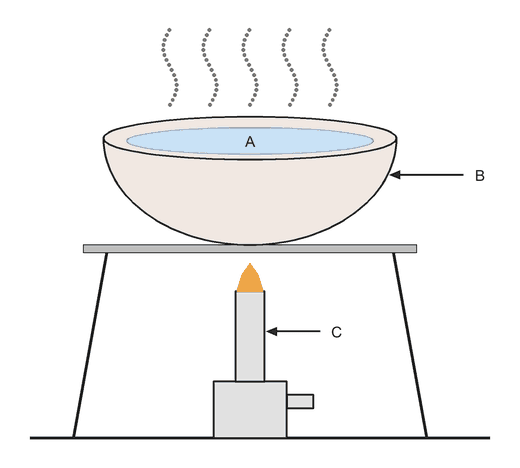
(a) Label the parts shown as A, B and C.
(b) Write the name of the method depicted above.
(c) What kind of mixture is separated by this method ?
(d) How can this process be made faster ?
(e) What is one disadvantage of this process?
Solve with AIWritten solution
Solution:
Concept: The figure shows a solution being heated in an evaporating dish. The liquid escapes as vapour, and the solid that was dissolved in it is left behind.
Step 1 — (a) Label the parts.
A is written on the liquid (the solution) in the dish, B points to the evaporating dish, and C points to the burner (a Bunsen burner) that heats it.
Step 2 — (b) Name the method.
Turning the liquid into vapour to leave the dissolved solid behind is evaporation.
Step 3 — (c) Kind of mixture.
Evaporation separates a homogeneous solid-liquid mixture (a solution) whose solid is soluble in the liquid, for example salt from salt water.
Step 4 — (d) Make it faster.
Evaporation is faster when the solution is heated more strongly, when it is spread in a wide, shallow dish (a larger surface) and when it is stirred.
Step 5 — (e) One disadvantage.
The liquid (solvent) is lost to the air as vapour; only the solid is collected. To get the liquid too, distillation must be used.
Watch out: Do not heat the last few drops strongly; the solid can spit out of the dish, so turn the heat down near the end.
Therefore, A is the solution, B the evaporating dish and C the burner; the method is evaporation, used for a soluble solid in a liquid, made faster by heating, a larger surface and stirring, but the liquid is lost.
- 405 marks
Question 40
Zainab was helping her mother in the kitchen. She took some rice grains in a bowl, which also contained a few small stones to sort. By mistake, she dropped a container of salt into the bowl, and salt got mixed with the rice grains. Her mother then asked her to separate the rice grains from the stones and the salt so that the rice would be clean and ready to cook for dinner later.
(a) What kind of mixture was formed by Zainab ? Justify your answer.
(b) How will you separate the stones from the mixture? Name the method used.
(c) What do you observe when water is added to the remaining mixture of rice grains and salt?
(d) What will you do to separate rice grains from water?
(e) How will you recover the dissolved salt from the solution?
Solve with AIWritten solution
Solution:
Concept: Rice, stones and salt are three solids that are only mixed, so each keeps its own properties. Each separation step uses a difference in size, solubility or state.
Step 1 — (a) Kind of mixture.
It is a heterogeneous (solid-solid) mixture. The rice, stones and salt are not spread evenly, each can be seen separately, and they are only mixed, not chemically combined.
Step 2 — (b) Remove the stones.
The stones are large enough to see and only a few, so they are picked out by hand: hand-picking.
Step 3 — (c) Add water.
When water is added, the salt dissolves to form salt solution, while the rice grains do not dissolve and settle at the bottom of the bowl.
Step 4 — (d) Separate rice from water.
Let the rice settle and gently pour off the salt water without disturbing it: decantation. (The water can also be strained off through a strainer.)
Step 5 — (e) Recover the salt.
Heat the salt solution in a dish (or leave it in the sun) until the water has evaporated; the salt is left behind: evaporation.
Therefore, the mixture is heterogeneous; stones are removed by hand-picking, the salt dissolves in water, the rice is separated by decantation, and the salt is recovered by evaporation.
What Class 6 Chemistry Ch 5 covers
The sections of the chapter, in the order the book takes them. Every question above comes from one of these.
- 01Pure Substances
- 02Mixtures (Impure Substances)
- 03Heterogeneous Mixtures
- 04Homogeneous Mixtures
- 05Differences Between Compounds and Mixtures
- 06Need for Separation of Constituents of Mixtures
- 07Separation Techniques of Mixtures
More ways to study this chapter
The same chapter asked three other ways. Practise it, revise it, and see what the board has set on Ch 5 before.
Class 6 Chemistry Ch 5 questions students ask
How many questions are there in Class 6 Chemistry Ch 5?
40 questions. Every one is solved step by step on this page.
Are these Class 6 Chemistry solutions free?
Yes. Every question and its full working is free to read, with no account needed.
Can I download the Class 6 Chemistry Ch 5 solutions as a PDF?
There is no PDF to download. Every solution is on this page instead, which means it is searchable, always the current syllabus, and readable on a phone. Use your browser's print option if you want it on paper.