
Opening your dashboard
Class 6 Chemistry Chapter 5 Pure Substances and Mixtures; Separation of Mixtures: Competency-Based Questions (CBQ)
40 questions on Chapter 5, each worked through on its own page with the AI tutor. Class 6 Chemistry, ICSE 2026-27.
40 questions
1–5 marks · Mixed difficulty
- 11 mark
Question 1
Cognitive domain: Application
On Diwali morning, Lakshmi is making a rangoli. Her bowl of white chalk powder tips over and falls into a bowl of common salt. The two white powders get mixed. She wants to get back both the dry chalk powder and the dry salt.
Which order of steps will work?
- 21 mark
Question 2
Cognitive domain: Analysis
Sana is given four liquids P, Q, R and S. She pours each one through a filter paper. Then she heats the liquid that passes through in a dish until the dish is dry. Her results are shown in the table.
Liquid How it looks Left on the filter paper Left in the dish after heating P Clear Nothing Nothing Q Clear Nothing White solid R Muddy Brown solid Nothing S Muddy Brown solid White solid Which conclusion is correct?
- 31 mark
Question 3
Cognitive domain: Understanding
A hospital in Chennai has a machine that makes distilled water from tap water. The nurse uses only this water to prepare injections, because the water must be completely pure. Even the salts dissolved in tap water must be removed.
In which of these cases is a mixture separated for the same reason?
- 41 mark
Question 4
Cognitive domain: Application
Imran has loose motions. A health worker tells his mother to make ORS at home. She stirs 6 level teaspoons of sugar and half a teaspoon of salt into 1 litre of clean drinking water. She stirs until no grains can be seen. The drink looks the same all through.
Which statement describes this drink correctly?
- 51 mark
Question 5
Cognitive domain: Understanding
Assertion (A): When tap water is warmed in a pan, tiny bubbles appear on the inside of the pan long before the water starts to boil.
Reason (R): Air that is dissolved in water escapes when the water is heated.
- 61 mark
Question 6
Cognitive domain: Analysis
Assertion (A): One litre of water from one sea can contain more salt than one litre of water from another sea.
Reason (R): In sea water the dissolved salt is spread evenly all through the water.
- 71 mark
Question 7
Cognitive domain: Understanding
Ammi makes garam masala at home. She roasts and grinds cumin, black pepper, cloves and cinnamon together. When she wants the masala hotter, she adds more pepper. The smell of each spice can still be noticed in the powder.
Complete the sentences about Ammi's garam masala.
Garam masala is a ________ (compound / mixture). The spices in it are called its ________. The spices are not present in a ________ proportion.
- 81 mark
Question 8
Cognitive domain: Application
Tara has four jars on her table: a piece of copper wire, some sugar, a salt solution and some muddy water. Her chart has four boxes: Element, Compound, Homogeneous mixture and Heterogeneous mixture. Exactly one jar belongs in each box.
Name the substance that Tara should place in the box marked Compound.
- 91 mark
Question 9
Cognitive domain: Understanding
Riya stirs a spoonful of atta (wheat flour) into a glass of water. She leaves the glass on the table for one hour without touching it.
Predict what Riya will see in the glass after one hour. Then say whether atta in water is a homogeneous or a heterogeneous mixture.
- 102 marks
Question 10
Cognitive domain: Application
Read these three facts.
- Sodium is a soft, silvery metal. It reacts violently with water.
- Chlorine is a greenish-yellow, poisonous gas.
- Common salt is made of sodium and chlorine. It is a white solid that we eat safely every day.
(a) Is common salt a mixture or a compound of sodium and chlorine? Give one reason from the facts above.
(b) Can sodium be taken out of common salt by a simple method such as sieving or using a filter paper? Give a reason.
- 112 marks
Question 11
Cognitive domain: Evaluation
A jewellery shop has a board that says: "Pure gold bangles – 22 carat". Meera's teacher tells her that 22-carat gold has 22 parts of gold and 2 parts of other metals such as copper. The other metals are added to make the gold harder. An 18-carat bangle has 18 parts of gold and 6 parts of other metals.
Meera says, "In science, these bangles are not a pure substance."
Is Meera right? Give two reasons to support your answer.
- 122 marks
Question 12
Cognitive domain: Evaluation
Aman has a sore throat. He stirs a spoonful of salt into a glass of warm water to gargle. Soon he cannot see any salt. He says, "The salt has vanished. Salt and water have joined to make a new substance. So salt water is a compound."
Do you agree with Aman? Describe two things he could do or observe at home that support your answer.
- 134 marks
Question 13
Cognitive domain: Application
Every morning a truck brings dry waste from homes to a waste-sorting centre. The waste has steel cans, aluminium cans, glass bottles, bits of paper, thin plastic wrappers and some sand. It moves slowly on a long belt. Machines and workers take out one kind of thing at a time. The sorted materials are sold to factories, where they are made into new things.
The table shows the four steps.
Step What is done What comes out 1 A strong magnet hangs just above the belt Steel (iron) cans 2 The waste falls off the belt while a fan blows air across it Paper bits and plastic wrappers 3 The rest is shaken on a wire mesh with small holes Sand 4 Workers pick by hand Glass bottles (a) Is the dry waste a homogeneous or a heterogeneous mixture? Give one reason. Name the property of steel that is used in step 1.
(b) Step 2 and step 3 work like two methods you have studied. Name the two methods. Explain why the fan removes the paper bits but not the cans and bottles.
(c) The aluminium cans are still on the belt after step 1. What does this tell you about aluminium? Give two reasons why it is better to separate the waste than to dump it all together.
- 144 marks
Question 14
Cognitive domain: Analysis
Gujarat makes more salt than any other state in India. On its coast, sea water is let into wide, shallow beds called salt pans. The beds lie open to the sun and the wind. After some weeks the water is gone and white salt is left.
Ishaan's class tried this in school. They made salt water as salty as sea water and put 200 mL of it into each of three vessels. They waited until each vessel was dry. Then they weighed the salt.
Vessel Shape Where it was kept Days taken to dry Salt left X Wide plate Sunny terrace 2 7 g Y Tall narrow glass Sunny terrace 9 7 g Z Wide plate Shady shelf in the classroom 6 7 g (a) Name the method of separation used in a salt pan. Where does the water go?
(b) Compare X with Y, and then X with Z. Use the table to explain why salt pans are made wide and shallow and are left open to the sun.
(c) Aarav says, "Vessel Y took the longest, so slow drying must give less salt." Is he right? Use the table to answer. Then work out how much salt the class would get from a 10-litre bucket of the same salt water.
- 155 marks
Question 15
Cognitive domain: Creativity
After a flood, the only water near Bornali's home is muddy. Her science teacher asks the class to design a simple filter to make this water clear.
Bornali has: an empty 1-litre plastic bottle with its bottom cut off, a ball of cotton, clean sand, small pebbles, crushed charcoal and a clean glass. She will hold the bottle upside down, with its open neck pointing into the glass.
(a) Design the filter. Describe what Bornali should put into the upside-down bottle, layer by layer, starting from the neck. Give a reason for where you place the cotton and where you place the pebbles.
(b) Bornali pours muddy water in at the top. What is the mud that stays inside the filter called? What is the clear water that drips into the glass called?
(c) Bornali wants to show that her filter cleans the water better than a ball of cotton alone. Describe a fair test she can do.
(d) The water in the glass now looks clear. Is it a pure substance? Give a reason. What should her family do before drinking it?
- 161 mark
Question 16
Cognitive domain: Analysis
At a building site, a worker stacks two sieves over an empty pan, as shown. The top sieve P has holes 10 mm wide and the lower sieve Q has holes 4 mm wide. He pours in a dry mixture of stones about 15 mm across, gravel about 6 mm across and sand grains about 1 mm across, and shakes the stack for a minute. (Hypothetical data.)
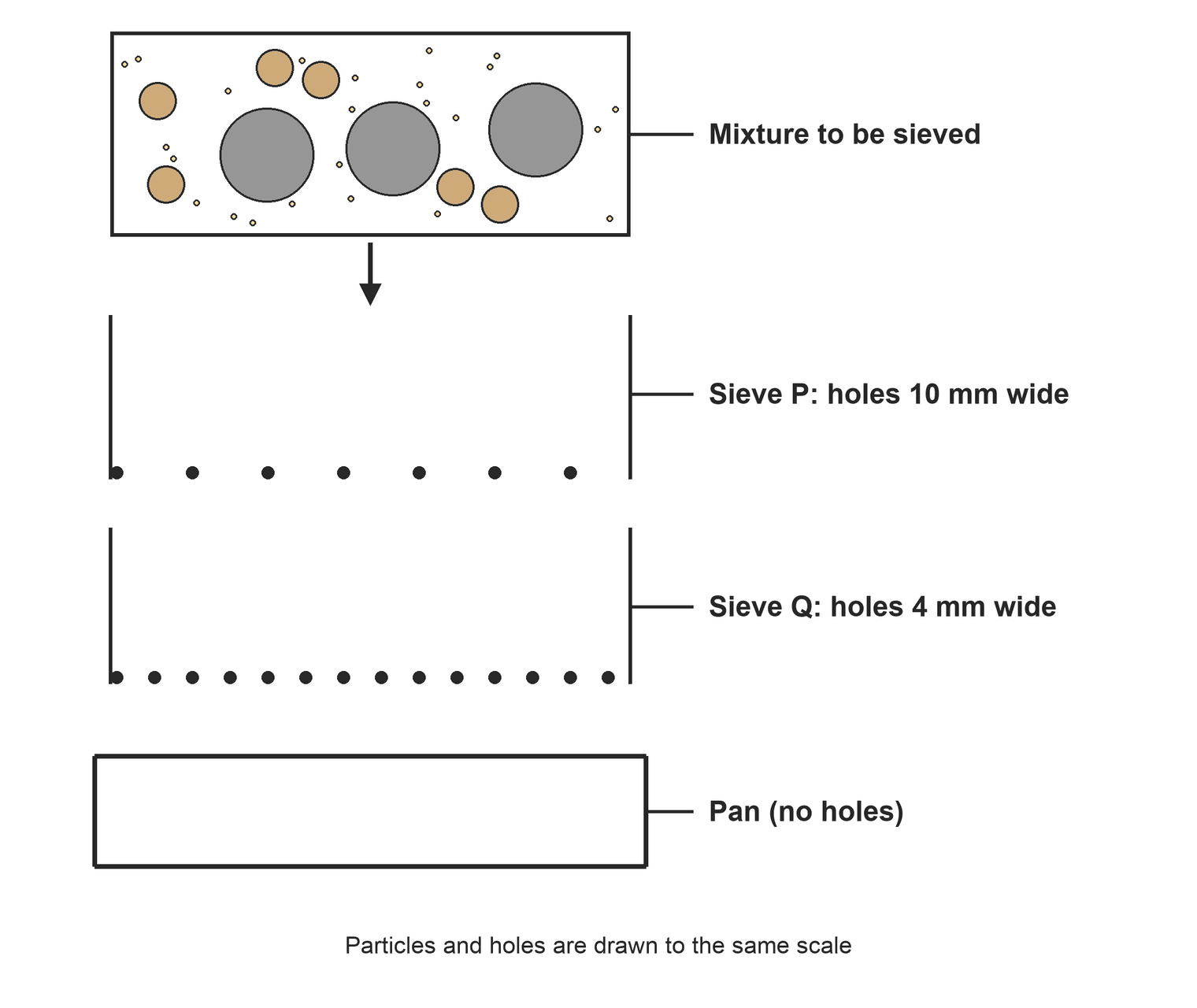
What is left on sieve P, what is left on sieve Q and what is in the pan?
- 171 mark
Question 17
Cognitive domain: Understanding
A kulfi seller packs his kulfi in a thermocol box with a block of dry ice (solid carbon dioxide). On a hot afternoon he opens the box after two hours. The block of dry ice is much smaller, but the inside of the box is dry and there is no pool of liquid in it.
Which statement explains what has happened to the dry ice?
- 181 mark
Question 18
Cognitive domain: Analysis
Chitra stirs one spoon of mustard oil into 100 mL of water in one beaker, one spoon of sugar into 100 mL of water in a second beaker, and one spoon of chalk powder into 100 mL of water in a third beaker. She labels the beakers P, Q and R in a mixed-up order. After 30 minutes the beakers look as shown.

Which option names the substance that was stirred into each beaker?
- 191 mark
Question 19
Cognitive domain: Understanding
Assertion (A): Water that has been boiled and cooled is still not good enough for topping up a car battery.
Reason (R): Boiling removes all the salts that are dissolved in tap water.
- 201 mark
Question 20
Cognitive domain: Analysis
Assertion (A): In a glass of distilled water with ice cubes made from distilled water, the ice, the liquid water and the water vapour just above the water form a mixture of three substances.
Reason (R): Ice, liquid water and water vapour are three different states of the same substance.
- 211 mark
Question 21
Cognitive domain: Application
Sarita fills a glass fish tank with tap water that she has boiled and cooled to room temperature. A few hours later her fish keep swimming to the top and gasping. A neighbour tells her, "Boiled water has lost something that fish need."
What has boiling taken out of the water?
- 221 mark
Question 22
Cognitive domain: Application
In the school laboratory, Hari heats 100 mL of sea water in a flask. The vapour passes through a long tube, kept cool by a wet cloth, into a clean beaker. When 70 mL of liquid has collected in the beaker, he stops the heating and lets everything cool.
What do the beaker and the flask hold now?
- 231 mark
Question 23
Cognitive domain: Understanding
Leela lives in a village on a river bank, and Ketan lives near a paddy field. Each of them takes a handful of soil from near home. Leela's soil is sandy and has small bits of dry leaves in it. Ketan's soil is sticky and has a lot of clay and a few small stones. The two friends wonder whether their two samples are the same kind of material.
Which statement about soil is correct?
- 241 mark
Question 24
Cognitive domain: Analysis
Anil wants to separate chalk powder from a glassful of chalk and water. He folds a filter paper into a cone and fits it into a funnel. He puts a clean beaker under the funnel and stirs the chalk and water well. Then he quickly tips all the mixture into the cone, filling it above the edge of the paper. The liquid that drips into the beaker is cloudy.
Which step of Anil's work is the reason for the cloudy liquid?
- 251 mark
Question 25
Cognitive domain: Application
Pooja shakes two spoons of powdered sugar with two spoons of fine dry sand in a jar. The mixture looks pale brown all through. She wants to show her younger brother that the sugar and the sand are only mixed, and that they have not changed into a new substance.
Which observation shows this best?
- 262 marks
Question 26
Cognitive domain: Application
A model-aircraft club needs material for the body of a model plane. The material has to be light and strong. Aluminium is light but not strong enough. The club's teacher tells them that duralumin is made by mixing a small amount of copper, magnesium and manganese with aluminium, and that it is light and much stronger than aluminium. Duralumin looks the same all through.
(a) What kind of mixture is duralumin? Give a reason for your answer.
(b) What does the use of duralumin instead of aluminium tell you about the properties of a mixture compared with those of its components?
- 272 marks
Question 27
Cognitive domain: Analysis
A sweet shop buys white sugar from two mills. Mill X makes its sugar from sugarcane, and Mill Y makes its sugar from sugar beet. The crystals from both mills look the same, taste equally sweet and are made of the same kind of molecules. The shop also buys jaggery (gur). One lump of jaggery is light brown, another is dark brown, and the two lumps do not taste exactly the same.
(a) Are the white sugars from Mill X and Mill Y the same pure substance? Give a reason.
(b) Is jaggery a pure substance? Use what the shop sees to give a reason.
- 282 marks
Question 28
Cognitive domain: Application
In water, 1 g of hydrogen is combined with 8 g of oxygen. This ratio by mass is the same in every sample of water, wherever the sample comes from. In air, the amounts of oxygen and nitrogen are not the same everywhere. Air in a crowded hall can have a little less oxygen than air in a garden.
(a) How much hydrogen and how much oxygen are there in 45 g of water?
(b) What does the difference between water and air in the passage tell you about a compound and a mixture?
- 292 marks
Question 29
Cognitive domain: Evaluation
Shweta says, "We separate the parts of a mixture only to throw away the impurities."
Use two examples from your chapter to show that Shweta's statement is not complete. For each example, name the mixture and say why it is separated.
- 302 marks
Question 30
Cognitive domain: Understanding
Imran has pasted four jars in his notebook and wants to write a chemical formula under each one. The jars hold distilled water, air, tap water and brass.
(a) Under which jar can he write a formula? Write the formula.
(b) Why can he not write a formula under each of the other three jars?
- 312 marks
Question 31
Cognitive domain: Evaluation
At a rice mill, raw rice is mixed with bits of husk. The bits of husk are almost as large as the rice grains. The owner wants to use a sieve to remove the husk. The foreman wants to drop the mixture from a height in a good wind.
(a) Will a sieve remove the husk well? Give a reason.
(b) On the day of the work there is no wind at all. Predict what will happen if the foreman still drops the mixture from a height, and suggest how the mill can make his method work on such a day.
- 323 marks
Question 32
Cognitive domain: Analysis
After tea time at a small workshop, the floor sweepings in a tin contain iron filings, sawdust and spilt sugar, all dry. The foreman makes a plan to get the three back separately.
Step What is done 1 A strong magnet is held over the dry sweepings. 2 Water is added to what is left, the mixture is stirred and then poured through a filter paper. 3 The liquid that passes through is heated in a dish until it is dry. (a) Write what is got from each of the steps 1, 2 and 3. In step 2, name both the residue and the filtrate.
(b) Why is it better to use the magnet in step 1, before the water is added?
(c) Name the method of separation used in each of the three steps.
- 333 marks
Question 33
Cognitive domain: Analysis
Rohan makes three sugar solutions by dissolving sugar in 100 g of water. He then finds the density of each solution. (Hypothetical data.)
Solution Sugar dissolved in 100 g of water Density of the solution X 10 g 1.03 g/mL Y 20 g 1.07 g/mL Z 30 g 1.10 g/mL (a) Describe how the density changes as more sugar is dissolved.
(b) Rohan makes one more solution with 15 g of sugar in 100 g of water. Between which two values will its density lie? Give a reason.
(c) What does the table tell you about the properties of a mixture such as sugar solution?
- 343 marks
Question 34
Cognitive domain: Application
In some river beds of Jharkhand, people look for tiny flakes of gold in the river sand. The flakes are about as small as the grains of sand. A worker scoops sand and water into a shallow pan and swirls it gently. He then tilts the pan, so that the water and the lighter sand wash over the edge. The heavy flakes of gold stay at the bottom of the pan.
(a) This work looks like two steps used to separate an insoluble solid from a liquid. Name the two steps.
(b) On which property of gold and sand does the method depend?
(c) Why can a magnet or a sieve not be used for this job?
- 353 marks
Question 35
Cognitive domain: Application
A South Indian filter coffee maker has two steel vessels, one over the other. The upper vessel has tiny holes in its base and holds coffee powder. When hot water is poured on the powder, a dark liquid slowly drips into the lower vessel, and the wet powder stays in the upper vessel.
(a) Name the residue and the filtrate in this work.
(b) Is the dark liquid a homogeneous or a heterogeneous mixture? Name the solvent in it.
(c) Sugar is now stirred into the dark liquid, and it disappears. Can the sugar be got back by passing the liquid through a filter? Give a reason.
- 363 marks
Question 36
Cognitive domain: Evaluation
A flour mill fits a strong magnet above the chute through which wheat flows to the grinding stone. Iron nails and bolts that may have fallen into the wheat would damage the stone and also get into the flour. The manager says, "This magnet will also remove the small stones, the pieces of glass and the bits of aluminium foil that are in the wheat."
(a) Is the manager right? Say which of the things named above the magnet will remove.
(b) Name the property of a component on which magnetic separation depends.
(c) Name one method that can remove the small stones that the magnet leaves behind.
- 374 marks
Question 37
Cognitive domain: Analysis
A steel mill in Jamshedpur makes steel by mixing a very small amount of carbon with iron. Different articles need steel with different amounts of carbon. A girder must bend a little without breaking, a knife must keep a sharp edge, and a file must be very hard. A visiting class is shown the table below, which gives the amount of carbon in 100 g of the steel used for three articles. The students are told that the rest of the steel is iron. (Hypothetical data.)
Article Carbon in 100 g of steel Girder of a bridge 0.2 g Kitchen knife 0.8 g File 1.2 g (a) Which article is made of steel with the most iron in 100 g, and how much iron is that?
(b) Name the kind of mixture that steel is. Say why the table shows that steel is a mixture and not a compound.
(c) How much carbon and how much iron are there in 500 g of the steel used for the knife?
- 385 marks
Question 38
Cognitive domain: Evaluation
A fishing village on a sunny coast has no source of drinking water except the sea. A school group builds a simple still. A wide shallow pot is filled with sea water and covered by a clear plastic sheet that slopes down to a small cup placed in the middle of the pot, above the water level. In the sun the water in the pot warms up, drops of water form under the sheet and run down into the cup. On a sunny day the cup fills with a little water. After several days a white crust is seen at the bottom of the pot.
(a) Name the two changes of state that take place in the pot and under the sheet. What is the whole method called?
(b) Is the water in the cup pure? What is the white crust?
(c) Judge how useful the still is for the village. Give one advantage and one limit of the still.
- 394 marks
Question 39
Cognitive domain: Analysis
Dr Banerjee's clinic keeps four bottles of liquid medicine on a shelf. A new nurse, Mala, is told that she must give every patient the right dose from the bottle. She notices that two of the bottles have the words "Shake well before use" on their labels, but the other two do not. She asks the doctor to explain, and the doctor shows her the table of what is in each bottle.
Bottle What is in it How it looks P Zinc oxide powder in water (calamine lotion) Pink, with a layer of powder settled at the bottom Q Medicine and sugar dissolved in water (cough syrup) Clear, the same all through R Salt dissolved in distilled water (saline) Clear, the same all through S A white solid in water (antacid) Milky, with a layer of white solid settled at the bottom (a) Name the bottles that hold a homogeneous mixture and the bottles that hold a heterogeneous mixture.
(b) Why do the labels of P and S say "Shake well before use", but the labels of Q and R do not?
(c) The liquid of each bottle is passed through a filter paper. In which bottles will a solid be left on the paper? Name one method by which the dissolved solids (the sugar and the medicine) can be got back from the liquid of Q.
- 405 marks
Question 40
Cognitive domain: Creativity
Gita's teacher gives her three jars of white powder with their labels removed. She knows that the jars hold chalk powder, common salt and ammonium chloride, one in each jar. The teacher says that Gita must find out which powder is in which jar by doing tests only, and not by tasting or smelling any of them. She may use water, a spoon, a few test tubes and, with her teacher's help, a flame. She must also write down what she sees, so that her classmates can repeat her tests and get the same results.
(a) Plan a first test that picks out the jar of chalk powder. Say what Gita should do and what she will see for chalk powder and for the other two powders.
(b) Plan a second test, with her teacher's help, that tells the other two jars apart. Say what she will see for each.
(c) Draw a table of 3 rows and 3 columns, to show what Gita will record for each powder: its name, what she sees in water and what she sees on heating a little in a dry test tube.