
Opening your dashboard
Class 6 Chemistry Chapter 5 Pure Substances and Mixtures; Separation of Mixtures: Practice Questions
52 questions on Chapter 5, each worked through on its own page with the AI tutor. Class 6 Chemistry, ICSE 2026-27.
52 questions
1–5 marks · Mixed difficulty
- 11 mark
Question 1
Bloom's level: Remember
Substances are classified into two main groups — pure substances and mixtures. In which pair are both substances pure?
- 21 mark
Question 2
Bloom's level: Remember
A pure substance is always:
- 31 mark
Question 3
Bloom's level: Understand
Which of the following pairs of liquids forms a heterogeneous mixture when shaken together and left to stand?
- 41 mark
Question 4
Bloom's level: Apply
When ammonia gas is passed into water, it dissolves and the liquid looks the same throughout. The mixture formed is a:
- 51 mark
Question 5
Bloom's level: Apply
A little iodine has got mixed with some powdered common salt. The best method to separate the two is:
- 61 mark
Question 6
Bloom's level: Apply
A builder receives a truck-load of sand that contains many small pebbles. Which method should be used to remove the pebbles?
- 71 mark
Question 7
Bloom's level: Understand
Iron sulphide is formed when a mixture of iron filings and sulphur is heated. Which observation shows that iron sulphide is a compound and not a mixture?
- 81 mark
Question 8
Bloom's level: Analyse
Liquid P is taken from three different bottles and each sample boils at exactly 78 °C. Liquid Q is also taken from three bottles; the samples boil at 101 °C, 102 °C and 104 °C. What can you conclude?
- 91 mark
Question 9
Bloom's level: Understand
Which of the following is not a reason for separating the constituents of a mixture?
- 101 mark
Question 10
Bloom's level: Understand
Assertion (A): Brass is a homogeneous mixture.
Reason (R): In brass, copper and zinc are uniformly distributed and cannot be seen separately.
- 111 mark
Question 11
Bloom's level: Evaluate
Assertion (A): Common salt can be separated from sea water by filtration.
Reason (R): Common salt is soluble in water.
- 121 mark
Question 12
Bloom's level: Analyse
Assertion (A): Water is a compound but air is a mixture.
Reason (R): Air is made up of more than one element.
- 132 marks
Question 13
Bloom's level: Remember
(a) Define solute and solvent.
(b) Tincture of iodine is made by dissolving iodine in alcohol. Name the solute and the solvent in it.
- 142 marks
Question 14
Bloom's level: Remember
Complete each statement with the correct word(s).
(a) A mixture is also called an ________ substance.
(b) Mixtures are of two types: ________ and ________.
(c) A pure substance has a definite ________ and definite properties.
(d) The constituents of a mixture can be separated by simple ________ methods.
- 152 marks
Question 15
Bloom's level: Understand
"A mixture has no definite set of properties." Explain this statement using a solution of sugar in water as the example.
- 162 marks
Question 16
Bloom's level: Apply
Each of the following is a heterogeneous mixture. State the physical states of its components (for example, solid + liquid).
(a) Smoke
(b) Mist
(c) Charcoal powder stirred into water
(d) Sand mixed with iron filings
- 172 marks
Question 17
Bloom's level: Understand
Gold is an element and sugar is a compound, yet both are called pure substances. Explain why.
- 182 marks
Question 18
Bloom's level: Apply
Name the method you would use to separate each mixture, and the property of the components on which it depends.
(a) Iron pins that have fallen into a heap of sawdust
(b) Powdered naphthalene mixed with common salt
- 192 marks
Question 19
Bloom's level: Apply
State which purpose of separation — getting useful substances, removing undesirable or harmful substances, or getting completely pure substances — is served in each case.
(a) Picking out small stones from pulses before cooking
(b) Obtaining LPG, petrol and kerosene from crude petroleum
(c) Preparing distilled water for use in car batteries
- 202 marks
Question 20
Bloom's level: Analyse
Two solids X and Y are tested.
Solid X: grey and yellow particles can be seen; a magnet pulls out the grey particles; the yellow particles dissolve in carbon disulphide.
Solid Y: a uniform black solid; nothing is attracted by a magnet; nothing dissolves in carbon disulphide.
Which solid is a mixture and which is a compound? Give a reason for each.
- 212 marks
Question 21
Bloom's level: Evaluate
Riya wants to get both the salt and pure water from a salt solution. She says, "Evaporation is the best method." Do you agree? Justify your answer.
- 221 mark
Question 22
Bloom's level: Understand
Tap water and honey look like pure substances. Why are they classified as mixtures?
- 234 marks
Question 23
Bloom's level: Apply
People in a village fill large earthen pots with muddy water from a pond. The water contains sand, very fine clay particles and some dissolved salts.
(a) A pot is left undisturbed for a few hours. Name this process and state what happens to the sand.
(b) The fine clay particles do not settle even after many hours. Name the chemical that can be added to make them settle faster, name this process, and explain how the chemical works.
(c) The clear water is then poured gently into another pot and passed through a clean cotton cloth folded several times. Name these two processes. Is the water now free of the dissolved salts? Give a reason.
- 244 marks
Question 24
Bloom's level: Analyse
In a science club, Rohan mixes iron filings and sulphur powder (sample A). He heats part of the mixture strongly in a test tube and gets a black mass (sample B). His observations are:
Test Sample A Sample B Appearance Grey and yellow particles seen Uniform black mass Magnet brought near Grey particles attracted Nothing attracted Carbon disulphide added Yellow part dissolves; grey particles settle Does not dissolve (a) Which sample is a mixture and which is a compound?
(b) What do the magnet test and the carbon disulphide test tell you about the properties of iron and sulphur in each sample?
(c) Rohan says, "Sample B is still just iron and sulphur stuck together." Use the observations to show why he is wrong, and state two other differences between a compound and a mixture.
- 255 marks
Question 25
Bloom's level: Create
You are given a mixture of iron filings, ammonium chloride, common salt and sand. Design a step-by-step plan to obtain each of the four components separately. For every step, name the method and the property of the component that makes it work, and explain why your steps are in that order.
- 264 marks
Question 26
Bloom's level: Evaluate
A classmate's revision notes contain the statements below. Judge whether each statement is correct or incorrect. Rewrite every incorrect statement correctly.
(a) A mixture has a fixed melting point.
(b) Mixtures can be represented by a chemical formula.
(c) Elements and compounds are both pure substances.
(d) Separating the constituents of a mixture always needs a chemical reaction.
- 273 marks
Question 27
Bloom's level: Analyse
Meena shakes a handful of garden soil with water in a tall glass jar and leaves it overnight. Next morning she sees, from the bottom up: a layer of small pebbles, a layer of coarse sand, a thin layer of fine clay, and slightly muddy water with bits of dry leaves floating on top.
(a) Is the soil–water mixture homogeneous or heterogeneous? Give two pieces of evidence from her observations.
(b) Explain why the layers formed in this order.
(c) Her friend repeats the test with soil from a riverbank and gets layers of very different thickness. What does this tell you about soil as a mixture?
- 284 marks
Question 28
Bloom's level: Apply
Aman makes lemonade by stirring sugar, a pinch of salt and strained lemon juice into a jug of water. The lemonade looks the same throughout.
(a) Is lemonade a pure substance or a mixture? Give two characteristics of mixtures that it shows.
(b) Is it homogeneous or heterogeneous? Give a reason.
(c) Aman's sister adds two more spoons of sugar to her glass. Is her drink still lemonade? What does this show about the composition of a mixture, and why can lemonade not be given a chemical formula?
- 294 marks
Question 29
Bloom's level: Apply
For each mixture, name the method of separation and state the principle on which it works.
(a) Tea leaves from freshly brewed tea
(b) Pure water from blue ink
(c) Dissolved carbon dioxide from a glass of soda water
(d) Very fine dust particles from a large tank of river water
- 304 marks
Question 30
Bloom's level: Create
Design a simple experiment to show that tap water is not a pure substance but contains dissolved substances. Write the aim, the materials needed, the steps, the expected observation and the conclusion. Also suggest how you would use distilled water to make your result more convincing.
- 311 mark
Question 31
A farmer stands on a raised platform and lets a mixture of grain and husk fall slowly from a basket. The wind carries the husk away, and the grain falls straight down. This method works because the two solids differ in their:
- 321 mark
Question 32
Some coconut oil has fallen into a jug of water. The oil floats as a separate layer on the water. Which apparatus is best for separating the two liquids?
- 331 mark
Question 33
Before cooking moong dal, Anita finds a few small black stones mixed in it. The stones can be seen easily. Which is the simplest method to remove them?
- 341 mark
Question 34
A mixture is left standing for some time so that the heavier particles sink to the bottom. This is called sedimentation. For which kind of mixture can it be used?
- 351 mark
Question 35
A hot, strong solution of impure alum is filtered and then left to cool slowly. Pure, clear pieces of solid alum with a regular shape separate out. Give the scientific name of this method of getting a pure solid from its solution.
- 361 mark
Question 36
Fill in the blank.
Muddy water is kept still in a beaker until the mud settles at the bottom. Then the clear water above it is poured out gently into another beaker without disturbing the mud. This second step is called ________ .
- 371 mark
Question 37
State whether the statement is true or false. If it is false, write the correct statement.
Distillation is the method used to separate two liquids that do not mix with each other, such as oil and water.
- 382 marks
Question 38
Give one example of each.
(a) A mixture made of two liquids
(b) A mixture whose components can be separated by filtration
- 393 marks
Question 39
Pick the odd one out in each set and give a reason for your choice.
(a) Sieving, winnowing, melting, filtration
(b) Iron sulphide, carbon dioxide, air, sugar
(c) Tap water, bronze, common salt, soil
- 403 marks
Question 40
Iron is an element. Iron sulphide is a compound. Iron filings stirred with sulphur powder form a mixture.
Compare an element, a compound and a mixture on these three points:
(a) what each is made of
(b) whether each can be broken down or separated, and how
(c) its properties
- 414 marks
Question 41
Name the method you would use for each task.
(a) To get clear water from a bucket of muddy water, without using a filter
(b) To remove chalk powder that has been stirred into a glass of water
(c) To get pure crystals of copper sulphate from an impure sample of it
(d) To get back the common salt dissolved in a cup of water, when the water is not needed
- 425 marks
Question 42
Kabir has a mixture of camphor and common salt. He heats it gently using the set-up shown below.
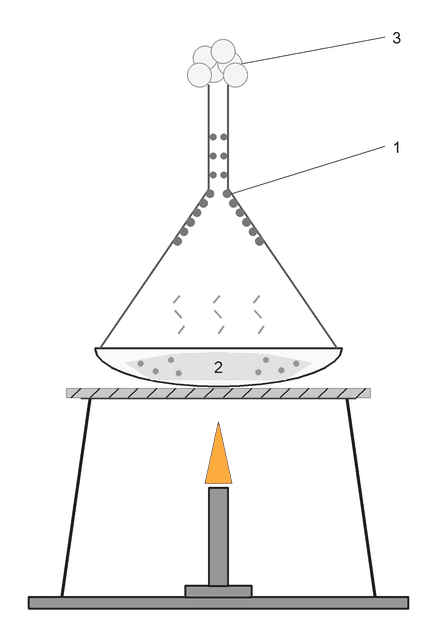
(a) Name this method of separation.
(b) Which solid collects at 1, and which solid is left at 2?
(c) Why is the opening of the funnel closed with cotton at 3?
(d) Which property of camphor makes this separation possible?
- 431 mark
Question 43
Soda water is a homogeneous mixture of :
- 441 mark
Question 44
A farmer drops a mixture of grain and husk from a height on a windy day. The husk is blown away and the grain falls in a heap near him. This method of separation is called :
- 451 mark
Question 45
A sample of which of the following contains only one kind of molecules ?
- 461 mark
Question 46
Fill in the blank :
The clear liquid that passes through the filter paper during filtration is called the ..............
- 471 mark
Question 47
Write true or false :
A mixture has a fixed melting point and a fixed boiling point.
- 482 marks
Question 48
A spoonful of chalk powder is stirred in water in beaker P, and a spoonful of sugar is stirred in water in beaker Q. Both beakers are then left undisturbed for some time.
(a) Which beaker contains a heterogeneous mixture ?
(b) Give two observations which show that this mixture is heterogeneous.
- 492 marks
Question 49
Tap water is fit for drinking. Yet distilled water, and not tap water, is used to prepare medicines that are given by injection.
(a) Why is tap water not used for this purpose ?
(b) Which need for the separation of the components of mixtures does this example show ?
- 505 marks
Question 50
A student is given 50 g of a dry mixture of sand and common salt. She stirs it well with water and filters it. The solid left on the filter paper is dried and weighed. Its mass is 32 g.
(a) Name the residue and the substance dissolved in the filtrate.
(b) Calculate the mass of common salt in the mixture, and the percentage of common salt in the mixture.
(c) Name the method by which she can get the salt back from the filtrate, and describe it briefly. Why can the salt not be separated from the water by filtration ?
- 514 marks
Question 51
Three samples of a black powder X, made in three different ways, were analysed. Three samples of a powder Y, collected from three places, were also analysed. The results are given in the table.
Sample Powder X : copper Powder X : oxygen Powder Y : sand Powder Y : salt 1 8 g 2 g 6 g 4 g 2 12 g 3 g 9 g 1 g 3 20 g 5 g 5 g 5 g (a) Find the ratio of the mass of copper to the mass of oxygen in each sample of X.
(b) Which powder is a compound and which is a mixture ? Give a reason from the table.
(c) How much oxygen will be present in a sample of X that contains 16 g of copper ?
(d) State one more difference between a compound and a mixture.
- 524 marks
Question 52
(a) Copy and complete the table.
Mixture Components Kind of mixture (by state) Homogeneous or heterogeneous Brass Muddy water Air Petrol and water (b) Brass is called an alloy. What is an alloy ?
(c) Mixtures are also called impure substances. Why ?