Solution:
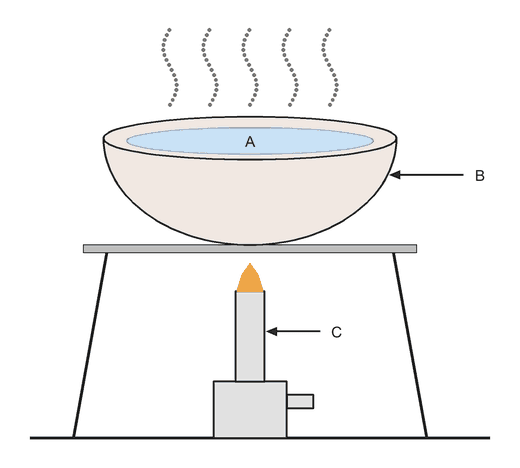
Concept: The figure shows a solution being heated in an evaporating dish. The liquid escapes as vapour, and the solid that was dissolved in it is left behind.
Step 1 — (a) Label the parts.
A is written on the liquid (the solution) in the dish, B points to the evaporating dish, and C points to the burner (a Bunsen burner) that heats it.
Step 2 — (b) Name the method.
Turning the liquid into vapour to leave the dissolved solid behind is evaporation.
Step 3 — (c) Kind of mixture.
Evaporation separates a homogeneous solid-liquid mixture (a solution) whose solid is soluble in the liquid, for example salt from salt water.
Step 4 — (d) Make it faster.
Evaporation is faster when the solution is heated more strongly, when it is spread in a wide, shallow dish (a larger surface) and when it is stirred.
Step 5 — (e) One disadvantage.
The liquid (solvent) is lost to the air as vapour; only the solid is collected. To get the liquid too, distillation must be used.
Watch out: Do not heat the last few drops strongly; the solid can spit out of the dish, so turn the heat down near the end.
Therefore, A is the solution, B the evaporating dish and C the burner; the method is evaporation, used for a soluble solid in a liquid, made faster by heating, a larger surface and stirring, but the liquid is lost.