
Opening your dashboard
Class 6 Biology Chapter 5: Respiratory System Solutions
33 textbook questions with step-by-step answers, free to read, for ICSE 2026-27.
Get talked through Ch 5, not just shown the answer
Reading a finished solution is not the same as being able to do it. The AI tutor takes one question at a time and works it with you, in your own words, until you can.
- Ask it out loud, in your own words
- It gives you the next step, not the answer
- Stuck on part (ii)? Start there
33 questions with solutions
1–12 marks · Mixed difficulty
- 11 mark
Question 1
In humans, taking air through nostrils into the nasal cavity is called
Solve with AIAnswer
- Correct
(A) Inhalation
(B) Exhalation
(C) Cellular respiration
(D) Internal respiration
Answer: (A) Inhalation
Concept: Breathing moves air in and out of the lungs. In inhalation the ribs move up and out and the diaphragm moves down, so the chest cavity becomes larger; in exhalation the ribs move down and in and the diaphragm moves up, so the chest cavity becomes smaller.
Step 1 — See what the stem describes.
The stem describes air being taken in through the nostrils into the nasal cavity, on its way to the lungs.
Step 2 — Name the step.
Taking air in is inhalation (also called inspiration), so the answer is option (A).
Watch out: Inhalation brings air in and exhalation sends it out; the two names are easy to swap.
Why the other options are wrong:
- (B) Exhalation: this is expiration, forcing air out of the lungs, the opposite of what the stem describes.
- (C) Cellular respiration: it is the breakdown of glucose inside the cells to release energy; it is not the movement of air into the nose.
- (D) Internal respiration: it is the exchange of gases between the blood and the body cells (some books use the term for cellular respiration); it does not take place in the nose.
Therefore, taking air through the nostrils into the nasal cavity is called inhalation, option (A).
- 21 mark
Question 2
The front opening of the wind pipe is guarded by —
Solve with AIAnswer
(A) Glottis
(B) Exoglottis
- Correct
(C) Epiglottis
(D) Trachea
Answer: (C) Epiglottis
Concept: Air travels along the respiratory system in this order: nose (nostrils and nasal cavity) → pharynx (throat) → larynx (voice box) → trachea (wind pipe) → bronchi → bronchioles → alveoli (air sacs) of the lungs.
Step 1 — Find the opening of the wind pipe.
At the top of the wind pipe (in the larynx) there is a slit-like opening called the glottis. Air passes through it into the wind pipe.
Step 2 — Find what guards it.
A leaf-shaped flap of tissue, the epiglottis, hangs over the glottis. When we swallow, it closes the glottis, so food goes into the food pipe and not into the wind pipe. So the answer is option (C).
Watch out: The glottis is the opening; the epiglottis is the lid over it.
Why the other options are wrong:
- (A) Glottis: it is the opening itself, not the flap that guards it.
- (B) Exoglottis: there is no part called the ‘exoglottis’ in the human body.
- (D) Trachea: it is the wind pipe itself, so it cannot guard its own opening.
Therefore, the front opening of the wind pipe is guarded by the epiglottis, option (C).
- 31 mark
Question 3
The process during which food is oxidised and energy is released is called
Solve with AIAnswer
- Correct
(A) Cellular respiration
(B) Excretion
(C) Digestion
(D) Transpiration
Answer: (A) Cellular respiration
Concept: Respiration is the process in which food (glucose) is broken down inside the body cells to release energy. In cellular (aerobic) respiration glucose is oxidised with oxygen, giving carbon dioxide, water and energy.
Step 1 — Match the stem with a process.
The stem speaks of food being oxidised and energy being released. This happens inside every living cell when glucose combines with oxygen.
Step 2 — Name the process.
This process is cellular respiration, option (A).
Watch out: Breathing only moves air; the energy is released in the cells by cellular respiration.
Why the other options are wrong:
- (B) Excretion: it is the removal of waste products, such as urea and carbon dioxide, from the body.
- (C) Digestion: it breaks large food molecules into small ones that can be absorbed; it does not oxidise food to release energy for the body.
- (D) Transpiration: it is the loss of water vapour from the leaves of plants.
Therefore, the process in which food is oxidised and energy is released is cellular respiration, option (A).
- 41 mark
Question 4
Which of the following is not a part of the respiratory system ?
Solve with AIAnswer
(A) Nostrils
(B) Lungs
- Correct
(C) Mouth
(D) Trachea
Answer: (C) Mouth
Concept: Air travels along the respiratory system in this order: nose (nostrils and nasal cavity) → pharynx (throat) → larynx (voice box) → trachea (wind pipe) → bronchi → bronchioles → alveoli (air sacs) of the lungs.
Step 1 — List the parts of the respiratory system.
The respiratory system is made of the nose (nostrils), pharynx, larynx, trachea, bronchi and lungs.
Step 2 — Find the odd one.
The mouth is the first part of the digestive system. We can breathe through it when the nose is blocked, but it is not one of the respiratory organs, so the answer is option (C).
Watch out: Breathing through the nose is better, because the nose filters, warms and moistens the air; the mouth does not.
Why the other options are wrong:
- (A) Nostrils: they are the openings through which air enters the respiratory system.
- (B) Lungs: they are the main organs of the respiratory system, where gases are exchanged.
- (D) Trachea: the wind pipe carries air from the larynx down to the bronchi and lungs.
Therefore, the mouth is not a part of the respiratory system, option (C).
- 51 mark
Question 5
The common passage of wind pipe and food pipe is termed as :
Solve with AIAnswer
(A) Larynx
(B) Glottis
- Correct
(C) Pharynx
(D) Epiglottis
Answer: (C) Pharynx
Concept: Air travels along the respiratory system in this order: nose (nostrils and nasal cavity) → pharynx (throat) → larynx (voice box) → trachea (wind pipe) → bronchi → bronchioles → alveoli (air sacs) of the lungs.
Step 1 — Follow food and air in the throat.
Food from the mouth and air from the nose both pass through the pharynx (throat). Below it, the passage divides into the wind pipe (in front) and the food pipe (behind).
Step 2 — Pick the option.
So the common passage of the wind pipe and the food pipe is the pharynx, option (C).
Watch out: Pharynx and larynx sound alike: the pharynx is the shared throat, the larynx is the voice box.
Why the other options are wrong:
- (A) Larynx: the voice box is the top part of the wind pipe only; food does not pass through it.
- (B) Glottis: it is only the opening of the wind pipe.
- (D) Epiglottis: it is the flap that closes the glottis during swallowing.
Therefore, the common passage of the wind pipe and the food pipe is the pharynx, option (C).
- 61 mark
Question 6
The energy produced during cellular respiration is :
Solve with AIAnswer
(A) ADP
(B) ADH
- Correct
(C) ATP
(D) None of the above
Answer: (C) ATP
Concept: Respiration is the process in which food (glucose) is broken down inside the body cells to release energy. In cellular (aerobic) respiration glucose is oxidised with oxygen, giving carbon dioxide, water and energy.
Step 1 — Recall how the cell stores energy.
The energy released when glucose is oxidised is not left loose in the cell. It is stored in molecules of ATP (adenosine triphosphate), the energy currency of the cell.
Step 2 — Pick the option.
So the energy produced during cellular respiration is held in ATP, option (C).
Watch out: ATP is not energy itself; it is the molecule that stores the energy and hands it on to the cell's work.
Why the other options are wrong:
- (A) ADP: adenosine diphosphate is what is left after ATP gives up some of its energy; it is changed back into ATP during respiration.
- (B) ADH: antidiuretic hormone controls how much water is lost in urine; it has nothing to do with storing energy.
- (D) None of the above: ATP is listed in option (C), so ‘none of the above’ is wrong.
Therefore, the energy produced during cellular respiration is stored as ATP, option (C).
- 71 mark
Question 7
The basic structural and functional unit of the lungs is :
Solve with AIAnswer
(A) Pleura
- Correct
(B) Alveolus
(C) Capillary
(D) Diaphragm
Answer: (B) Alveolus
Concept: Air travels along the respiratory system in this order: nose (nostrils and nasal cavity) → pharynx (throat) → larynx (voice box) → trachea (wind pipe) → bronchi → bronchioles → alveoli (air sacs) of the lungs.
Step 1 — Recall what the lungs are made of.
Each lung is made of millions of tiny air sacs called alveoli (singular: alveolus). Each one is covered by a network of blood capillaries.
Step 2 — Find the unit.
Gases are exchanged between the air and the blood in every alveolus, so the alveolus is the basic structural and functional unit of the lungs, option (B).
Why the other options are wrong:
- (A) Pleura: it is the double membrane that covers and protects the lungs; it is a covering, not a unit.
- (C) Capillary: capillaries are fine blood vessels wrapped around the alveoli; they belong to the circulatory system.
- (D) Diaphragm: it is the muscular sheet below the lungs; it helps in breathing but is not part of the lungs.
Therefore, the basic structural and functional unit of the lungs is the alveolus, option (B).
- 81 mark
Question 8
Vocal cords are found in :
Solve with AIAnswer
- Correct
(A) Larynx
(B) Gullet
(C) Pharynx
(D) Glottis
Answer: (A) Larynx
Concept: Air travels along the respiratory system in this order: nose (nostrils and nasal cavity) → pharynx (throat) → larynx (voice box) → trachea (wind pipe) → bronchi → bronchioles → alveoli (air sacs) of the lungs.
Step 1 — Recall where sound is made.
Sound is produced in the larynx (voice box) at the top of the trachea. It has two folds called the vocal cords.
Step 2 — Say how they work.
When air from the lungs is forced between the vocal cords, they vibrate and make sound. So vocal cords are found in the larynx, option (A).
Why the other options are wrong:
- (B) Gullet: this is the food pipe (oesophagus); it carries food, not air.
- (C) Pharynx: it is the throat, the common passage for food and air above the larynx.
- (D) Glottis: it is the opening between the vocal cords; the cords themselves belong to the larynx.
Therefore, vocal cords are found in the larynx, option (A).
- 91 mark
Question 9
Which of the following is a respiratory pigment ?
Solve with AIAnswer
(A) Melanin
- Correct
(B) Haemoglobin
(C) Chlorophyll
(D) None of the above
Answer: (B) Haemoglobin
Concept: A respiratory pigment is a coloured substance in the blood that carries oxygen.
Step 1 — Find the oxygen carrier.
In the red blood cells, haemoglobin combines with oxygen in the lungs and gives it up to the body cells.
Step 2 — Pick the option.
So haemoglobin is the respiratory pigment, option (B).
Why the other options are wrong:
- (A) Melanin: it is the pigment that colours the skin, hair and eyes; it does not carry oxygen.
- (C) Chlorophyll: it is the green pigment of plants that traps sunlight for photosynthesis.
- (D) None of the above: haemoglobin is a respiratory pigment, so ‘none of the above’ is wrong.
Therefore, haemoglobin is a respiratory pigment, option (B).
- 101 mark
Question 10
The muscular sheet which divides the body cavity into thorax and abdomen is termed as :
Solve with AIAnswer
(A) Inner pleura
(B) Rib cage
(C) Outer pleura
- Correct
(D) Diaphragm
Answer: (D) Diaphragm
Concept: Breathing moves air in and out of the lungs. In inhalation the ribs move up and out and the diaphragm moves down, so the chest cavity becomes larger; in exhalation the ribs move down and in and the diaphragm moves up, so the chest cavity becomes smaller.
Step 1 — Recall the floor of the chest.
A dome-shaped muscular sheet, the diaphragm, lies below the lungs. It separates the chest (thoracic) cavity above from the abdominal cavity below.
Step 2 — Pick the option.
So the muscular sheet that divides the body cavity into thorax and abdomen is the diaphragm, option (D).
Why the other options are wrong:
- (A) Inner pleura: it is a thin membrane covering the lungs, not a muscular sheet.
- (B) Rib cage: it is made of bones (ribs) round the chest; it protects the lungs and heart.
- (C) Outer pleura: it is a thin membrane lining the chest wall, not a muscular sheet.
Therefore, the muscular sheet that divides the body cavity into thorax and abdomen is the diaphragm, option (D).
- 111 mark
Question 11
Assertion (A): The energy produced during the process of respiration is utilized by the body for various external and internal activities.
Reason (R): No energy is used by the body during sleep because all physical activities stop when we are asleep.
Solve with AIAnswer
(A) (1) Both A and R are true and R is the correct explanation of A.
(B) (2) Both A and R are true but R is not the correct explanation of A.
- Correct
(C) (3) A is true but R is false.
(D) (4) A is false but R is true.
Answer: (C) (3) A is true but R is false.
Concept: In an assertion-reason item, first judge the Assertion (A) and the Reason (R) separately as true or false; only when both are true do we ask whether R correctly explains A.
Step 1 — Judge the Assertion.
A is true. Energy from respiration is used for outside (external) activities, such as walking and playing, and for inside (internal) ones, such as digestion, growth and the working of the brain.
Step 2 — Judge the Reason.
R is false. Even in sleep the heart keeps beating, we keep breathing, food is digested, the body is kept warm and the brain keeps working. All these use energy.
Step 3 — Pick the option.
A is true and R is false, so the answer is option (C).
Watch out: The body never stops using energy; it only uses less of it when we rest.
Why the other options are wrong:
- (A): R is false, so it cannot explain A.
- (B): R is false, so ‘both true’ cannot be right.
- (D): A is true: the body does use the energy from respiration for its activities.
Therefore, A is true but R is false, option (C).
- 121 mark
Question 12
Assertion (A): The front opening (glottis) of the wind pipe is guarded by a muscular flap called epiglottis which prevents the entry of food in the trachea.
Reason (R): The trachea is supported by C-shaped cartilage rings that keep it open for the passage of air.
Solve with AIAnswer
(A) (1) Both A and R are true and R is the correct explanation of A.
- Correct
(B) (2) Both A and R are true but R is not the correct explanation of A.
(C) (3) A is true but R is false.
(D) (4) A is false but R is true.
Answer: (B) (2) Both A and R are true but R is not the correct explanation of A.
Concept: In an assertion-reason item, first judge the Assertion (A) and the Reason (R) separately as true or false; only when both are true do we ask whether R correctly explains A.
Step 1 — Judge the Assertion.
A is true. When we swallow, the epiglottis closes the glottis, so food goes into the food pipe and not into the trachea.
Step 2 — Judge the Reason.
R is true. C-shaped rings of cartilage in the wall of the trachea stop it from collapsing, so the air passage always stays open.
Step 3 — Decide whether R explains A.
A is about how food is kept out of the wind pipe; R is about how the tube is kept open. R does not explain A, so the answer is option (B).
Watch out: Two true facts about the same organ are not enough; R must give the cause of A.
Why the other options are wrong:
- (A): the cartilage rings keep the tube open; they do not stop food entering it, so R does not explain A.
- (C): R is true: the trachea does have C-shaped cartilage rings.
- (D): A is true: the epiglottis does guard the glottis.
Therefore, both A and R are true but R is not the correct explanation of A, option (B).
- 131 mark
Question 13
Assertion (A): Alveoli are the basic structural and functional units of lungs which are richly supplied with blood capillaries.
Reason (R): The thin walls of the blood capillaries allow faster diffusion of the respiratory gases into the lungs as alveoli are surrounded by blood capillaries.
Solve with AIAnswer
- Correct
(A) (1) Both A and R are true and R is the correct explanation of A.
(B) (2) Both A and R are true but R is not the correct explanation of A.
(C) (3) A is true but R is false.
(D) (4) A is false but R is true.
Answer: (A) (1) Both A and R are true and R is the correct explanation of A.
Concept: In an assertion-reason item, first judge the Assertion (A) and the Reason (R) separately as true or false; only when both are true do we ask whether R correctly explains A.
Step 1 — Judge the Assertion.
A is true. The alveoli are the units of the lungs where gases are exchanged, and each alveolus is wrapped in a dense network of blood capillaries.
Step 2 — Judge the Reason.
R is true. The walls of the capillaries are very thin, and they lie right against the alveoli, so the respiratory gases diffuse across quickly.
Step 3 — Decide whether R explains A.
R tells us why the alveoli need such a rich supply of thin-walled capillaries: it makes the exchange of gases fast. So R explains A, and the answer is option (A).
Note: Strictly, the gases move both ways: oxygen passes from the alveoli into the blood, and carbon dioxide from the blood into the alveoli. The walls of the alveoli are also only one cell thick.
Why the other options are wrong:
- (B): R gives the purpose of the rich capillary supply, so it does explain A.
- (C): R is true: thin capillary walls next to the alveoli do allow fast diffusion.
- (D): A is true: the alveoli are the units of the lungs and are richly supplied with capillaries.
Therefore, both A and R are true and R is the correct explanation of A, option (A).
- 141 mark
Question 14
Assertion (A): Air enters the lungs during inhalation because the pressure inside the lungs becomes lower than the air outside.
Reason (R): The chest cavity becomes smaller during inhalation, which forces air to rush in.
Solve with AIAnswer
(A) (1) Both A and R are true and R is the correct explanation of A.
(B) (2) Both A and R are true but R is not the correct explanation of A.
- Correct
(C) (3) A is true but R is false.
(D) (4) A is false but R is true.
Answer: (C) (3) A is true but R is false.
Concept: In an assertion-reason item, first judge the Assertion (A) and the Reason (R) separately as true or false; only when both are true do we ask whether R correctly explains A.
Step 1 — Judge the Assertion.
A is true. During inhalation the lungs expand, so the air pressure inside them falls below the pressure of the air outside, and air rushes in.
Step 2 — Judge the Reason.
R is false. During inhalation the ribs move up and out and the diaphragm flattens, so the chest cavity becomes larger, not smaller. It becomes smaller during exhalation.
Step 3 — Pick the option.
A is true and R is false, so the answer is option (C).
Watch out: A larger chest cavity means lower pressure inside, so air flows in.
Why the other options are wrong:
- (A): R is false, so it cannot explain A.
- (B): R is false, so ‘both true’ cannot be right.
- (D): A is true: air does enter because the pressure in the lungs falls.
Therefore, A is true but R is false, option (C).
- 151 mark
Question 15
Assertion (A): In an alveolus, carbon dioxide diffuses from the air into the blood.
Reason (R): Carbon dioxide concentration is higher in the blood than in the alveolar air.
Solve with AIAnswer
(A) (1) Both A and R are true and R is the correct explanation of A.
(B) (2) Both A and R are true but R is not the correct explanation of A.
(C) (3) A is true but R is false.
- Correct
(D) (4) A is false but R is true.
Answer: (D) (4) A is false but R is true.
Concept: A gas diffuses from where there is more of it to where there is less.
Step 1 — Judge the Assertion.
A is false. Blood reaching the alveoli has more carbon dioxide than the air in them, so carbon dioxide moves out of the blood into the air, and is breathed out. It is oxygen that moves from the air into the blood.
Step 2 — Judge the Reason.
R is true. The blood coming from the body cells carries the carbon dioxide made in respiration, so it has more carbon dioxide than the alveolar air.
Step 3 — Pick the option.
A is false and R is true, so the answer is option (D).
Watch out: R itself shows that A is wrong: more carbon dioxide in the blood means it moves out of the blood.
Why the other options are wrong:
- (A): A is false, so R cannot explain it.
- (B): A is false, so ‘both true’ cannot be right.
- (C): this is the reverse of the truth: A is false and R is true.
Therefore, A is false but R is true, option (D).
- 165 marks
Question 16
Fill in the blanks with suitable words :
(i) The .......... emerges from the larynx down below in the neck.
(ii) The inner lining of trachea consists of .......... epithelium.
(iii) .......... end up into microscopic alveoli.
(iv) The volume of chest cavity .......... during inspiration.
(v) The amount of .......... gas remains the same in the inspired air and expired air.
Solve with AIWritten solution
Solution:
Concept: Air travels along the respiratory system in this order: nose (nostrils and nasal cavity) → pharynx (throat) → larynx (voice box) → trachea (wind pipe) → bronchi → bronchioles → alveoli (air sacs) of the lungs.
Step 1 — (i) The tube below the larynx.
The trachea (wind pipe) runs down from the larynx through the neck into the chest.
Step 2 — (ii) Lining of the trachea.
The trachea is lined by ciliated epithelium. Its tiny hairs (cilia) beat upwards and sweep out dust and germs caught in the mucus.
Step 3 — (iii) Tubes ending in air sacs.
The smallest branches of the bronchi, the bronchioles, end in the microscopic alveoli.
Step 4 — (iv) Chest cavity in inspiration.
In inspiration the ribs move up and out and the diaphragm moves down, so the volume of the chest cavity increases.
Step 5 — (v) The unchanged gas.
Our body does not use nitrogen, so the amount of nitrogen stays about the same in inspired and expired air.
Therefore, (i) trachea (wind pipe), (ii) ciliated, (iii) bronchioles, (iv) increases, (v) nitrogen.
- 175 marks
Question 17
Match the terms given in column A with those of column B :
Column A Column B (i) Aerobic (a) Two-lobed (ii) Anaerobic (b) Three-lobed (iii) Trachea (c) Absence of oxygen (iv) Left lung (d) Presence of oxygen (v) Right lung (e) C-shaped cartilaginous rings Solve with AIWritten solution
Solution:
Concept: A match pairs each term with its feature. Start with the pairs you are sure of; the last pair then follows.
Step 1 — (i) and (ii) The two kinds of respiration.
Aerobic respiration takes place in the presence of oxygen, so (i) matches (d). Anaerobic respiration takes place in the absence of oxygen, so (ii) matches (c).
Step 2 — (iii) The wind pipe.
The trachea is kept open by C-shaped cartilaginous rings, so (iii) matches (e).
Step 3 — (iv) and (v) The two lungs.
The left lung is smaller, because the heart lies towards the left, and has two lobes, so (iv) matches (a). The right lung has three lobes, so (v) matches (b).
Step 4 — Write the matched table.
The pairs are collected below.
Column A Column B (i) Aerobic (d) Presence of oxygen (ii) Anaerobic (c) Absence of oxygen (iii) Trachea (e) C-shaped cartilaginous rings (iv) Left lung (a) Two-lobed (v) Right lung (b) Three-lobed Watch out: The left lung has fewer lobes, not more; it makes room for the heart.
Therefore, (i) matches (d), (ii) matches (c), (iii) matches (e), (iv) matches (a) and (v) matches (b).
- 188 marks
Question 18
Answer the following briefly :
(i) Why do our body cells require oxygen ?
(ii) What is the difference between breathing and respiration ?
(iii) Name the by-products formed during the oxidation of food.
(iv) Name the agent which transports oxygen to all parts of the body.
(v) What is the role of epiglottis during swallowing ?
Solve with AIWritten solution
Solution:
Concept: Respiration is the process in which food (glucose) is broken down inside the body cells to release energy. In cellular (aerobic) respiration glucose is oxidised with oxygen, giving carbon dioxide, water and energy.
Step 1 — (i) Why cells need oxygen.
Our body cells need oxygen to oxidise (break down) glucose and release energy. This energy is used for all our activities, such as moving, thinking and growing.
Step 2 — (ii) Breathing and respiration.
The two words do not mean the same thing, as the table shows.
Breathing Respiration A physical process of taking in air and giving out air. A bio-chemical process in which glucose is oxidised to release energy. Takes place in the lungs (with the air passages). Takes place in every living cell. No energy is released. Energy is released. Step 3 — (iii) By-products.
When food is oxidised, carbon dioxide and water are formed along with the energy.
Step 4 — (iv) Oxygen carrier.
Blood carries oxygen to all parts of the body. The haemoglobin in its red blood cells picks up the oxygen in the lungs.
Step 5 — (v) Epiglottis during swallowing.
When we swallow, the epiglottis closes the glottis (the opening of the wind pipe), so food goes into the food pipe and does not enter the wind pipe.
Watch out: Breathing only brings oxygen in; the energy is released by respiration inside the cells.
Therefore, (i) cells need oxygen to oxidise glucose and release energy; (ii) breathing is a physical process in the lungs, respiration a bio-chemical process in all cells; (iii) carbon dioxide and water; (iv) blood (haemoglobin); (v) the epiglottis closes the wind pipe during swallowing.
- 192 marks
Question 19
Name the gas which is expelled out during expiration. Where is it originally produced in our body ?
Solve with AIWritten solution
Solution:
Concept: Respiration is the process in which food (glucose) is broken down inside the body cells to release energy. In cellular (aerobic) respiration glucose is oxidised with oxygen, giving carbon dioxide, water and energy.
Step 1 — Name the gas.
The gas expelled during expiration is carbon dioxide.
Step 2 — Say where it is made.
It is produced in the body cells (tissues) during cellular respiration, when glucose is oxidised. The blood carries it to the lungs, and from the alveoli it is breathed out.
Watch out: Carbon dioxide is not made in the lungs; the lungs only get rid of it.
Therefore, carbon dioxide is expelled during expiration; it is produced in the body cells during cellular respiration.
- 2010 marks
Question 20
Write one important role of each of the following :
(i) Epiglottis
(ii) Larynx
(iii) Alveolus
(iv) Pleura
(v) Nasal chamber
Solve with AIWritten solution
Solution:
Concept: Air travels along the respiratory system in this order: nose (nostrils and nasal cavity) → pharynx (throat) → larynx (voice box) → trachea (wind pipe) → bronchi → bronchioles → alveoli (air sacs) of the lungs.
Step 1 — (i) Epiglottis.
The epiglottis closes the wind pipe while we swallow, so that food does not enter the wind pipe.
Step 2 — (ii) Larynx.
The larynx is the voice box. Its vocal cords vibrate when air is forced between them, and so produce sound.
Step 3 — (iii) Alveolus.
The alveolus is where the exchange of gases takes place: oxygen passes into the blood and carbon dioxide passes out of it.
Step 4 — (iv) Pleura.
The two pleural membranes, with a thin layer of fluid between them, protect the lungs and let them slide smoothly as they expand and shrink, so there is little friction.
Step 5 — (v) Nasal chamber.
The hairs and mucus of the nasal chamber trap dust and germs, and the chamber warms and moistens the air before it reaches the lungs.
Therefore, the epiglottis keeps food out of the wind pipe, the larynx produces sound, the alveolus exchanges gases, the pleura protects the lungs, and the nasal chamber cleans, warms and moistens the air.
- 2110 marks
Question 21
Define the terms given below :
(i) Respiration
(ii) Breathing
(iii) Lungs
(iv) Inhalation
(v) Exhalation
Solve with AIWritten solution
Solution:
Concept: A definition gives the exact meaning of a term in one or two sentences, with its key words.
Step 1 — (i) Respiration.
Respiration is the process of releasing energy by breaking down food (glucose) in the cells, usually with the help of oxygen.
Step 2 — (ii) Breathing.
Breathing is the physical process of drawing air rich in oxygen into the lungs and forcing air rich in carbon dioxide out of the lungs.
Step 3 — (iii) Lungs.
The lungs are a pair of pink, spongy, elastic organs in the chest cavity, protected by the rib cage, in which gases are exchanged between the air and the blood.
Step 4 — (iv) Inhalation.
Inhalation is the drawing in of air through the nostrils into the nasal cavity and on into the lungs.
Step 5 — (v) Exhalation.
Exhalation is the forcing out of air, rich in carbon dioxide, from the lungs.
Watch out: Breathing and respiration are different: breathing moves air, respiration releases energy in the cells.
Therefore, respiration releases energy from food, breathing moves air in and out, the lungs are the organs of gas exchange, inhalation draws air in and exhalation forces it out.
- 229 marks
Question 22
Name the following.
(i) Respiratory process in which oxygen is not utilized.
(ii) Respiratory process in which oxygen is utilized.
(iii) The microscopic air-sacs of the lungs.
(iv) The two membranes which protect the lungs.
(v) Six main parts of the human respiratory system.
(vi) Two types of respiration.
(vii) Three phases of respiration.
(viii) Two steps of breathing.
(ix) Three common respiratory diseases.
Solve with AIWritten solution
Solution:
Concept: Respiration is the process in which food (glucose) is broken down inside the body cells to release energy. In cellular (aerobic) respiration glucose is oxidised with oxygen, giving carbon dioxide, water and energy.
Step 1 — (i) and (ii) Respiration with and without oxygen.
Respiration without oxygen is anaerobic respiration; respiration that uses oxygen is aerobic respiration.
Step 2 — (iii) and (iv) Parts of the lungs.
The microscopic air sacs are the alveoli. The two membranes that protect the lungs are the outer pleura and the inner pleura.
Step 3 — (v) Six main parts.
The six main parts of the respiratory system are the nose, pharynx, larynx, trachea, bronchi and lungs.
Step 4 — (vi) to (viii) Types, phases and steps.
The two types of respiration are aerobic and anaerobic. The three phases are breathing, gaseous transport (by the blood) and cellular respiration. The two steps of breathing are inspiration (inhalation) and expiration (exhalation).
Step 5 — (ix) Three diseases.
Three common respiratory diseases are bronchitis, asthma and pneumonia (tuberculosis is another).
Therefore, (i) anaerobic respiration, (ii) aerobic respiration, (iii) alveoli, (iv) outer and inner pleura, (v) nose, pharynx, larynx, trachea, bronchi and lungs, (vi) aerobic and anaerobic, (vii) breathing, gaseous transport and cellular respiration, (viii) inspiration and expiration, (ix) bronchitis, asthma and pneumonia.
- 235 marks
Question 23
Correct the following statements by changing the first/last word only :
(i) BCG is a kind of vaccine used to prevent Pneumonia.
(ii) Streptomycin is a kind of vaccine.
(iii) Breathing is a bio-chemical process.
(iv) The amount of oxygen in expired air is 21%.
(v) The front opening of the trachea is guarded by a muscular flap called diaphragm.
Solve with AIWritten solution
Solution:
Concept: Change only the first or the last word, so that the statement becomes correct.
Step 1 — (i) The BCG vaccine.
BCG is the vaccine against tuberculosis, so the last word changes: BCG is a kind of vaccine used to prevent Tuberculosis.
Step 2 — (ii) Streptomycin.
Streptomycin is a medicine that kills bacteria, not a vaccine: Streptomycin is a kind of antibiotic.
Step 3 — (iii) Breathing.
Breathing is a physical process; the bio-chemical one is respiration: Respiration is a bio-chemical process.
Step 4 — (iv) Oxygen in expired air.
Inhaled air has about 21% oxygen, and the body keeps some of it, so: The amount of oxygen in expired air is 16%.
Step 5 — (v) The flap over the trachea.
The flap that guards the glottis is the epiglottis, not the diaphragm: The front opening of the trachea is guarded by a muscular flap called epiglottis.
Watch out: Keep every other word as printed; change only the first or the last one.
Note: The BCG vaccine is given to babies. It protects young children mainly against the severe forms of tuberculosis; it does not cure the disease.
Therefore, the corrected words are (i) Tuberculosis, (ii) antibiotic, (iii) Respiration, (iv) 16% and (v) epiglottis.
- 243 marks
Question 24
Why is a respiratory system necessary ?
Solve with AIWritten solution
Solution:
Concept: Respiration is the process in which food (glucose) is broken down inside the body cells to release energy. In cellular (aerobic) respiration glucose is oxidised with oxygen, giving carbon dioxide, water and energy.
Step 1 — Every cell needs energy.
Every cell of the body needs energy for its work. This energy comes from oxidising glucose, which needs a steady supply of oxygen.
Step 2 — Oxygen in.
The respiratory system takes in oxygen from the air and passes it into the blood through the alveoli of the lungs.
Step 3 — Carbon dioxide out.
It also removes carbon dioxide (and some water vapour), the wastes formed in respiration. If carbon dioxide piled up in the body, it would harm the cells.
Step 4 — Cleaner air.
Its parts also clean, warm and moisten the air we breathe in, which protects the lungs from dust and germs.
Therefore, a respiratory system is necessary to take in oxygen for releasing energy from food and to remove carbon dioxide from the body.
- 253 marks
Question 25
What factors are most likely to affect the breathing rate ?
Solve with AIWritten solution
Solution:
Concept: We breathe faster whenever the body needs more energy, and so more oxygen, or when it is disturbed.
Step 1 — Physical activity.
Breathing is faster after running, climbing stairs or exercise than at rest, because the working muscles need more oxygen.
Step 2 — Rest and sleep.
Breathing is slowest when we are lying down, relaxed or asleep.
Step 3 — Age.
A young child breathes faster than an adult. A child's body uses energy faster for its size, and its lungs are smaller.
Step 4 — Health and emotions.
Fever, illness, fear or excitement make breathing faster.
Therefore, physical activity, rest or sleep, age, and health or emotions are the factors most likely to affect the breathing rate.
- 263 marks
Question 26
What happens to the energy liberated during respiration ?
Solve with AIWritten solution
Solution:
Concept: Respiration is the process in which food (glucose) is broken down inside the body cells to release energy. In cellular (aerobic) respiration glucose is oxidised with oxygen, giving carbon dioxide, water and energy.
Step 1 — The energy is stored.
The energy released by the oxidation of glucose is stored in the cells as ATP (adenosine triphosphate).
Step 2 — The energy is used.
ATP then supplies energy for all the work of the body: the contraction of muscles for movement, the working of the brain and nerves, the beating of the heart, digestion and growth.
Step 3 — Some becomes heat.
Part of the energy is given out as heat, which keeps the body warm.
Therefore, the energy liberated during respiration is stored as ATP and used for all body activities, and some of it is released as heat that keeps the body warm.
- 274 marks
Question 27
What do you understand by inhalation and exhalation ? How are they different from each other ?
Solve with AIWritten solution
Solution:
Concept: Breathing moves air in and out of the lungs. In inhalation the ribs move up and out and the diaphragm moves down, so the chest cavity becomes larger; in exhalation the ribs move down and in and the diaphragm moves up, so the chest cavity becomes smaller.
Step 1 — Define the two steps.
Inhalation (inspiration) is drawing air rich in oxygen through the nostrils into the lungs. Exhalation (expiration) is forcing air rich in carbon dioxide out of the lungs.
Step 2 — Compare them.
The ribs and the diaphragm move in opposite ways in the two steps, as the table shows.
Inhalation Exhalation Ribs move upwards and outwards. Ribs move downwards and inwards. Diaphragm contracts, moves down and becomes flat. Diaphragm relaxes, moves up and becomes dome-shaped. Volume of the chest cavity increases. Volume of the chest cavity decreases. Lungs expand; the pressure inside falls, so air rushes in. Lungs shrink; the pressure inside rises, so air is pushed out. Watch out: The diaphragm is flat during inhalation and dome-shaped during exhalation, not the other way round.
Therefore, inhalation draws air into the lungs as the chest cavity enlarges, and exhalation forces air out as the chest cavity becomes smaller.
- 284 marks
Question 28
What do you understand by the term respiratory diseases ? Name any three common respiratory diseases.
Solve with AIWritten solution
Solution:
Concept: Respiratory diseases affect the air passages and the lungs. Common ones are bronchitis (inflamed bronchi), asthma (narrowed air passages), pneumonia (infected air sacs) and tuberculosis (TB) (a bacterial infection, mainly of the lungs).
Step 1 — Define the term.
Respiratory diseases are diseases that affect the organs of the respiratory system, the air passages and the lungs, and make breathing difficult.
Step 2 — Name three.
Three common respiratory diseases are bronchitis, asthma and pneumonia (tuberculosis is another).
Therefore, respiratory diseases are diseases of the air passages and lungs, for example bronchitis, asthma and pneumonia.
- 296 marks
Question 29
State the cause and treatment for the following diseases —
(i) Tuberculosis
(ii) Pneumonia
(iii) Bronchitis
Solve with AIWritten solution
Solution:
Concept: Respiratory diseases affect the air passages and the lungs. Common ones are bronchitis (inflamed bronchi), asthma (narrowed air passages), pneumonia (infected air sacs) and tuberculosis (TB) (a bacterial infection, mainly of the lungs).
Step 1 — (i) Tuberculosis.
TB is caused by a bacterium (Mycobacterium tuberculosis). It spreads through the air when an infected person coughs or sneezes, and through sputum. It is treated with several antibiotics taken together for at least six months (streptomycin was the first antibiotic used against TB). The BCG vaccine protects young children against its severe forms.
Step 2 — (ii) Pneumonia.
Pneumonia is caused mainly by bacteria, and also by some viruses. The germs are breathed in, enter the air sacs and multiply there. Bacterial pneumonia is treated with antibiotics such as penicillin, given by a doctor; rest and plenty of fluids also help.
Step 3 — (iii) Bronchitis.
Bronchitis (inflamed bronchi) is caused mainly by a virus; smoking and air pollution also cause it. It is treated with adequate rest, plenty of fluids and a well-balanced diet, and by keeping away from smoke. Frequent hand washing stops its spread.
Watch out: Antibiotics act only on bacteria, so they do not help viral bronchitis; a doctor decides when they are needed.
Therefore, TB is caused by a bacterium and treated with a long course of antibiotics; pneumonia is caused mainly by bacteria and treated with antibiotics such as penicillin; bronchitis is caused mainly by a virus and treated with rest, fluids and a good diet.
- 303 marks
Question 30
Describe in brief the function of ribs and diaphragm in breathing.
Solve with AIWritten solution
Solution:
Concept: Breathing moves air in and out of the lungs. In inhalation the ribs move up and out and the diaphragm moves down, so the chest cavity becomes larger; in exhalation the ribs move down and in and the diaphragm moves up, so the chest cavity becomes smaller.
Step 1 — During inhalation.
The rib muscles contract and the ribs move upwards and outwards. The diaphragm contracts, moves down and becomes flat. The chest cavity becomes bigger, the lungs expand, the pressure inside them falls, and air rushes in.
Step 2 — During exhalation.
The rib muscles relax and the ribs move downwards and inwards. The diaphragm relaxes, moves up and becomes dome-shaped again. The chest cavity becomes smaller, the lungs are pressed, the pressure inside rises, and air is pushed out.
Watch out: The lungs have no muscles of their own; they fill and empty only because the ribs and diaphragm change the size of the chest cavity.
Therefore, the ribs and the diaphragm enlarge the chest cavity to draw air in and make it smaller to push air out.
- 3112 marks
Question 31
The diagram given alongside is an experimental set up mimicking a certain process occuring in living beings. Study the figure and answer the following questions :
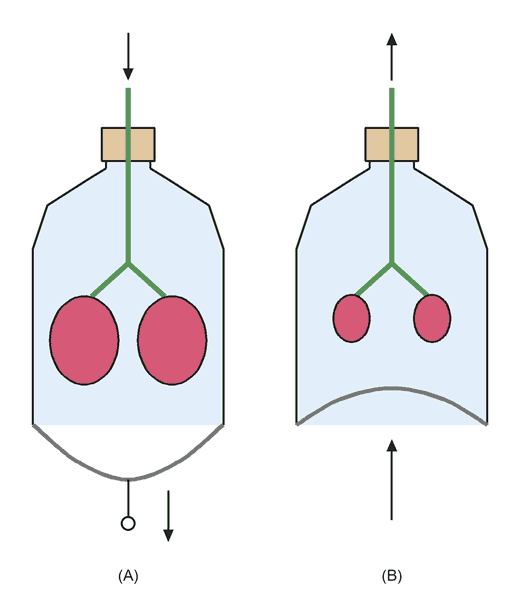
(i) Name the process and define it.
(ii) What are the two phases of the above mentioned process shown as (A) and (B) ?
(iii) Name the particular organs of the body shown in the figure with :
(a) Bell jar (b) Balloons (iii) Rubber sheet
(iv) How do these phases (A) and (B) differ with respect to the position of ribs ?
(v) Does the breathing rate of a young boy and an old person differ ? Explain.
Solve with AIWritten solution
Solution:
Concept: The bell-jar model shows how the movement of the diaphragm makes the lungs fill with air and empty again.
Step 1 — (i) The process.
The model shows breathing. Breathing is the process by which air containing oxygen is drawn into the lungs and air containing carbon dioxide is forced out of them.
Step 2 — (ii) The two phases.
In (A) the rubber sheet is pulled down, the space in the jar becomes larger, and the balloons fill with air: this is inspiration (inhalation). In (B) the sheet is pushed up, the space becomes smaller, and the balloons shrink: this is expiration (exhalation).
Step 3 — (iii) The organs shown.
Each part of the model stands for a part of the body.
- (a) Bell jar: the chest (thoracic) cavity, with its rib cage;
- (b) Balloons: the lungs;
- (c) Rubber sheet: the diaphragm.
- The Y-shaped tube stands for the trachea and the two bronchi.
Step 4 — (iv) Position of the ribs.
In phase (A), inspiration, the ribs move upwards and outwards, so the chest cavity becomes bigger. In phase (B), expiration, the ribs move downwards and inwards, so the chest cavity becomes smaller.
Step 5 — (v) A child and an older person.
Yes, they differ. At rest, a young boy breathes faster than an older person (about 18 to 30 breaths a minute at school age, against about 12 to 20 for adults). A growing child uses energy faster for his size, so his cells need oxygen faster.
Watch out: The bell jar has rigid walls, so it cannot show the movement of the ribs; only the diaphragm is copied.
Note: The third organ in part (iii) is printed as ‘(iii) Rubber sheet’; it is read as (c).
Therefore, (i) breathing; (ii) (A) inspiration and (B) expiration; (iii) bell jar = chest cavity, balloons = lungs, rubber sheet = diaphragm; (iv) ribs move up and out in (A), down and in in (B); (v) yes, the young boy breathes faster.
- 329 marks
Question 32
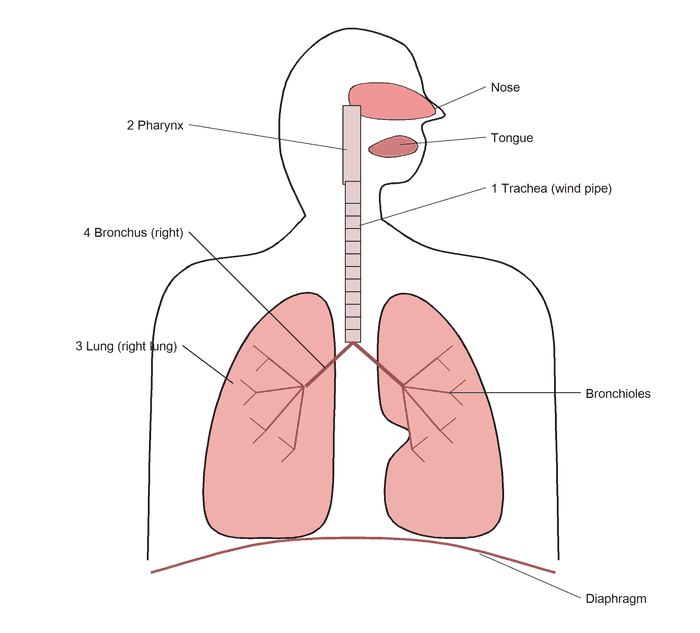
The diagram given alongside shows the "Human Respiratory System". Study the same and answer the following questions :

(i) Label the guidelines 1 to 4.
(ii) Define the structure shown as part 2.
(iii) Name the basic structural and functional unit of part 3.
(iv) Write one specific structural feature of the inner lining of part 1.
(v) What is the muscular sheet on which part 3 rests ?
Solve with AIWritten solution
Solution:
Concept: Air travels along the respiratory system in this order: nose (nostrils and nasal cavity) → pharynx (throat) → larynx (voice box) → trachea (wind pipe) → bronchi → bronchioles → alveoli (air sacs) of the lungs.
Step 1 — (i) Label the guidelines.
Following the air path in the figure gives the labels: 1 – trachea (wind pipe), 2 – pharynx, 3 – lung (right lung), 4 – bronchus (right bronchus). The labelled figure is shown below.
Step 2 — (ii) Part 2.
The pharynx (throat) is the passage behind the nose and the mouth. It is a common passage for air and food, and leads into the wind pipe and the food pipe.
Step 3 — (iii) Unit of part 3.
The basic structural and functional unit of the lung is the alveolus (air sac).
Step 4 — (iv) Lining of part 1.
The inner lining of the trachea is ciliated epithelium. Its cilia keep beating and push dust particles and germs, trapped in mucus, up and out of the wind pipe.
Step 5 — (v) The sheet below part 3.
The lungs rest on the muscular sheet called the diaphragm.
Watch out: The subject's right lung is on the viewer's left in a front view, so part 3 is the right lung.
Therefore, (i) 1 trachea, 2 pharynx, 3 lung, 4 bronchus; (ii) the pharynx is the common passage for air and food; (iii) alveolus; (iv) ciliated epithelium; (v) diaphragm.
- 335 marks
Question 33
Vivaan is a class 6 boy who loves playing football and shouting instructions to his teammates on the field. One afternoon, during an intense match, he starts feeling like something is stuck in his throat. He keeps clearing it, but it doesn't help. By the end of the game, his voice becomes weak and hoarse, and speaking starts to hurt. Answer the following questions:
(i) Write the technical term for the voice-box found in the human body that was affected in Vivaan's case.
(ii) What is the exact location of the voice-box in our body?
(iii) What could be the possible reason for Vivaan temporarily losing his voice?
(iv) Name the two ligamentous folds associated with the voice-box.
Solve with AIWritten solution
Solution:
Concept: Sound is made in the larynx (voice box) when air from the lungs makes the two vocal cords vibrate.
Step 1 — (i) The voice box.
The technical term for the voice box is the larynx.
Step 2 — (ii) Where it is.
The larynx lies in the front of the neck, at the top of the trachea (wind pipe), just below the pharynx. It forms the bump called the Adam's apple.
Step 3 — (iii) Why the voice was lost.
Vivaan kept shouting loudly for a long time. This overused and strained his vocal cords, which became swollen (inflamed). Swollen vocal cords cannot vibrate properly, so his voice became weak and hoarse. Resting the voice and sipping water help it to recover.
Step 4 — (iv) The two folds.
The two ligamentous folds of the larynx are the vocal cords (vocal folds).
Watch out: If hoarseness lasts more than about three weeks, a doctor should check the throat.
Therefore, (i) larynx; (ii) in the front of the neck at the top of the trachea; (iii) shouting strained and swelled his vocal cords; (iv) the vocal cords.
What Class 6 Biology Ch 5 covers
The sections of the chapter, in the order the book takes them. Every question above comes from one of these.
- 01What Is Respiration
- 02Types of Respiration
- 03Respiratory System in Humans
- 04Phases in Respiration
- 05Mechanism of Breathing
- 06Common Respiratory Diseases
More ways to study this chapter
The same chapter asked three other ways. Practise it, revise it, and see what the board has set on Ch 5 before.
Class 6 Biology Ch 5 questions students ask
How many questions are there in Class 6 Biology Ch 5?
33 questions. Every one is solved step by step on this page.
Are these Class 6 Biology solutions free?
Yes. Every question and its full working is free to read, with no account needed.
Can I download the Class 6 Biology Ch 5 solutions as a PDF?
There is no PDF to download. Every solution is on this page instead, which means it is searchable, always the current syllabus, and readable on a phone. Use your browser's print option if you want it on paper.