Solution:
Concept: Air travels along the respiratory system in this order: nose (nostrils and nasal cavity) → pharynx (throat) → larynx (voice box) → trachea (wind pipe) → bronchi → bronchioles → alveoli (air sacs) of the lungs.
Step 1 — (i) Label the guidelines.
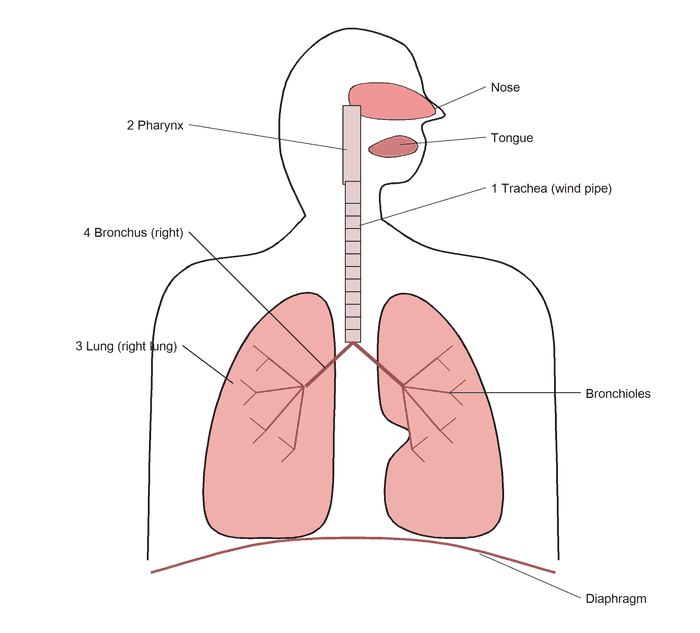
Following the air path in the figure gives the labels: 1 – trachea (wind pipe), 2 – pharynx, 3 – lung (right lung), 4 – bronchus (right bronchus). The labelled figure is shown below.
Step 2 — (ii) Part 2.
The pharynx (throat) is the passage behind the nose and the mouth. It is a common passage for air and food, and leads into the wind pipe and the food pipe.
Step 3 — (iii) Unit of part 3.
The basic structural and functional unit of the lung is the alveolus (air sac).
Step 4 — (iv) Lining of part 1.
The inner lining of the trachea is ciliated epithelium. Its cilia keep beating and push dust particles and germs, trapped in mucus, up and out of the wind pipe.
Step 5 — (v) The sheet below part 3.
The lungs rest on the muscular sheet called the diaphragm.
Watch out: The subject's right lung is on the viewer's left in a front view, so part 3 is the right lung.
Therefore, (i) 1 trachea, 2 pharynx, 3 lung, 4 bronchus; (ii) the pharynx is the common passage for air and food; (iii) alveolus; (iv) ciliated epithelium; (v) diaphragm.

