Solution:
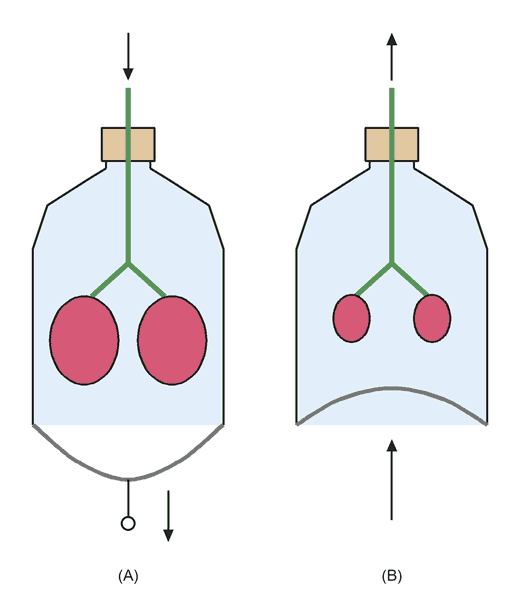
Concept: The bell-jar model shows how the movement of the diaphragm makes the lungs fill with air and empty again.
Step 1 — (i) The process.
The model shows breathing. Breathing is the process by which air containing oxygen is drawn into the lungs and air containing carbon dioxide is forced out of them.
Step 2 — (ii) The two phases.
In (A) the rubber sheet is pulled down, the space in the jar becomes larger, and the balloons fill with air: this is inspiration (inhalation). In (B) the sheet is pushed up, the space becomes smaller, and the balloons shrink: this is expiration (exhalation).
Step 3 — (iii) The organs shown.
Each part of the model stands for a part of the body.
- (a) Bell jar: the chest (thoracic) cavity, with its rib cage;
- (b) Balloons: the lungs;
- (c) Rubber sheet: the diaphragm.
- The Y-shaped tube stands for the trachea and the two bronchi.
Step 4 — (iv) Position of the ribs.
In phase (A), inspiration, the ribs move upwards and outwards, so the chest cavity becomes bigger. In phase (B), expiration, the ribs move downwards and inwards, so the chest cavity becomes smaller.
Step 5 — (v) A child and an older person.
Yes, they differ. At rest, a young boy breathes faster than an older person (about 18 to 30 breaths a minute at school age, against about 12 to 20 for adults). A growing child uses energy faster for his size, so his cells need oxygen faster.
Watch out: The bell jar has rigid walls, so it cannot show the movement of the ribs; only the diaphragm is copied.
Note: The third organ in part (iii) is printed as ‘(iii) Rubber sheet’; it is read as (c).
Therefore, (i) breathing; (ii) (A) inspiration and (B) expiration; (iii) bell jar = chest cavity, balloons = lungs, rubber sheet = diaphragm; (iv) ribs move up and out in (A), down and in in (B); (v) yes, the young boy breathes faster.