
Opening your dashboard
Class 6 Biology Chapter 5 Respiratory System: Competency-Based Questions (CBQ)
40 questions on Chapter 5, each worked through on its own page with the AI tutor. Class 6 Biology, ICSE 2026-27.
40 questions
1–5 marks · Mixed difficulty
- 11 mark
Question 1
Cognitive domain: Application
On a January morning in Shimla, the air outside is at and very dry. Yet the air that reaches Pema's lungs is warm and moist. Which part of her respiratory system brings about this change, when she breathes in the proper way ?
- 21 mark
Question 2
Cognitive domain: Analysis
The two diagrams show Suresh's chest at two different moments. At one of these moments he is blowing air out hard to fill a balloon.
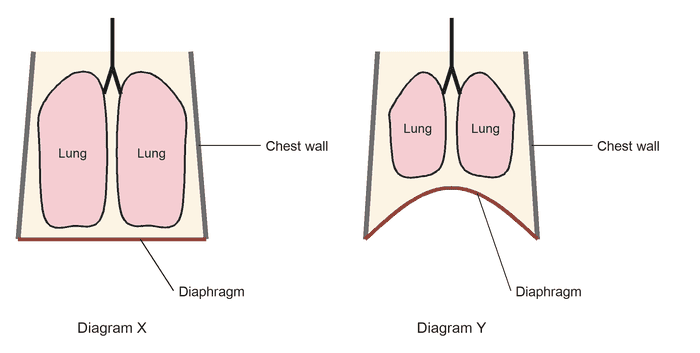
Which diagram shows the moment when he is blowing into the balloon, and how does the air pressure in his lungs compare with the pressure of the air outside at that moment ?
- 31 mark
Question 3
Cognitive domain: Application
A blood test shows that Lata has much less haemoglobin than normal. Her nose, wind pipe and lungs are healthy, but she gets tired very easily. Which phase of respiration is affected first in her body ?
- 41 mark
Question 4
Cognitive domain: Analysis
A doctor at a health camp noted the main complaints of four patients.
Patient Main complaints W Tightness in the chest, shortness of breath and wheezing. It comes from time to time, mostly when the air is dusty. X Continuous cough, low fever, chest pain and loss of weight Y Chest pain, chills and high fever Z Spells of coughing and breathlessness after a viral infection Which set of diseases best matches the four patients ?
- 51 mark
Question 5
Cognitive domain: Understanding
Assertion (A): Fine dust particles that get past the nose are still mostly kept out of the lungs.
Reason (R): The inner linings of the trachea, bronchi and bronchioles have cilia, and their continuous movement pushes out unwanted particles present in the inhaled air.
- 61 mark
Question 6
Cognitive domain: Analysis
Assertion (A): When a swimmer holds her breath under water for half a minute, respiration stops in her body for that time.
Reason (R): Respiration occurs in all the living cells of the body.
- 71 mark
Question 7
Cognitive domain: Understanding
The air high up on Mount Everest is very thin. Climbers carry cylinders of a gas on their backs and breathe it through a mask. Without it, their body cells cannot release enough energy for the climb.
Complete the sentence :
The climbers need this gas because the cells of the human body carry out ______ respiration, which utilises ______.
- 81 mark
Question 8
Cognitive domain: Application
On a cold winter morning, Ali breathes out on a cold window pane. The glass at once turns misty with tiny drops of water. When he fans ordinary room air on to the next pane, it stays clear.
Complete the sentence :
The drops come from the high amount of water ______ in his expired air, which was added to the air from the moist lining of his respiratory ______.
- 91 mark
Question 9
Cognitive domain: Application
During a football match, the ball hits Rohit hard on the chest. It hurts for a while, but the doctor finds that his soft, spongy lungs are not harmed at all.
Complete the sentence :
His lungs were protected by the bony ______ cage around them, and by the fluid between the two ______, which acts as a shock absorber.
- 102 marks
Question 10
Cognitive domain: Evaluation
Ravi's cousin has asthma. Ravi has read that pneumonia is treated with the antibiotic penicillin. He says, "Asthma and pneumonia are both diseases of breathing. So asthma must also be caused by bacteria, and penicillin will cure it too."
Is Ravi's reasoning correct ? Justify your answer.
- 112 marks
Question 11
Cognitive domain: Understanding
When you suck hard on a soft plastic straw, its walls get pulled in and the straw goes flat. The hose of a vacuum cleaner has stiff rings all along it, and it stays open however hard the machine sucks.
Use this idea to explain how the wind pipe is built, and why this is important for breathing.
- 122 marks
Question 12
Cognitive domain: Evaluation
Arun tells his younger sister, "We breathe in oxygen and we breathe out carbon dioxide. So the air that comes out of your nose is only carbon dioxide. It has no oxygen in it."
Is Arun correct ? Use the figures for inspired and expired air from your chapter to support your answer.
- 134 marks
Question 13
Cognitive domain: Application
Case: One evening in May, a dust storm (aandhi) blows through Bikaner in Rajasthan. Asha is walking home from school and the air around her is full of fine dust. She sneezes several times on the way. Her friend Meera, who has asthma, starts to feel unwell in the dusty air.
(a) State two ways in which Asha's nose stops the dust from going further in.
(b) Why did Asha sneeze again and again ? How does sneezing help her ?
(c) Some very fine dust still gets past her nose. Explain how her wind pipe deals with it.
(d) Why can the dusty air be a bigger problem for Meera ? What is she likely to feel ?
- 145 marks
Question 14
Cognitive domain: Analysis
Case: In the games period, a teacher measured the chests of three students with a measuring tape. Each student first breathed out fully, and then breathed in fully. The tape was held at the same level of the chest both times.
Student Chest after breathing out fully Chest after breathing in fully Aman 66 cm 71 cm Bina 64 cm 70 cm Chetan 68 cm 72 cm (a) Calculate the increase in the chest measurement of each student. Whose chest expanded the most ?
(b) Explain why the chest measures more after breathing in than after breathing out.
(c) The tape shows only what the ribs do. Which other part also makes the chest cavity bigger during breathing in ? What does it do, and how can a student feel this change with a hand ?
(d) When the chest cavity becomes bigger, what happens to the air pressure in the lungs ? How does this make air enter the lungs ?
- 155 marks
Question 15
Cognitive domain: Creativity
Case: Class 6 students notice that they breathe faster after the games period than during the maths period. They want to plan a simple investigation to find out how the breathing rate changes with activity. They have a watch that shows seconds, a notebook and the school corridor.
(a) Plan the investigation. Which three conditions would you compare ? How will the breathing rate be counted ? Name two things that must be kept the same to make it a fair test.
(b) Draw a table in which the results of three students can be recorded.
(c) What result do you expect ? Explain it using what you know about respiration. Suggest one precaution the students should take.
- 161 mark
Question 16
Cognitive domain: Analysis
A teacher writes four statements on cards. Neha has to pick the two cards that describe respiration, and not breathing.
- Card P : It is a physical process in which the lungs are mainly involved.
- Card Q : Oxygen taken in is used to oxidise glucose, and energy is released.
- Card R : It goes on in all the living cells of the body, for example in the cells of the leg muscles.
- Card S : Air containing oxygen is taken into the lungs, and air loaded with carbon dioxide is given out.
Which two cards should Neha pick ?
- 171 mark
Question 17
Cognitive domain: Application
In a rare operation, a surgeon removes one lobe from the right lung and one lobe from the left lung of a patient. (Hypothetical case.) Taking the usual number of lobes in each human lung, how many lobes are left in the two lungs together, and why does the left lung normally have fewer lobes than the right lung ?
- 181 mark
Question 18
Cognitive domain: Application
Ritu sings a long note in the school choir. The chapter explains how the voice is produced. Which statement describes what happens in her body while she sings the note ?
- 191 mark
Question 19
Cognitive domain: Analysis
In Activity 3, two balloons hang inside a bell-jar and are joined to a Y-shaped glass tube. The tube passes through a cork at the top and is open to the outside air. A rubber sheet is tied tightly over the wide mouth of the jar at the bottom. Rahul pulls the sheet downwards, but the balloons hardly swell. He then finds a small hole in the rubber sheet. Why did the balloons hardly swell ?
- 201 mark
Question 20
Cognitive domain: Understanding
Assertion (A): When a person takes a deep breath in, the abdomen bulges slightly.
Reason (R): During inhalation, the ribs move upwards and outwards.
- 211 mark
Question 21
Cognitive domain: Analysis
Assertion (A): In bronchitis the passages of the bronchi become narrow.
Reason (R): Bronchitis is a disease in which the air sacs of the lungs get filled with fluid.
- 221 mark
Question 22
Cognitive domain: Analysis
A student wears a stretchy belt around her chest. A sensor on the belt records how the volume of her chest cavity changes during two breaths. The graph is divided into four time intervals, A, B, C and D. (Hypothetical data.)
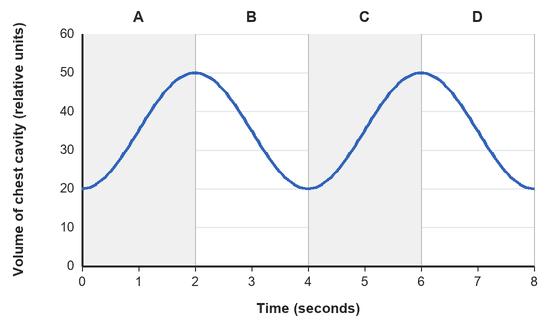
During which two intervals is air being forced out of her lungs ?
- 231 mark
Question 23
Cognitive domain: Evaluation
Four students describe the human respiratory system.
- Asha : "The front opening of the wind pipe is a muscular flap called the glottis, which closes the wind pipe when we swallow."
- Bilal : "The lungs rest on the ribs, which divide the body cavity into the chest cavity above and the abdominal cavity below."
- Chitra : "The dust in the inhaled air is pushed out by the C-shaped rings of cartilage in the wall of the trachea."
- Dev : "The trachea divides into two bronchi, and each bronchus divides into smaller bronchioles which end in the microscopic air sacs called alveoli."
Whose description is correct ?
- 241 mark
Question 24
Cognitive domain: Application
In a hospital, Mrs Bose, who has pneumonia, is given air with extra oxygen through a mask. Many of her air sacs are filled with fluid, but the other air sacs still work. (Hypothetical case.) How does the extra oxygen help her ?
- 251 mark
Question 25
Cognitive domain: Application
At a village health camp, the nurse asks everyone with a cough that lasts for weeks, along with weight loss and a low fever, to be tested for tuberculosis. She also asks all villagers not to spit on the roads or in public places. Which statement from the chapter explains why this advice is sensible ?
- 262 marks
Question 26
Cognitive domain: Evaluation
Sonia says, "Anaerobic respiration does not use oxygen, so it cannot release any energy from food."
Is she correct ? Justify your answer using the chapter's definition of respiration.
- 272 marks
Question 27
Cognitive domain: Analysis
A student asks, "Why do the lungs have millions of tiny air sacs and not one big air bag of the same total volume ?" A teacher tells her that millions of tiny sacs have a much larger total wall area than a single big bag of the same total volume.
Using what the chapter says about the walls of the alveoli, explain why gaseous exchange would be poorer in a single big bag.
- 282 marks
Question 28
Cognitive domain: Application
Tobacco smoke is known to damage the cilia that line the trachea and the bronchi, so that they stop moving. Kamal's grandfather has smoked for many years.
What job do these cilia normally do ? State one problem that is likely to arise in his air passages when they stop working.
- 292 marks
Question 29
Cognitive domain: Evaluation
Tina says, "Sneezing and coughing are harmful, and I should try to stop them every time."
Evaluate her statement, using one example of each from the chapter.
- 302 marks
Question 30
Cognitive domain: Application
A small bead gets stuck in the right bronchus of a child. (Hypothetical case.) The child is rushed to a doctor, who removes the bead.
Which lung is cut off from fresh air, and why does the child still get air into the other lung ?
- 312 marks
Question 31
Cognitive domain: Understanding
The events of one inhalation are given in a jumbled order.
- P : The air pressure inside the lungs becomes low.
- Q : Atmospheric air, at a higher pressure, rushes into the lungs.
- R : The volume of the chest cavity increases.
- S : The ribs move upwards and outwards and the diaphragm is pushed downwards.
Write the correct order of the events. Give a reason for the position of event P.
- 322 marks
Question 32
Cognitive domain: Understanding
In the chapter, respiration is described as the breakdown of food with the help of oxygen, in which the food is oxidised (burnt) to release energy. When a candle burns, the wax is oxidised by the oxygen of the air and gives out energy as heat and light.
State one similarity and one difference between this burning and respiration in a body cell.
- 333 marks
Question 33
Cognitive domain: Analysis
Respiration occurs in three phases: breathing, gaseous transport and cellular respiration. Three patients are described. (Hypothetical cases.)
- Patient 1 : The lining of the bronchi is swollen and narrow, so air cannot move freely in and out of the lungs.
- Patient 2 : The air sacs are filled with fluid, so the oxygen of the air cannot easily pass into the blood.
- Patient 3 : A substance in the cells stops them from using oxygen to oxidise glucose.
For each patient, name the phase of respiration that is affected first, and give a reason.
- 343 marks
Question 34
Cognitive domain: Analysis
Meera has asthma. For one week in November she notes the air around her each day and whether she had an attack. (Hypothetical data.)
Day What the air was like Attack ? Monday Clear air; she read at home No Tuesday Neighbours burnt a heap of dry leaves; smoke filled the lane Yes Wednesday Clear air; she went to school No Thursday Dusty air while she cleaned old books in a storeroom Yes Friday Clear air; she played badminton indoors No Saturday Thick traffic smoke and smog near the market Yes Sunday Clear air; windows closed at home No (i) What is common to all the days on which Meera had an attack ? Name the kind of thing the chapter says can trigger an asthmatic attack.
(ii) On four days she breathed normally. Which feature of asthma, as described in the chapter, does this pattern show ?
(iii) Next week many firecrackers will be burst near her home on Diwali night. Predict whether she is likely to have an attack that night, and give a reason from the diary.
- 353 marks
Question 35
Cognitive domain: Application
Case: In a yoga class, the teacher asks the students to breathe in slowly and deeply for five counts, hold the breath for five counts, and then breathe out slowly. Rohan is puzzled. "We learnt that breathing is an involuntary act," he says. "How can we change it like this?"
(a) Explain how breathing can be involuntary and yet be changed in the yoga class.
(b) While Rohan breathes in slowly and deeply, what happens to the volume of his chest cavity and to the air pressure in his lungs ?
(c) The teacher never asks the class to hold the breath for long. Using what you know about cellular respiration, explain why.
- 363 marks
Question 36
Cognitive domain: Evaluation
At a health talk, three students make statements. (Hypothetical statements.)
- Gita : "The BCG vaccine is a medicine that cures a person who already has tuberculosis."
- Hari : "Tuberculosis spreads only when we touch the hand of an infected person."
- Zeba : "Smoking and air pollution can cause bronchitis."
Evaluate each statement as correct or wrong, and correct the wrong ones.
- 375 marks
Question 37
Cognitive domain: Analysis
Case: After a 5-minute jog, two students, P and Q, count their breaths per minute every 2 minutes and plot a graph. Student P plays football every day, and student Q mostly sits and reads. At rest, both breathe 16 times a minute. (Hypothetical data.)
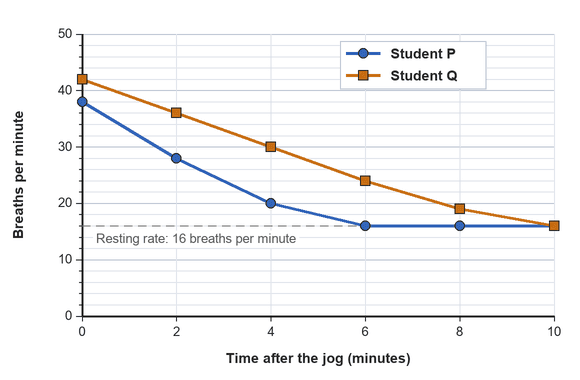
(a) Read the graph (each small gridline step is 2 breaths per minute). What is the breathing rate of each student just after the jog (time 0) ? After how many minutes does each student return to the resting rate ?
(b) Explain why the breathing rate of both students rose after the jog, using what you know about respiration.
(c) Which student recovered faster ? How many more breaths per minute does Q take than P at 4 minutes ? Suggest one reason why P may have recovered faster.
- 385 marks
Question 38
Cognitive domain: Analysis
Case: The diagram shows one alveolus (air sac) of the lungs and its surroundings. P is the air passage that opens into the alveolus, Q is the wall of the alveolus, R is a blood capillary, and S is a red blood cell. The arrows X and Y show two gases moving between the air in the alveolus and the blood.
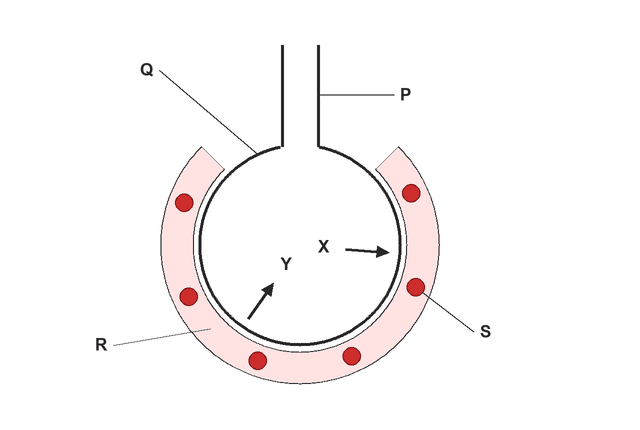
(a) Name the gas that moves along arrow X and the gas that moves along arrow Y.
(b) Name the substance in the red blood cell S that picks up oxygen. State two features of the wall Q that make the exchange of gases fast.
(c) Suppose that, because of a disease, the wall Q of many alveoli became thick and dry. (Hypothetical case.) Predict what would happen to the movement along X and along Y, and how the person would feel.
- 394 marks
Question 39
Cognitive domain: Evaluation
Case: Rohit builds the Activity 3 model of breathing for his class. A Y-shaped tube runs from the open air, through the top of a bell-jar, to two balloons that hang inside. A rubber sheet covers the open bottom of the jar. Pulling the sheet down makes the balloons swell, and pushing it up makes them shrink.
(a) Which parts of the respiratory system are shown by the long arm of the Y-tube and by its two short arms ?
(b) Name two things about real breathing that this model does not show.
(c) Suggest one change to the model so that it can also show the part played by the ribs, and say what you would expect to see.
- 404 marks
Question 40
Cognitive domain: Creativity
Case: Your school is holding a "Healthy Lungs Week" for Class 6. You are asked to make a poster with three panels.
(a) Panel 1, "Breathe the right way": write one slogan and one fact from the chapter that supports it.
(b) Panel 2, "Stop the spread": write a short message for a student with a cough that lasts for weeks. Name the disease, say how it spreads and give one measure that helps to stop it spreading.
(c) Panel 3, "Help a friend with asthma": list two things to keep away from your friend and one thing your friend can use for quick relief.