
Opening your dashboard
Class 6 Biology Chapter 3: Cell – The Structure and Functions Solutions
38 textbook questions with step-by-step answers, free to read, for ICSE 2026-27.
Get talked through Ch 3, not just shown the answer
Reading a finished solution is not the same as being able to do it. The AI tutor takes one question at a time and works it with you, in your own words, until you can.
- Ask it out loud, in your own words
- It gives you the next step, not the answer
- Stuck on part (ii)? Start there
38 questions with solutions
1–10 marks · Mixed difficulty
- 11 mark
Question 1
Identify the part which contains pigment :
Solve with AIAnswer
(A) cell membrane
- Correct
(B) plastid
(C) centrosome
(D) cell wall
Answer: (B) plastid
Concept: Plastids are found in plant cells. Chloroplasts are green (chlorophyll) and make food, chromoplasts hold yellow, orange and red pigments, and leucoplasts are colourless and store food.
Step 1 — Look for the part that carries colour.
Pigments are the colouring substances of a cell, such as green chlorophyll and the yellow and red pigments of ripe fruits and flowers.
Step 2 — Pick the option.
These pigments are held in the plastids (chloroplasts and chromoplasts), so the answer is option (B).
Watch out: The cell wall of a plant cell is outside the membrane but has no pigment; colour comes from plastids.
Why the other options are wrong:
- (A) cell membrane: the cell membrane is a thin living covering of the cell and holds no pigment.
- (C) centrosome: the centrosome is a small body near the nucleus of an animal cell that helps in cell division; it has no pigment.
- (D) cell wall: the cell wall is a non-living layer of cellulose that gives shape and support; it has no pigment.
Therefore, the part of the cell that contains pigment is the plastid, option (B).
- 21 mark
Question 2
The organelle that controls all activities in a cell :
Solve with AIAnswer
- Correct
(A) nucleus
(B) vacuole
(C) plastids
(D) cytoplasm
Answer: (A) nucleus
Concept: Every cell has three essential parts: the cell membrane (a thin, flexible, selectively permeable covering), the cytoplasm (the jelly-like substance in which the organelles lie) and the nucleus (the control centre, holding the chromosomes).
Step 1 — Recall the control centre.
The nucleus regulates and coordinates all the life processes of the cell. Its chromosomes carry the genes that direct the cell's work.
Step 2 — Pick the option.
So the organelle that controls all activities of the cell is the nucleus, option (A).
Watch out: The cytoplasm is where most activities take place, but it is the nucleus that controls them.
Why the other options are wrong:
- (B) vacuole: a vacuole is a space filled with cell sap that stores water and dissolved substances; it controls nothing.
- (C) plastids: it hold pigments or store food; they do not control the other parts of the cell.
- (D) cytoplasm: it is the jelly-like substance in which the organelles lie; it does not direct the cell's work.
Therefore, the organelle that controls all activities in a cell is the nucleus, option (A).
- 31 mark
Question 3
A cell that is spherical in shape is :
Solve with AIAnswer
(A) white blood cell
(B) nerve cell
- Correct
(C) red blood cell
(D) amoeba
Answer: (C) red blood cell
Concept: Cells come in many shapes, and the shape of a cell suits the work it does: for example, nerve cells are long and branched, muscle cells of the gut are spindle-shaped and red blood cells are round discs.
Step 1 — Recall the shape of each cell.
White blood cells and Amoeba keep changing their shape (amoeboid). Nerve cells are long and branched. A red blood cell has a regular rounded shape.
Step 2 — Pick the option.
Of the four, the rounded cell is the red blood cell, option (C).
Watch out: White blood cells look rounded when they are still, but they keep changing their shape as they move.
Note: A human red blood cell is really a round disc, thinner in the middle than at the rim (biconcave), so it looks circular when seen from the front. It is the most regularly rounded cell in this list, which is why it is called spherical here.
Why the other options are wrong:
- (A) white blood cell: white blood cells have no fixed shape; they change shape as they move (amoeboid).
- (B) nerve cell: nerve cells are long and branched, with fine fibres, so they are not round.
- (D) amoeba: Amoeba has no fixed shape; it keeps changing shape as it pushes out false feet (pseudopodia).
Therefore, the cell called spherical here is the red blood cell, option (C).
- 41 mark
Question 4
The vacuole contains :
Solve with AIAnswer
(A) water
- Correct
(B) cell sap
(C) salts
(D) food
Answer: (B) cell sap
Concept: A vacuole is a fluid-filled space in the cytoplasm, bounded by a membrane. The fluid inside it, water with salts, sugars and other substances dissolved in it, is called cell sap.
Step 1 — Name the liquid in the vacuole.
The vacuole is filled with water in which many substances are dissolved. This whole solution has its own name, cell sap.
Step 2 — Pick the option.
The option that names the whole content is cell sap, option (B).
Watch out: Water, salts and food are all present in the vacuole, but each is only one part of the cell sap.
Why the other options are wrong:
- (A) water: it is only the liquid part of the cell sap; the vacuole also holds substances dissolved in it.
- (C) salts: they are only some of the substances dissolved in the cell sap.
- (D) food: this tissue (such as sugar) is only one of the substances that may be dissolved in the cell sap.
Therefore, the vacuole contains cell sap, option (B).
- 51 mark
Question 5
The type of microscope that we use in our school laboratories is :
Solve with AIAnswer
(A) Simple microscope
(B) Electron microscope
- Correct
(C) Compound microscope
(D) Both (a) and (b)
Answer: (C) Compound microscope
Concept: A simple microscope has a single convex (biconvex) lens; a compound microscope has two sets of lenses, the eyepiece and the objective.
Step 1 — Think of the school microscope.
The microscope in a school laboratory has an eyepiece at the top and objective lenses near the slide, so it uses two sets of lenses.
Step 2 — Pick the option.
A microscope with two sets of lenses is a compound microscope, option (C).
Watch out: A hand lens (simple microscope) is also used in schools, but the microscope used to study slides of cells is the compound microscope.
Why the other options are wrong:
- (A) Simple microscope: a simple microscope has only one lens and magnifies much less; it is not the laboratory microscope used for cells.
- (B) Electron microscope: an electron microscope is very costly and large, and is used only in research laboratories.
- (D) Both (a) and (b): neither the simple nor the electron microscope is the one used in school laboratories, so this choice is wrong too.
Therefore, the microscope used in school laboratories is the compound microscope, option (C).
- 61 mark
Question 6
Which of the following lens is used in a simple microscope ?
Solve with AIAnswer
(A) A single biconcave lens
(B) Two convex lenses
- Correct
(C) A single biconvex lens
(D) Two concave lenses
Answer: (C) A single biconvex lens
Concept: A simple microscope has a single convex (biconvex) lens; a compound microscope has two sets of lenses, the eyepiece and the objective.
Step 1 — Recall what magnifies.
A convex lens (thicker in the middle) magnifies an object held close to it. A concave lens makes things look smaller.
Step 2 — Count the lenses.
A simple microscope uses only one such lens, curved on both sides (biconvex). So the answer is option (C).
Watch out: Two lenses make a compound microscope, not a simple one.
Why the other options are wrong:
- (A) A single biconcave lens: a biconcave lens makes objects look smaller, so it cannot magnify.
- (B) Two convex lenses: they are used in a compound microscope, not in a simple one.
- (D) Two concave lenses: concave lenses do not magnify, and a simple microscope has only one lens.
Therefore, a simple microscope uses a single biconvex lens, option (C).
- 71 mark
Question 7
Which of the following is not a unicellular organism ?
Solve with AIAnswer
(A) Bacterium
(B) Paramecium
- Correct
(C) Spirogyra
(D) Chlamydomonas
Answer: (C) Spirogyra
Concept: A unicellular organism is made of a single cell; a multicellular organism is made of many cells.
Step 1 — Check each organism.
A bacterium, Paramecium and Chlamydomonas each consist of one cell. Spirogyra is a green alga whose body is a long thread made of many cells joined end to end.
Step 2 — Pick the odd one.
The organism that is not unicellular is Spirogyra, option (C).
Watch out: Spirogyra and Chlamydomonas are both green algae, but only Chlamydomonas is single-celled.
Why the other options are wrong:
- (A) Bacterium: a bacterium is a single cell.
- (B) Paramecium: Paramecium is a single-celled, slipper-shaped organism of pond water.
- (D) Chlamydomonas: Chlamydomonas is a single-celled green alga that swims with two flagella.
Therefore, the organism that is not unicellular is Spirogyra, option (C).
- 81 mark
Question 8
The outermost layer of the cell is known as :
Solve with AIAnswer
(A) Cytoplasm
(B) Protoplasm
(C) Epidermis
- Correct
(D) Plasma membrane
Answer: (D) Plasma membrane
Concept: Every cell has three essential parts: the cell membrane (a thin, flexible, selectively permeable covering), the cytoplasm (the jelly-like substance in which the organelles lie) and the nucleus (the control centre, holding the chromosomes).
Step 1 — Find the boundary of the cell.
Every cell is enclosed by a thin, delicate and flexible cell membrane, also called the plasma membrane. In an animal cell nothing lies outside it.
Step 2 — Pick the option.
So the outermost layer of the cell among the options is the plasma membrane, option (D).
Watch out: A plant cell also has a cell wall outside its plasma membrane, but the cell wall is not among the options.
Why the other options are wrong:
- (A) Cytoplasm: it lies inside the cell membrane, around the nucleus.
- (B) Protoplasm: it is the whole living substance inside the cell (cytoplasm and nucleus together), not a covering.
- (C) Epidermis: the epidermis is a layer of many cells covering an organ such as a leaf, not a part of one cell.
Therefore, the outermost layer of the cell is the plasma membrane, option (D).
- 91 mark
Question 9
The definite number of chromosomes in the cells of a human body is :
Solve with AIAnswer
- Correct
(A) 23 pairs
(B) 23
(C) 46 pairs
(D) 32
Answer: (A) 23 pairs
Concept: Every species has a fixed (definite) number of chromosomes in its body cells. A human body cell has 46 chromosomes, which occur as 23 pairs.
Step 1 — Recall the human number.
Each body cell of a human has 46 chromosomes. They come in matching pairs, one of each pair from the mother and one from the father.
Step 2 — Turn the number into pairs.
Since 46 chromosomes form 23 pairs, the answer is option (A).
Watch out: Do not confuse 23 pairs (46 chromosomes) with 46 pairs (92 chromosomes).
Why the other options are wrong:
- (B) 23: it single chromosomes are found only in an egg or a sperm, not in the body cells.
- (C) 46 pairs: it would mean 92 chromosomes, twice the real number.
- (D) 32: it is not the human chromosome number (an adult has 32 teeth, which is a different fact).
Therefore, the cells of the human body have 23 pairs of chromosomes, option (A).
- 101 mark
Question 10
Which of the following are non-living cell inclusions ?
Solve with AIAnswer
(A) Nucleolus
(B) Genes
- Correct
(C) Vacuoles
(D) Chromosomes
Answer: (C) Vacuoles
Concept: The living part of a cell is its protoplasm (cytoplasm and nucleus with their parts). Non-living inclusions are spaces or stored materials in the cytoplasm, such as vacuoles filled with cell sap.
Step 1 — Sort the options.
The nucleolus, the chromosomes and the genes on them all belong to the living nucleus. A vacuole is only a space filled with cell sap.
Step 2 — Pick the option.
So the non-living cell inclusions are the vacuoles, option (C).
Watch out: A vacuole is bounded by a living membrane, but the vacuole itself, its cell sap, is non-living.
Why the other options are wrong:
- (A) Nucleolus: the nucleolus is a living part inside the nucleus.
- (B) Genes: they are small parts of the chromosomes, inside the living nucleus.
- (D) Chromosomes: they are living thread-like parts of the nucleus.
Therefore, the non-living cell inclusions are vacuoles, option (C).
- 111 mark
Question 11
Assertion (A): Every organism, whether big or small, begins its life as a single cell.
Reason (R): The size of a single cell varies among different organisms.
Solve with AIAnswer
(A) (1) Both A and R are true and R is the correct explanation of A.
- Correct
(B) (2) Both A and R are true but R is not the correct explanation of A.
(C) (3) A is true but R is false.
(D) (4) A is false but R is true.
Answer: (B) (2) Both A and R are true but R is not the correct explanation of A.
Concept: In an assertion-reason item, first judge the Assertion (A) and the Reason (R) separately as true or false; only when both are true do we ask whether R correctly explains A.
Step 1 — Judge the Assertion.
A is true. An elephant, a banyan tree or a human begins life as a single cell (the fertilised egg), which divides again and again. A unicellular organism also starts as one cell, formed when its parent splits.
Step 2 — Judge the Reason.
R is true. Cells differ in size, from tiny bacteria to the yolk of an ostrich egg.
Step 3 — Check whether R explains A.
The size of cells says nothing about why life starts from one cell. So R does not explain A, and the answer is option (B).
Watch out: Both statements are about cells, but they are two separate facts.
Note: A few multicellular organisms produced without sex, such as a plant grown from a cutting or a bud of Hydra, start from a group of cells. The statement describes the usual start of life, so it is taken as true.
Why the other options are wrong:
- (A): R does not explain A, so “R is the correct explanation” is wrong.
- (C): R is a true statement.
- (D): A is a true statement.
Therefore, both A and R are true but R is not the correct explanation of A, option (B).
- 121 mark
Question 12
Assertion (A): Root hairs are very important for the survival of plants as they absorb the raw materials for photosynthesis (water and dissolved minerals) from the soil.
Reason (R): Photosynthesis occurs in the chloroplasts of leaf cells.
Solve with AIAnswer
(A) (1) Both A and R are true and R is the correct explanation of A.
- Correct
(B) (2) Both A and R are true but R is not the correct explanation of A.
(C) (3) A is true but R is false.
(D) (4) A is false but R is true.
Answer: (B) (2) Both A and R are true but R is not the correct explanation of A.
Concept: In an assertion-reason item, first judge the Assertion (A) and the Reason (R) separately as true or false; only when both are true do we ask whether R correctly explains A.
Step 1 — Judge the Assertion.
A is true. Root hairs absorb water and dissolved minerals from the soil. Water is a raw material of photosynthesis, so without root hairs the plant wilts and dies.
Step 2 — Judge the Reason.
R is true. Photosynthesis takes place in the chloroplasts of the green cells of leaves.
Step 3 — Check whether R explains A.
R tells us where food is made, not why root hairs matter. So R does not explain A, and the answer is option (B).
Watch out: R is linked to A (both are about photosynthesis), but a link is not an explanation.
Why the other options are wrong:
- (A): R does not explain A, so “R is the correct explanation” is wrong.
- (C): R is a true statement.
- (D): A is a true statement.
Therefore, both A and R are true but R is not the correct explanation of A, option (B).
- 131 mark
Question 13
Assertion (A): The cell membrane of a cell is selectively permeable as it allows the entry or exit of certain substances only.
Reason (R): The cell membrane acts as a rigid barrier, protecting cells from mechanical injury and pathogen attack.
Solve with AIAnswer
(A) (1) Both A and R are true and R is the correct explanation of A.
(B) (2) Both A and R are true but R is not the correct explanation of A.
- Correct
(C) (3) A is true but R is false.
(D) (4) A is false but R is true.
Answer: (C) (3) A is true but R is false.
Concept: In an assertion-reason item, first judge the Assertion (A) and the Reason (R) separately as true or false; only when both are true do we ask whether R correctly explains A.
Step 1 — Judge the Assertion.
A is true. The cell membrane lets only certain substances pass in and out, so it is selectively permeable.
Step 2 — Judge the Reason.
R is false. The cell membrane is thin, delicate and flexible, not rigid. The rigid layer that protects a plant cell from injury is the cell wall.
Step 3 — Pick the option.
A is true and R is false, so the answer is option (C).
Watch out: Do not mix up the cell membrane (flexible, in every cell) with the cell wall (rigid, in plant cells but not in animal cells).
Why the other options are wrong:
- (A): R is false, so it cannot explain A.
- (B): R is false, so “both A and R are true” is wrong.
- (D): A is a true statement.
Therefore, A is true but R is false, option (C).
- 141 mark
Question 14
Assertion (A): The nucleus is an integral part of a cell which contains a definite number of chromosomes in each cell of every species.
Reason (R): Chromosomes carry hereditary units called genes, responsible for transmitting characteristics from parents to offsprings.
Solve with AIAnswer
(A) (1) Both A and R are true and R is the correct explanation of A.
- Correct
(B) (2) Both A and R are true but R is not the correct explanation of A.
(C) (3) A is true but R is false.
(D) (4) A is false but R is true.
Answer: (B) (2) Both A and R are true but R is not the correct explanation of A.
Concept: In an assertion-reason item, first judge the Assertion (A) and the Reason (R) separately as true or false; only when both are true do we ask whether R correctly explains A.
Step 1 — Judge the Assertion.
A is true. The nucleus is an essential part of the cell, and the number of chromosomes is fixed for each species: 46 (23 pairs) in human body cells and 14 (7 pairs) in pea plant cells.
Step 2 — Judge the Reason.
R is true. Chromosomes carry genes, which pass characteristics from parents to offspring.
Step 3 — Check whether R explains A.
A is about the number of chromosomes; R is about their work. Carrying genes does not explain why the number is fixed, so the answer is option (B).
Why the other options are wrong:
- (A): R does not explain A, so “R is the correct explanation” is wrong.
- (C): R is a true statement.
- (D): A is a true statement.
Therefore, both A and R are true but R is not the correct explanation of A, option (B).
- 151 mark
Question 15
Assertion (A): Leukoplasts are the kind of plastids which do not contain any pigment. They are colourless.
Reason (R): Leukoplasts do not play any significant role in plants due to the absence of pigments.
Solve with AIAnswer
(A) (1) Both A and R are true and R is the correct explanation of A.
(B) (2) Both A and R are true but R is not the correct explanation of A.
- Correct
(C) (3) A is true but R is false.
(D) (4) A is false but R is true.
Answer: (C) (3) A is true but R is false.
Concept: In an assertion-reason item, first judge the Assertion (A) and the Reason (R) separately as true or false; only when both are true do we ask whether R correctly explains A.
Step 1 — Judge the Assertion.
A is true. Leucoplasts are plastids without any pigment, so they are colourless.
Step 2 — Judge the Reason.
R is false. Leucoplasts have an important job: they store food such as starch, oils and proteins, for example in seeds, potato tubers and roots.
Step 3 — Pick the option.
A is true and R is false, so the answer is option (C).
Watch out: Having no colour does not mean having no use.
Why the other options are wrong:
- (A): R is false, so it cannot explain A.
- (B): R is false, so “both A and R are true” is wrong.
- (D): A is a true statement.
Therefore, A is true but R is false, option (C).
- 165 marks
Question 16
Match the terms given in column A with those of column B :
Column A Column B (i) Paramecium (a) Cylindrical (ii) White blood cells (b) Spherical (iii) Smooth muscles (c) Amoeboid (iv) Spirogyra (d) Slipper-shaped (v) Red blood cells (e) Spindle-shaped Solve with AIWritten solution
Solution:
Concept: Cells come in many shapes, and the shape of a cell suits the work it does: for example, nerve cells are long and branched, muscle cells of the gut are spindle-shaped and red blood cells are round discs.
Step 1 — Match each cell with its shape.
The table pairs each item of Column A with its shape from Column B.
Column A Column B (i) Paramecium (d) Slipper-shaped (ii) White blood cells (c) Amoeboid (iii) Smooth muscles (e) Spindle-shaped (iv) Spirogyra (a) Cylindrical (v) Red blood cells (b) Spherical Step 2 — Reasons for the matches.
Paramecium is shaped like the sole of a slipper. White blood cells keep changing shape (amoeboid) to squeeze out of blood vessels. Smooth muscle cells are long and taper at both ends (spindle-shaped). Each cell of the Spirogyra thread is a short cylinder. Red blood cells are rounded.
Watch out: White blood cells and red blood cells are both blood cells; only the white ones keep changing shape.
Note: A human red blood cell is really a round disc, thinner in the middle than at the rim (biconcave), so it looks circular when seen from the front. It is the most regularly rounded cell in this list, which is why it is called spherical here.
Therefore, (i) matches (d), (ii) matches (c), (iii) matches (e), (iv) matches (a), (v) matches (b).
- 175 marks
Question 17
Fill in the blanks with suitable words :
(i) Inside the nucleus, there is a small, spherical, darker body called .......... .
(ii) The plastids which do not contain any pigment are called .......... .
(iii) Cell wall is composed of .......... .
(iv) .......... contain yellow and red pigments.
(v) The process of preparing food by the plants is known as .......... .
Solve with AIWritten solution
Solution:
Concept: Recall the parts of the cell: the nucleolus inside the nucleus, the three kinds of plastids, the cellulose cell wall, and photosynthesis, the making of food by green plants.
Step 1 — Fill in blanks (i) and (ii).
The small, round, darker body inside the nucleus is the nucleolus. Plastids without any pigment are colourless leucoplasts.
Step 2 — Fill in blanks (iii) and (iv).
The plant cell wall is made of cellulose. Plastids with yellow and red pigments are chromoplasts.
Step 3 — Fill in blank (v).
Green plants prepare food from carbon dioxide and water in sunlight; this process is photosynthesis.
Watch out: Leucoplasts are colourless and chromoplasts are coloured; the names start alike, so read each carefully.
Therefore, (i) nucleolus, (ii) leucoplasts, (iii) cellulose, (iv) chromoplasts, (v) photosynthesis.
- 185 marks
Question 18
Identify the cellular structures with the help of the following clues :
(i) It is a colourless, translucent, viscous liquid found between the cell membrane and nuclear membrane.
(ii) It contains chromosomes.
(iii) It traps solar energy for the process of photosynthesis.
(iv) The selectively permeable, thin, delicate and flexible membrane.
(v) The hereditary unit which is located on the chromosomes.
Solve with AIWritten solution
Solution:
Concept: Every cell has three essential parts: the cell membrane (a thin, flexible, selectively permeable covering), the cytoplasm (the jelly-like substance in which the organelles lie) and the nucleus (the control centre, holding the chromosomes).
Step 1 — Clues (i) and (ii).
The colourless, translucent, thick liquid between the cell membrane and the nuclear membrane is the cytoplasm. The part that contains the chromosomes is the nucleus.
Step 2 — Clue (iii).
The green plastid that traps the energy of sunlight for photosynthesis is the chloroplast.
Step 3 — Clues (iv) and (v).
The thin, delicate, flexible and selectively permeable covering is the cell membrane (plasma membrane). The unit of heredity on the chromosomes is the gene.
Watch out: The cell wall is not the answer to (iv): it is thick, rigid and freely permeable.
Therefore, (i) cytoplasm, (ii) nucleus, (iii) chloroplast, (iv) cell membrane (plasma membrane), (v) gene.
- 192 marks
Question 19
Name the scientist who :
(i) developed a simple microscope.
(ii) developed a compound microscope.
Solve with AIWritten solution
Solution:
Concept: A simple microscope has a single convex (biconvex) lens; a compound microscope has two sets of lenses, the eyepiece and the objective.
Step 1 — Part (i): the simple microscope.
Antonie van Leeuwenhoek made powerful simple microscopes, each with a single small biconvex lens, and with them he was the first to see living cells.
Step 2 — Part (ii): the compound microscope.
Robert Hooke built and improved a compound microscope, using two lenses, and with it he observed cork cells in 1665.
Watch out: Do not swap the two names: Leeuwenhoek used one lens, Hooke used two.
Note: The very first compound microscopes were made by Dutch spectacle makers (Hans and Zacharias Janssen) around 1590; Hooke made and improved his own instrument.
Therefore, (i) Antonie van Leeuwenhoek and (ii) Robert Hooke.
- 201 mark
Question 20
Name the scientist who invented the first microscope.
Solve with AIWritten solution
Solution:
Concept: A simple microscope has a single convex (biconvex) lens; a compound microscope has two sets of lenses, the eyepiece and the objective.
Step 1 — Name the scientist.
Antonie van Leeuwenhoek (1632–1723) ground tiny, very powerful biconvex lenses and built simple microscopes with them. He was the first person to see living cells, such as bacteria and single-celled organisms in pond water.
Watch out: Robert Hooke named the cell, but he did not make the first microscope.
Note: Historians usually credit the first compound microscope to the Dutch spectacle makers Hans and Zacharias Janssen, around 1590; Leeuwenhoek's microscopes, made later, were the first able to show living cells.
Therefore, the scientist is Antonie van Leeuwenhoek.
- 211 mark
Question 21
Who coined the term “cell” ?
Solve with AIWritten solution
Solution:
Concept: The word cell was first used for the tiny box-like spaces seen in a thin slice of cork.
Step 1 — Name the scientist.
In 1665 Robert Hooke looked at a thin slice of cork under his microscope. He saw many small box-like compartments, like the rooms (cells) of monks, and called them cells.
Watch out: Hooke coined the term; Leeuwenhoek was the first to see living cells.
Therefore, the term “cell” was coined by Robert Hooke in 1665.
- 222 marks
Question 22
Briefly describe the three essential parts of a cell.
Solve with AIWritten solution
Solution:
Concept: Every cell has three essential parts: the cell membrane (a thin, flexible, selectively permeable covering), the cytoplasm (the jelly-like substance in which the organelles lie) and the nucleus (the control centre, holding the chromosomes).
Step 1 — Describe the cell membrane.
The cell membrane (plasma membrane) is a very thin, delicate and flexible living covering around the cell. It lets only certain substances pass in and out, so it is selectively permeable.
Step 2 — Describe the cytoplasm.
The cytoplasm is a semi-liquid, colourless and translucent substance between the cell membrane and the nucleus. The cell organelles lie in it, and most of the cell's work goes on here.
Step 3 — Describe the nucleus.
The nucleus is a small, round body, usually near the centre of the cell. It is enclosed by a nuclear membrane and holds the nucleolus and the chromosomes. It controls all the activities of the cell.
Watch out: The cell wall is not one of the three essential parts: animal cells do not have it.
Therefore, the three essential parts are the cell membrane, the cytoplasm and the nucleus.
- 232 marks
Question 23
The cell membrane is called selectively permeable. Why ?
Solve with AIWritten solution
Solution:
Concept: Permeable means letting substances pass through; selectively means choosing which ones.
Step 1 — Say what the membrane allows.
The cell membrane has very fine openings. Through them, only certain substances, such as water, oxygen and food materials, can pass in or out of the cell.
Step 2 — Say what it holds back.
Other substances are kept out, and the useful contents of the cell are kept in. Because the membrane selects what may pass, it is called selectively permeable.
Watch out: The cell wall lets almost everything through (freely permeable); only the membrane selects.
Therefore, the cell membrane is called selectively permeable because it allows only certain substances to enter or leave the cell.
- 246 marks
Question 24
State the difference between :
(i) Nucleus and nucleolus.
(ii) Cytoplasm and protoplasm.
(iii) Cell wall and cell membrane.
Solve with AIWritten solution
Solution:
Concept: Compare the two parts of each pair by where they are found and what they are or do.
Step 1 — Nucleus and nucleolus.
The nucleolus is a part of the nucleus, as the table shows.
Nucleus Nucleolus A large, round body lying in the cytoplasm. A small, darker, round body lying inside the nucleus. Enclosed by a nuclear membrane. Has no membrane around it. Controls all the activities of the cell. Is only one part of the nucleus. Step 2 — Cytoplasm and protoplasm.
Protoplasm is the larger idea: it includes the cytoplasm.
Cytoplasm Protoplasm The jelly-like substance between the cell membrane and the nucleus. The whole living substance of the cell. Only a part of the protoplasm. Made up of the cytoplasm and the nucleus. Step 3 — Cell wall and cell membrane.
The two coverings differ in where they occur and in what they let through.
Cell wall Cell membrane Found in plant cells, not in animal cells. Found in both plant and animal cells. Non-living, thick and rigid; made of cellulose. Living, thin, delicate and flexible. Freely permeable. Selectively permeable. Watch out: Protoplasm is not another name for cytoplasm: it also includes the nucleus.
Therefore, the nucleolus is a part of the nucleus, the cytoplasm is a part of the protoplasm, and the cell wall is a rigid, freely permeable plant-cell layer outside the flexible, selectively permeable cell membrane.
- 252 marks
Question 25
List the major differences between a plant cell and an animal cell.
Solve with AIWritten solution
Solution:
Concept: A plant cell has a cell wall and plastids, and usually one large vacuole; an animal cell has none of these.
Step 1 — List the differences.
The table compares the two kinds of cells point by point.
Plant cell Animal cell Usually larger. Usually smaller. Has a rigid cell wall outside the cell membrane. Has no cell wall. Cytoplasm forms a thin layer, pushed to the sides by the vacuole. Cytoplasm is denser and fills most of the cell. Vacuoles few and large (often one big central vacuole). Vacuoles many and small, or absent. Contains plastids. Has no plastids. Centrosome absent in most plant cells. Has a centrosome near the nucleus. Watch out: Both kinds of cells have a cell membrane, cytoplasm and a nucleus; these are not differences.
Therefore, a plant cell has a cell wall, plastids and large vacuoles, while an animal cell has no cell wall and no plastids, small vacuoles and a centrosome.
- 262 marks
Question 26
Briefly discuss the importance of chromosomes in an organism.
Solve with AIWritten solution
Solution:
Concept: Chromosomes are thread-like bodies in the nucleus that carry the genes, the units of heredity.
Step 1 — Say what chromosomes carry.
Chromosomes carry genes, which pass characteristics from parents to their offspring. That is why children resemble their parents.
Step 2 — Say how their number matters.
The number of chromosomes is fixed for each species: 46 in human body cells and 14 in the cells of a pea plant. This fixed set keeps each species true to its kind.
Therefore, chromosomes are important because their genes pass characteristics from parents to offspring, and their fixed number is kept in every species.
- 275 marks
Question 27
Fill up the blanks with the terms given below in the box.
pigments, wall, pre-existing, cell, vacuoles.
(i) The .......... is the structural unit of all living things.
(ii) All cells arise from .......... cells.
(iii) Animal cells have no cell .......... .
(iv) Plastids contain .......... .
(v) .......... are filled with water and dissolved substance.
Solve with AIWritten solution
Solution:
Concept: Use each word from the box once: the cell is the unit of life, new cells come from pre-existing cells, and plant cells differ from animal cells in having a wall and plastids.
Step 1 — Fill in blanks (i) and (ii).
The cell is the structural unit of all living things, and every cell arises from a pre-existing cell by division.
Step 2 — Fill in blanks (iii) and (iv).
Animal cells have no cell wall. Plastids contain pigments such as chlorophyll.
Step 3 — Fill in blank (v).
Vacuoles are spaces filled with water and dissolved substances (cell sap).
Therefore, (i) cell, (ii) pre-existing, (iii) wall, (iv) pigments, (v) vacuoles.
- 284 marks
Question 28
Try to find the names of four cell organelles hidden in this maze. (Hint : The hidden words can appear horizontally or vertically; forward or backward or even mixed up). Write them in the lines provided. For example : “NUCLEUS” in the last row, seven backward letters.
A J F B H E M O E L O U C A V H V L E U C O P L A S T N O E C H R O M O P L A S T X T E R S U E L C U N W P L A S T I D (i) ..........
(ii) ..........
(iii) ..........
(iv) ..........
Solve with AIWritten solution
Solution:
Concept: Read each row of the grid forwards and backwards, and look for the names of cell parts; NUCLEUS (row 4, backwards) is the example and is not counted.
Step 1 — Rows 1 and 2.
Reading row 1 backwards from its last letter gives V A C U O L E. Reading row 2 forwards from its third letter gives L E U C O P L A S T.
Step 2 — Rows 3 and 4.
Reading row 3 forwards from its first letter gives C H R O M O P L A S T. Reading row 4 forwards from its ninth letter gives P L A S T I D.
Watch out: Leave out NUCLEUS, the example, or you will count only three new words.
Therefore, the four hidden organelles are (i) vacuole, (ii) leucoplast, (iii) chromoplast and (iv) plastid.
- 295 marks
Question 29
Name the following :
(i) Three essential parts of a living cell.
(ii) Three types of plastids.
(iii) Five parts of a nucleus.
(iv) Two cellular structures found only in plant cells.
(v) Two types of cellular membranes on the basis of their permeability.
Solve with AIWritten solution
Solution:
Concept: Recall the parts of the cell named in the chapter, and the two kinds of cell coverings.
Step 1 — Parts (i) and (ii).
The three essential parts of a living cell are the cell membrane, cytoplasm and nucleus. The three types of plastids are chloroplasts, chromoplasts and leucoplasts.
Step 2 — Part (iii).
The five parts of a nucleus are the nuclear membrane, nuclear pores, nucleoplasm, nucleolus and chromatin network (chromosomes).
Step 3 — Parts (iv) and (v).
Two structures found only in plant cells are the cell wall and plastids. On the basis of permeability, cell coverings are freely permeable (the cell wall) or selectively permeable (the cell membrane).
Watch out: The vacuole is not a plant-only part; animal cells also have small vacuoles.
Therefore, (i) cell membrane, cytoplasm, nucleus; (ii) chloroplasts, chromoplasts, leucoplasts; (iii) nuclear membrane, nuclear pores, nucleoplasm, nucleolus, chromatin network; (iv) cell wall, plastids; (v) freely permeable and selectively permeable.
- 3010 marks
Question 30
Write one important role of the following :
(i) Nerve cells
(ii) Genes
(iii) Leukoplasts
(iv) Muscle cells
(v) Nucleus
Solve with AIWritten solution
Solution:
Concept: Each kind of cell, and each part of a cell, has a special job that suits its structure.
Step 1 — Nerve cells and genes.
Nerve cells carry messages, as impulses, from one part of the body to another. Genes pass characteristics from parents to offspring.
Step 2 — Leucoplasts and muscle cells.
Leucoplasts store food such as starch, oils and proteins, for example in seeds and potato tubers. Muscle cells contract and relax to move body parts.
Step 3 — Nucleus.
The nucleus regulates and coordinates all the life processes of the cell, and it takes the lead in cell division.
Watch out: Leucoplasts are colourless, but they are far from useless: they are the food stores of the plant.
Therefore, nerve cells carry messages, genes pass on characteristics, leucoplasts store food, muscle cells bring about movement, and the nucleus controls the cell.
- 3110 marks
Question 31
Define the terms given below :
(i) Cell
(ii) Cytology
(iii) Protoplasm
(iv) Cytoplasm
(v) Chloroplast
Solve with AIWritten solution
Solution:
Concept: A definition gives the exact meaning of a term in one short sentence.
Step 1 — Cell and cytology.
A cell is the basic structural and functional unit of all living things. Cytology is the branch of biology that deals with the study of cells.
Step 2 — Protoplasm and cytoplasm.
Protoplasm is the living substance of the cell, made up of the cytoplasm and the nucleus. Cytoplasm is the semi-liquid, colourless, translucent substance between the cell membrane and the nucleus.
Step 3 — Chloroplast.
A chloroplast is a green plastid containing chlorophyll, which traps the energy of sunlight for photosynthesis.
Watch out: Protoplasm includes the nucleus; cytoplasm does not.
Therefore, the cell is the unit of life, cytology is the study of cells, protoplasm is the living substance of the cell, cytoplasm is the part of it outside the nucleus, and a chloroplast is the green plastid of photosynthesis.
- 323 marks
Question 32
Briefly describe the structre of nucleus and mention its any two function.
Solve with AIWritten solution
Solution:
Concept: The nucleus is the control centre of the cell: a membrane-bound body holding the nucleolus and the chromosomes.
Step 1 — Describe its shape and covering.
The nucleus is a small, round body, usually near the centre of the cell. It is covered by a thin nuclear membrane with tiny nuclear pores, through which materials pass between the nucleus and the cytoplasm.
Step 2 — Describe what is inside.
Inside is a dense fluid, the nucleoplasm. It holds a small, darker, round body, the nucleolus, and a network of fine threads, the chromatin, which forms the chromosomes (carrying the genes) when the cell divides.
Step 3 — State two functions.
First, the nucleus regulates and coordinates all the life processes of the cell. Second, it directs cell division, and through its chromosomes it passes characteristics from parents to offspring.
Watch out: The nucleolus is inside the nucleus; do not describe it as a separate organelle in the cytoplasm.
Therefore, the nucleus is a round body bounded by a porous nuclear membrane, holding nucleoplasm, a nucleolus and chromatin; it controls the cell's activities and passes on characteristics through cell division.
- 333 marks
Question 33
Name the scientist who coined the term “cell”. How many lenses did he use in his microscope? What did he observe under his microscope ?
Solve with AIWritten solution
Solution:
Concept: The word cell was first used by Robert Hooke for what he saw in a thin slice of cork.
Step 1 — Name the scientist and his lenses.
The term was coined by Robert Hooke in 1665. His microscope used two lenses, so it was a compound microscope.
Step 2 — Describe what he saw.
He looked at a very thin slice of cork (the dead bark of a tree) and saw many small, box-like compartments packed together like a honeycomb. They reminded him of the small rooms of monks, so he called them cells. What he saw were only the walls of dead cells.
Watch out: Hooke saw the empty walls of dead cork cells, not living cells.
Therefore, Robert Hooke coined the term “cell”; he used two lenses and saw the honeycomb-like walls of dead cork cells.
- 345 marks
Question 34
Name the three essential parts of a cell. Breifly descibe the structure of cell-membrane.
Solve with AIWritten solution
Solution:
Concept: Every cell has three essential parts: the cell membrane (a thin, flexible, selectively permeable covering), the cytoplasm (the jelly-like substance in which the organelles lie) and the nucleus (the control centre, holding the chromosomes).
Step 1 — Name the three essential parts.
The three essential parts of a cell are the cell membrane (plasma membrane), the cytoplasm and the nucleus.
Step 2 — Describe the cell membrane.
The cell membrane is the outermost covering of an animal cell; in a plant cell it lies just inside the cell wall. It is very thin, delicate and flexible, and it is living.
Step 3 — Say how it works.
It has very fine openings, so only certain substances can pass in and out. This makes it selectively permeable, and it keeps the contents of the cell together.
Watch out: The cell membrane is present in every cell, plant or animal; animal cells have no cell wall.
Therefore, the three essential parts are the cell membrane, cytoplasm and nucleus, and the cell membrane is a thin, flexible, living, selectively permeable covering of the cell.
- 353 marks
Question 35
Write the significance of cell division (4 points).
Solve with AIWritten solution
Solution:
Concept: New cells are formed only by the division of existing cells, and the body needs new cells all through life.
Step 1 — Growth and repair.
First, growth: a single cell divides again and again to form a whole organism, and the body grows by adding cells. Second, repair: new cells heal wounds and damaged parts.
Step 2 — Replacement and reproduction.
Third, replacement: old and dead cells, such as skin cells and red blood cells, are replaced by new ones. Fourth, reproduction: a unicellular organism divides into two to form new individuals, and gametes are also formed by cell division.
Therefore, cell division is needed for growth, repair, replacement of old cells and reproduction.
- 369 marks
Question 36
The diagram given alongside represents a certain kind of cells found in humans. Study the same and answer the following questions :
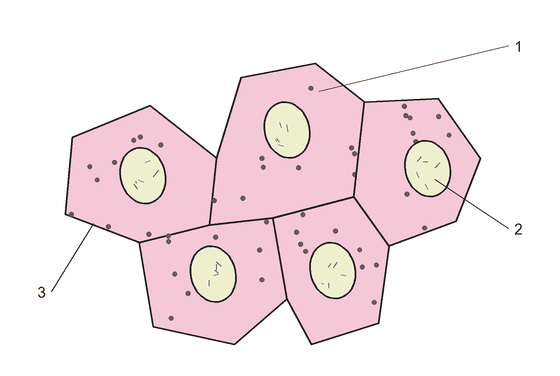
(i) Identify the kind of cells.
(ii) Label the guidelines 1 to 3.
(iii) Which of the above labelled part regulates and coordinates the various life processes of the cell ?
(iv) If we were to prepare a slide of the cells shown above, what stain will we use in order to clearly see the cells ?
(v) How many chromosomes are found in the part shown as 2 ?
Solve with AIWritten solution
Solution:
Concept: Human cheek cells are flat, irregular animal cells with a round nucleus, a granular cytoplasm and a thin cell membrane, and no cell wall.
Step 1 — (i) Identify the cells.
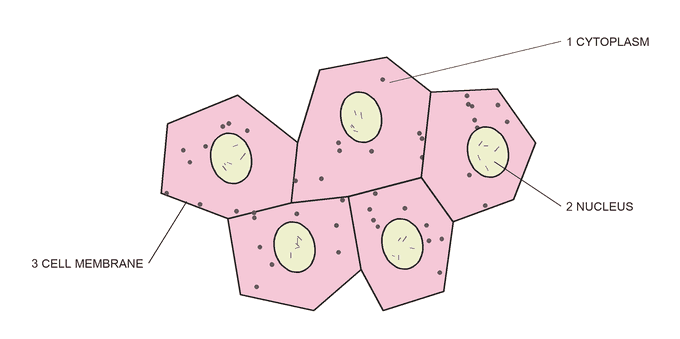
The cells are flat, many-sided and fitted together like tiles, with a central nucleus and no cell wall. These are human cheek cells (squamous epithelial cells scraped from the inside of the cheek).
Step 2 — (ii) Label guidelines 1 to 3.
Guideline 1 ends in the granular substance of a cell, guideline 2 on the round body inside it, and guideline 3 on the boundary of a cell: 1 cytoplasm, 2 nucleus, 3 cell membrane.
Step 3 — (iii) The control centre.
Part 2, the nucleus, regulates and coordinates the life processes of the cell.
Step 4 — (iv) The stain.
Cheek cells are stained with methylene blue, which colours the nucleus deep blue so that it stands out clearly.
Step 5 — (v) Chromosomes in part 2.
The nucleus of a human body cell has 46 chromosomes, in 23 pairs.
Watch out: The boundary seen between cheek cells is the cell membrane, not a cell wall.
Therefore, (i) human cheek cells; (ii) 1 cytoplasm, 2 nucleus, 3 cell membrane; (iii) the nucleus (2); (iv) methylene blue; (v) 46 chromosomes (23 pairs).
- 379 marks
Question 37
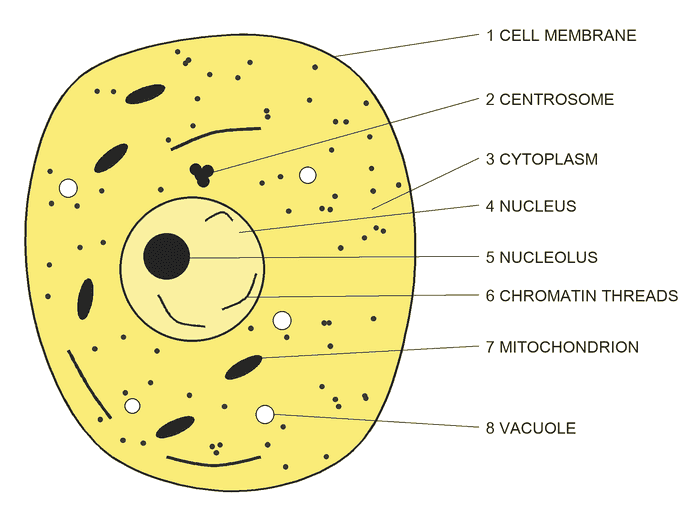
The diagram given alongside represents a cell. Study the same and answer the following questions :

(i) Is it a plant cell or an animal cell ? Give reason in support of your answer.
(ii) Label the guidelines 1 to 8.
(iii) Name one structure shown in the figure which is found in both plant and animal cells, but with different sizes.
(iv) What is the protective membranous covering of the part shown as 4 called ?
(v) Name any two organelles.
Solve with AIWritten solution
Solution:
Concept: An animal cell has a cell membrane as its outermost layer, no plastids, small vacuoles and a centrosome near the nucleus.
Step 1 — (i) Plant cell or animal cell.
It is an animal cell. It has no cell wall (the cell membrane is its outermost layer), no plastids, a centrosome, and many small vacuoles.
Step 2 — (ii) Label guidelines 1 to 8.
Following each guideline to the part it ends on gives these names: 1 cell membrane, 2 centrosome, 3 cytoplasm, 4 nucleus, 5 nucleolus, 6 chromatin threads (chromosomes), 7 mitochondrion, 8 vacuole.
Step 3 — (iii) In both cells, with different sizes.
The vacuole is found in both plant and animal cells. Animal cells have many small vacuoles, while plant cells have a few large ones, often one big central vacuole.
Step 4 — (iv) Covering of part 4.
Part 4 is the nucleus. Its protective covering is the thin, porous nuclear membrane.
Step 5 — (v) Two organelles.
Two organelles shown are the mitochondria and the centrosome.
Watch out: The centrosome is a mark of an animal cell; most plant cells do not have one.
Note: Guideline 4 ends just inside the nuclear membrane. Part 4 is read as the whole nucleus, because part (iv) asks for the membranous covering of part 4, and that covering is the nuclear membrane.
Therefore, (i) animal cell (no cell wall or plastids, centrosome present); (ii) 1 cell membrane, 2 centrosome, 3 cytoplasm, 4 nucleus, 5 nucleolus, 6 chromatin threads, 7 mitochondrion, 8 vacuole; (iii) the vacuole; (iv) the nuclear membrane; (v) mitochondria and centrosome.
- 386 marks
Question 38
For a classroom activity, class 6 students collected pond water samples from near their school. The water looked dirty and greenish, yet they couldn’t spot any organism with the naked eye. Their Biology teacher then helped them observe the samples they collected under a microscope. To their surprise, they saw tiny organisms that had no visible legs or hands but showed quick movements. Answer the following questions :
(i) Identify the organisms based on the clues :
(a) Irregular-shaped, unicellular animal.
(b) A unicellular, slipper-shaped animal that moves with the help of cilia.
(c) A unicellular plant with flagella.
(ii) Mention one biological function that occurs in both unicellular and multicellular organisms.
(iii) Why do cells differ in their shapes?
Solve with AIWritten solution
Solution:
Concept: Pond water is full of unicellular organisms, most of them too small to be seen with the naked eye; each one carries out every life process within its single cell.
Step 1 — (i) Identify the organisms.
Each clue points to one pond organism. (a) The single-celled organism of irregular, changing shape is Amoeba. (b) The single-celled, slipper-shaped organism that swims with cilia is Paramecium. (c) The single-celled green organism with flagella is Chlamydomonas.
Step 2 — (ii) A function common to all.
Nutrition, taking in and using food, goes on in unicellular and multicellular organisms alike. Respiration, growth and reproduction are other examples.
Step 3 — (iii) Why cells differ in shape.
The shape of a cell suits its function. For example, red blood cells are rounded discs that carry oxygen and slip through narrow capillaries, while nerve cells are long and branched to carry messages over long distances.
Note: The question calls Amoeba and Paramecium animals and Chlamydomonas a plant, as older books did; today all three are grouped as protists, single-celled organisms with a nucleus.
Therefore, (i) (a) Amoeba, (b) Paramecium, (c) Chlamydomonas; (ii) nutrition (or respiration, growth, reproduction); (iii) the shape of a cell depends on the work it does.
What Class 6 Biology Ch 3 covers
The sections of the chapter, in the order the book takes them. Every question above comes from one of these.
- 01Discovery of Cell
- 02Cells – Their Numbers, Shapes and Sizes
- 03Cell Theory
- 04Cell – The Structural Unit of Life
- 05Cell – The Functional Unit of Life
- 06Structure of a Cell
- 07The Cell Organelles
More ways to study this chapter
The same chapter asked three other ways. Practise it, revise it, and see what the board has set on Ch 3 before.
Class 6 Biology Ch 3 questions students ask
How many questions are there in Class 6 Biology Ch 3?
38 questions. Every one is solved step by step on this page.
Are these Class 6 Biology solutions free?
Yes. Every question and its full working is free to read, with no account needed.
Can I download the Class 6 Biology Ch 3 solutions as a PDF?
There is no PDF to download. Every solution is on this page instead, which means it is searchable, always the current syllabus, and readable on a phone. Use your browser's print option if you want it on paper.