Solution:
Concept: An animal cell has a cell membrane as its outermost layer, no plastids, small vacuoles and a centrosome near the nucleus.
Step 1 — (i) Plant cell or animal cell.
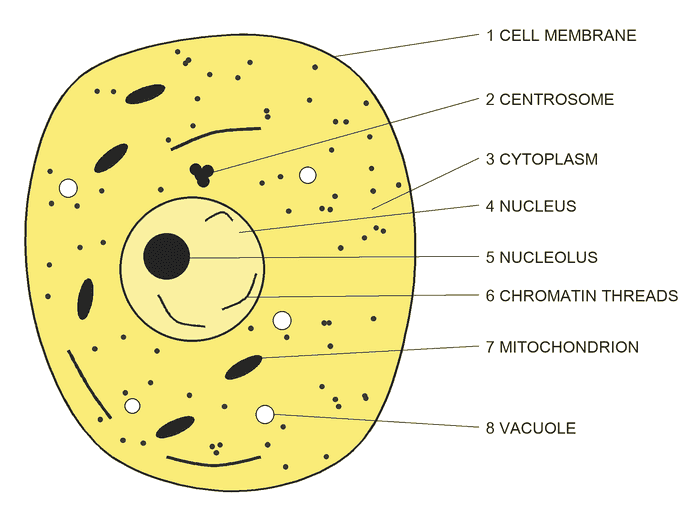
It is an animal cell. It has no cell wall (the cell membrane is its outermost layer), no plastids, a centrosome, and many small vacuoles.
Step 2 — (ii) Label guidelines 1 to 8.
Following each guideline to the part it ends on gives these names: 1 cell membrane, 2 centrosome, 3 cytoplasm, 4 nucleus, 5 nucleolus, 6 chromatin threads (chromosomes), 7 mitochondrion, 8 vacuole.
Step 3 — (iii) In both cells, with different sizes.
The vacuole is found in both plant and animal cells. Animal cells have many small vacuoles, while plant cells have a few large ones, often one big central vacuole.
Step 4 — (iv) Covering of part 4.
Part 4 is the nucleus. Its protective covering is the thin, porous nuclear membrane.
Step 5 — (v) Two organelles.
Two organelles shown are the mitochondria and the centrosome.
Watch out: The centrosome is a mark of an animal cell; most plant cells do not have one.
Note: Guideline 4 ends just inside the nuclear membrane. Part 4 is read as the whole nucleus, because part (iv) asks for the membranous covering of part 4, and that covering is the nuclear membrane.
Therefore, (i) animal cell (no cell wall or plastids, centrosome present); (ii) 1 cell membrane, 2 centrosome, 3 cytoplasm, 4 nucleus, 5 nucleolus, 6 chromatin threads, 7 mitochondrion, 8 vacuole; (iii) the vacuole; (iv) the nuclear membrane; (v) mitochondria and centrosome.

