Solution:
Concept: Human cheek cells are flat, irregular animal cells with a round nucleus, a granular cytoplasm and a thin cell membrane, and no cell wall.
Step 1 — (i) Identify the cells.
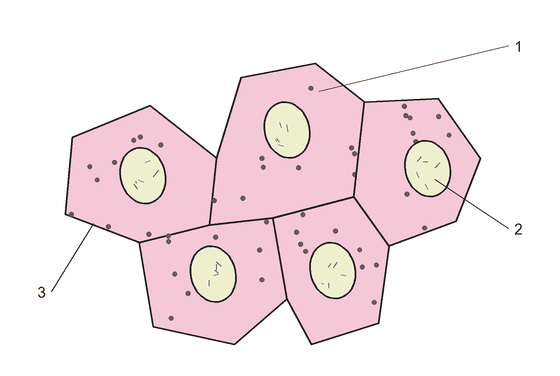
The cells are flat, many-sided and fitted together like tiles, with a central nucleus and no cell wall. These are human cheek cells (squamous epithelial cells scraped from the inside of the cheek).
Step 2 — (ii) Label guidelines 1 to 3.
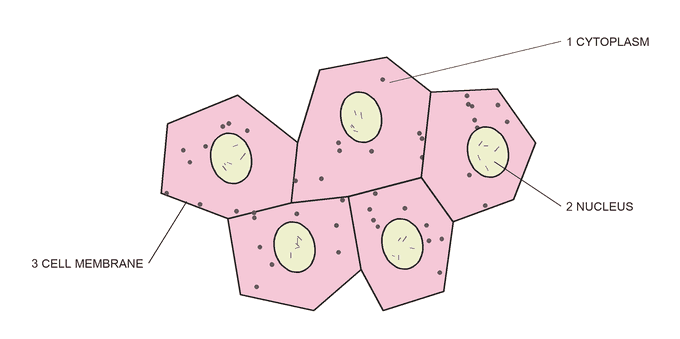
Guideline 1 ends in the granular substance of a cell, guideline 2 on the round body inside it, and guideline 3 on the boundary of a cell: 1 cytoplasm, 2 nucleus, 3 cell membrane.
Step 3 — (iii) The control centre.
Part 2, the nucleus, regulates and coordinates the life processes of the cell.
Step 4 — (iv) The stain.
Cheek cells are stained with methylene blue, which colours the nucleus deep blue so that it stands out clearly.
Step 5 — (v) Chromosomes in part 2.
The nucleus of a human body cell has 46 chromosomes, in 23 pairs.
Watch out: The boundary seen between cheek cells is the cell membrane, not a cell wall.
Therefore, (i) human cheek cells; (ii) 1 cytoplasm, 2 nucleus, 3 cell membrane; (iii) the nucleus (2); (iv) methylene blue; (v) 46 chromosomes (23 pairs).