
Opening your dashboard
Class 6 Biology Chapter 3 Cell – The Structure and Functions: Competency-Based Questions (CBQ)
40 questions on Chapter 3, each worked through on its own page with the AI tutor. Class 6 Biology, ICSE 2026-27.
40 questions
1–5 marks · Mixed difficulty
- 11 mark
Question 1
Cognitive domain: Application
The windows of Zara's classroom have a fine wire mesh. Fresh air passes in and out through it, but mosquitoes and flies are kept out. The corridor outside has only an open grill, and anything small can pass through it freely. Which part of a plant cell works most like the wire mesh ?
- 21 mark
Question 2
Cognitive domain: Analysis
Rohan looked at a stained scraping from the inside of his cheek under the microscope. Later he drew one cell from memory for the class chart. His teacher said, "You have drawn one part that a cheek cell does not have." Four parts of his drawing are marked P, Q, R and S.

Which part should Rohan remove from his drawing ?
- 31 mark
Question 3
Cognitive domain: Application
A new-born kitten weighed 100 g. Two years later it is a full-grown cat of 4 kg. A scientist finds that the cells of the cat are about the same size as the cells of the kitten. What best explains how its body became so much bigger ?
- 41 mark
Question 4
Cognitive domain: Analysis
A science club made this table for four living things W, X, Y and Z, but left out their names.
Living thing Its body is made of W one cell X one cell Y many cells Z many cells Which set of names fits W, X, Y and Z, in that order ?
- 51 mark
Question 5
Cognitive domain: Understanding
Assertion (A): With the microscope in the school laboratory, students can see the nucleus of an onion peel cell, but they cannot see organelles such as ribosomes in it.
Reason (R): Organelles such as ribosomes are minute structures in the cytoplasm that were revealed only by microscopes of higher magnification, specially the electron microscope.
- 61 mark
Question 6
Cognitive domain: Analysis
Assertion (A): A huge peepal tree and a tiny Chlamydomonas seen only under a microscope are both made up of cells.
Reason (R): Every living organism is made up of many cells.
- 71 mark
Question 7
Cognitive domain: Understanding
In the laboratory, four groups look at four different things under the microscope. These are thin slices of a carrot root, a balsam stem and a spinach leaf, and a prepared slide of frog skin. The shapes they see are different, but every group finds that its slide is built of tiny units of the same basic plan.
Complete the sentence :
These observations support the statement that the ______ is the ______ unit of all living organisms.
- 81 mark
Question 8
Cognitive domain: Application
At a juice stall in Pune, a long sugarcane stem is crushed between rollers. A full glass of sweet, watery juice flows out of the plant cells.
Complete the sentence :
Most of this watery liquid was stored in the large ______ of the plant cells, and the liquid inside them is called ______.
- 91 mark
Question 9
Cognitive domain: Application
Riya makes a model of the stomach for her class. She puts bits of chapati and some water in a thick plastic bag and squeezes the bag again and again with her hands. The chapati gets mashed, just as food is churned by the muscle cells in the wall of the stomach. But the mashed chapati is still chapati. It has not been digested.
Complete the sentence :
Riya's model has nothing to do the work of the ______ cells of the stomach, whose job is to secrete ______ that digest the food.
- 102 marks
Question 10
Cognitive domain: Evaluation
Aman is making notes on the plant cell. He writes, "The cell wall is thick and lies on the outside. So it is the cell wall that decides which substances may enter the cell and which may not."
Is Aman's conclusion correct ? Justify your answer.
- 112 marks
Question 11
Cognitive domain: Understanding
In a mustard field in Punjab, the leaves of the plants are green but the petals of the flowers are bright yellow. Both colours come from plastids in the cells.
Name the plastid that gives each colour, and explain how each colour helps the mustard plant.
- 122 marks
Question 12
Cognitive domain: Evaluation
During a class quiz, Priya says, "A cell is always so small that nobody can ever see one without a microscope."
How far is Priya's statement correct ? Support your answer with examples from what you have learnt about the sizes of cells.
- 134 marks
Question 13
Cognitive domain: Application
Case: It is a hot afternoon and Arjun is playing a kho-kho match for his school in Nashik. The moment he feels a tap on his back, he springs up and chases a player of the other team. He plays in the open sun for an hour. After the match he sits in the shade and eats two bananas.
(a) Which cells carried the message of the tap on Arjun's back ? In what form was the message carried ?
(b) Which cells made his legs move when he sprang up and ran ? What ability of these cells makes movement possible ?
(c) For a whole hour, one kind of cells formed the outermost covering of his body. State two ways in which these cells helped him during the match.
(d) Which cells help Arjun to digest the bananas ? How do they do it ?
- 145 marks
Question 14
Cognitive domain: Analysis
Case: The laboratory of a school has three old prepared slides whose labels have fallen off. The three loose labels read leaf, cork and smooth muscle. Class 6 students study the slides K, L and M under the microscope and note what they see.
Slide Shape of the cells Wall outside the cell membrane Protoplasm (cytoplasm and nucleus) Green plastids K Rectangular Present Present Present L Long and thin, tapering at both ends Absent Present Absent M Box-like, piled up together Present Absent, the boxes are empty Absent (a) Match each slide with its correct label. Give one observation from the table to support each match.
(b) On which slide are the cells not living ? How does the table tell you this ? Name the scientist who first saw such cells.
(c) What is the special name for the shape of the cells on slide L ? How is the work of these cells different from the work of the cells on slide K ?
(d) Sameer says, "Slides K and M both show a wall, so both must be able to prepare food." Is he right ? Explain.
- 155 marks
Question 15
Cognitive domain: Creativity
Case: For the science exhibition, Diya's group wants to make a chart called "A plant cell is like our school". They want to compare six parts of a plant cell with parts of the school, so that younger children can remember what each part does. The six parts are the cell wall, cell membrane, nucleus, cytoplasm, vacuole and chloroplast.
(a) Choose a part of a school (a place, a thing or a person) to stand for each of the six cell parts. Give the reason for each choice.
(b) Next year the group wants to change the chart to "An animal cell is like our school". Which two comparisons must they remove, and why ? What should they change about the vacuole ?
(c) No comparison is perfect. State one important way in which a living cell is not like a school building.
- 161 mark
Question 16
Cognitive domain: Analysis
A museum has two display boards about the early study of cells. Board 1 shows a very thin slice of dead cork seen through a microscope with two lenses: a cluster of box-like cubicles piled together. Board 2 shows blood cells in the thin blood vessels (capillaries) of a frog's foot-web, seen through a single biconvex lens: the cells are alive and are being carried along in the blood.
Which conclusion can be drawn from Board 2 but not from Board 1 ?
- 171 mark
Question 17
Cognitive domain: Analysis
Four scientists reported new findings. Which one of them, if it were confirmed, would go against the cell theory as stated in your chapter ?
- 181 mark
Question 18
Cognitive domain: Analysis
A very thin needle (imagine it) is pushed in a straight line from the nucleus of a plant cell to the outside, along a path that does not meet any vacuole. After leaving the nucleus, which list gives the parts of the cell that the needle passes through, in order, from inside to outside ?
- 191 mark
Question 19
Cognitive domain: Understanding
Dipti makes cards for the parts of an onion peel cell and sorts them into two piles, 'living' and 'non-living'. Which pair of cards must go together into the non-living pile ?
- 201 mark
Question 20
Cognitive domain: Application
A laboratory sheet gives the length of a bacterial cell as . (Hypothetical data.) Meena knows that one micrometre () is one-thousandth of a millimetre, and that the smallest cells, found among bacteria, are about to long.
Which statement is correct ?
- 211 mark
Question 21
Cognitive domain: Understanding
Assertion (A): Spirogyra is called a multicellular organism, while Chlamydomonas is called a unicellular organism, although both are green algae.
Reason (R): Whether an organism is called unicellular or multicellular depends on the number of cells in its body.
- 221 mark
Question 22
Cognitive domain: Analysis
Assertion (A): In an animal cell, the cytoplasm is dense and granular and fills almost the entire cell.
Reason (R): The vacuoles of an animal cell are few and very large, and they push the cytoplasm towards the edge of the cell.
- 231 mark
Question 23
Cognitive domain: Understanding
Amoeba is a single-celled organism, while an earthworm has a body made up of a very large number of cells. Both carry out their life activities. Which statement about how they do this is correct ?
- 241 mark
Question 24
Cognitive domain: Application
Imran has pulled a thin lining from the inner surface of an onion 'leaf' with forceps. His four remaining steps are given below in a jumbled order.
P. Place the piece of lining on a slide and add a drop of dilute iodine solution.
Q. Gently place a coverslip over it.
R. Cut a small piece of the lining, about square, with a pair of scissors.
S. Examine the slide under the microscope, first under low power and then under high power.
Which order of the steps is correct ?
- 251 mark
Question 25
Cognitive domain: Evaluation
In an imaginary experiment, the nucleus is removed from a living cell and the rest of the cell is kept in a suitable fluid. A student says, "The cell will go on working normally and will divide, because the cytoplasm is the living part of the cell and the nucleus is only a small round body."
Which reply to the student is the best ?
- 262 marks
Question 26
Cognitive domain: Evaluation
Aarav keeps a dry slice of onion peel in a glass of tap water for a week. When he looks at a drop of the water under the microscope, he sees a few tiny green single-celled organisms swimming in it. He says, "These new cells were made by the onion peel, which has now died."
Is Aarav's claim in agreement with the cell theory ? Give a reason, and say where the green cells could have come from.
- 272 marks
Question 27
Cognitive domain: Application
Meera picks up a green, slippery thread from a pond. Under a compound microscope the thread shows many cylindrical cells joined end to end, and each cell has a green spiral ribbon inside it.
(a) Is the thread unicellular or multicellular ? Give a reason.
(b) Name the plastid that forms the green spiral ribbon and state its function.
- 282 marks
Question 28
Cognitive domain: Application
Rohit saw two slides of muscle cells of the human body, labelled only M and N. On slide M the cells were long and thin, tapering at both ends. On slide N the cells were cylindrical in shape. His teacher told him that one slide was of smooth muscles and the other was of cardiac muscles (muscles of the heart).
(a) Which slide is of cardiac muscles ? Name the shape of the cells on the other slide.
(b) Why is the cylindrical shape useful to the cardiac muscles ?
- 292 marks
Question 29
Cognitive domain: Analysis
A disease dissolves the cell walls of the outer layer of cells in an onion bulb, while the cell membranes and all the other parts are left in place. (Hypothetical situation.)
Using what a cell wall does, predict two ways in which these cells will be affected.
- 302 marks
Question 30
Cognitive domain: Application
Zoya is about to study some cheek scrapings stained with methylene blue. The figure shows the compound microscope that she uses in her school laboratory. Parts P and Q are marked.

(a) Name the parts marked P and Q.
(b) The scrapings are spread over the slide. Should Zoya first use the low-power or the high-power objective lens ? Give a reason.
- 312 marks
Question 31
Cognitive domain: Understanding
The cell theory has four points: (1) every living organism is made up of one or many cells; (2) the cell is the structural unit of all living organisms; (3) the cell is the functional unit of all living organisms; (4) all cells arise from pre-existing cells.
Name the point of the cell theory that each observation supports.
(a) A single yeast cell, alone in a drop of sugar solution, takes in food, releases energy and grows.
(b) In a root tip, one cell is seen splitting into two cells, and each of them later splits again.
- 323 marks
Question 32
Cognitive domain: Analysis
At the science club, Rani watched two short videos of cells dividing.
-
Video 1: In a drop of pond water, one Amoeba divided into two, and soon two separate Amoebae were swimming apart.
-
Video 2: In the growing tip of a pea root, one cell divided into two, but the pea plant was still one single plant.
(a) Which need for new cells is met by the division in Video 1 ? Give a reason.
(b) Which need for new cells is met by the division in Video 2 ? Give a reason.
(c) The same process, cell division, meets different needs in the two videos. Explain why, using the number of cells in the body of each organism.
-
- 333 marks
Question 33
Cognitive domain: Analysis
A student copied the number of chromosomes counted in some cells from a reference book.
Cell Number of chromosomes Human skin cell 46 Human nerve cell 46 Pea leaf cell 14 Pea root cell 14 Onion root cell 15 (a) Her teacher said that the entry for the onion root cell must be a copying mistake, even without looking it up. Give the reason, using the number of pairs in a human cell and in a pea cell.
(b) What does the table show about the number of chromosomes in the cells of one species, and in the cells of different species ?
(c) Name the part of the cell in which chromosomes are found, and the units they carry.
- 343 marks
Question 34
Cognitive domain: Analysis
In each set of four, one item does not belong with the other three. Name the odd one out and give a reason.
(a) Robert Hooke, Schleiden, Schwann, Virchow
(b) Chloroplast, chromoplast, leukoplast, centrosome
(c) Nucleolus, chromosomes, nuclear membrane, cell wall
- 353 marks
Question 35
Cognitive domain: Evaluation
Kabir wrote these notes about his activity on cheek cells.
-
I took a sharp blade and scraped the inside of my cheek hard.
-
I put the scrapings on a glass slide and added a drop of methylene blue.
-
I did the activity alone at home, to save time.
-
I looked under the high power first, to see the cells big, and then under the low power.
Three of his notes describe a mistake. Find them and say how each should be corrected.
-
- 363 marks
Question 36
Cognitive domain: Creativity
A writer is inventing a single-celled pond creature called 'Greenie' for a story for young children. Greenie must make its own food using sunlight, must keep a definite shape and be protected from injury, and must swim with the help of whip-like threads called flagella.
(a) Name two cell parts that Greenie must have to make its own food and to keep a definite shape, and say what each does.
(b) Name the three essential parts that Greenie, like every cell, must have.
(c) Which single-celled organism named in the chapter is the most like Greenie ? Give a reason.
- 374 marks
Question 37
Cognitive domain: Evaluation
Case: The science club of a school in Jaipur found two instruments in its store room: a simple microscope with a single biconvex lens, and a compound microscope like those used in school laboratories. A nearby college has an electron microscope. The club has three jobs, and it wants to use each instrument for exactly one job. (Hypothetical situation.)
Job What is to be seen X The cells in a stained piece of onion peel Y The tiny organelles, such as ribosomes, in the cytoplasm of a cell Z Blood cells in a frog's foot-web, as Leeuwenhoek did (a) Match each job X, Y and Z with the instrument that is suited to it, using each instrument once.
(b) Why can the organelles in job Y not be studied with the instrument used for job X ?
(c) A member says, "The electron microscope is the best for every job, so the other two instruments are not needed." Evaluate this claim.
- 384 marks
Question 38
Cognitive domain: Analysis
Case: In the school garden, Pooja counted the cells in one thin strip of the growing tip of a bean root, once every day from day to day , and drew this graph. (Hypothetical data.)

(a) How many cells did the strip have on day ?
(b) The pattern continues in the same way. How many cells will the strip have on day ? Explain the pattern, using cell division.
(c) Name the need for new cells that the graph shows. If an insect nibbles the tip, which different need for new cells will be met when the cells divide to fill the gap ?
- 394 marks
Question 39
Cognitive domain: Application
Case: Ishaan drew four cells, P, Q, R and S, for a chart on the shapes of cells. P is a cell from a leaf. Q is a cell from human blood that carries oxygen. R is another kind of cell from human blood, which does not carry oxygen. S is a single-celled pond animal that moves with the help of cilia.
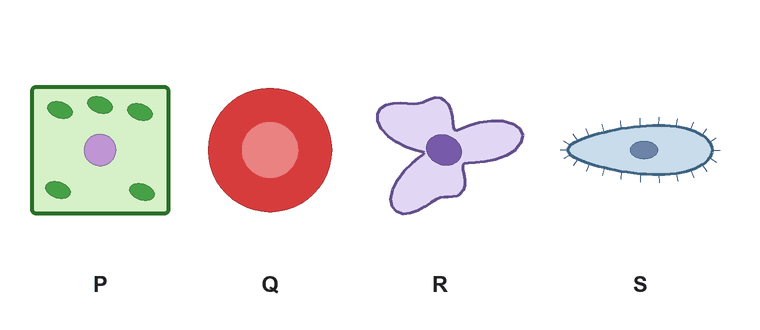
(a) Which one of the four cells has a cell wall ? How does the cell wall help this cell to keep the shape seen in the drawing ?
(b) The shape of cell R is called amoeboid. After which single-celled organism is this shape named, and what does the word tell you about the shape of R ?
(c) Ishaan wants to add a fifth drawing, T, of a nerve cell. Describe the shape he should draw, and explain how this shape suits the work of a nerve cell.
- 405 marks
Question 40
Cognitive domain: Creativity
Case: For the school science fair, Ishaan's group invents a 'Cell Passport', a small card that records a few facts about one kind of cell. They make one passport for a cell from the red flesh of a ripe tomato and one for a white blood cell from human blood.
(a) Copy and fill in the two passports for these four fields: outer covering, plastids (with the kind of plastid, if any), vacuoles and shape.
(b) Invent two more fields for the passport, and fill them in for both cells.
(c) Name one field whose entry is the same in both passports, and give the entry.