
Opening your dashboard
Class 5 Science Chapter 10: Light and Shadows Solutions
29 textbook questions with step-by-step answers, free to read, for ICSE 2026-27.
Get talked through Ch 10, not just shown the answer
Reading a finished solution is not the same as being able to do it. The AI tutor takes one question at a time and works it with you, in your own words, until you can.
- Ask it out loud, in your own words
- It gives you the next step, not the answer
- Stuck on part (ii)? Start there
29 questions with solutions
1–5 marks · Mixed difficulty
- 11 mark
Question 1
Give two examples of the following.
Artificial source of light ________ ________
Solve with AIWritten solution
Solution:
Concept: A source of light is an object that gives off its own light. Natural sources, such as the Sun, are not made by people. Artificial sources are made by people.
Step 1 — What is asked.
We need two sources of light that are made by people.
Step 2 — Recall the examples.
An electric bulb and a candle are made by people, and both give off their own light. A torch and a tube light are other examples.
Therefore, two artificial sources of light are an electric bulb and a candle.
- 21 mark
Question 2
Give two examples of the following.
Transparent objects ________ ________
Solve with AIWritten solution
Solution:
Concept: Transparent objects let almost all the light falling on them pass through. So we can see clearly through them.
Step 1 — What is asked.
We need two objects that we can see clearly through.
Step 2 — Recall the examples.
We can see clearly through a glass window pane and through clear water. Spectacle glasses and a car windscreen are other examples.
Therefore, two transparent objects are a glass window pane and clear water.
- 31 mark
Question 3
Give two examples of the following.
Translucent objects ________ ________
Solve with AIWritten solution
Solution:
Concept: Translucent objects let only some of the light falling on them pass through. We can see through them, but not clearly.
Step 1 — What is asked.
We need two objects that we can see through only partly.
Step 2 — Recall the examples.
Tracing paper and frosted glass let some light through, so things behind them look blurred. Oiled paper and butter paper are other examples.
Therefore, two translucent objects are tracing paper and frosted glass.
- 41 mark
Question 4
Give two examples of the following.
Opaque objects ________ ________
Solve with AIWritten solution
Solution:
Concept: Opaque objects do not let any light pass through them. We cannot see through them at all.
Step 1 — What is asked.
We need two objects that block light completely.
Step 2 — Recall the examples.
A wooden door and a brick wall block all the light, so we cannot see through them. A book and a metal plate are other examples.
Therefore, two opaque objects are a wooden door and a brick wall.
- 51 mark
Question 5
Choose the correct option.
Which of these is not a source of light?
Solve with AIAnswer
(A) Sun
- Correct
(B) Books
(C) Bulb
(D) Candle
Answer: (B) Books
Concept: A source of light gives off its own light. Other objects do not give off light; we see them only because they bounce back (reflect) light that falls on them.
Step 1 — What is asked.
We must find the one option that does not give off its own light.
Step 2 — Check each option.
The Sun, a lit bulb and a burning candle all give off their own light. A book gives off no light of its own.
Step 3 — Say how we see a book.
We see a book only when light from a source falls on it and the book reflects this light into our eyes. In a dark room we cannot see it.
Step 4 — Check the other options.
Each of the other options is wrong for the reason given below.
- (A): The Sun gives off its own light. It is the main natural source of light.
- (C): A lit electric bulb gives off its own light. It is an artificial source of light.
- (D): A burning candle gives off its own light from its flame. It is an artificial source of light.
Therefore, books are not a source of light: option (B).
- 61 mark
Question 6
Choose the correct option.
You will be able to see most clearly through something that
Solve with AIAnswer
- Correct
(A) allows all light to pass through it
(B) reflects all light falling on it
(C) absorbs all light falling on it
(D) allows half the light to pass through and reflects the other half
Answer: (A) allows all light to pass through it
Concept: We see an object behind a material only when light from that object passes through the material and reaches our eyes. The more light passes through, the more clearly we see.
Step 1 — What is asked.
We must find the kind of material that we can see through most clearly.
Step 2 — Link seeing to light passing through.
If a material lets all the light pass through, the light from things behind it reaches our eyes fully. Such a material is transparent, like clear glass.
Step 3 — Choose the answer.
So we see most clearly through a material that lets all the light pass through it.
Step 4 — Check the other options.
Each of the other options is wrong for the reason given below.
- (B): A material that reflects all the light sends it back. No light from behind it reaches our eyes, so we cannot see through it.
- (C): A material that absorbs all the light lets none of it through. It is opaque, so we cannot see through it.
- (D): A material that lets only half the light through behaves like a translucent object. Things behind it look blurred.
Watch out: Real transparent objects, such as window glass, let almost all the light through. A very small part is reflected, which is why we sometimes see our reflection in a window.
Therefore, we see most clearly through something that allows all light to pass through it: option (A).
- 71 mark
Question 7
Choose the correct option.
If you smear a few drops of oil on a white sheet of paper, it becomes
Solve with AIAnswer
(A) transparent
(B) opaque
- Correct
(C) translucent
(D) none of these
Answer: (C) translucent
Concept: A translucent object lets some light pass through it, so we can see through it, but not clearly.
Step 1 — What is asked.
We must say what kind of object a white paper becomes after a little oil is spread on it.
Step 2 — Recall the activity.
When we look at a candle flame through oiled paper, we can see the glow of the flame, but not clearly. The oiled part lets some light pass through.
Step 3 — Choose the answer.
An object that lets some light through is translucent.
Step 4 — Check the other options.
Each of the other options is wrong for the reason given below.
- (A): Oiled paper does not let us see clearly through it, so it is not transparent.
- (B): Oiled paper lets some light pass through, so it is not opaque.
- (D): One of the given words, translucent, does describe oiled paper, so 'none of these' is not correct.
Therefore, oiled paper becomes translucent: option (C).
- 81 mark
Question 8
Choose the correct option.
A lunar eclipse occurs when the
Solve with AIAnswer
- Correct
(A) Earth is between the Sun and the Moon
(B) Moon is between the Sun and the Earth
(C) Sun is between the Earth and the Moon
(D) in all the above situations
Answer: (A) Earth is between the Sun and the Moon
Concept: An eclipse happens when the Sun, the Earth and the Moon come in a straight line. The body in the middle casts its shadow on the body behind it. In a lunar eclipse, the Earth's shadow falls on the Moon.
Step 1 — What is asked.
We must find the order of the Sun, Earth and Moon in a lunar eclipse.
Step 2 — Find which shadow falls on the Moon.
In a lunar eclipse the Moon goes dark because the Earth's shadow falls on it. For this, the Earth must block the sunlight going to the Moon.
Step 3 — Find the order.
So the Earth must be in the middle, between the Sun and the Moon. The figure shows this order.

Step 4 — Check the other options.
Each of the other options is wrong for the reason given below.
- (B): When the Moon is between the Sun and the Earth, the Moon's shadow falls on the Earth. That is a solar eclipse.
- (C): If the Sun were in the middle, no shadow could fall on the Earth or the Moon, because the Sun itself gives the light.
- (D): Only one order, with the Earth in the middle, gives a lunar eclipse, so not all the situations do.
Therefore, a lunar eclipse occurs when the Earth is between the Sun and the Moon: option (A).
- 91 mark
Question 9
Choose the correct option.
The shadow of an object
Solve with AIAnswer
(A) always the same size
(B) has the same colour as the object
(C) is fixed at a place
- Correct
(D) none of the above
Answer: (D) none of the above
Concept: A shadow is the dark patch formed behind an opaque object when it blocks light. Its size depends on the distances, it is dark whatever the colour of the object, and it moves when the object or the light moves.
Step 1 — What is asked.
We must check each statement about a shadow and find the correct option.
Step 2 — Check the size.
When the light source is moved nearer to the object, the shadow becomes bigger. When it is moved farther away, the shadow becomes smaller. So a shadow is not always the same size.

Step 3 — Check the colour and the place.
A shadow is a dark patch, whatever the colour of the object, because it is a place that light does not reach. When the object moves, its shadow moves with it, so a shadow is not fixed at a place.
Step 4 — Choose the answer.
Options (A), (B) and (C) are all false, so the correct option is 'none of the above'.
Step 5 — Check the other options.
Each of the other options is wrong for the reason given below.
- (A): This is false. The size of a shadow changes when the distance between the object and the light source changes.
- (B): This is false. A red ball and a blue ball both make a dark shadow, not a red or a blue one.
- (C): This is false. A shadow moves when the object moves, just as our shadow walks with us.
Therefore, none of the given statements is correct: option (D).
- 101 mark
Question 10
Fill in the blanks.
Word box: light · lunar · energy · opaque · sun
__________ is the main source of light.
Solve with AIWritten solution
Solution:
Concept: The Sun gives off its own light. It is the main and natural source of light for the Earth.
Step 1 — What is asked.
We need the main source of light.
Step 2 — Pick the word from the box.
The Sun lights up the Earth during the day. It is the main source of light, so the word is 'Sun'.
Therefore, the answer is: Sun is the main source of light.
- 111 mark
Question 11
Fill in the blanks.
Word box: light · lunar · energy · opaque · sun
Light is a form of __________.
Solve with AIWritten solution
Solution:
Concept: Energy is what makes things work or change. Light is one form of energy; heat and sound are other forms.
Step 1 — What is asked.
We need the word that tells us what light is a form of.
Step 2 — Pick the word from the box.
Light helps us to see, and plants use it to make food. It is a form of energy.
Therefore, the answer is: Light is a form of energy.
- 121 mark
Question 12
Fill in the blanks.
Word box: light · lunar · energy · opaque · sun
__________ objects do not allow light to pass through them.
Solve with AIWritten solution
Solution:
Concept: Objects are of three kinds: transparent (let almost all light through), translucent (let some light through) and opaque (let no light through).
Step 1 — What is asked.
We need the kind of object that lets no light pass through it.
Step 2 — Pick the word from the box.
Objects such as a wooden door and a brick wall block all the light. They are opaque.
Therefore, the answer is: Opaque objects do not allow light to pass through them.
- 131 mark
Question 13
Fill in the blanks.
Word box: light · lunar · energy · opaque · sun
Shadow forms when an object blocks the path of __________ .
Solve with AIWritten solution
Solution:
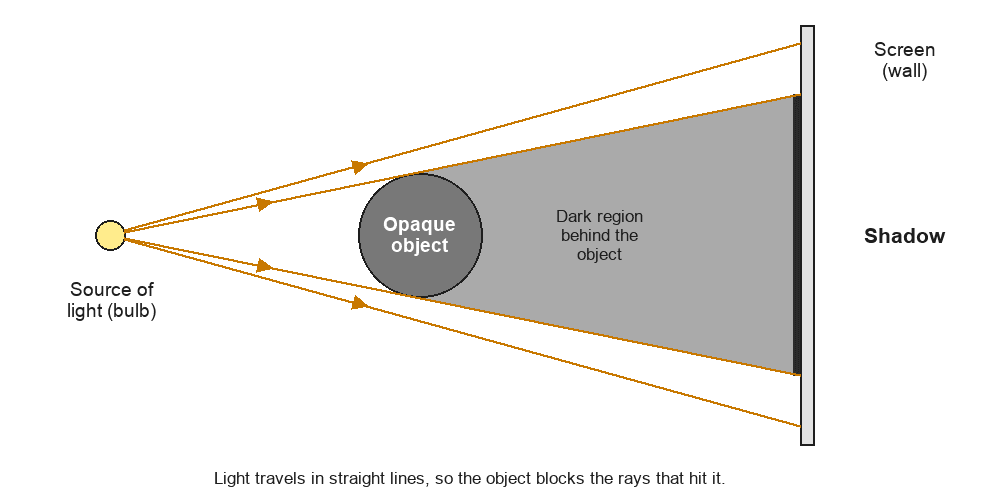
Concept: Light travels in straight lines. When an opaque object comes in its way, the light cannot reach the space behind the object, and a dark patch called a shadow forms there.
Step 1 — What is asked.
We need the thing whose path is blocked when a shadow forms.
Step 2 — Pick the word from the box.
The object blocks the rays of light coming from the source, as the figure shows. So the word is 'light'.
Therefore, the answer is: Shadow forms when an object blocks the path of light.
- 141 mark
Question 14
Fill in the blanks.
Word box: light · lunar · energy · opaque · sun
The __________ eclipse can last a few hours.
Solve with AIWritten solution
Solution:
Concept: In a lunar eclipse the Earth's shadow falls on the Moon. The Earth's shadow is very large, so the Moon takes a long time to pass through it.
Step 1 — What is asked.
We need the kind of eclipse that can last a few hours.
Step 2 — Compare the two eclipses.
A total solar eclipse lasts only a few minutes at one place, because the Moon's small shadow moves quickly over the Earth. A lunar eclipse can last a few hours, because the Moon moves slowly through the Earth's big shadow.
Step 3 — Pick the word from the box.
So the word is 'lunar'.
Therefore, the answer is: The lunar eclipse can last a few hours.
- 151 mark
Question 15
Write T for True statements or F for False statements.
Wood is an example of translucent material.
Solve with AIWritten solution
Solution:
Concept: A translucent material lets some light pass through it. An opaque material lets no light pass through it.
Step 1 — Read the statement.
It says that wood lets some light pass through it.
Step 2 — Check it.
We cannot see anything through a wooden door or a wooden plank. Wood blocks the light completely, so it is opaque, not translucent.
Step 3 — Correct it.
The correct statement is: Wood is an example of opaque material.
Therefore, the statement is False (F).
- 161 mark
Question 16
Write T for True statements or F for False statements.
Our shadow is long during morning and evening.
Solve with AIWritten solution
Solution:
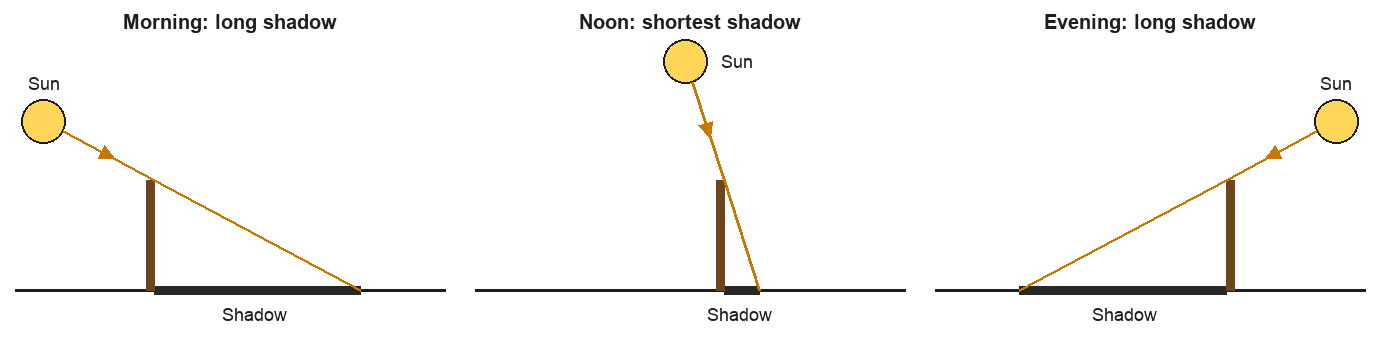
Concept: The length of our shadow depends on how high the Sun is in the sky. When the Sun is low, the rays come in at a slant and the shadow is long. When the Sun is high, the shadow is short.
Step 1 — Read the statement.
It says that our shadow is long in the morning and in the evening.
Step 2 — Check it.
In the morning, just after sunrise, and in the evening, just before sunset, the Sun is low in the sky. Its slanting rays make a long shadow. At noon the Sun is high, and the shadow is shortest. The figure shows a pole's shadow at these three times.
Therefore, the statement is True (T).
- 171 mark
Question 17
Write T for True statements or F for False statements.
During partial lunar eclipse, the Earth's shadow completely covers the Moon.
Solve with AIWritten solution
Solution:
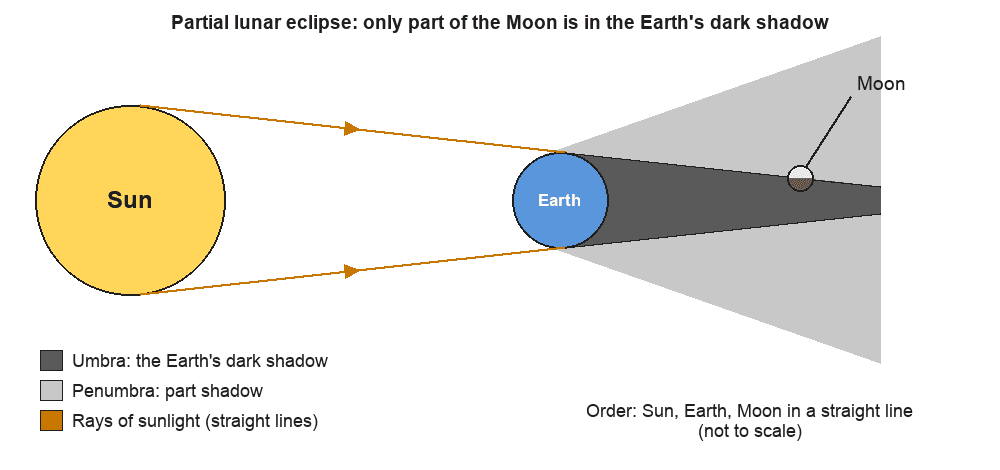
Concept: In a lunar eclipse the Earth's shadow falls on the Moon. If the shadow covers the whole Moon, it is a total lunar eclipse. If it covers only a part of the Moon, it is a partial lunar eclipse.
Step 1 — Read the statement.
It says that in a partial lunar eclipse the whole Moon is covered.
Step 2 — Check it.
In a partial lunar eclipse only a part of the Moon is in the Earth's dark shadow, so we can still see the rest of the Moon shining. The figure shows this.
Step 3 — Correct it.
The correct statement is: During a total lunar eclipse, the Earth's shadow completely covers the Moon.
Therefore, the statement is False (F).
- 181 mark
Question 18
Write T for True statements or F for False statements.
A total solar eclipse can last only for a few minutes.
Solve with AIWritten solution
Solution:
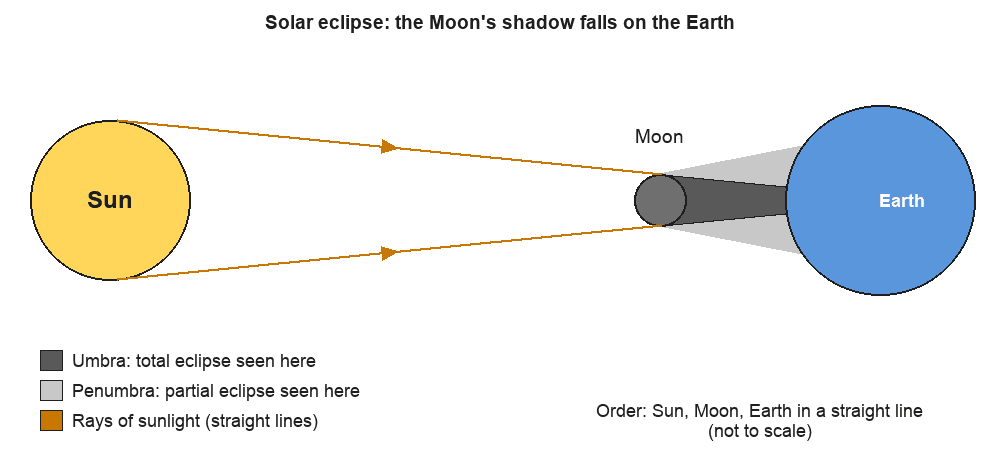
Concept: In a solar eclipse the Moon's shadow falls on the Earth. The darkest part of the Moon's shadow makes only a small patch on the Earth, and this patch moves quickly.
Step 1 — Read the statement.
It says that a total solar eclipse lasts only a few minutes.
Step 2 — Check it.
At any one place, the Sun stays fully covered only while the small dark patch of the Moon's shadow passes over it. This takes a few minutes, never more than about seven and a half minutes. The figure shows how small this patch is.
Therefore, the statement is True (T).
- 191 mark
Question 19
Write T for True statements or F for False statements.
It is safe to look directly at the Sun during solar eclipse.
Solve with AIWritten solution
Solution:
Concept: Sunlight is very strong. Looking straight at the Sun, even when the Moon covers a part of it, can harm our eyes for life.
Step 1 — Read the statement.
It says that we can safely look straight at the Sun during a solar eclipse.
Step 2 — Check it.
The uncovered part of the Sun is still very bright and can burn the inside of the eye. The eye does not feel pain, so the harm can happen without warning. Ordinary sunglasses do not protect the eyes.
Step 3 — Correct it.
The correct statement is: It is not safe to look directly at the Sun during a solar eclipse. Use special eclipse glasses, or see the Sun's image on a screen through a pinhole.
Therefore, the statement is False (F).
- 205 marks
Question 20
Match the following.
Column A Column B 1. Shadow a. Artificial source of light 2. Candle b. Natural source of light 3. Transparent c. Caused by shadow of Earth or Moon 4. Eclipse d. Path of light blocked 5. Glow-worm e. Can see clearly through it Solve with AIWritten solution
Solution:
Concept: Each term in column A is linked to one fact about it in column B. Use each item of column B only once.
Step 1 — Match 1 (Shadow).
A shadow forms when an object blocks the path of light. So 1 matches d.
Step 2 — Match 2 (Candle).
A candle is made by people and gives off light when it burns. So 2 matches a.
Step 3 — Match 3 (Transparent).
We can see clearly through a transparent object, such as clear glass. So 3 matches e.
Step 4 — Match 4 (Eclipse).
An eclipse happens when the shadow of the Earth falls on the Moon, or the shadow of the Moon falls on the Earth. So 4 matches c.
Step 5 — Match 5 (Glow-worm).
A glow-worm is a small insect that makes its own light. It is not made by people, so it is a natural source of light. So 5 matches b.
Step 6 — Write the matched pairs.
The table below shows each term with its match.
Column A Column B 1. Shadow d. Path of light blocked 2. Candle a. Artificial source of light 3. Transparent e. Can see clearly through it 4. Eclipse c. Caused by shadow of Earth or Moon 5. Glow-worm b. Natural source of light Therefore, 1 matches d, 2 matches a, 3 matches e, 4 matches c and 5 matches b.
- 212 marks
Question 21
What is a source of light? Give one example each of natural and artificial sources of light.
Solve with AIWritten solution
Solution:
Concept: Some objects give off light of their own. Others only bounce back the light that falls on them.
Step 1 — Define a source of light.
A source of light is an object that gives off light of its own.
Step 2 — Give a natural source.
The Sun is a natural source of light. It is not made by people. Stars and glow-worms are other natural sources.
Step 3 — Give an artificial source.
An electric bulb is an artificial source of light. It is made by people. A candle and a torch are other artificial sources.
Note: The Moon is not a source of light. It shines only because it reflects the sunlight that falls on it.
Therefore, a source of light is an object that gives off its own light; the Sun is a natural source and an electric bulb is an artificial source.
- 222 marks
Question 22
What are the conditions required to form a shadow?
Solve with AIWritten solution
Solution:
Concept: Light travels in straight lines. A shadow is the dark patch that forms behind an object when the object blocks the light.
Step 1 — First condition.
There must be a source of light, such as the Sun, a bulb or a torch.
Step 2 — Second condition.
There must be an opaque object in the path of the light to block it. A translucent object blocks only some light, so it makes a faint shadow.
Step 3 — Third condition.
There must be a surface behind the object, such as a wall, a screen or the ground, on which the shadow can fall.
Step 4 — See the three together.
The figure shows all three. The rays that just touch the object mark the edges of the shadow on the screen.
Therefore, to form a shadow we need a source of light, an opaque object to block the light, and a surface on which the shadow can fall.
- 232 marks
Question 23
Distinguish between transparent and translucent objects.
Solve with AIWritten solution
Solution:
Concept: Objects are grouped by how much light they let pass through them.
Step 1 — Compare them in a table.
The table below compares the two kinds of objects.
Transparent objects Translucent objects Let almost all the light pass through them. Let only some of the light pass through them. We can see clearly through them. We can see through them only partly; things look blurred. Make hardly any shadow. Make a faint shadow. Examples: clear glass, clear water Examples: tracing paper, frosted glass Therefore, transparent objects let almost all the light pass through so we see clearly through them, while translucent objects let only some light through so we see through them only partly.
- 242 marks
Question 24
What is total lunar eclipse?
Solve with AIWritten solution
Solution:
Concept: In a lunar eclipse, the Sun, the Earth and the Moon are in a straight line with the Earth in the middle. The Earth blocks the sunlight, and its shadow falls on the Moon.
Step 1 — Describe the positions.
The Earth comes exactly between the Sun and the Moon. This can happen only on a full Moon night.
Step 2 — Describe a total eclipse.
When the Earth's dark shadow covers the whole Moon, the eclipse is called a total lunar eclipse. The figure shows the whole Moon inside the Earth's dark shadow.
Note: During a total lunar eclipse the Moon usually does not vanish completely. It looks dim and dull red, because a little sunlight is bent through the Earth's air into the shadow.
Therefore, a total lunar eclipse is an eclipse in which the Earth's shadow completely covers the Moon.
- 252 marks
Question 25
When does an eclipse occur?
Solve with AIWritten solution
Solution:
Concept: The Earth and the Moon are opaque. Sunlight falls on them, and each casts a shadow on the side away from the Sun.
Step 1 — State the condition.
An eclipse occurs when the Sun, the Earth and the Moon come in a straight line. The body in the middle casts its shadow on the body behind it.
Step 2 — Describe a lunar eclipse.
If the Earth is in the middle, the Earth's shadow falls on the Moon. This is a lunar eclipse, and it happens on a full Moon night.
Step 3 — Describe a solar eclipse.
If the Moon is in the middle, the Moon's shadow falls on the Earth. This is a solar eclipse, and it happens on a new Moon day.
Note: We do not get an eclipse on every full Moon or new Moon. The Moon's path is tilted a little (about 5°) to the Earth's path, so most months the Moon passes just above or below the line joining the Sun and the Earth.
Therefore, an eclipse occurs when the Sun, the Earth and the Moon lie in a straight line, so that the body in the middle casts its shadow on the one behind it.
- 263 marks
Question 26
What are transparent objects? Give a few examples.
Solve with AIWritten solution
Solution:
Concept: Objects are grouped by how much light passes through them. Transparent objects let the most light through.
Step 1 — Define transparent objects.
Transparent objects are objects that let almost all the light falling on them pass through. So we can see clearly through them.
Step 2 — Give examples of materials.
Clear water, glass, groundnut oil and some plastics are transparent materials.
Step 3 — Give examples of things.
Window panes, spectacle glasses and a car windscreen are made of transparent material, so we can see clearly through them.
Therefore, transparent objects let almost all the light pass through them; examples are clear water, glass, window panes, spectacle glasses and a car windscreen.
- 273 marks
Question 27
Write any three properties of a shadow.
Solve with AIWritten solution
Solution:
Concept: A shadow is a dark patch that forms when an object blocks the path of light. Light travels in straight lines, so it cannot bend round the object into the space behind it.
Step 1 — Property 1: the side on which it forms.
A shadow always forms on the side of the object away from the source of light. The figure shows a bulb on one side of an object and the shadow on the other side.
Step 2 — Property 2: its colour.
A shadow is dark, whatever the colour of the object. A red ball and a green ball both make a dark shadow.
Step 3 — Property 3: its size.
The size of a shadow changes with the distance between the object and the source of light. When the source is brought nearer to the object, the shadow becomes bigger, as the figure shows.
Step 4 — Other properties.
Opaque objects make dark shadows, translucent objects make faint shadows, and transparent objects make hardly any shadow. A shadow also moves when the object moves, and its shape changes with the direction from which the light falls.
Note: Any three of the properties in Steps 1 to 4 are correct.
Therefore, three properties of a shadow are: it forms on the side opposite to the source of light, it is dark whatever the colour of the object, and its size depends on the distance between the object and the source of light.
- 284 marks
Question 28
How does solar eclipse occur?
Solve with AIWritten solution
Solution:
Concept: The Moon is opaque. When sunlight falls on it, it casts a shadow on the side away from the Sun. A solar eclipse happens when this shadow falls on the Earth.
Step 1 — The three bodies come in a line.
The Moon moves round the Earth. Sometimes, on a new Moon day, the Sun, the Moon and the Earth come in a straight line, with the Moon in the middle.
Step 2 — The Moon blocks the sunlight.
The Moon blocks the sunlight that would have reached a part of the Earth. Light travels in straight lines, so it cannot bend round the Moon.
Step 3 — The Moon's shadow falls on the Earth.
The Moon's shadow falls on a part of the Earth. The figure shows the rays of sunlight and the Moon's shadow on the Earth.
Step 4 — Total and partial eclipse.
People in the small, darkest part of the shadow (the umbra) see the Sun fully covered: a total solar eclipse. People in the lighter part of the shadow (the penumbra) see only a part of the Sun covered: a partial solar eclipse.
Step 5 — How long it lasts.
The Moon keeps moving, so its shadow moves quickly over the Earth. A total solar eclipse lasts only a few minutes at one place. The eclipse is over when the Moon moves out of the line of the Sun and the Earth.
Watch out: Never look straight at the Sun during a solar eclipse, even with sunglasses. Use special eclipse glasses, or see the Sun's image through a pinhole on a screen.
Note: Sometimes the Moon is a little farther from the Earth and cannot cover the whole Sun. Then a bright ring of the Sun is left around the Moon. This is called an annular (ring) eclipse.
Therefore, a solar eclipse occurs when the Moon comes between the Sun and the Earth in a straight line and the Moon's shadow falls on the Earth.
- 292 marks
Question 29
Which category would you put clouds in – transparent, translucent or opaque?
Solve with AIWritten solution
Solution:
Concept: Transparent objects let almost all light through, translucent objects let some light through, and opaque objects let no light through.
Step 1 — Check whether clouds are transparent.
We cannot see the Sun clearly through clouds, so clouds are not transparent.
Step 2 — Check whether clouds are opaque.
On a cloudy day it is still daytime and we can see things around us. So some sunlight does pass through the clouds, and they are not fully opaque.
Step 3 — Decide the category.
Clouds let some light pass through and block the rest. On a sunny day with a few clouds, we can also see the faint, moving shadows of clouds on the ground. So clouds are translucent.
Note: Thick, dark rain clouds let very little light through, so they are close to opaque. Thin, white clouds let more light through.
Therefore, clouds are translucent.
What Class 5 Science Ch 10 covers
The sections of the chapter, in the order the book takes them. Every question above comes from one of these.
- 01How do we see things?
- 02Transparent, translucent and opaque objects
- 03Formation of shadows
- 04Lunar and solar eclipse
More ways to study this chapter
The same chapter asked three other ways. Practise it, revise it, and see what the board has set on Ch 10 before.
Class 5 Science Ch 10 questions students ask
How many questions are there in Class 5 Science Ch 10?
29 questions. Every one is solved step by step on this page.
Are these Class 5 Science solutions free?
Yes. Every question and its full working is free to read, with no account needed.
Can I download the Class 5 Science Ch 10 solutions as a PDF?
There is no PDF to download. Every solution is on this page instead, which means it is searchable, always the current syllabus, and readable on a phone. Use your browser's print option if you want it on paper.