
Question 252 marksEasy
When does an eclipse occur?
Confirming your payment
Sign up now and get 250 free tokens.
Light and Shadows · Question 25 of 29
When does an eclipse occur?
Solution:
Concept: The Earth and the Moon are opaque. Sunlight falls on them, and each casts a shadow on the side away from the Sun.
Step 1 — State the condition.
An eclipse occurs when the Sun, the Earth and the Moon come in a straight line. The body in the middle casts its shadow on the body behind it.
Step 2 — Describe a lunar eclipse.
If the Earth is in the middle, the Earth's shadow falls on the Moon. This is a lunar eclipse, and it happens on a full Moon night.

Step 3 — Describe a solar eclipse.
If the Moon is in the middle, the Moon's shadow falls on the Earth. This is a solar eclipse, and it happens on a new Moon day.
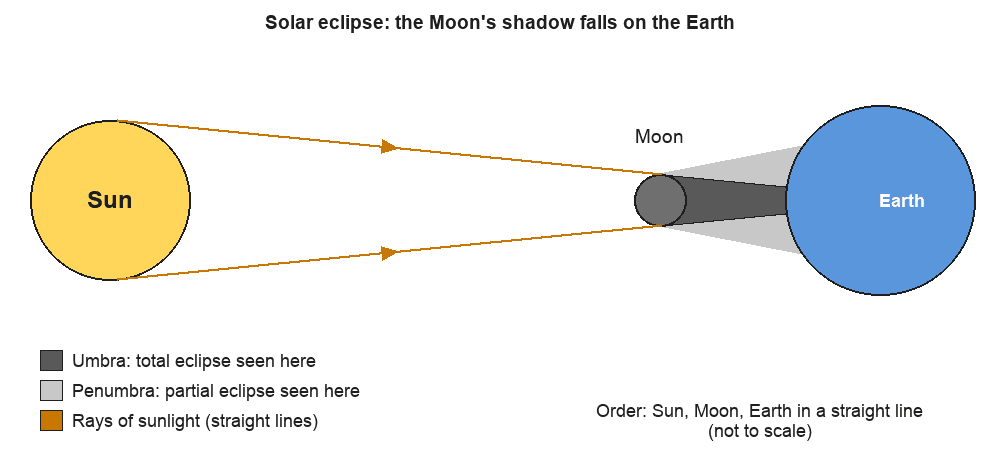
Note: We do not get an eclipse on every full Moon or new Moon. The Moon's path is tilted a little (about 5°) to the Earth's path, so most months the Moon passes just above or below the line joining the Sun and the Earth.
Therefore, an eclipse occurs when the Sun, the Earth and the Moon lie in a straight line, so that the body in the middle casts its shadow on the one behind it.