
Question 284 marksMedium
How does solar eclipse occur?
Confirming your payment
Sign up now and get 250 free tokens.
Light and Shadows · Question 28 of 29
How does solar eclipse occur?
Solution:
Concept: The Moon is opaque. When sunlight falls on it, it casts a shadow on the side away from the Sun. A solar eclipse happens when this shadow falls on the Earth.
Step 1 — The three bodies come in a line.
The Moon moves round the Earth. Sometimes, on a new Moon day, the Sun, the Moon and the Earth come in a straight line, with the Moon in the middle.
Step 2 — The Moon blocks the sunlight.
The Moon blocks the sunlight that would have reached a part of the Earth. Light travels in straight lines, so it cannot bend round the Moon.
Step 3 — The Moon's shadow falls on the Earth.
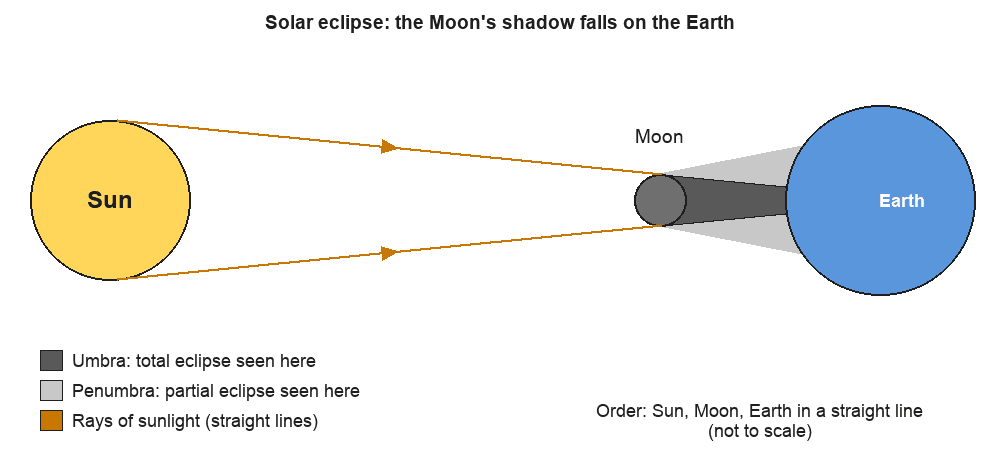
The Moon's shadow falls on a part of the Earth. The figure shows the rays of sunlight and the Moon's shadow on the Earth.
Step 4 — Total and partial eclipse.
People in the small, darkest part of the shadow (the umbra) see the Sun fully covered: a total solar eclipse. People in the lighter part of the shadow (the penumbra) see only a part of the Sun covered: a partial solar eclipse.
Step 5 — How long it lasts.
The Moon keeps moving, so its shadow moves quickly over the Earth. A total solar eclipse lasts only a few minutes at one place. The eclipse is over when the Moon moves out of the line of the Sun and the Earth.
Watch out: Never look straight at the Sun during a solar eclipse, even with sunglasses. Use special eclipse glasses, or see the Sun's image through a pinhole on a screen.
Note: Sometimes the Moon is a little farther from the Earth and cannot cover the whole Sun. Then a bright ring of the Sun is left around the Moon. This is called an annular (ring) eclipse.
Therefore, a solar eclipse occurs when the Moon comes between the Sun and the Earth in a straight line and the Moon's shadow falls on the Earth.