
Opening your dashboard
Class 5 Science Chapter 10 Light and Shadows: Competency-Based Questions (CBQ)
40 questions on Chapter 10, each worked through on its own page with the AI tutor. Class 5 Science, ICSE 2026-27.
40 questions
1–5 marks · Mixed difficulty
- 11 mark
Question 1
Cognitive domain: Application
Tanvi shines a torch on a bright red ball in a dark room. The ball's shadow falls on a white wall behind it. What colour will the shadow be?
- 21 mark
Question 2
Cognitive domain: Analysis
Rohan looked at a candle flame through four different sheets, P, Q, R and S. He wrote down what he saw.
Sheet What Rohan saw P The flame, clear and sharp Q Only a blurred glow of the flame R Nothing at all S The flame, clear and sharp Which sheet is translucent?
- 31 mark
Question 3
Cognitive domain: Analysis
There is a power cut at night. Mira's room has no light at all, and she cannot see the white book on her table.
Assertion (A): In a completely dark room, we cannot see a white book lying on the table.
Reason (R): We see an object only when light coming from it enters our eyes.
- 41 mark
Question 4
Cognitive domain: Application
On a foggy winter morning, drivers switch on their headlights and drive slowly. They can see the lights of other cars only as a blurred glow. Which statement best describes the fog?
- 51 mark
Question 5
Cognitive domain: Analysis
A news report says, "Watch the lunar eclipse tonight, on the full Moon night!"
Assertion (A): A lunar eclipse can happen only on a full Moon night.
Reason (R): On a full Moon night, the Earth lies between the Sun and the Moon.
- 61 mark
Question 6
Cognitive domain: Application
Many houses have frosted glass, and not clear glass, in their bathroom windows. Why is frosted glass a good choice there?
- 74 marks
Question 7
Cognitive domain: Analysis & Evaluation
On a sunny day in March, Class 5 fixed a stick 1 m tall upright in the school ground. They measured the length of its shadow every two hours. (Hypothetical readings.)
Time Length of shadow 8 a.m. 1.9 m 10 a.m. 0.7 m 12 noon 0.4 m 2 p.m. 0.7 m 4 p.m. 1.9 m (a) At what time was the shadow shortest? (1 mark)
(b) How much longer was the shadow at 8 a.m. than at 12 noon? (1 mark)
(c) Will the shadow at 5 p.m. be longer or shorter than at 4 p.m.? Explain why. (2 marks)
- 83 marks
Question 8
Cognitive domain: Application & Evaluation
Class 5 is putting up a shadow-puppet show. A lamp is placed behind a thin white cloth screen. The puppets are moved between the lamp and the cloth. The audience sits on the other side of the cloth.
(a) Name the three things needed to form a shadow, and say which thing in the show plays each part. (1 mark)
(b) The children can make the puppets from cardboard, clear plastic sheet or butter paper. Which is best? Give a reason. (1 mark)
(c) Why is a thin white cloth used as the screen, and not a wooden board? (1 mark)
- 92 marks
Question 9
Cognitive domain: Evaluation
A partial solar eclipse will be seen in Kabir's town next week. Kabir says, "I will just look at the Sun through my dark sunglasses."
(a) Is Kabir's plan safe? Give a reason. (1 mark)
(b) Suggest two safe ways for Kabir to watch the eclipse. (1 mark)
- 103 marks
Question 10
Cognitive domain: Application & Creativity
Ishaan wants to show his class how eclipses happen. He has a torch, a big ball and a small ball, and he can make the room dark.
(a) Which object should stand for the Sun, which for the Earth and which for the Moon? (1 mark)
(b) How should he arrange them to show a lunar eclipse? What will the class see? (1 mark)
(c) How should he change the arrangement to show a solar eclipse? What will the class see? (1 mark)
- 113 marks
Question 11
Cognitive domain: Application
For a festival, Anu makes three lanterns of the same size, each with the same small LED light inside. The sides of lantern 1 are clear glass, lantern 2 has white paper sides, and lantern 3 has tin sides with no holes.
(a) Which lantern will light up the room most brightly? Why? (1 mark)
(b) Which lantern will give a soft, gentle glow? Why? (1 mark)
(c) Which lantern will be of no use for lighting the room? Why? (1 mark)
- 124 marks
Question 12
Cognitive domain: Creativity & Evaluation
Neel has a torch, a plain wall, a sheet of clear (colourless) cellophane, a sheet of tissue paper and a piece of cardboard. He wants to find out which sheet is transparent, which is translucent and which is opaque, by looking at the shadows.
(a) Write the steps of a fair test for Neel. (2 marks)
(b) Name two things he must keep the same for every sheet. (1 mark)
(c) What shadow should he see for each sheet? (1 mark)
- 133 marks
Question 13
Cognitive domain: Analysis
Read the notice and answer the questions.
Total lunar eclipse tonight (hypothetical times)
- The Moon starts to enter the Earth's dark shadow: 9:15 p.m.
- The whole Moon is inside the dark shadow: 10:30 p.m. to 11:20 p.m.
- The Moon leaves the dark shadow completely: 12:40 a.m.
(a) For how long is the whole Moon inside the Earth's dark shadow? (1 mark)
(b) For how long does the whole eclipse last, from 9:15 p.m. to 12:40 a.m.? (1 mark)
(c) Could people in India have seen this eclipse if it had happened at 2 p.m. Indian time instead? Give a reason. (1 mark)
- 144 marks
Question 14
Cognitive domain: Application & Analysis
Long ago, people told the time with a shadow clock: a stick standing upright in an open, sunny place. Its shadow moves round during the day.
(a) The Sun rises in the east. In which direction will the stick's shadow point at 8 a.m.? (1 mark)
(b) Why does the shadow move during the day? (1 mark)
(c) At about what time will the shadow be shortest? (1 mark)
(d) Give one reason why a shadow clock cannot tell the time at night or on a cloudy day. (1 mark)
- 154 marks
Question 15
Cognitive domain: Creativity & Evaluation
Your family is building a new house. Choose a transparent, translucent or opaque material for each part below, and give a reason for each choice.
(a) The living-room window, from which you want to see the garden (1 mark)
(b) The bathroom window (1 mark)
(c) The front door (1 mark)
(d) The shade of a reading lamp, which should give soft light without glare (1 mark)
- 161 mark
Question 16
Cognitive domain: Understanding
On a clear night, Anil looks at the full Moon. Four events happen, but they are listed in a jumbled order.
Event 1: The Moon bounces the light back.
Event 2: Light from the Sun falls on the Moon.
Event 3: The bounced light enters Anil's eyes.
Event 4: Anil sees the Moon.
Which order shows the correct sequence of events?
- 171 mark
Question 17
Cognitive domain: Application
Asha drops a coin into a clear glass tumbler of clean water and looks at it from above. She can see the coin clearly. Then she adds milk to the water, a few drops at a time, and stirs each time. (Hypothetical experiment.)
First the coin looks blurred, and in the end she cannot see the coin at all.
Which option correctly describes how the water in the tumbler changes as more and more milk is added?
- 181 mark
Question 18
Cognitive domain: Analysis
Mohan walks along a straight road in the evening, facing the Sun.
Assertion (A): While Mohan walks towards the Sun, his shadow falls behind him.
Reason (R): A shadow always forms on the side of the object that is opposite to the source of light.
- 191 mark
Question 19
Cognitive domain: Analysis
Meera holds a sheet of thin tissue paper in front of a torch, near a wall. A faint shadow of the paper falls on the wall.
Assertion (A): A sheet of tissue paper forms a faint shadow on the wall.
Reason (R): A torch is an artificial (man-made) source of light.
- 201 mark
Question 20
Cognitive domain: Analysis
The figure shows the Sun, the Earth and the path of the Moon round the Earth. The Moon is drawn at four positions, P, Q, R and S.
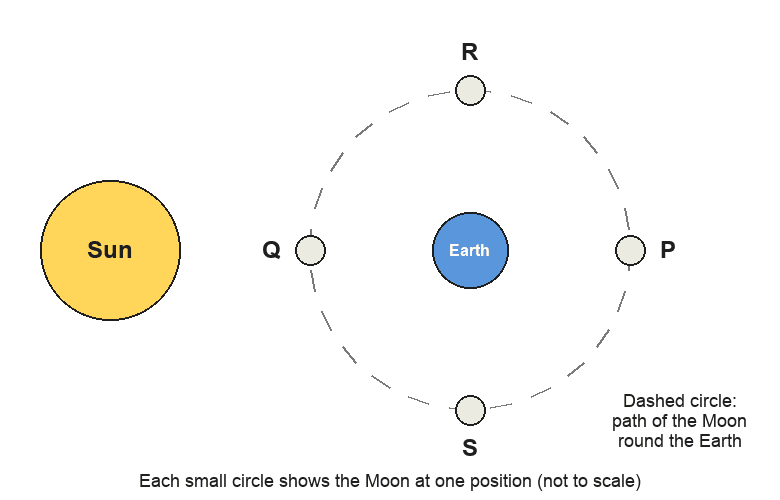
When the Moon is at which position can a person on the Earth see a lunar eclipse?
- 211 mark
Question 21
Cognitive domain: Evaluation
In a dark room, Meena holds a round cardboard disc between a lit torch and a wall. First she holds the disc with its flat face towards the torch. Then she slowly turns the disc until its thin edge faces the torch. Four friends predict what the shadow on the wall will look like the second time.
Which friend's prediction is correct?
- 221 mark
Question 22
Cognitive domain: Application
In a dark cinema hall, a beam of light from the projector falls on a large white screen. Rahul, sitting in the hall, can see the pictures on the screen. Which statement explains how Rahul sees the screen?
- 231 mark
Question 23
Cognitive domain: Application
Meera is 1.2 m tall. She stands in an open ground on a sunny day and measures her shadow. It is 3.6 m long, three times her height. (Hypothetical reading.) At which time of the day was she most likely measuring?
- 241 mark
Question 24
Cognitive domain: Analysis
Ravi shines a torch on four sheets, P, Q, R and S, one by one. A screen behind each sheet catches the light that passes through it. (Hypothetical readings.)
Sheet Share of the torch light reaching the screen P 95 out of 100 Q 0 out of 100 R 45 out of 100 S 60 out of 100 Which two sheets will form a faint shadow on a wall?
- 251 mark
Question 25
Cognitive domain: Analysis
A sky-watching club noted four events in one year. (Hypothetical notes.)
Event What was seen P At midday, for about three minutes, the sky went dark in a small town Q On a full Moon night, the whole Moon slowly turned dull red R On a new Moon day, a dark round shape slowly covered part of the Sun S On a full Moon night, a dark patch covered one part of the Moon Which two events were caused by the shadow of the Earth?
- 262 marks
Question 26
Cognitive domain: Evaluation
Anil and Reema talk about shadows.
Anil says: "A shadow is a thing stuck to an object. It goes wherever the object goes."
Reema says: "A shadow is a dark patch that forms where an object blocks the light."
(a) Whose statement is correct? (1 mark)
(b) Give one observation that supports your choice. (1 mark)
- 272 marks
Question 27
Cognitive domain: Application
Sana keeps one potted green plant on a sunny window sill and another similar plant in a closed cupboard. She waters both equally for ten days. (Hypothetical experiment.) The plant in the cupboard turns pale and weak, but the plant on the window sill stays healthy.
(a) Which one thing was different for the two plants, and which one thing did Sana keep the same? (1 mark)
(b) Use this result to explain why the plant in the cupboard became pale and weak. (1 mark)
- 282 marks
Question 28
Cognitive domain: Understanding
The Earth and the Moon both receive light from the Sun.
(a) Why does each of them have a shadow? (1 mark)
(b) On which side of the Earth does its shadow fall? (1 mark)
- 292 marks
Question 29
Cognitive domain: Evaluation
Dev says: "A solar eclipse and a lunar eclipse can never happen on the same day."
(a) Is Dev correct? (1 mark)
(b) Give a reason, using the position of the Moon in each eclipse. (1 mark)
- 302 marks
Question 30
Cognitive domain: Analysis
Sonu says: "We see a lighted candle flame in the same way as we see a book. Both bounce light into our eyes." Is Sonu fully right? Explain.
- 312 marks
Question 31
Cognitive domain: Application
On a full Moon night, Priya watches a partial lunar eclipse. She notices that the edge of the dark part on the Moon is a curved arc, never a straight line. Her book says that the edge of the Earth's shadow on the Moon has been curved in every lunar eclipse ever seen.
(a) Whose shadow makes the dark part on the Moon? (1 mark)
(b) What does the curved edge of this shadow tell us about the shape of the Earth? Give a reason. (1 mark)
- 323 marks
Question 32
Cognitive domain: Application
Tina tries to make a shadow of her hand three times in one evening.
Try 1: In a dark room, she holds her hand in front of a wall, but her torch is switched off. She sees no shadow.
Try 2: In the same room, she switches the torch on and holds her hand between the torch and the wall. She sees a dark shadow of her hand on the wall.
Try 3: On the open roof at night, she points the lit torch at the sky and holds her hand in front of it. She sees no shadow anywhere.
(a) Which thing needed to form a shadow was missing in Try 1? (1 mark)
(b) Which thing needed to form a shadow was missing in Try 3? (1 mark)
(c) Why was the shadow in Try 2 dark, and not faint? (1 mark)
- 333 marks
Question 33
Cognitive domain: Analysis
The figure shows the same stick in sunlight in three pictures, P, Q and R, drawn at different times of one day. One picture has a shadow drawn on the wrong side.
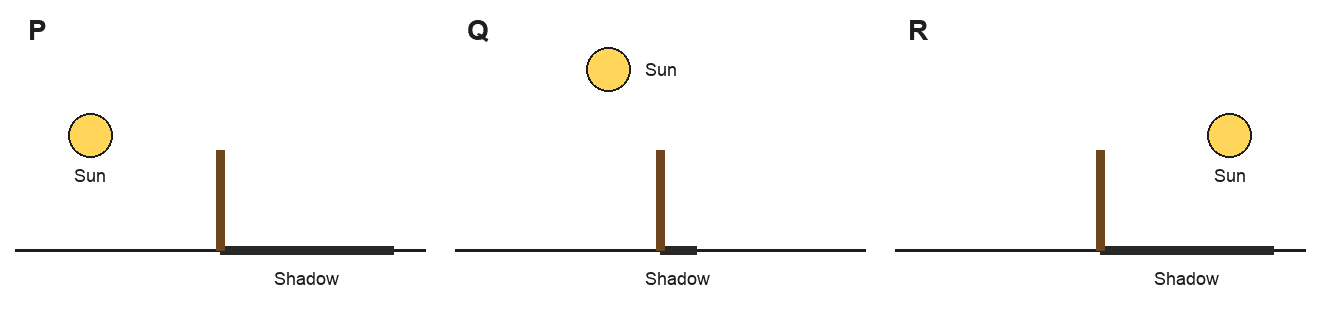
(a) Which picture shows the time near noon? (1 mark)
(b) In which picture is the shadow drawn wrongly? Give a reason. (1 mark)
(c) Picture P shows the morning. Describe the stick's shadow just before sunset. (1 mark)
- 343 marks
Question 34
Cognitive domain: Analysis
The figure shows the Earth's dark shadow (grey) and the outline of the Moon at four positions, A, B, C and D, on a night when the Moon passes through the shadow.
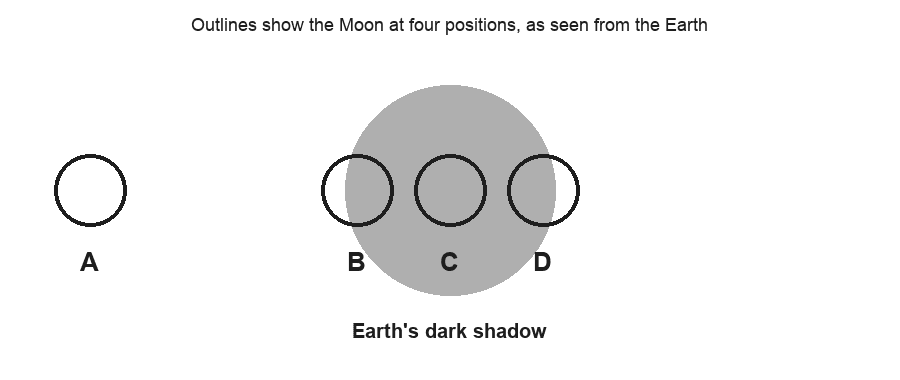
(a) At which position is the Moon completely inside the Earth's dark shadow? Name the kind of eclipse seen there. (1 mark)
(b) At which two positions is only a part of the Moon in the Earth's dark shadow? Name the kind of eclipse. (1 mark)
(c) At position A, would an eclipse be seen? Give a reason. (1 mark)
- 353 marks
Question 35
Cognitive domain: Analysis
Hari fixes a torch so that its light falls on a wall 100 cm away. He holds a book 10 cm tall between the torch and the wall, at different distances from the torch, and measures the height of the shadow on the wall. (Hypothetical data.)
Distance of the book from the torch Height of the shadow on the wall 25 cm 40 cm 50 cm 20 cm 80 cm 12.5 cm (a) At which distance is the shadow the biggest? (1 mark)
(b) What happens to the size of the shadow as the book moves away from the torch towards the wall? (1 mark)
(c) What height of shadow will Hari get when he holds the book against the wall? (1 mark)
- 363 marks
Question 36
Cognitive domain: Creativity
Ria wants to make a night lamp that throws bright star shapes on the ceiling. She has a small bulb, a sheet of thin cardboard, a clear plastic cup and a sheet of tissue paper.
(a) Which material should she use to cover the bulb? Give a reason. (1 mark)
(b) What should she cut in the cover, and why will bright stars appear on the ceiling? (1 mark)
(c) What would she see on the ceiling if she covered the bulb with only the tissue paper? (1 mark)
- 374 marks
Question 37
Cognitive domain: Analysis
A school science club watched a partial lunar eclipse from the roof. The members noted how much of the Moon's face was covered by the Earth's dark shadow. (Hypothetical readings.)
Time Part of the Moon covered 8:30 p.m. None 9:15 p.m. One-quarter 10:00 p.m. One-half 10:45 p.m. One-quarter 11:30 p.m. None (a) At which time was the most of the Moon covered? (1 mark)
(b) Was this a total or a partial lunar eclipse? Give a reason from the table. (1 mark)
(c) The Moon was clear of the shadow at both 8:30 p.m. and 11:30 p.m. What does this tell you about how long the eclipse lasted? On what kind of Moon night does a lunar eclipse take place? (2 marks)
- 384 marks
Question 38
Cognitive domain: Application
During a power cut, Grandmother sits at a table and reads a letter by the light of an oil lamp. Raju sits on the floor near her. He sees a glow-worm blink near the window.
(a) Name the natural source of light and the artificial source of light in the story. (1 mark)
(b) The letter does not give out light. Explain how Grandmother is able to see it. (1 mark)
(c) Raju puts his school bag between the lamp and the letter. What happens on the letter, and why? (2 marks)
- 394 marks
Question 39
Cognitive domain: Evaluation
Rohit wants to show that light travels in straight lines. He lists three observations.
Observation 1: A friend standing behind a wall cannot be seen from the other side, even in bright sunlight.
Observation 2: A thin beam of sunlight from a small gap in a curtain looks like a straight line.
Observation 3: A glass tumbler of clear water in front of a torch hardly makes any shadow.
(a) Which two observations support his claim? (1 mark)
(b) Which idea does the other observation support? (1 mark)
(c) Rohit looks at a candle through a straight pipe and sees the flame. When the pipe is bent, he cannot see it. Explain. (2 marks)
- 405 marks
Question 40
Cognitive domain: Understanding
The figure shows three bodies, P, Q and R, in a straight line. It also shows two shaded regions, X and Y, on R. (Not to scale.)

(a) Which eclipse does the figure show? On which kind of Moon day does it happen? (2 marks)
(b) Name the bodies P, Q and R. (1 mark)
(c) Name the shadow regions X and Y. What kind of eclipse is seen from each? (2 marks)