
Opening your dashboard
Class 12 Physics Chapter 28: Radioactivity Solutions
84 textbook questions with step-by-step answers, free to read, for ISC 2026-27.
Get talked through Ch 28, not just shown the answer
Reading a finished solution is not the same as being able to do it. The AI tutor takes one question at a time and works it with you, in your own words, until you can.
- Ask it out loud, in your own words
- It gives you the next step, not the answer
- Stuck on part (ii)? Start there
84 questions with solutions
1–5 marks · Mixed difficulty
The first 29 solutions are on this page. This chapter is a long one, so the rest open on their own page to keep this one quick to load.
- 11 mark
Question 1
In the following reactions,
Radioactive radiations are emitted in the sequence of
Solve with AIAnswer
(A) α, β, τ
- Correct
(B) β, α, γ
(C) γ, α, β
(D) γ, β, α
Answer: (B) β, α, γ
Concept: An -particle carries away mass number 4 and charge number 2. A -particle carries away no mass number and charge number , so rises by 1. A -ray changes neither nor .
Step 1 — Identify the first step. In the mass number stays the same and rises by 1, so a -particle is emitted.
Step 2 — Identify the second step. In the mass number falls by 4 and the atomic number falls by , so an -particle is emitted.
Step 3 — Identify the third step. In nothing changes in or ; the excited nucleus only loses energy, so a -ray is emitted.
Step 4 — Check the other options. Each of the other sequences fails at the first step:
- (A) The first step keeps the mass number, so it cannot be an emission; also τ is not a kind of radiation (it stands where γ is meant).
- (C) A -ray cannot change , but the first step raises by 1.
- (D) This also starts with a -ray, which cannot raise the atomic number.
Therefore, the radiations are emitted in the order β, α, γ.
- 21 mark
Question 2
A positron has the same mass as
Solve with AIAnswer
(A) proton
(B) α–particle
(C) neutron
- Correct
(D) electron
Answer: (D) electron
Concept: A positron is the antiparticle of the electron: it has the same mass as an electron but a positive charge .
Step 1 — Compare the masses. The positron's rest mass is kg, exactly that of the electron (rest energy 0.511 MeV).
Step 2 — Check the other options. Each of the other particles is far heavier:
- (A) A proton is about 1836 times as heavy as an electron.
- (B) An -particle (helium nucleus) is about 7300 times as heavy as an electron.
- (C) A neutron is about 1839 times as heavy as an electron.
Therefore, a positron has the same mass as an electron.
- 31 mark
Question 3
Curie is the unit of
Solve with AIAnswer
(A) energy of γ-rays
(B) half-life
- Correct
(C) radioactivity
(D) intensity of γ-rays
Answer: (C) radioactivity
Concept: The activity of a radioactive sample is the number of nuclei that decay per second. Its old unit is the curie: decays per second. The S.I. unit is the becquerel (1 decay per second).
Step 1 — Name what the curie measures. The curie measures the activity, or radioactivity, of a source.
Step 2 — Check the other options. Each of the other quantities has a different unit:
- (A) The energy of -rays is measured in joules or electronvolts (MeV).
- (B) Half-life is a time, measured in seconds, minutes, days or years.
- (D) Intensity of a beam is power per unit area, in .
Therefore, the curie is the unit of radioactivity.
- 41 mark
Question 4
When a radioactive nucleus emits a β-particle, the mass number of the atom
Solve with AIAnswer
(A) increases by 1
(B) decreases by 1
(C) increases by 4
- Correct
(D) remains the same
Answer: (D) remains the same
Concept: In decay a neutron in the nucleus changes into a proton, and an electron and an antineutrino are emitted. The total number of nucleons (protons + neutrons) does not change.
Step 1 — Count the nucleons. One neutron is lost and one proton is gained, so the mass number is unchanged, while the atomic number rises by 1.
Step 2 — Check the other options. Each of the other options describes a different change:
- (A) It is the atomic number, not the mass number, that increases by 1 in decay.
- (B) The mass number does not fall in decay; even in positron emission it is the atomic number that falls by 1.
- (C) No radioactive decay adds nucleons; decay lowers the mass number by 4.
Therefore, the mass number remains the same.
- 51 mark
Question 5
1 gram of radioactive element reduces to gram in 2 days. The mass of the element remaining at the end of 6 days is
Solve with AIAnswer
(A) g
(B) g
(C) g
- Correct
(D) g
Answer: (D) g
Concept: Radioactive decay is exponential, . So in every equal time interval the mass is multiplied by the same factor.
Step 1 — Find the factor for 2 days. In 2 days the mass falls from 1 g to g, so the decay factor for 2 days is one-third:
Step 2 — Count the 2-day intervals. Six days hold such intervals, so the factor for 6 days is the 2-day factor cubed:
Step 3 — Find the mass left. We multiply the starting mass by this factor:
Step 4 — Check the other options. Each of the other values breaks the rule of a fixed factor per interval:
- (A) g is only half of the g left after 2 days, but each further 2 days divides the mass by 3, not 2.
- (B) g is the mass left after 4 days (two factors of ), not 6 days.
- (C) g is not a power of , so it cannot be the mass after a whole number of 2-day intervals.
Therefore, the mass remaining after 6 days is g.
- 61 mark
Question 6
A substance reduces to (1/16)th of the original mass in 2 hours. The half-life period of the substance is
Solve with AIAnswer
(A) 120 min
(B) 15 min
- Correct
(C) 30 min
(D) 60 min
Answer: (C) 30 min
Concept: In each half-life the number of undecayed nuclei (and so the mass of the radioactive substance) falls to half. After half-lives, where , the fraction left is:
Step 1 — Find the number of half-lives. The fraction left is , so we set the decay rule equal to it:
Step 2 — Find the half-life. Four half-lives take 2 hours (120 minutes):
Step 3 — Check the other options. Each of the other half-lives gives a different fraction in 120 minutes:
- (A) 120 min is the whole time; with this half-life only half the mass would have decayed.
- (B) 15 min would mean 8 half-lives in 2 hours, leaving of the mass.
- (D) 60 min would mean only 2 half-lives, leaving of the mass.
Therefore, the half-life is 30 min.
- 71 mark
Question 7
The half-life of radium is 1600 years. What is the fraction of sample undecayed after 6400 years?
Solve with AIAnswer
- Correct
(A)
(B)
(C)
(D)
Answer: (A)
Concept: In each half-life the number of undecayed nuclei (and so the mass of the radioactive substance) falls to half. After half-lives, where , the fraction left is:
Step 1 — Count the half-lives. We divide the time by the half-life:
Step 2 — Find the fraction left. We put in the decay rule:
Step 3 — Check the other options. Each of the other fractions belongs to a different time or to no whole number of half-lives:
- (B) is left after 2 half-lives (3200 years).
- (C) is left after 3 half-lives (4800 years).
- (D) is not a power of , so it is never the fraction left after a whole number of half-lives.
Therefore, of the sample is undecayed after 6400 years.
- 81 mark
Question 8
A radioactive series is . How many α- and β-particles are emitted?
Solve with AIAnswer
- Correct
(A) 8 α, 6 β
(B) 10 β, 6 α
(C) 8 α, 8 β
(D) 12 α, 6 β
Answer: (A) 8 α, 6 β
Concept: Only emission changes the mass number (by each time). Each lowers the atomic number by 2, and each raises it by 1 without changing the mass number.
Step 1 — Find the number of α-particles. The mass number falls by , and each removes 4:
Step 2 — Find the atomic number after the α emissions alone. Eight -particles lower by :
Step 3 — Find the number of β-particles. Lead has atomic number 82, so the -particles must raise the atomic number from 76 to 82. Each raises it by 1, so the number of β-particles is the rise in atomic number:
Step 4 — Check the other options. Each of the other pairs fails a conservation check:
- (B) Six -particles lower the mass number by only 24, giving 214, not 206.
- (C) Eight -particles would raise the atomic number from 76 to 84, which is polonium, not lead.
- (D) Twelve -particles lower the mass number by 48, giving 190, not 206.
Therefore, 8 α-particles and 6 β-particles are emitted.
- 91 mark
Question 9
The half-life of a radioactive substance is 3.6 days. How much of 20 mg of that substance will remain after 36 days?
Solve with AIAnswer
- Correct
(A) 0.019 mg
(B) 1.019 mg
(C) 1.109 mg
(D) 0.0019 mg
Answer: (A) 0.019 mg
Concept: In each half-life the number of undecayed nuclei (and so the mass of the radioactive substance) falls to half. After half-lives, where , the fraction left is:
Step 1 — Count the half-lives. We divide the time by the half-life:
Step 2 — Find the mass left. We multiply 20 mg by :
Option (A), 0.019 mg, is this value cut to two significant figures (rounded, it would be 0.020 mg).
Step 3 — Check the other options. Each of the other values is far from the computed mass:
- (B) 1.019 mg is more than 1 mg; 20 mg falls to that much after only about 4.3 half-lives (about 15.5 days), not 10.
- (C) 1.109 mg is also more than 1 mg, again the mass left after only about four half-lives.
- (D) 0.0019 mg is ten times too small; it would need about 13.4 half-lives.
Therefore, about 0.019 mg (more precisely 0.0195 mg) of the substance remains after 36 days.
- 101 mark
Question 10
Consider a radioactive material of half-life 1 minute. If one of the nuclei decays now, the next one will decay
Solve with AIAnswer
(A) after one minute
(B) after minute
- Correct
(C) after any time
(D) after minutes where is the number of nuclei present at that moment
Answer: (C) after any time
Concept: Radioactive decay is a random process. The decay law tells us only what fraction of a large number of nuclei decays on average in a given time; it cannot say when any particular nucleus will decay.
Step 1 — Apply the idea. The decay of one nucleus has no effect on the others, so the time until the next decay is a matter of chance. It may happen at any moment.
Step 2 — Check the other options. Each of the other options treats an average as a fixed waiting time:
- (A) One minute is the half-life, the time in which half of a large number of nuclei decay on average; it is not the gap between two decays.
- (B) min is the mean life of one nucleus, again only an average.
- (D) For nuclei the average gap between decays is min, but this too is only an average; the actual gap is random.
Therefore, the next nucleus may decay after any time.
- 111 mark
Question 11
After an interval of one day, (1/16)th of the initial amount of a radioactive material remains in a sample. Its half-life is
Solve with AIAnswer
(A) 12 h
- Correct
(B) 6 h
(C) 3 h
(D) 2 h
Answer: (B) 6 h
Concept: In each half-life the number of undecayed nuclei (and so the mass of the radioactive substance) falls to half. After half-lives, where , the fraction left is:
Step 1 — Find the number of half-lives. The fraction left is , so .
Step 2 — Find the half-life. One day is 24 hours, and it holds four half-lives:
Step 3 — Check the other options. Each of the other half-lives gives a different fraction in 24 hours:
- (A) 12 h means only 2 half-lives in a day, leaving .
- (C) 3 h means 8 half-lives, leaving .
- (D) 2 h means 12 half-lives, leaving .
Therefore, the half-life is 6 h.
- 121 mark
Question 12
After two hours, one one-sixteenth of the starting amount of a certain radioactive isotope remained undecayed. The half-life of the isotope is
Solve with AIAnswer
(A) 15 minutes
- Correct
(B) 30 minutes
(C) 45 minutes
(D) 1 hour
Answer: (B) 30 minutes
Concept: In each half-life the number of undecayed nuclei (and so the mass of the radioactive substance) falls to half. After half-lives, where , the fraction left is:
Step 1 — Find the number of half-lives. One-sixteenth is , so four half-lives have passed.
Step 2 — Find the half-life. Two hours is 120 minutes, shared by four half-lives:
Step 3 — Check the other options. Each of the other half-lives gives a different fraction in 2 hours:
- (A) 15 minutes means 8 half-lives, leaving .
- (C) 45 minutes means about 2.67 half-lives, leaving about .
- (D) 1 hour means 2 half-lives, leaving .
Therefore, the half-life of the isotope is 30 minutes.
- 131 mark
Question 13
The radioactive decay of uranium into thorium is represented by the equation . What is ?
Solve with AIAnswer
- Correct
(A) an α-particle
(B) an electron
(C) a proton
(D) a neutron
Answer: (A) an α-particle
Concept: In every nuclear equation the mass numbers and the charge numbers on the two sides must be equal.
Step 1 — Balance the mass numbers. The mass number of the particle is the difference of the two mass numbers:
Step 2 — Balance the charge numbers. The charge number of the particle is the difference of the two atomic numbers:
Step 3 — Identify the particle. A particle with and is the helium nucleus , the -particle.
Step 4 — Check the other options. Each of the other particles fails the balance:
- (B) An electron has and ; emitting it would leave the mass number at 238 and raise to 93.
- (C) A proton has , ; the product would be .
- (D) A neutron has , ; the product would be .
Therefore, is an α-particle.
- 141 mark
Question 14
A radioactive substance decays to (1/16)th of the initial mass in 40 days. The half-life of the substance in days is
Solve with AIAnswer
(A) 20
- Correct
(B) 10
(C) 5
(D) 2.5
Answer: (B) 10
Concept: In each half-life the number of undecayed nuclei (and so the mass of the radioactive substance) falls to half. After half-lives, where , the fraction left is:
Step 1 — Find the number of half-lives. Since , four half-lives have passed.
Step 2 — Find the half-life. Forty days hold four half-lives:
Step 3 — Check the other options. Each of the other half-lives gives a different fraction in 40 days:
- (A) 20 days means 2 half-lives, leaving .
- (C) 5 days means 8 half-lives, leaving .
- (D) 2.5 days means 16 half-lives, leaving .
Therefore, the half-life is 10 days.
- 151 mark
Question 15
In a gamma ray emission from nucleus
Solve with AIAnswer
(A) Only the number of protons change
(B) The number of protons and neutrons both change.
- Correct
(C) There is no change in the number of protons and the number of neutrons
(D) Only the number of neutrons change.
Answer: (C) There is no change in the number of protons and the number of neutrons
Concept: A -ray is a photon of high energy. It has no charge and no mass number. It is given out when a nucleus in an excited state drops to a lower energy state.
Step 1 — Apply the idea. Since the photon carries away only energy, the nucleus keeps all its protons and neutrons; and stay the same and the element does not change.
Step 2 — Check the other options. Each of the other options needs a particle with charge or mass number to leave:
- (A) A change in the proton number alone would change the element; a -ray carries no charge, so cannot change.
- (B) Both numbers change in decay (2 protons and 2 neutrons leave) and in decay (a neutron turns into a proton), not in emission.
- (D) The neutron number alone changes only if a neutron is emitted, which is not emission.
Therefore, in γ emission the numbers of protons and neutrons do not change.
- 161 mark
Question 16
What is the -value of the reaction?
The atomic masses of , and are 1.0078254 u, 4.0026034 u and 7.016004 u, respectively.
Solve with AIAnswer
- Correct
(A) 17.35 MeV
(B) 18.06 MeV
(C) 177.35 MeV
(D) 170.35 MeV
Answer: (A) 17.35 MeV
Concept: The -value of a nuclear reaction is the energy equivalent of the mass lost:
Step 1 — Add the masses of the reactants. We add the masses of hydrogen-1 and lithium-7:
Step 2 — Add the masses of the products. The two helium-4 atoms together have this mass:
Step 3 — Find the mass defect. We subtract the products from the reactants:
Step 4 — Convert to energy. We multiply by 931.5 MeV per u:
is positive, so energy is released.
Step 5 — Check the other options. Each of the other values needs a mass loss that the data do not give:
- (B) 18.06 MeV would need a mass loss of u, more than the 0.0186226 u found.
- (C) 177.35 MeV would need about 0.1904 u, roughly ten times the actual mass loss.
- (D) 170.35 MeV would need about 0.1829 u, again about ten times the actual mass loss.
Therefore, the Q-value of the reaction is about 17.35 MeV.
- 171 mark
Question 17
Among alpha, beta and gamma radiations, which are the ones affected by a magnetic field?
Solve with AIWritten solution
Solution:
Concept: A magnetic field exerts a force only on a moving charged particle. A particle with no charge feels no magnetic force.
Step 1 — Look at the charges. We first note which radiations carry charge. An -particle is a helium nucleus with charge , a -particle is an electron with charge , and a -ray is uncharged electromagnetic radiation (a stream of photons).
Step 2 — Apply the magnetic force. Because - and -particles are charged and moving, the field pushes each of them sideways, and their paths curve. Their charges have opposite signs, so they curve in opposite directions: with the field into the page, as in the figure, the -particles bend to the left and the -particles to the right. The -particle bends far less, because its much larger momentum gives a much larger path radius . The -ray feels no force and goes straight on.
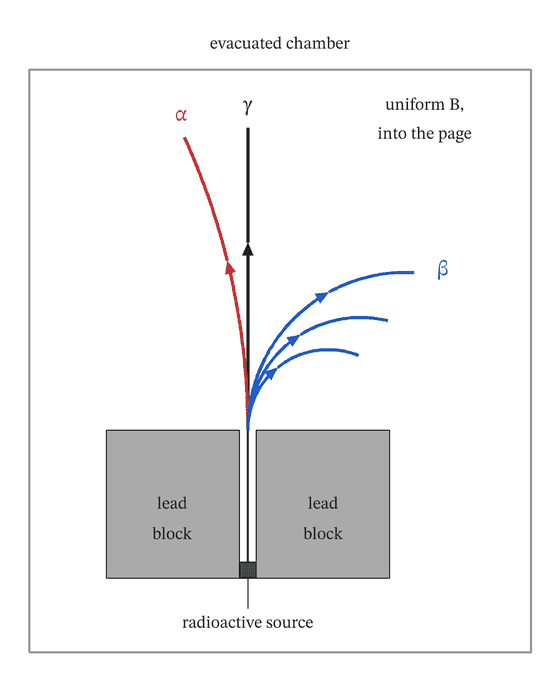
Therefore, alpha and beta radiations are affected by a magnetic field, because they are charged.
- 181 mark
Question 18
Define radioactive constant.
Solve with AIWritten solution
Solution:
Concept: The rate of decay of a radioactive sample is proportional to the number of undecayed nuclei, . The constant is the radioactive (decay) constant.
Step 1 — State the definition. The radioactive constant is the ratio of the rate of decay to the number of undecayed nuclei present at that instant:
Step 2 — Give the equivalent definition. Since , at the number left is . So is also the reciprocal of the time in which falls to (36.8 %).
Therefore, the radioactive constant is the fraction of the nuclei present that decay per unit time; it is the reciprocal of the time in which N/N₀ falls to 1/e.
- 191 mark
Question 19
How is the half-life of radioactive substance related to its decay constant?
Solve with AIWritten solution
Solution:
Concept: After one half-life the number of nuclei is , and the decay law is .
Step 1 — Put in the decay law. After one half-life only half the nuclei are left, so is when :
Step 2 — Write the relation. We divide both sides by and use :
Note: The book's printed answer reads ; the factor is , as in the chapter's own derivation, so 0.633 is a misprint.
Therefore, the half-life is inversely proportional to the decay constant: T = 0.693/λ.
- 201 mark
Question 20
Which has greater ionising power: alpha particle or beta?
Solve with AIWritten solution
Solution:
Concept: A charged particle ionises a gas by pulling electrons off its atoms with its electric force. The larger its charge and the more slowly it moves, the more atoms it ionises along each centimetre of its path.
Step 1 — Compare the charges. We first compare how hard each particle pulls on an atomic electron. An -particle has charge and a -particle has charge , so at the same distance the -particle exerts twice the force.
Step 2 — Compare the speeds. Next we compare how long each particle stays near an atom. An -particle is about 7300 times as heavy as a -particle, so it moves much more slowly: a 5 MeV -particle travels at only about , while a 1 MeV -particle travels at about . The slow -particle spends far longer near each atom it passes, so it knocks out many more electrons per centimetre.
Step 3 — Combine the two effects. The larger charge and the much lower speed work together. An -particle is usually quoted as ionising about 100 times as strongly as a -particle, which is also why it is stopped by a few centimetres of air.
Therefore, the alpha particle has the greater ionising power.
- 211 mark
Question 21
Why does alpha particle have a high ionising power?
Solve with AIWritten solution
Solution:
Concept: Ionisation is caused by the electric force of a passing charged particle on the electrons of the atoms it passes.
Step 1 — Look at its charge. An -particle carries charge , so its pull on atomic electrons is strong.
Step 2 — Look at its mass and speed. It is massive (about 7300 electron masses), so for the same energy it moves slowly; it spends more time near each atom and knocks out many electrons along a short path.
Note: The book's hint mentions a "large nuclear cross section"; the ionisation is due to the electric force on the atoms' electrons, so the double charge and the low speed of the massive particle are the real reasons.
Therefore, an alpha particle ionises strongly because it is massive and slow and carries a double positive charge.
- 221 mark
Question 22
Write a general equation for beta emission.
Solve with AIWritten solution
Solution:
Concept: In emission a neutron in the nucleus changes into a proton, so rises by 1 and is unchanged; an electron and an antineutrino are emitted, and energy is released.
Step 1 — Follow the change inside the nucleus. We start from what happens to the nucleons. One neutron becomes a proton, with an electron and an antineutrino created and sent out:
Step 2 — Write the general equation. We now write it for a parent nucleus X with mass number and atomic number . The daughter Y has the same mass number and one more proton:
Step 3 — Check the balance. We check that both numbers are conserved. The mass numbers give , and the charge numbers give , so the equation balances.
Note: In (positron) emission the equation is , with a neutrino in place of the antineutrino.
Therefore, the general equation is .
- 231 mark
Question 23
Explain whether the neutron–proton ratio increases or decreases during beta decay.
Solve with AIWritten solution
Solution:
Concept: In decay one neutron in the nucleus changes into a proton, while the electron and antineutrino created in the change leave the nucleus.
Step 1 — Follow the numbers. We write for the neutron number and for the proton number of the parent. After the decay the neutron number falls by one and the proton number rises by one, so the new ratio is .
Step 2 — Compare the two ratios. The numerator has become smaller and the denominator larger, so the new ratio is smaller than . For example, carbon-14 (8 neutrons, 6 protons) decays to nitrogen-14 (7 neutrons, 7 protons), and the ratio falls from to .
Note: This is why decay happens in nuclei that have too many neutrons; in decay a proton turns into a neutron and the ratio increases.
Therefore, the neutron–proton ratio decreases during beta decay.
- 241 mark
Question 24
What do you mean by the activity of a radioactive material?
Solve with AIWritten solution
Solution:
Concept: Activity tells us how fast a radioactive sample is decaying.
Step 1 — State the definition. The activity is the number of nuclei that decay per unit time. Since the number of undecayed nuclei falls with time, we write it with a minus sign:
Step 2 — Link it to the decay constant. The decay law gives , so the activity can also be written in terms of :
The activity therefore falls with time in the same way as . Its S.I. unit is the becquerel (1 Bq = 1 decay per second); the older unit is the curie ( Bq).
Therefore, the activity of a radioactive material is its rate of decay, the number of disintegrations per second.
- 251 mark
Question 25
How are the two units of radioactivity related to each other?
Solve with AIWritten solution
Solution:
Concept: Activity is measured in decays per second. The two older units of activity are the curie and the rutherford.
Step 1 — Write each unit in decays per second. We express both units in the same base so they can be compared:
Step 2 — Divide one unit by the other. We find how many rutherfords make one curie:
Note: The rutherford is no longer used; the S.I. unit of activity is the becquerel, and .
Therefore, 1 curie = 3.7 × 10⁴ rutherford.
- 261 mark
Question 26
Why is the energy distribution of beta rays continuous?
Solve with AIWritten solution
Solution:
Concept: In decay three particles are produced: the daughter nucleus, the -particle and an antineutrino (a neutrino in decay).
Step 1 — Note that the energy released is fixed. Each decay of a given nuclide releases the same energy , fixed by the mass difference between the parent and the products. If only two bodies shared it, momentum conservation would give the -particle one definite energy, as happens for -particles.
Step 2 — Explain the sharing. In decay this fixed energy is shared between the -particle and the antineutrino in all possible proportions (the heavy nucleus takes very little). So the -particle can have any energy from nearly zero up to a maximum equal to , reached when the antineutrino carries almost nothing.
Note: This continuous spectrum is what led Pauli in 1930 to propose the neutrino, so that energy and momentum are conserved in decay.
Therefore, the energy distribution of beta rays is continuous because the decay energy is shared between the electron and the antineutrino in all possible proportions.
- 271 mark
Question 27
A radioactive substance having nuclei has activity . What is the expression for its half-life in terms of and ?
Solve with AIWritten solution
Solution:
Concept: Activity is , and the half-life is .
Step 1 — Find λ from the activity. We divide the activity by the number of nuclei:
Step 2 — Put λ into the half-life formula. We substitute this decay constant:
Therefore, the half-life is T = 0.693N/A.
- 281 mark
Question 28
Is there any difference between a β-particle and an electron?
Solve with AIWritten solution
Solution:
Concept: A -particle is an electron emitted from a nucleus during decay.
Step 1 — Compare their nature. In nature there is no difference: a -particle has the same charge and the same rest mass as any electron.
Step 2 — Compare their origin and speed. The difference is in where it comes from and how fast it moves. A -particle is created in the nucleus (when a neutron changes into a proton) and leaves with a kinetic energy anywhere from almost zero up to the decay's maximum, typically a few hundred keV to a few MeV. So it usually moves at a large fraction of the speed of light: about at 0.5 MeV and about at 1 MeV. Its total energy is then about two to three times its rest-mass energy of 0.511 MeV (older books describe this as a greater "relativistic mass"; its rest mass is the same as any electron's).
Therefore, a β-particle is an electron with the same charge and rest mass; it differs only in coming from the nucleus, usually with a high speed and energy.
- 291 mark
Question 29
A radioactive isotope decays according to the sequence, . If the mass number and atomic number of are 176 and 71, respectively, find the mass number and atomic number of . Amongst , and , do we have any isobars or isotopes?
Solve with AIWritten solution
Solution:
Concept: Emitting a neutron lowers the mass number by 1 and leaves the atomic number unchanged. Emitting an -particle lowers the mass number by 4 and the atomic number by 2.
Step 1 — Work back from to . lost an -particle to become , so we add 4 to the mass number and 2 to the atomic number of :
Step 2 — Work back from to . lost a neutron to become , so we add 1 to the mass number and keep the atomic number:
Step 3 — Look for isotopes and isobars. and have the same atomic number (73) but different mass numbers (181, 180), so they are isotopes. The three mass numbers 181, 180 and 176 are all different, so there are no isobars.
Therefore, D has mass number 181 and atomic number 73; D and D₁ are isotopes, and there are no isobars.
- 301 mark
Question 30
In the nuclear decay reaction, , find and hence identify .
- 311 mark
Question 31
What do you mean by -value of a nuclear reaction?
- 321 mark
Question 32
Among alpha, beta and gamma radiations, which get deflected by the electric field?
- 331 mark
Question 33
Write the nuclear decay process for β-decay of .
- 341 mark
Question 34
Does the ratio of neutrons to protons in a nucleus increase, decrease or remain the same after the emission of an α-particle?
- 351 mark
Question 35
Write the relation between decay constant λ and half-life of a radioactive element.
- 361 mark
Question 36
A radioactive nuclide has a decay constant equal to λ. Give the formula for the (i) half-life and (ii) mean life of this nuclide.
- 371 mark
Question 37
Write the S.I. unit for the activity of a radioactive nuclide.
- 381 mark
Question 38
A radioactive substance has a half-life period of 30 days, what is the disintegration constant?
- 392 marks
Question 39
What is natural radioactivity?
- 402 marks
Question 40
Name the five kinds of radioactive decay with examples.
- 412 marks
Question 41
Describe an experiment to study radioactivity.
- 422 marks
Question 42
Mention three important properties of (i) α-particle and (ii) β-particles.
- 432 marks
Question 43
Does a nucleus emit α, β and γ-ray at the same time?
- 442 marks
Question 44
What happens to the atomic number and mass number of an element when it emits an α-particle ?
- 452 marks
Question 45
What is neutrino ? Why its prediction was necessary?
- 462 marks
Question 46
Draw an energy level diagram to show the emission of a γ-ray.
- 472 marks
Question 47
State Soddy–Fajans’ displacement law.
- 482 marks
Question 48
Define decay constant or disintegration constant.
- 492 marks
Question 49
Define half-life period. How is it related to decay constant?
- 502 marks
Question 50
Define activity. Give its unit.
- 512 marks
Question 51
Name the quantities that are conserved in a nuclear reaction.
- 522 marks
Question 52
Why is the energy distribution of beta rays continuous?
Or
Why do all the electrons emitted during beta decay not have the same energy?
- 532 marks
Question 53
What percentage of a given mass of a radioactive substance will be left undecayed after five half-life period?
- 542 marks
Question 54
Plutonium decays with a half-life of 24000 years. If plutonium is stored for 72000 years, what fraction of it remains?
- 552 marks
Question 55
The half-life period of a radioactive element is the same as the mean life of another radioactive element . Initially both of them have the same number of atoms. The radioactive element decays faster than . Explain why.
- 562 marks
Question 56
Explain how radioactive nuclei can emit β-particles even though atomic nuclei do not contain these particles. Hence explain why the mass number of a radioactive nuclide does not change during β-decay.
- 572 marks
Question 57
A nucleus emits one alpha particle and one beta particle. Find the mass number and atomic number of the product nucleus.
- 582 marks
Question 58
With the help of an example, explain how the neutron–proton ratio changes during the alpha decay of a nucleus.
- 592 marks
Question 59
Explain with an example, whether the neutron–proton ratio in a nucleus increases or decreases due to beta (β) decay.
- 602 marks
Question 60
Explain why the β-decay of a free proton is not possible but that of a proton bound in the nucleus is possible.
- 612 marks
Question 61
Define decay constant of a radioactive sample. Which of the following radiations, α-rays, β-rays, γ-rays
(i) are similar to X-rays
(ii) are easily absorbed by matter
(iii) travel with greatest speed
(iv) are similar in nature to cathode rays
- 622 marks
Question 62
A radioactive nucleus ‘’ decays as given: . If the mass number of atomic number of and are 180 and 73, respectively, find the mass number and atomic number of and .
- 633 marks
Question 63
What is radioactivity? Mention the properties of α-particle, β-particle and γ-rays.
- 643 marks
Question 64
Explain nuclear reactions with examples. What is -value of nuclear reaction? How will you calculate the Q-value?
- 653 marks
Question 65
Define half-life of a radioactive substance. Establish a relation between half-life and decay constant .
- 663 marks
Question 66
What is meant by the activity of a radioactive substance? Draw time–activity graph for a radioactive substance. Find the activity after four half-lives in terms of initial activity. After how much time the activity will become zero?
- 673 marks
Question 67
Starting with the law of radioactive disintegration, show that where the terms have their usual meaning.
- 685 marks
Question 68
Explain what is meant by radioactivity and half-life. How are the atomic number and mass number of a radioactive nucleus changed by the emission of (i) alpha particle, (ii) beta particle and (iii) a gamma ray?
- 695 marks
Question 69
What do you understand by radioactivity and half-life? Plot an accurate graph to show how the number of radioactive atoms of a given element (expressed as percentage of those initially present) varies with time. Use the time scale extending over five half-lives.
- 705 marks
Question 70
(i) State the radioactive decay law.
(ii) Show by derivation that the number of unchanged nuclei left (i.e., the number of parent nuclei) decreases exponentially with time.
(iii) Define the term half-life of a radioactive substance and establish its relation with decay constant.
- 715 marks
Question 71
Explain the conservation laws which can be applied to the nuclear reactions. Distinguish between exothermic and endothermic nuclear reactions. Mention a few examples of nuclear reactions.
- 723 marks
Question 72
The half-life of thorium is years. Find the time required for 10% of a sample of thorium to disintegrate.
- 733 marks
Question 73
One gram of radium is reduced by 2.1 mg in 5 years by α-decay. Find the half-life period of radium.
- 743 marks
Question 74
Find the half-life and average life of a radioactive sample whose disintegration constant is per day.
- 753 marks
Question 75
Some amount of radioactive substance (half-life = 10 days) is spread inside a room and consequently the level of radiation becomes 50 times the permissible level for normal occupancy of the room. After how many days, the room will be safe for occupation?
- 763 marks
Question 76
The half-life of is 138 days. Find the amount of needed to provide a source of α-particle of 3 mCi.
- 773 marks
Question 77
A radioactive isotope has a half-life of 3 seconds. At second, a given sample of this isotope contains 8000 atoms. Calculate (i) its decay constant, (ii) the time when 1000 atom of the isotope remain in the sample and (iii) the number of decays per second in the sample at second.
- 783 marks
Question 78
One gram of a radioactive substance disintegrates at the rate of disintegration per second. The atomic weight of the substance is 226. Calculate its mean life.
- 793 marks
Question 79
At a given instant, there are 25% undecayed radioactive nuclei in a sample. After 10 seconds, the number of undecayed nuclei reduces to 12.5%. Calculate (i) the mean life of nuclei and (ii) the time in which the number of undecayed nuclei will further reduce to 6.25% of the reduced number.
- 803 marks
Question 80
The isotopes of U and U occur in nature in the ratio 1 : 140. Assuming that at the time of the Earth's formation, they were present in equal ratio, make an estimate of the age of the Earth. The half-lives of U and U are years and years.
- 813 marks
Question 81
In the chemical analysis of a rock, the mass ratio of two radioactive isotopes is found to be 100 : 1. The mean lives of the two isotopes are years and years respectively. If it is assumed that at the time of formation, the atoms of both the two isotopes were in equal proportion, calculate the age of the rock. Ratio of atomic weights of the two isotopes is 1.02 : 1.
- 823 marks
Question 82
What fraction of the original nuclei of a sample of radioactive nuclei are left behind after (i) 2 half-lives, (ii) 4 half-lives and (iii) half-lives.
- 833 marks
Question 83
A neutron breaks into a proton, an electron and an antineutrino. Calculate the energy released in MeV, kg, kg, kg and mass of neutrino is zero.
- 843 marks
Question 84
The half-life of RaA is 3.0 min. Find after how long the quantity of RaA is reduced to one-fourth.
What Class 12 Physics Ch 28 covers
The sections of the chapter, in the order the book takes them. Every question above comes from one of these.
- 01Radioactivity and Its Discovery
- 02Alpha, Beta and Gamma Decay
- 03Radioactive Decay Law
- 04Half-Life and Mean Life
- 05Activity and Its Units
- 06Radiocarbon Dating
More ways to study this chapter
The same chapter asked three other ways. Practise it, revise it, and see what the board has set on Ch 28 before.
- Competency-Based Questions (CBQ)Case study questions: a situation, and the part of the chapter that answers it.40questionsOpen
- Previous Year QuestionsQuestions that have actually appeared in board papers, each tagged with its year.8questionsOpen
- Practice QuestionsExtra questions per chapter, for when one attempt at a method is not enough.124questionsOpen
Ch 28 in past ISC papers
The same chapter as the board has actually asked it. These are worded differently from the textbook exercise, which is the point of reading them.
- 13 marks
Board paper question 1
(i) Define half-life of a radioactive substance.
(ii) Using the equation , obtain the relation between half-life (T) and decay constant () of a radioactive substance.
Solve with AIWritten solution
Solution:
Key idea: A radioactive sample decays according to , where is the number of nuclei at , the number left at time and the decay constant. The half-life is the time for to fall to half of .
Step 1 — Part (i): define half-life.
The half-life of a radioactive substance is the time in which half of the radioactive nuclei present at the start decay. After one half-life of the nuclei are left, after two half-lives , after three , and so on, whatever amount we start with.
Step 2 — Part (ii): use the decay law at t = T.
After one half-life, , the number of nuclei left is half the starting number. We put and in the decay law.
Dividing both sides by and taking the reciprocal gives the next line.
We take the natural logarithm of both sides.
Since , the relation is usually written as follows.
So the half-life is inversely proportional to the decay constant: a substance that decays quickly (large ) has a short half-life.
Therefore, (i) half-life is the time in which half the radioactive nuclei of a sample decay; (ii) T = 0.693/λ.
- 23 marks
Board paper question 2
Half life of a certain radioactive material is 8 hours.
(i) Find disintegration constant of this material.
(ii) If one starts with of this substance, how much of it will disintegrate in one day?
Solve with AIWritten solution
Solution:
Key idea: The decay constant is related to the half-life by . In each half-life the amount of the radioactive substance left is halved.
Step 1 — Part (i): find the disintegration constant.
The half-life is , so we divide by it.
In SI units we convert the hours to seconds ().
Step 2 — Part (ii): count the half-lives in one day.
One day is , so we divide it by the half-life.
Step 3 — Part (ii): find the mass left after three half-lives.
The mass is halved three times, so it is multiplied by .
Step 4 — Part (ii): find the mass that disintegrates.
The mass that has disintegrated is the starting mass minus the mass left.
Watch out: The question asks how much disintegrates, not how much is left; is what remains.
Therefore, (i) the disintegration constant is about 0.0866 per hour (2.41 × 10⁻⁵ s⁻¹); (ii) 525 g of the substance disintegrates in one day.
- 31 mark
Board paper question 3
A radioactive substance decays to 1/16th of its initial mass in 40 days. The half life of the substance, in days, is:
Solve with AIAnswer
(A) 20
- Correct
(B) 10
(C) 5
(D) 2.5
Answer: (B) 10
Key idea: In each half-life the amount of a radioactive substance is halved, so after half-lives the fraction left is .
Step 1 — Find the number of half-lives.
The fraction left is , and , so four halvings have taken place.
Step 2 — Find the half-life.
Four half-lives take days, so one half-life is a quarter of this time.
Why the others are wrong:
- (A) A half-life of 20 days fits only two half-lives into 40 days, which leaves of the mass, not .
- (C) A half-life of 5 days fits eight half-lives into 40 days, which leaves of the mass.
- (D) A half-life of 2.5 days fits sixteen half-lives into 40 days, which leaves only of the mass.
Therefore, the half-life of the substance is 10 days, option (B).
- 42 marks
Board paper question 4
Obtain a relation between half life of a radioactive substance and decay constant ().
Solve with AIWritten solution
Solution:
Key idea: Radioactive decay follows the law ; solving this law and using the definition of half-life gives the relation between the half-life and the decay constant .
Step 1 — Write the decay law and integrate it.
The rate of decay is proportional to the number of undecayed nuclei present, with the decay constant as the constant of proportionality.
We separate the variables and integrate from nuclei at to nuclei at time . Inside the integrals we write and , so that the variables are not confused with the limits and .
Step 2 — Apply the definition of half-life.
After one half-life, , the number of nuclei left is half the starting number. We put and in the decay law.
Dividing both sides by and taking the reciprocal gives the next line.
We take the natural logarithm of both sides.
Since , the relation is usually written as follows.
So the half-life is inversely proportional to the decay constant: a substance that decays quickly (large ) has a short half-life.
Therefore, the half-life and the decay constant are related by T = 0.693/λ.
- 52 marks
Board paper question 5
What is meant by the terms half-life of a radioactive substance and binding energy of a nucleus?
Solve with AIWritten solution
Solution:
Key idea: The half-life describes how fast a radioactive sample decays. The binding energy describes how firmly the nucleons are held together in a nucleus.
Step 1 — Define half-life.
The half-life of a radioactive substance is the time in which half of the radioactive nuclei present at the start decay. After one half-life of the nuclei are left, after two half-lives , after three , and so on, whatever amount we start with. It is related to the decay constant by the following formula.
Step 2 — Define binding energy.
The binding energy of a nucleus is the energy needed to separate it completely into its individual protons and neutrons; the same energy is released when the nucleus is formed from them. It equals the mass defect (the total mass of the separate nucleons minus the mass of the nucleus) multiplied by .
Therefore, half-life is the time in which half the radioactive nuclei of a sample decay, and binding energy is the energy needed to break a nucleus completely into its separate nucleons.
- 61 mark
Board paper question 6
In a gamma ray emission from nucleus
Solve with AIAnswer
(A) Only the number of proton change
(B) The number of proton and neutron both changes
- Correct
(C) There is no change in the number of protons and the number of neutrons
(D) Only the number of neutrons changes
Answer: (C) There is no change in the number of protons and the number of neutrons
Key idea: Gamma emission happens when a nucleus in an excited energy state drops to a lower energy state of the same nucleus. The gamma ray is a photon: it has no charge and no rest mass.
Step 1 — Look at what the gamma ray carries away.
The gamma photon carries away only energy. It removes no charge, so the atomic number does not change, and it removes no nucleons, so the mass number does not change.
Step 2 — Conclude.
Since and are both unchanged, the number of protons and the number of neutrons () both stay the same. The nucleus only moves to a lower energy state.
Why the others are wrong:
- (A) A change in the number of protons would change the charge of the nucleus, but the gamma photon carries no charge away.
- (B) Both numbers change in alpha decay (two protons and two neutrons leave), not in gamma emission.
- (D) A change in the number of neutrons alone would change the mass number, but the gamma photon carries away no nucleons.
Therefore, in gamma emission neither the number of protons nor the number of neutrons changes, option (C).
All 8 board paper questions for this chapter, solved the same way.
Class 12 Physics Ch 28 questions students ask
How many questions are there in Class 12 Physics Ch 28?
84 questions. Every one is solved step by step on this page.
Are these Class 12 Physics solutions free?
Yes. Every question and its full working is free to read, with no account needed.
Can I download the Class 12 Physics Ch 28 solutions as a PDF?
There is no PDF to download. Every solution is on this page instead, which means it is searchable, always the current syllabus, and readable on a phone. Use your browser's print option if you want it on paper.