
Opening your dashboard
Class 12 Physics Chapter 28 Radioactivity: Practice Questions
124 questions on Chapter 28, each worked through on its own page with the AI tutor. Class 12 Physics, ICSE 2026-27.
124 questions
1–4 marks · Mixed difficulty
- 11 mark
Question 1
In 1896 Henri Becquerel was testing whether sunlight makes uranium salts give out penetrating rays. During a spell of cloudy weather, he left photographic plates wrapped in black paper, with crystals of a uranium salt on top, in a dark drawer for several days. Which observation showed that the rays came from the uranium itself and did not need sunlight?
- 24 marks
Question 2
Radiation from a small radium source at the bottom of a narrow channel in a lead block passes upwards into an evacuated chamber, where a uniform magnetic field acts into the plane of the page. Three tracks P, Q and R are seen, as shown in the figure (not to scale).
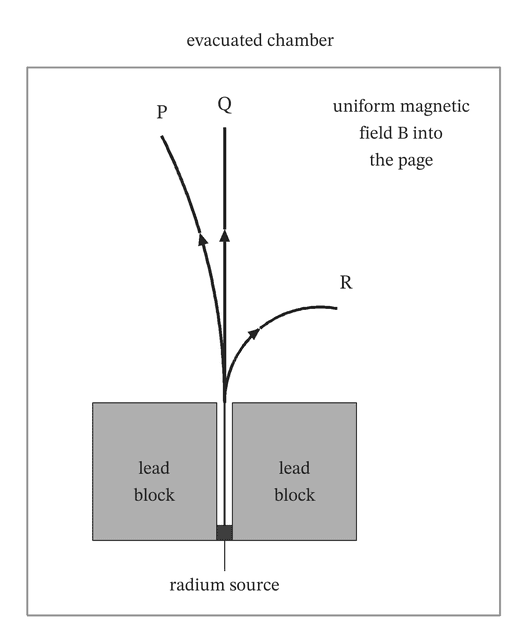
(i) Identify the radiation that follows each track, giving your reason.
(ii) Most α-particles from radium-226 have a kinetic energy of . Find the radius of their path in a field of . (Take the mass of an α-particle as , and .)
(iii) The α-particle carries twice the charge of a β-particle, yet its track is far less curved. Explain why.
- 31 mark
Question 3
A sealed sample of radium chloride gives out α-particles from its radium-226 nuclei at a steady rate. A student plans three changes: heating the sample to , converting it chemically into radium sulfate containing the same mass of radium, and placing it in a magnetic field of . What happens to the rate at which the radium-226 nuclei emit α-particles?
- 42 marks
Question 4
(Hypothetical data.) Two samples are tested one after the other in the same ionisation chamber under identical conditions. Sample 1 is pure uranium oxide containing of uranium. Sample 2 is a powdered uranium ore that also contains of uranium. Sample 2 gives an ionisation current times that of sample 1. Earlier tests had shown that the current from any uranium compound depends only on the mass of uranium it contains.
(i) What can you conclude about the ore?
(ii) What fraction of the ore's ionisation current comes from substances other than uranium?
- 53 marks
Question 5
Polonium-210 emits α-particles of kinetic energy . In air, an α-particle produces one ion pair (a positive ion and a free electron) for every of energy it loses, and it stops when it has lost all its energy.
(i) How many ion pairs does one α-particle produce before it stops?
(ii) In an ionisation chamber filled with air, α-particles from this source stop in the gas every second, and all the ions of one sign are collected. Find the current. (Take .)
(iii) A β-particle of the same energy produces far fewer ion pairs per centimetre of its path. Give a reason.
- 63 marks
Question 6
In 1909 Rutherford and Royds put radon gas, which emits α-particles, into a glass tube A whose wall was so thin that α-particles could pass through it, although gas atoms could not. Tube A was sealed inside an evacuated outer glass tube B, as shown. After a few days, the gas that had collected in B was pushed up into the narrow discharge tube C, and an electric discharge through it showed the bright-line spectrum of helium.

(i) What does this experiment show about α-particles?
(ii) In a check, tube A was filled with helium gas instead of radon, and no helium appeared in B. Why was this check needed?
(iii) Why did the helium spectrum appear only after a few days?
- 71 mark
Question 7
Strontium-90, a product of nuclear fission, decays by emission. Which equation correctly represents this decay?
- 83 marks
Question 8
The figure shows part of the decay chain that starts from radium-226, plotted on a chart of neutron number against proton number . Each arrow is one decay.

(i) Name the type of decay shown by each of the arrows 1 to 6, giving the rule you use.
(ii) Write the nuclear equation for step 4, showing every particle emitted.
(iii) Polonium appears twice in this chain. Use the displacement laws to explain how an element can appear again, and state how the two polonium nuclei differ.
- 93 marks
Question 9
Fluorine-18 (), used in PET scans, decays to oxygen-18. About 97 % of its nuclei decay by positron () emission and the rest by electron capture.
(i) Write the nuclear equation for each route, showing every particle.
(ii) Explain why both routes give the same daughter nucleus.
(iii) The emitted positron soon meets an electron. The pair, almost at rest, annihilates into two γ-ray photons that move off in opposite directions. Find the energy of each photon in MeV. (Take , and .)
- 103 marks
Question 10
A radium-226 nucleus at rest decays to radon-222 by emitting an α-particle. The energy released is , and all of it becomes kinetic energy of the two products.
(i) Using conservation of momentum, find how this energy is shared between the α-particle and the radon nucleus. (Take the masses of the two in the ratio of their mass numbers, .)
(ii) Find the speed of the recoiling radon nucleus. (Take and .)
- 111 mark
Question 11
Phosphorus-32 decays by emission to sulfur-32, releasing . This energy is shared between the electron and the antineutrino (the recoil energy of the sulfur nucleus is negligible). In one decay the electron leaves with a kinetic energy of . The energy carried away by the antineutrino is
- 123 marks
Question 12
Technetium-99m, the tracer most widely used in medical imaging, is a technetium-99 nucleus in an excited (metastable) state. It reaches the ground state mainly by emitting a γ-ray photon of energy .
(i) Write the decay equation, and state how the mass number and the atomic number change.
(ii) Find the wavelength of the γ-ray photon. (Take , and .)
(iii) The element does not change in this decay. Why is it still called radioactive decay?
- 131 mark
Question 13
(Hypothetical data.) An end-window Geiger tube is placed from a radioactive source, as shown, and the count rate is recorded with different absorbers between them. The background count rate is 30 per minute.
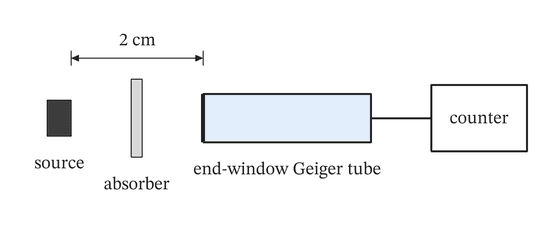
Absorber between source and tube Count rate (per minute) none 1250 a sheet of paper 520 aluminium, thick 140 lead, thick 32 Assume that paper stops all α-particles, of aluminium stops all β-particles, and γ-rays are only slightly absorbed by paper and aluminium. Which radiations does the source emit?
- 141 mark
Question 14
(Hypothetical data.) To model radioactive decay, a class throws 1200 fair dice together. Every die that shows a six is removed (it has "decayed"), and the rest are thrown again, over and over. Treating the number of throws as a continuous variable, the "half-life" of the dice, that is, the number of throws after which the expected number of dice left is 600, is closest to (take and )
- 153 marks
Question 15
(Hypothetical data.) The number of undecayed nuclei in a radioactive sample was found every :
(min) 0 2.0 4.0 6.0 8.0 () 800 640 512 410 328 (i) Show that these readings obey the decay law .
(ii) Find the decay constant . (Take .)
(iii) Predict at .
- 164 marks
Question 16
Lutetium-177 (half-life days, molar mass ) is used to treat some cancers. A sample contains of lutetium-177. (Take and .)
(i) Find the number of lutetium-177 nuclei in the sample.
(ii) Find the decay constant.
(iii) How many nuclei decay during the first days, and how many during the next days?
(iv) Explain why the second number is smaller.
- 171 mark
Question 17
For a radioactive sample, the graph of against time , where is the number of undecayed nuclei, is the straight line shown.

The decay constant of the sample is
- 182 marks
Question 18
(Hypothetical data.) A radioactive sample loses 10 % of its undecayed nuclei in the first hour. A student argues: "It loses 10 % every hour, so after 10 hours nothing will be left."
(i) Explain the mistake in this argument.
(ii) Find the percentage of the original nuclei still undecayed after 10 hours.
- 193 marks
Question 19
The decay law can also be read for a single nucleus: the probability that a particular undecayed nucleus is still undecayed after a further time is . For radon-222, .
(i) Find the probability that a particular radon-222 nucleus is still undecayed after days.
(ii) Find the probability that it decays during the first day.
(iii) Another radon-222 nucleus has already lasted days without decaying. What is the probability that it decays during the next day? Explain your answer.
- 203 marks
Question 20
(Hypothetical data.) The graph shows how the number of undecayed nuclei in a radioactive sample changes with time .

(i) Read the half-life from the graph twice: once starting at , and once starting from the moment when . Show that the two readings agree.
(ii) Find the decay constant and the mean life. (Take .)
(iii) Use the half-life to predict at , and check your prediction on the graph.
- 211 mark
Question 21
Two samples of sodium-24 (half-life ) are prepared at the same time. Sample X contains of sodium-24 and sample Y contains . How long does each sample take to lose half of its sodium-24 nuclei?
- 221 mark
Question 22
The Voyager 1 spacecraft, launched in 1977, gets its electrical power from the heat given out by plutonium-238 (half-life years). The heat output is proportional to the number of plutonium-238 nuclei present. Considering only the decay of the plutonium, by 2026, about 49 years after launch, the heat output has fallen to about what percentage of its value at launch?
- 233 marks
Question 23
Iodine is taken up by the thyroid gland. Iodine-123 (half-life ) decays by electron capture and emits no β-particles; its γ-rays are used to make images. Iodine-131 (half-life days) emits β-particles as well as γ-rays.
(i) Considering only radioactive decay, find the fraction of each isotope left days after it is given to a patient.
(ii) Hence give two reasons why iodine-123 is preferred for imaging the thyroid.
- 243 marks
Question 24
The figure shows a decay curve of the number of undecayed nuclei against time . The tangent to the curve at a point P meets the time axis at Q, and F is the foot of the perpendicular from P to the time axis.
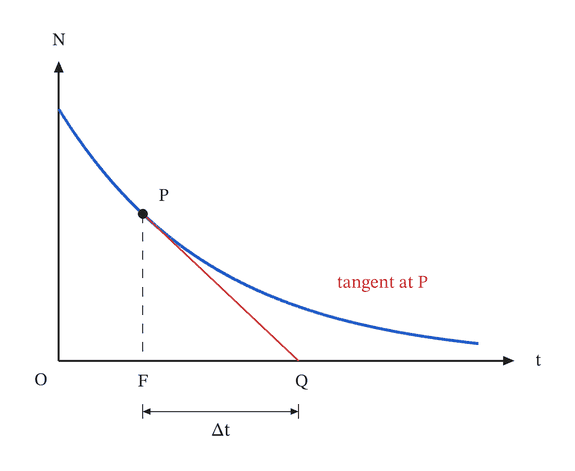
(i) Using , show that the gap equals , the mean life , wherever P lies on the curve.
(ii) For a nuclide of half-life , find , and say where the tangent drawn at meets the time axis. (Take .)
- 251 mark
Question 25
The mean life of a radioactive nuclide is longer than its half-life. Its half-life is about (take )
- 261 mark
Question 26
Four samples each contain of a single pure radioactive isotope. Their half-lives and molar masses are:
Isotope Half-life Molar mass cobalt-60 5.27 years uranium-238 years iodine-131 8.02 days caesium-137 30.1 years Take , , and . Which sample has the greatest activity?
- 273 marks
Question 27
A sealed source of phosphorus-32, a pure -emitter that gives out one -particle in each decay, is placed in front of a Geiger–Müller counter. With the source removed the counter records a background of 30 counts per minute; with the source in place it records 3360 counts per minute. Only of the -particles given out by the source are counted, because most travel in other directions or pass through the tube undetected. (Hypothetical data.)
(a) Find the count rate due to the source alone, in counts per second.
(b) Find the activity of the source in becquerel.
(c) Express this activity in the older units microcurie and rutherford (, ).
- 281 mark
Question 28
A household ionisation smoke detector contains about of americium-241, whose half-life is 432 years. About how many americium nuclei in the detector decay in one day ()?
- 294 marks
Question 29
A student measures the count rate from a short-lived radioactive sample every 10 minutes. The background count rate, measured with the sample removed, is 30 counts per minute. (Hypothetical data.)
(min) 0 10 20 30 40 Measured count rate (counts per minute) 1630 1038 665 430 282 (a) Correct each reading for the background.
(b) Plot a graph of against , where is the corrected count rate in counts per minute, and explain why it is a straight line.
(c) Use the slope of the graph to find the decay constant and the half-life of the sample.
- 303 marks
Question 30
The World Health Organization recommends a reference level of per cubic metre for radon in the air of homes. Radon-222 has a half-life of 3.82 days. (Take and .)
(a) Find the number of radon-222 atoms in one cubic metre of air at this level.
(b) Air at room conditions contains about molecules per cubic metre. What fraction of these molecules are radon atoms?
(c) Find the total radon activity in a room of volume at this level, in becquerel and in nanocuries ().
- 311 mark
Question 31
A tiny iodine-125 seed placed permanently in a tumour has an activity of when it is implanted. (Hypothetical data.) Iodine-125 has a half-life of 59.4 days. Taking and , the total number of iodine-125 nuclei that will decay in the seed over its whole life is about
- 323 marks
Question 32
A cobalt-60 teletherapy unit in a hospital is fitted with a new source of activity . Cobalt-60 has a half-life of 5.27 years. With the new source one treatment session lasts minutes. The session time is set so that the patient always receives the same dose, so it is inversely proportional to the activity of the source. (Hypothetical data.)
(a) Express the activity of the new source in becquerel and in terabecquerel (, ).
(b) How long must the same session last 3.0 years later?
(c) The hospital replaces the source when a session would last longer than 4.0 minutes. After how many years does this happen?
- 331 mark
Question 33
Which statement about the activity of a radioactive sample is correct?
- 343 marks
Question 34
In the carbon of living plants and animals there are about carbon-14 atoms for every carbon-12 atoms. Carbon-14 has a half-life of 5730 years. (Take , the molar mass of carbon as , and .)
(a) How many carbon-14 atoms are there in of carbon from a living tree?
(b) Find the decay constant of carbon-14 in .
(c) Find the activity of of this carbon, in becquerel and in decays per minute.
- 353 marks
Question 35
A radiocarbon laboratory uses the same counter for every measurement. With no sample in place it records a background of 2.4 counts per minute. A carbon sample from fresh wood gives 50.4 counts per minute, and a carbon sample from an ancient wooden beam gives 14.4 counts per minute. (Hypothetical data.) The half-life of carbon-14 is 5730 years.
(a) Find the corrected count rate per gram of carbon for each sample.
(b) Find the age of the beam.
(c) What age would the laboratory get if it forgot to subtract the background? (Use and .)
- 361 mark
Question 36
A museum is asked to find the age of a 65-million-year-old dinosaur bone by carbon-14 dating. The half-life of carbon-14 is 5730 years. Why can this method not give the bone's age?
- 373 marks
Question 37
Radiocarbon dating assumes that the fraction of carbon-14 in the carbon of the atmosphere, and so in living things, has always been the same.
(a) Explain why a living plant keeps a steady fraction of carbon-14, and why the fraction starts to fall when the plant dies.
(b) Give two reasons why the assumption above is not exactly true.
(c) How do laboratories correct radiocarbon ages for these changes?
- 383 marks
Question 38
An accelerator mass spectrometer counts carbon-14 atoms directly instead of waiting for them to decay. In of carbon from an ancient seed it finds 4.5 carbon-14 atoms for every carbon atoms, while carbon from living plants has 1.2 carbon-14 atoms for every carbon atoms. (Hypothetical data.) Take the half-life of carbon-14 as 5730 years, , , , the molar mass of carbon as and .
(a) Find the age of the seed.
(b) How many carbon-14 atoms are there in the sample, and about how many of them decay in one day ()?
(c) Use your answer to (b) to explain why counting atoms works with far smaller samples than counting decays.
- 391 mark
Question 39
The carbon-14 used in radiocarbon dating is produced continuously in the upper atmosphere. Which of these nuclear reactions produces it?
- 401 mark
Question 40
Carbon from living wood has an activity of per gram. A wooden bowl was carved from a tree that was cut down 2000 years ago. Taking the half-life of carbon-14 as 5730 years, the activity of of carbon from the bowl today is about
- 413 marks
Question 41
In an excavation, charcoal from a lower (older) hearth gives 6.2 decays per minute per gram of carbon, and charcoal from an upper hearth at the same site gives 9.8 decays per minute per gram. (Hypothetical data.) The half-life of carbon-14 is 5730 years. (Use , and .)
(a) Find how many years passed between the use of the two hearths, without using the activity of living carbon.
(b) Explain why the activity of living carbon is not needed in (a).
(c) Carbon from living wood gives 13.6 decays per minute per gram. Find the age of the upper hearth.
- 421 mark
Question 42
In 1919 Rutherford changed nitrogen into oxygen by bombarding it with α-particles:
The atomic masses are , , and ; . The -value of this reaction is
- 433 marks
Question 43
In 1932 Chadwick identified the neutron in the radiation given out when beryllium is bombarded with α-particles from polonium:
The atomic masses are , , and ; . Take the products to be formed in their ground states.
(a) Find the -value of the reaction and say whether it is exothermic or endothermic.
(b) The α-particles from polonium-210 have a kinetic energy of , and the beryllium nuclei are at rest. Find the total kinetic energy shared by the carbon-12 nucleus and the neutron.
(c) Explain why the neutron cannot carry away all of this kinetic energy.
- 441 mark
Question 44
In every nuclear reaction, which one of these quantities is NOT necessarily the same before and after the reaction?
- 453 marks
Question 45
In 1934 Irène Curie and Frédéric Joliot bombarded aluminium with α-particles and made the first artificial radioactive isotope:
The atomic masses are , , and ; .
(a) Identify the particle .
(b) Find the -value of the reaction. What does its sign tell you about the α-particles needed?
(c) Phosphorus-30 decays by positron () emission into silicon. Write the equation for this decay.
- 461 mark
Question 46
A beam of protons of kinetic energy strikes a thin lithium target and produces neutrons by the reaction
The atomic masses are , , and ; . Take the products to be formed in their ground states. For a lithium nucleus at rest, the total kinetic energy of the beryllium-7 nucleus and the neutron is about
- 472 marks
Question 47
Cobalt-60 for radiotherapy is made by placing ordinary cobalt-59 in a nuclear reactor, where it captures slow neutrons:
The atomic masses are , and ; .
(a) Find the -value of this capture. About how much energy is given out as γ-rays when a very slow neutron is captured? (Neglect the recoil of the nucleus.)
(b) Slow neutrons have kinetic energies of only about . Why can they enter the cobalt nucleus, when slow protons cannot?
- 483 marks
Question 48
Boron-10 captures slow neutrons very readily, which is why boron is used in reactor control rods and in neutron detectors:
The atomic masses are , , and ; . Take the products to be formed in their ground states.
(a) Find the -value.
(b) The neutron is so slow that its momentum and kinetic energy can be neglected. Find the kinetic energies of the α-particle and the lithium-7 nucleus, using mass numbers to share the momentum.
(c) Explain why a neutron detector can use this reaction, even though neutrons themselves cause almost no ionisation.
- 491 mark
Question 49
One way in which a uranium-235 nucleus can split after capturing a slow neutron is
The values of and are
- 502 marks
Question 50
Name two radioactive elements which are not found in observable quantities. Why is it so?
- 511 mark
Question 51
Give an example of a nuclear disintegration in which radioactivity is due to positron emission.
- 522 marks
Question 52
How are β-rays emitted from a nucleus when it does not contain electrons?
- 532 marks
Question 53
Show that after ten half-lives the amount of radioactive element is reduced to about one-thousandth part at the beginning.
- 541 mark
Question 54
Will a single nucleus emit α-particle, β-particle and γ-ray together ?
- 551 mark
Question 55
Why do we call the electrons emitted during radioactivity as β-particle ?
- 563 marks
Question 56
A radioactive source contains one microgram of Pu. This source is estimated to emit 2200 α-particles per second in all directions. Estimate the half-life of plutonium from this data. Mass of one alpha particle is 4.00387 amu.
- 573 marks
Question 57
A radioactive material of mass 10 mg with a half-life period of two years is kept in store for six years. How much of the material remains unchanged?
- 583 marks
Question 58
The disintegration constant of a sample of radioactive substance is . If its molecular weight is 232, find the number of alpha particles emitted from one gram of the sample during one year.
- 593 marks
Question 59
64 g of polonium disintegrates with a half-life of 3 minutes. How much of the original material will be left at the end of 30 minutes?
- 603 marks
Question 60
The half-life of radium is 1600 years. After how many years 25% of radium block remains undecayed?
- 613 marks
Question 61
Determine the half-life of a radioactive material if its activity falls to (1/16)th of its initial value in 30 years.
- 623 marks
Question 62
1 mg radium has atoms. Its half-life is 1620 years. How many radium atoms will disintegrate from 1 mg of pure radium in 3240 years?
- 633 marks
Question 63
The half-life of radon is 3.8 days. After how many days will only one-twentieth of a radon sample be left over?
- 643 marks
Question 64
The mean-lives of a radioactive substance are 1620 years and 405 years for α-emission and β-emission respectively. Find out the time during which three-fourths of a sample will decay if it is decaying both by α-emission and β-emission simultaneously.
- 653 marks
Question 65
A sample of uranium is a mixture of three isotopes of , and present in the ratio of 0.006%, 0.71% and 99.24% respectively. The half-lives of these isotopes are years, years and years respectively. Calculate the contribution to activity (in percentage) of each isotope in this sample.
- 663 marks
Question 66
Check whether it is possible for nucleus to decay into a nucleus by the following reaction.
Given binding energy per nucleon MeV, MeV, MeV.
- 673 marks
Question 67
A γ-ray source when placed before a Geiger counter shows a count rate of 480 s. After 3 hours the source shows a count rate of 30 s. Calculate the half-life period of the γ-ray source.
- 683 marks
Question 68
The half-life of against alpha decay is years. How long does it take 15/16 of a sample of this isotope to decay?
- 693 marks
Question 69
A certain radioactive substance has a half-life period of 30 days. What is the disintegration constant?
- 703 marks
Question 70
A radioisotope of silver has half-life of 20 minutes. What fraction of the original mass would remain after one hour?
- 713 marks
Question 71
The half-life of a radioactive substance is 1672 years. If the initial mass of the substance is 1 g, after how many years will only 1 mg of it to be left behind?
- 723 marks
Question 72
The half-life of a radioactive substance is 100 years. In how many years will its activity decay to 0.1 times its initial value?
- 732 marks
Question 73
Show graphically the variation of mass of a radioactive substance with time. Mark the values of time on the X-axis in terms of half-life (, , , etc) and the corresponding values of mass on the Y-axis.
- 742 marks
Question 74
The half-life of radon is 3.8 days. Calculate the amount of radon undecayed in a sample containing 1024 mg of radon after 38 days.
- 751 mark
Question 75
Which of the radiations α-rays, β-rays or γ-rays are
(i) easily absorbed by matter?
(ii) similar to X-rays?
- 761 mark
Question 76
What is meant by the activity of a radioactive substance?
- 771 mark
Question 77
What is meant by half-life of a radioactive substance?
- 782 marks
Question 78
The half-life of a radioactive substance is 16 hours. After how much time will 6.25% of the material remains undecayed?
- 792 marks
Question 79
A radioactive sample has a half-life of second and a mass number of 238. Calculate the number of disintegrations per second in 1 g of this sample. Avogadro number is mol.
- 802 marks
Question 80
The half-life of a certain radioactive element is 8 hours. If a pupil starts with 32 g of this element, how much of the sample will be left behind at the end of one day?
- 812 marks
Question 81
Half-life of a certain radioactive substance is 6 hours. If you had 32 kg of this substance in the beginning. How much of it will disintegrate in one day?
- 821 mark
Question 82
Half-life of a certain radioactive element is 3.465 days. Find its disintegration constant.
- 831 mark
Question 83
How are average life and decay constant related?
- 841 mark
Question 84
How are half-life () and disintegration constant () related?
- 851 mark
Question 85
In a mean life of a radioactive sample
- 861 mark
Question 86
1 curie is equal to
- 871 mark
Question 87
The electron emitted in beta radiation originates from
- 881 mark
Question 88
When a radioactive substance emits an α-particle, its position in the periodic table is lowered by
- 891 mark
Question 89
In a sample of radioactive material, what percentage of the initial number of active nuclei will decay during one mean life
- 901 mark
Question 90
The S.I. unit of radioactivity is
- 911 mark
Question 91
Half-life of a substance is 10 years. In what time, it becomes (1/4)th part of the initial amount?
- 921 mark
Question 92
If is the original mass of the substance of half-life period years, then the amount of substance left after 15 years is
- 931 mark
Question 93
Two radioactive samples have decay constant and . If they have the same number of nuclei initially, the ratio of number of nuclei after a time is
- 941 mark
Question 94
A radioactive substance emits
(A) Electromagnetic radiation
(B) Electrons revolving around the nucleus
(C) Charged particles
(D) Neutral particles
- 951 mark
Question 95
A radioactive material has a half-life of 10 days. What fraction of the material would remain after 30 days?
- 961 mark
Question 96
Which of the following processes represent a gamma decay?
- 971 mark
Question 97
A radioactive sample at any instant has its disintegration rate 5000 disintegrations per minute. After 5 minutes, the rate is 1250 disintegrations per minute. Then, the decay constant (per minute) is
- 981 mark
Question 98
Radioactive nuclei that are injected into a patient collect at certain sites within its body, undergoing radioactive decay and emitting electromagnetic radiation. These radiations can then be recorded by a detector. This procedure provides an important diagnostic tool called
- 991 mark
Question 99
Activity of radioactive element decreased to one-third of original activity in 9 years. After further 9 years, its activity will be
- 1001 mark
Question 100
The half-life of a radioactive substance is 20 minutes. The time taken between 50% decay and 87.5% decay of the substance will be
- 1011 mark
Question 101
A radioactive sample of decays to Pb through a process for which half-life is years. The ratio of number of nuclei of Pb to after a time of years (given )
- 1021 mark
Question 102
After 280 days, the activity of a radioactive sample is 6000 dps. The activity reduces to 3000 dps after another 140 days. The initial activity of the sample in dps is
- 1031 mark
Question 103
Half-life of a radioactive substance is 20 minutes. The time between 20% and 80% decay will be
- 1041 mark
Question 104
Two radioactive materials and have decay constants and respectively. If initially they have the same number of nuclei, then the ratio of the number of nuclei of to that of will be after a time
- 1051 mark
Question 105
The activity of a radioactive sample is measured as counts per minute at and counts per minute at minutes. The time (in minutes) at which the activity reduces to half its value is
- 1061 mark
Question 106
Half-life of a radioactive substance is 20 minutes. Difference between points of time when it is 33% disintegrated and 67% disintegrated is approximately
- 1071 mark
Question 107
A radioactive isotope with a half-life of years decays to which is stable. A sample of rock from the Moon was found to contain both the elements and which were in the ratio of 1 : 7. The age of the rock is
- 1081 mark
Question 108
The half-life period of a radioactive element is same as the mean lifetime of another radioactive element . Initially both of them have the same number of atoms. Then
- 1091 mark
Question 109
The half-life of radium is 1620 years and its atomic weight is 226 kg per kmol. The number of atoms that will decay from its 1 g sample per second will be
- 1101 mark
Question 110
A radioactive material decays by simultaneous emission of two particles with respective half-lives 1620 and 810 years. The time (in years) after which one-fourth of the material remains is
- 1111 mark
Question 111
A radioactive sample having an activity of has twice the number of nuclei as another sample which has an activity of . The half-lives of and can be
- 1121 mark
Question 112
A sample of radioactive material A, that has an activity of 10 mCi (1 Ci = decays/s), has twice the number of nuclei as another sample of a different radioactive material B which has an activity of 20 mCi. The correct choices for half-lives of A and B would then be respectively
- 1131 mark
Question 113
In a radioactive chain, the initial nucleus is . At the end there are 6 α-particles and 4 β-particles which are emitted. If the end nucleus is , and are given by
- 1141 mark
Question 114
Two radioactive materials and have decay constant and , respectively. If initially they have the same number of nuclei, then the ratio of the number of nuclei of to that of will be after a time
- 1151 mark
Question 115
α-particle consists of
- 1161 mark
Question 116
In a radioactive material, fraction of active material remaining after time is . The fraction that was remaining after is
- 1171 mark
Question 117
A radioactive nucleus decays by two different processes. The half-life for the first process is 10 s and that for the second is 100 s. The effective half-life of the nucleus is close to
- 1181 mark
Question 118
The decay of a proton to neutron is
- 1191 mark
Question 119
A radioactive sample disintegrates via two independent decay processes having half-lives and respectively. The effective half-life of the nuclei is
- 1201 mark
Question 120
The half-life of is 3 days. If atomic weight of is 198 g/mol then the activity of 2 mg of is [in disintegration/second]
- 1211 mark
Question 121
If '' denotes the ratio of the number of nuclei decayed () to the number of nuclei at () then for a collection of radioactive nuclei, the rate of change of '' with respect to time is given as [ is the radioactive decay constant]
- 1221 mark
Question 122
The half-life period of a radioactive element is same as the mean lifetime of another radioactive element . Initially they have the same numbers of atoms. Then
- 1231 mark
Question 123
There are radioactive nuclei in a given radioactive element. Its half-life time is 1 minute. How many nuclei will remain after 30 seconds ()?
- 1241 mark
Question 124
A radioactive nucleus undergoes spontaneous decay in the sequence
where is the atomic number of element . The possible decay particles in the sequence are