
Question 412 marksMedium
Describe an experiment to study radioactivity.
Confirming your payment
Sign up now and get 250 free tokens.
Radioactivity · Question 41 of 84
Describe an experiment to study radioactivity.
Solution:
Concept: Charged particles moving across a magnetic field are bent in opposite directions according to the sign of their charge, while uncharged radiation goes straight on. This lets us separate the radiations from a source.
Step 1 — Set up the apparatus. A small piece of radium is placed at the bottom of a narrow hole drilled in a lead block. Radiation can escape only upwards through the hole; the lead absorbs the rest. The block is kept in an evacuated chamber so that air does not absorb the rays.
Step 2 — Apply a magnetic field. A strong uniform magnetic field is applied perpendicular to the plane of the paper, directed into it, as in the figure.
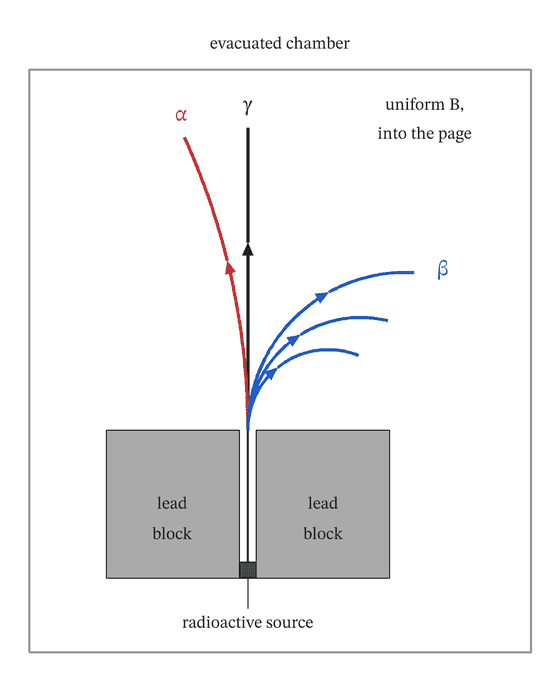
Step 3 — Observe the three beams. The beam splits into three. By Fleming's left-hand rule, the rays bending gently to the left are positively charged (-particles); the rays bending sharply to the right are negatively charged (-particles), spread over a range of curvatures because their energies differ; the rays that go straight on are uncharged (-rays). The -particles bend much less than the -particles because they are far heavier.
Step 4 — Confirm with an electric field. Placing the source between charged plates gives the same result: -rays bend towards the negative plate, -rays towards the positive plate, -rays are undeflected.
Therefore, passing the radiation from a source in a lead block through a magnetic (or electric) field in an evacuated chamber separates it into positive α-rays, negative β-rays and uncharged γ-rays.