
Opening your dashboard
Class 12 Physics Chapter 28 Radioactivity: Competency-Based Questions (CBQ)
40 questions on Chapter 28, each worked through on its own page with the AI tutor. Class 12 Physics, ICSE 2026-27.
40 questions
1–5 marks · Mixed difficulty
- 13 marks
Question 1
Competency: Application
Marie and Pierre Curie announced the discovery of polonium and radium in 1898. Their laboratory notebooks from that period are still radioactive today, mainly because radium-226 got on to the pages. Radium-226 has a half-life of years and decays by α-emission to radon-222. The polonium that the Curies separated was polonium-210, whose half-life is days. (Take , , and days.)
(a) What fraction of the radium-226 that got on to the pages in 1898 is still there in 2026?
(b) Show that practically none of the polonium-210 separated in 1898 can be left today. A test of such a page would nevertheless find polonium-210 in it. Explain where this polonium-210 comes from.
(c) Write the nuclear equation for the α-decay of radium-226 (). Explain why the pages also give out β-particles, although radium-226 itself decays by α-emission.
- 21 mark
Question 2
Competency: Analysis & Evaluation
A student reads that bananas, granite worktops and even the human body are slightly radioactive, because they contain naturally occurring radioactive nuclides.
Assertion (A): Some light elements, such as potassium (), have isotopes that are naturally radioactive.
Reason (R): Natural radioactivity is found only in elements heavier than lead ().
- 31 mark
Question 3
Competency: Analysis & Evaluation
The hands and numbers of an old alarm clock, made about 80 years ago, were painted with luminous paint: a radium-226 compound mixed with zinc sulphide, which gives a tiny flash of light whenever an α-particle strikes it. Today the paint no longer glows in the dark, yet a Geiger counter held near the hands still shows a high count rate. (Hypothetical data.) Radium-226 has a half-life of years. (Take .)
Which statement best explains these observations?
- 43 marks
Question 4
Competency: Application
A paper mill controls the thickness of its paper with the gauge shown. A krypton-85 source below the moving sheet decays by β⁻ emission (half-life years), and a Geiger–Müller (G–M) tube above the sheet counts the radiation that gets through. A computer moves the rollers to keep the count rate at a set value.
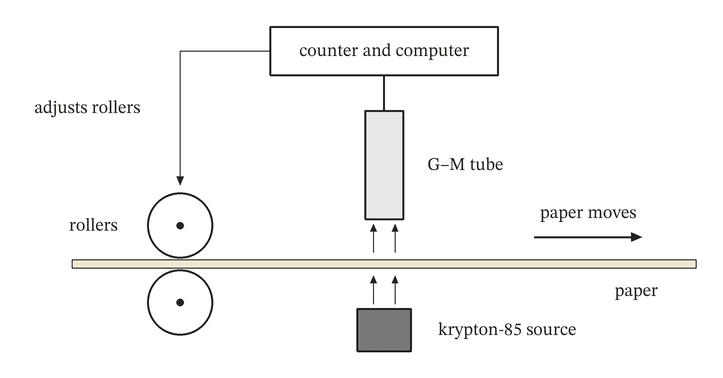
With paper of the correct thickness, the count rate (after subtracting the background) is per minute. (Hypothetical data.)
(a) Write the equation for the β⁻ decay of krypton-85 () into rubidium, showing every particle. Explain why an α-source or a γ-source would not be suitable for this gauge.
(b) One morning the count rate rises to per minute. Is the paper now too thick or too thin? What must the rollers do?
(c) Show that, because of the source's own decay, the count rate for paper of the correct thickness falls by only about in days. (Take , days and .)
- 51 mark
Question 5
Competency: Analysis & Evaluation
A household ionisation smoke detector contains a very small americium-241 source between two metal plates. The radiation ionises the air between the plates, so a tiny current flows; when smoke particles enter, the current falls and the alarm sounds. Americium-241 decays by α-emission with a half-life of 432 years.
Assertion (A): The detector uses an α-emitting source rather than a source that emits only γ-rays.
Reason (R): Americium-241 has a half-life of 432 years, so its activity hardly changes during the working life of the detector.
- 61 mark
Question 6
Competency: Analysis & Evaluation
In 1930 Wolfgang Pauli suggested that a tiny neutral particle, later called the neutrino, is emitted together with the electron in β decay. It was first detected directly by Clyde Cowan and Frederick Reines in 1956, using the enormous number of antineutrinos coming from a nuclear reactor.
Assertion (A): The neutrino was detected directly only about 25 years after it was proposed.
Reason (R): Neutrinos have no charge and interact extremely weakly with matter, so almost all of them pass through a detector without leaving any trace.
- 71 mark
Question 7
Competency: Analysis & Evaluation
In many countries, spices and some other foods are exposed to γ-rays from cobalt-60 (photon energies and ) to kill bacteria and insects.
Assertion (A): Food treated in this way does not become radioactive.
Reason (R): γ-rays carry no charge, so they are not deflected by electric or magnetic fields.
- 81 mark
Question 8
Competency: Application
Laboratories check radiation detectors with caesium-137 sources, which are known for their γ-rays. Caesium-137 () decays by β⁻ emission with a half-life of years, mostly into barium-137m, an excited state of barium-137 () with a half-life of minutes.
Which equation shows the step in which the γ-rays are emitted?
- 93 marks
Question 9
Competency: Application
A family fills a glass vial with air from their basement at 9 a.m. on Monday, seals it and posts it to a laboratory. At 9 a.m. on Thursday the laboratory measures the radon-222 activity of the air in the vial as per cubic metre. (Hypothetical data.) Radon-222 has a half-life of days. The World Health Organization recommends a reference level of for radon in homes and advises that, where this cannot be reached, the level should not exceed . (Take and .)
(a) Explain why the laboratory must correct its measurement for the time the vial spent in the post.
(b) Find the radon activity of the basement air when the vial was filled, and compare it with the WHO levels.
(c) The family says: "If we keep the basement closed for a month, the radon will decay away." Explain why this is wrong.
- 101 mark
Question 10
Competency: Analysis & Evaluation
Polonium-214, one of the nuclides in the decay chain of radon-222, has a half-life of only . (Take .)
Assertion (A): Because the decay constant is often described as the fraction of the nuclei that decay per second, no nuclide can have a decay constant greater than .
Reason (R): For a time much shorter than the half-life, the fraction of the nuclei that decay during is very nearly .
- 111 mark
Question 11
Competency: Application
The Fukushima nuclear accident in March 2011 released caesium-134 (half-life years) and caesium-137 (half-life years) into the air and the sea in roughly equal activities. Because caesium-134 decays much faster, the ratio of the two activities works like a clock, and oceanographers used it to recognise caesium from Fukushima in sea water. Assume that the two activities were exactly equal in March 2011, and consider only radioactive decay. (Take , and .)
In March 2026, the activity of the caesium-134 divided by the activity of the caesium-137 from Fukushima in a sample of sea water is about
- 123 marks
Question 12
Competency: Application
Hospitals obtain technetium-99m, the most widely used tracer for medical scans, from a "generator" that contains molybdenum-99 (half-life hours). Most molybdenum-99 nuclei decay by β⁻ emission into technetium-99m (half-life hours), which is washed out of the generator with salt solution each morning. At 7:00 a.m. a nurse washes out a sample of technetium-99m with an activity of . (Hypothetical data.) (Take , and .)
(a) Write the equation for the β⁻ decay of molybdenum-99 () into technetium-99m, showing every particle.
(b) A bone scan needs an activity of . Until what time can this sample be used for one such scan?
(c) The hospital receives a new generator every week. Find the fraction of the molybdenum-99 left in a generator after 7 days, and use it to explain why weekly replacement makes sense.
- 131 mark
Question 13
Competency: Analysis & Evaluation
Engineers suspect a leak in a water main buried about below a road. They plan to add a small amount of a radioactive tracer to the water and then, over the next day or so, walk along the route of the pipe with a detector at the surface, looking for a patch of high count rate where water has leaked into the soil.
Which tracer is the best choice?
- 144 marks
Question 14
Competency: Analysis & Evaluation
The 1986 accident at the Chernobyl nuclear power plant released, by international estimates, about of iodine-131 (half-life days) and about of caesium-137 (half-life years) into the air (). Iodine collects in the thyroid gland, while caesium stays in the soil and enters food for many years. (Take , and .)
(a) Find the mean life of each nuclide.
(b) Treating the caesium-137 activity as constant over a few weeks, find how many days after the accident the activity of the released iodine-131 had fallen to that of the caesium-137. Explain why treating the caesium-137 activity as constant is reasonable.
(c) Use your results to explain why taking iodine tablets, which stop the thyroid from taking up radioactive iodine, mattered only in the first weeks, while some land near the plant is still closed in 2026. Find the fraction of the caesium-137 still present in 2026.
- 151 mark
Question 15
Competency: Analysis & Evaluation
Radiographers check welds in steel pipelines by placing a sealed iridium-192 γ-source (half-life 74 days) on one side of the weld and a film or digital detector on the other side, and exposing it for a set time.
Assertion (A): To get equally good images, the radiographer must use longer exposure times as the source gets older.
Reason (R): The half-life of iridium-192 becomes longer as the source gets older, so the source gives out fewer γ-rays each second.
- 164 marks
Question 16
Competency: Application
The Mars rover Perseverance is powered by a radioisotope generator that holds about of plutonium dioxide. Plutonium-238 (half-life years, molar mass ) decays by α-emission, releasing per decay, and almost all of this energy becomes heat in the fuel. Thermocouples turn part of the heat into electricity. At launch the generator gave about of heat and of electrical power. (Take , , and .)
(a) Find the decay constant of plutonium-238 in , and its mean life in years.
(b) Find the heat produced each second by of plutonium-238.
(c) Estimate the mass of plutonium-238 needed to give of heat, and the efficiency with which the generator turns heat into electricity.
- 171 mark
Question 17
Competency: Analysis & Evaluation
A teacher compares two small sealed sources, each with an activity of . One gives out only α-particles of about ; the other gives out γ-rays of about . Each is held in the same position, from a student's hand. (Hypothetical data.)
Assertion (A): Although the two sources have the same activity, they give the student's hand very different radiation doses.
Reason (R): The becquerel counts only the number of decays per second; it does not tell us the type or the energy of the radiation given out.
- 181 mark
Question 18
Competency: Application
A hospital's whole-body counter detects the γ-rays given out by the potassium-40 in a person's body. After allowing for the efficiency of the counter, it finds that the potassium-40 in an adult's body has an activity of . Of every potassium atoms, are atoms of radioactive potassium-40, whose half-life is years. (Take the molar mass of potassium as , , and .)
The total mass of potassium in this person's body is about
- 193 marks
Question 19
Competency: Analysis & Evaluation
Charcoal from an ancient hearth is sent for radiocarbon dating. Its true age is years. While it lay in the ground, roots of living plants grew into it, so that of the carbon in the cleaned sample still comes from these roots, which contain carbon-14 at the same level as living plants. (Hypothetical data.) The half-life of carbon-14 is years. (Take , and .)
(a) What fraction of its original carbon-14 does the ancient charcoal itself still contain?
(b) Find the carbon-14 content of the contaminated sample as a fraction of that of living carbon, and the age that the laboratory would report from it.
(c) Explain why contamination with modern carbon always makes a sample seem younger, and why the same contamination matters much more for a sample years old than for one years old. (For the -year-old sample, take and .)
- 201 mark
Question 20
Competency: Analysis & Evaluation
Burning petrol, diesel and coal adds large amounts of carbon dioxide to the air, especially near busy roads. Plants take in this carbon dioxide during photosynthesis.
Assertion (A): Fresh leaves picked beside a busy highway give a younger radiocarbon age than fresh leaves of the same plant species picked far from any road on the same day.
Reason (R): Petrol, diesel and coal contain practically no carbon-14, because they formed from living things that died millions of years ago.
- 211 mark
Question 21
Competency: Analysis & Evaluation
Archaeologists date charcoal from a hearth that, according to other evidence, was used 1000 years ago. Wood analysis shows that the charcoal came from the innermost rings of a tree that was 300 years old when it was cut down and burnt. Each ring of a tree stops taking in carbon from the air once it has formed. (Hypothetical data.)
Ignoring measurement errors, the radiocarbon age of the charcoal is about
- 223 marks
Question 22
Competency: Application
Geologists date a layer of volcanic rock by the potassium–argon method. Potassium-40 (half-life years) decays in two ways: of every 1000 decays, about 893 give calcium-40 by β⁻ emission and about 107 give argon-40 by electron capture. Argon is a gas that escapes from molten lava, so the rock contains no argon-40 when it becomes solid; all the argon-40 found later was made by decay inside the solid rock and trapped there. A sample of the rock contains atom of argon-40 for every atom of potassium-40. (Hypothetical data.) (Take and .)
(a) Write the equations for the two ways in which potassium-40 () decays, showing every particle.
(b) For every potassium-40 atom now in the rock, how many potassium-40 atoms have decayed since the rock became solid? What fraction of the original potassium-40 is left?
(c) Find the age of the rock.
- 234 marks
Question 23
Competency: Application
Some exit signs in aircraft and buildings glow in the dark without any electricity. Each letter is a sealed glass tube, coated on the inside with a phosphor and filled with tritium (hydrogen-3) gas. Tritium decays by β⁻ emission into helium-3, and the β-particles make the phosphor glow. The half-life of tritium is years. Atomic masses: and ; . (Take .)
(a) Write the equation for the decay of tritium, showing every particle.
(b) Using the atomic masses, find the -value of the decay in keV. Explain why no electron masses have to be added or subtracted when atomic masses are used.
(c) The fastest β-particles from tritium travel less than in glass. Explain why a sealed sign is safe to handle, and what hazard arises if a tube breaks.
(d) Find the fraction of the tritium left after 10 years.
- 241 mark
Question 24
Competency: Analysis & Evaluation
Beryllium-7, made in the upper atmosphere by cosmic rays, changes into lithium-7 with a half-life of 53 days. Atomic masses: and ; ; the rest energy of an electron is . In terms of atomic masses , electron capture can occur if is positive, while positron emission can occur only if is positive.
Which statement about the decay of beryllium-7 is correct?
- 253 marks
Question 25
Competency: Application
Fluorine-18 for PET scans is made in hospital cyclotrons by firing protons at water enriched in oxygen-18:
Atomic masses: , , and ; .
(a) Find the -value of the reaction and say whether it is exothermic or endothermic.
(b) Because momentum must be conserved, a proton striking an oxygen-18 nucleus at rest can make the reaction happen only if its kinetic energy is at least , where the masses may be taken in the ratio of the mass numbers. Find this threshold energy, and explain why it is larger than .
(c) Natural oxygen contains only about oxygen-18, nearly all the rest being oxygen-16. Explain why the cyclotron target is water enriched in oxygen-18 rather than ordinary water.
- 264 marks
Question 26
Americium-241 decays by α-emission:
The atomic masses are , and ; . Take the americium nucleus to be at rest, and use mass numbers when sharing momentum.
(a) Find the -value of the decay.
(b) Find the kinetic energy of the α-particle, and of the recoiling neptunium nucleus, if the neptunium is left in its ground state.
(c) Most α-particles from americium-241 are measured to have . Explain what this shows, and find the energy of the γ-ray that follows such a decay.
- 273 marks
Question 27
A counter rate meter is used to measure the activity of a radioactive sample. At a certain instant, the count rate was recorded as 4750 counts per minute. Five minutes later, the count rate recorded was 2700 counts per minute. Compute (i) the decay constant and (ii) the half-life of the sample.
- 283 marks
Question 28
kg of a radioactive isotope (atomic number 226) emits α-particles in a second. Calculate the half-life of the isotope. If J of energy is released in one hour in the process, what is the average energy of the alpha particle?
- 293 marks
Question 29
In an ore containing uranium, the ratio of U to Pb nuclei is 3. Calculate the age of the ore, assuming that all the lead present in the ore is the final stable product of U. Take the half-life of U to be years.
- 304 marks
Question 30
Polonium () emits α-particles and is converted into lead (). This reaction is used for producing electric power in a space mission. Po has half-life of 138.6 days. Assuming an efficiency of 10% of the thermoelectric machine, how much Po is required to produce J of electric energy per day at the end of 693 days? Also find the initial activity of the material.
Given masses of nuclei amu, amu, amu.
- 313 marks
Question 31
Calculate the energy available by disintegration of 100 g of into by bombardment of proton. Given mass of amu, amu, amu, Avogadro number /kg.
- 323 marks
Question 32
How many disintegrations per second will occur in one gram of , if its half-life against alpha decay is s?
- 333 marks
Question 33
At a given instant, there are 25% undecayed radioactive nuclei in a sample. After 10 s, the number of undecayed nuclei reduces to 12.5%. Calculate (a) mean life of the nuclei and (b) the time in which the number of undecayed nuclei will further reduce to 6.25% of the reduced number.
- 343 marks
Question 34
In an experiment, the activity of 1.2 milligrams (mg) of radioactive potassium chloride (KCl) was found to be 170 s. Taking molar mass of KCl to be 0.075 kg mol, find the number of K atoms in the sample and the half-life of K. Take Avogadro number mol.
- 353 marks
Question 35
Starting with obtain a relation between disintegration constant of a radioactive element and its half-life (). Various forms have their usual meanings.
- 363 marks
Question 36
Half-life of a certain radioactive material is 8 hours.
(a) Find disintegration constant of this material.
(b) If one starts with 600 g of this substance, how much of it will disintegrate in one day?
- 371 mark
Question 37
Competency: Analysis & Evaluation
A radiation-safety officer at a hospital checks three radioactive sources. At 9 a.m. today each of them has an activity of : a technetium-99m source (half-life hours), an iodine-131 source (half-life days) and a cobalt-60 source (half-life years). (Hypothetical data.) She wants to know which source will give out the most radiation in total, that is, which one will undergo the largest number of decays during the next 10 days. (Take , and .)
Which source undergoes the largest number of decays in the next 10 days?
- 381 mark
Question 38
Competency: Analysis & Evaluation
Marie and Pierre Curie extracted their first radium from tonnes of pitchblende, a uranium ore. Geologists find that such ores formed hundreds of millions of years ago, while radium-226 has a half-life of only years. Uranium-238 has a half-life of years.
Assertion (A): Radium-226 is still present in uranium ores that formed hundreds of millions of years ago.
Reason (R): Radium-226 is formed all the time in the decay chain that starts from uranium-238.
- 393 marks
Question 39
Competency: Application
Disposable syringes are sterilised in their sealed packets by γ-rays from cobalt-60. Cobalt-60 () decays by β⁻ emission into nickel-60 (). In almost every decay the nickel-60 nucleus is formed in an excited state above its ground state. It then falls to an excited state above the ground state, giving out one γ-ray photon, and then to the ground state, giving out a second photon. Atomic masses: and ; . For β⁻ decay, the -value is in terms of atomic masses.
(a) Find the energies of the two γ-ray photons. Neglect the recoil of the nucleus.
(b) Find the -value of the β⁻ decay of cobalt-60, and hence the greatest kinetic energy that a β-particle from cobalt-60 can have.
- 405 marks
Question 40
Competency: Analysis & Evaluation
In a college laboratory a thin metal foil is placed near a neutron source for an hour. Neutron capture makes two different radioactive isotopes in the foil, and both of them decay to stable nuclei. The foil is then moved to a scintillation counter, and the count rate is recorded at intervals. The background has already been subtracted. Each isotope decays according to its own half-life, so the measured count rate is the sum of two separate decaying parts. (Hypothetical data.)
Time (s) 0 40 120 240 360 480 Count rate (counts per second) 3200 1148 360 161 80 40 (Take .)
(a) Using the readings at and , find the half-life of the longer-lived isotope. Explain why the early readings cannot be used for this.
(b) Find the count rate due to the longer-lived isotope at and at . Hence find the count rate due to the shorter-lived isotope at these two times, and its half-life.
(c) Use your two half-lives to predict the count rate at , and compare it with the measured value. A student joins only the first and last readings and claims that the foil has a single half-life of about . Evaluate this claim.