
Opening your dashboard
Class 12 Biology Chapter 5: Principles of Inheritance and Variation Solutions
82 textbook questions with step-by-step answers, free to read, for ISC 2026-27.
Get talked through Ch 5, not just shown the answer
Reading a finished solution is not the same as being able to do it. The AI tutor takes one question at a time and works it with you, in your own words, until you can.
- Ask it out loud, in your own words
- It gives you the next step, not the answer
- Stuck on part (ii)? Start there
82 questions with solutions
1–5 marks · Mixed difficulty
The first 68 solutions are on this page. This chapter is a long one, so the rest open on their own page to keep this one quick to load.
- 11 mark
Question 1
Give scientific name of the plant Mendel chose for his experiments.
Solve with AIWritten solution
Solution:
Key idea: Gregor Mendel worked out the laws of inheritance from hybridisation experiments on the garden pea, carried out from 1856 to 1863.
Step 1 — Recall the plant. Mendel chose the garden pea because it has clear contrasting traits, normally self-pollinates but can be crossed by hand, grows quickly and gives many seeds.
Step 2 — Write the scientific name. The garden pea is Pisum sativum: genus Pisum with a capital letter and species epithet sativum with a small letter, both in italics.
Therefore, the plant Mendel chose is Pisum sativum (garden pea).
- 21 mark
Question 2
How do the flowers get pollinated in garden pea?
Solve with AIWritten solution
Solution:
Key idea: In self-pollination pollen reaches the stigma of the same flower (or another flower of the same plant).
Step 1 — Look at the structure of the pea flower. The two lower petals of the pea flower are joined to form a boat-shaped keel. The keel closely encloses the stamens and the pistil, so pollen from outside cannot easily reach the stigma.
Step 2 — See how pollination happens. The anthers shed their pollen onto the stigma of the same flower, mostly before the flower opens fully. So the pea flower is normally self-pollinated. This is why Mendel had to remove the anthers by hand whenever he wanted to cross two plants.
Therefore, flowers of the garden pea are normally pollinated by self-pollination.
- 31 mark
Question 3
According to Mendel, how many factors does a gamete possess?
Solve with AIWritten solution
Solution:
Key idea: Mendel proposed that each character is controlled by a pair of factors, and that the two factors of a pair separate when gametes are formed (law of segregation, or purity of gametes).
Step 1 — Count the factors in the parent. A pea plant carries two factors for height, for example T and t in a Tt plant.
Step 2 — Follow them into the gametes. At gamete formation the two factors separate, so each gamete receives only one of them: either T or t. A gamete is therefore pure for the character.
Therefore, according to Mendel, a gamete possesses only one factor of each pair (one factor for each character).
- 41 mark
Question 4
Name the condition when both the alleles are identical in an organism.
Solve with AIWritten solution
Solution:
Key idea: A diploid organism carries two alleles of each gene, one on each of a pair of homologous chromosomes.
Step 1 — Describe the condition. When the two alleles are the same, as TT (pure tall) or tt (pure dwarf) in the pea plant, the organism forms only one kind of gamete and breeds true for that trait.
Step 2 — Name it. This condition is called homozygous (the organism is a homozygote). Two different alleles, as in Tt, would make it heterozygous.
Therefore, the condition is homozygous.
- 51 mark
Question 5
Name the cross between two pairs of contrasting characters called?
Solve with AIWritten solution
Solution:
Key idea: Crosses are named by the number of character pairs they follow: one pair gives a monohybrid cross, two pairs a dihybrid cross.
Step 1 — Look at an example. Mendel crossed pea plants with round yellow seeds (RRYY) with plants with wrinkled green seeds (rryy), following seed shape and seed colour together. This cross follows two pairs of contrasting characters.
Step 2 — Name the cross. A cross that follows two pairs of contrasting characters is a dihybrid cross; its gives the ratio 9 : 3 : 3 : 1.
Therefore, the cross is called a dihybrid cross.
- 61 mark
Question 6
What will be the genotype of a tall plant which on self-crossing gives rise to a few dwarf plants also?
Solve with AIWritten solution
Solution:
Key idea: Tallness (T) is dominant over dwarfness (t) in the pea plant, so a tall plant may be TT or Tt, while a dwarf plant must be tt.
Step 1 — Work back from the dwarf offspring. Each dwarf offspring is tt, so it received one t from each gamete. Since the plant was selfed, both gametes came from the same tall plant, so that plant carries t.
Step 2 — Combine this with the parent's own phenotype. The parent is tall, so it also carries T. Its genotype is therefore Tt, which is heterozygous.
Step 3 — Check by selfing Tt. A Tt plant forms T and t gametes in equal numbers.
Gametes T t T TT (tall) Tt (tall) t Tt (tall) tt (dwarf) One quarter of the offspring are tt and dwarf, which are the few dwarf plants seen; a TT plant would give no dwarf plants at all.
Therefore, the tall plant is heterozygous, with the genotype Tt.
- 71 mark
Question 7
According to Mendel, how many factors for each character are present in an offspring?
Solve with AIWritten solution
Solution:
Key idea: Mendel proposed that each character is controlled by a pair of factors, and that each gamete carries only one factor of each pair.
Step 1 — Follow the factors at fertilisation. An offspring is formed when a male gamete fuses with a female gamete. Each gamete brings one factor for the character.
Step 2 — Count the factors. The offspring therefore has two factors for each character, one received from each parent, for example T from one parent and t from the other in a Tt plant.
Therefore, according to Mendel, an offspring has two factors for each character, one from each parent.
- 81 mark
Question 8
What are Mendel's factors known as by the scientists today?
Solve with AIWritten solution
Solution:
Key idea: Mendel called the units that pass from parents to offspring and control each character "factors".
Step 1 — Recall the modern name. In 1909 Wilhelm Johannsen introduced the word "gene" for these units of inheritance.
Step 2 — Link factor and gene. A Mendelian factor is a gene, and its alternative forms (such as T and t) are alleles. Genes are segments of DNA on chromosomes.
Therefore, Mendel's factors are known today as genes.
- 91 mark
Question 9
How did Mendel make sure that he gets true-breeding or pure-breeding forms?
Solve with AIWritten solution
Solution:
Key idea: A true-breeding (pure-breeding) line is one that, after continuous self-pollination, always gives offspring with the same form of a trait as the parent.
Step 1 — Describe what Mendel did. Mendel let each pea variety self-pollinate for several generations and examined the offspring of each generation.
Step 2 — Explain how this proves purity. He kept only those varieties whose offspring showed the same form of the trait generation after generation, such as tall plants giving only tall plants. Such plants are homozygous (for example TT or tt), so he could use them as pure parents.
Therefore, Mendel made sure of true-breeding forms by allowing the pea plants to self-pollinate for several generations and keeping only those that always gave the same trait.
- 101 mark
Question 10
How did Mendel pollinate his flowers:
(a) At the start of his experiment,
(b) Flowers of generation
Solve with AIWritten solution
Solution:
Key idea: The pea flower normally self-pollinates, so a cross between two chosen plants must be made by hand (artificial cross-pollination).
Step 1 — Describe the pollination at the start, for part (a). To cross two pure plants, Mendel removed the anthers of a flower of one parent before they shed pollen (emasculation). He then dusted that flower's stigma with pollen from a flower of the other parent and covered it to keep out stray pollen. So at the start he used cross-pollination.
Step 2 — Describe the pollination of the flowers, for part (b). To raise the generation, Mendel let the flowers of the plants pollinate themselves naturally. So the flowers were self-pollinated.
Therefore, (a) at the start Mendel used cross-pollination, and (b) he allowed the flowers of the generation to self-pollinate.
- 111 mark
Question 11
If Mendel crossed tall and dwarf plants, what kind of plants did he get in and and in which ratio?
Solve with AIWritten solution
Solution:
Key idea: In the pea plant, tallness (T) is completely dominant over dwarfness (t), and the two alleles separate when gametes form.
Step 1 — Find the . Pure tall (TT) × pure dwarf (tt) gives only Tt offspring, because each receives T from one parent and t from the other. All plants are tall.
Step 2 — Find the . Selfing the Tt plants combines T and t gametes as shown.
Gametes T t T TT (tall) Tt (tall) t Tt (tall) tt (dwarf) Step 3 — Count the classes. The has 1 TT, 2 Tt and 1 tt, which gives 3 tall plants for every 1 dwarf plant. Mendel's own counts for this cross were 787 tall and 277 dwarf plants, about 2.84 : 1, close to 3 : 1.
Therefore, the plants were all tall, and the plants were tall and dwarf in the ratio 3 : 1.
- 121 mark
Question 12
If a plant of violet colour (C) is dominant over white (c), then give the possible genotypes of violet colour plants?
Solve with AIWritten solution
Solution:
Key idea: When one allele is completely dominant, the dominant phenotype appears whenever at least one dominant allele is present, so two different genotypes can look alike.
Step 1 — List the possible pairs of alleles. Each pea plant carries two alleles of the flower-colour gene, so the possible genotypes are CC, Cc and cc.
Step 2 — Pick the genotypes that give violet flowers. Since C (violet) is dominant over c (white), a plant with even one C allele has violet flowers. So CC (homozygous dominant) and Cc (heterozygous) are both violet, while cc has no C allele and is white.
Therefore, a violet-flowered plant can have the genotype CC or Cc.
- 131 mark
Question 13
To know the genotype of a dominant phenotype, what kind of cross is done?
Solve with AIWritten solution
Solution:
Key idea: A plant with a dominant phenotype may be homozygous (TT) or heterozygous (Tt), and the two look exactly alike, so a special cross is needed to tell them apart.
Step 1 — Choose the partner for the cross. The plant of unknown genotype is crossed with a homozygous recessive plant (tt). All its gametes carry the recessive allele t, so it cannot hide any allele that comes from the unknown parent.
Step 2 — Read the offspring. If all the offspring show the dominant trait, the unknown plant is TT. If dominant and recessive offspring appear in the ratio 1 : 1, the unknown plant is Tt.
Therefore, a test cross is done, in which the plant is crossed with a homozygous recessive individual.
- 141 mark
Question 14
In a dihybrid cross between round and green seed variety with wrinkled and yellow seed variety, generation shows 9:3:3:1. In this ratio what kind of phenotypes are represented by 9 and 3?
Solve with AIWritten solution
Solution:
Key idea: In a dihybrid cross the two gene pairs assort independently, so the shows four phenotype classes in the ratio 9 : 3 : 3 : 1. The 9 class has both dominant traits, each 3 class has one dominant and one recessive trait, and the 1 class has both recessive traits.
Step 1 — Write the parents and the . Let R stand for round seeds (dominant over wrinkled, r) and Y for yellow seeds (dominant over green, y). The round green parent is RRyy and the wrinkled yellow parent is rrYY. Their gametes are Ry and rY, so every plant is RrYy and has round yellow seeds.
Step 2 — Group the by phenotype. Selfing RrYy gives 16 equally likely combinations of gametes, which fall into four phenotype classes.
Phenotype Genotypes Number out of 16 Round yellow RRYY, RRYy, RrYY, RrYy 1 + 2 + 2 + 4 = 9 Round green RRyy, Rryy 1 + 2 = 3 Wrinkled yellow rrYY, rrYy 1 + 2 = 3 Wrinkled green rryy 1 Step 3 — Match the numbers to the phenotypes. The 9 is round yellow, with both dominant traits. The two 3s are round green and wrinkled yellow, each with one dominant and one recessive trait; in this cross they are the two parental types. The 1 is wrinkled green. Notice that here the 9 class (round yellow) is a new combination, not one of the parents.
Note: The book's answer gives 9 as round green and 3 as round yellow and green wrinkled. That does not fit the cross, because the 9 class of a 9 : 3 : 3 : 1 ratio always carries both dominant traits.
Therefore, 9 represents round yellow seeds, and the two 3s represent round green and wrinkled yellow seeds.
- 151 mark
Question 15
In snapdragon, if white flower variety is crossed with red variety, what is the genotype and phenotype of generation, if red is represented by R and white by r?
Solve with AIWritten solution
Solution:
Key idea: In snapdragon (Antirrhinum majus), flower colour shows incomplete dominance. Neither allele fully masks the other, so the heterozygote has a colour in between those of the two parents.
Step 1 — Write the cross. The pure red parent is RR and the pure white parent is rr. RR forms only R gametes and rr forms only r gametes, so every plant receives R from one parent and r from the other and is Rr.
Step 2 — Find the phenotype of the . A single R allele makes less red pigment than two, so the Rr flowers are pink, intermediate between red and white.
Therefore, the genotype of the is Rr and its phenotype is pink flowers (all the plants are pink).
- 161 mark
Question 16
If represents A allele and as B allele and i third allele in blood groups, what will be the genotypes of A blood group and O blood group?
Solve with AIWritten solution
Solution:
Key idea: The ABO blood group is controlled by one gene with three alleles in the population (multiple alleles): and are co-dominant with each other, and both are dominant over . Each person carries any two of them.
Step 1 — Find the genotypes for group A. Group A red blood cells carry the A antigen but not the B antigen. This happens with , and also with , because is dominant over .
Step 2 — Find the genotype for group O. Group O cells carry neither antigen, so neither nor can be present. The only genotype left is .
Therefore, blood group A has the genotype or , and blood group O has the genotype .
- 171 mark
Question 17
Which allele of and in blood groups is dominant?
Solve with AIWritten solution
Solution:
Key idea: When both alleles of a heterozygote show their effect fully, neither is dominant over the other, and the alleles are called co-dominant.
Step 1 — Look at the heterozygote . A person with makes both the A antigen and the B antigen on the red blood cells, so neither allele masks the other.
Step 2 — Compare each allele with . Both and are dominant over , because gives group A and gives group B.
Therefore, neither nor is dominant over the other: they are co-dominant, although each of them is dominant over .
- 181 mark
Question 18
If the genotype is , what will be the type of blood group and why?
Solve with AIWritten solution
Solution:
Key idea: The allele codes for an enzyme that adds the A sugar to an antigen on the red blood cell surface, and the allele codes for a slightly different enzyme that adds the B sugar. The allele makes no working enzyme.
Step 1 — Work out which antigens are made. In a person with , both enzymes are made and both work, so the red blood cells carry the A antigen and the B antigen together.
Step 2 — Name the blood group and the type of inheritance. Cells with both antigens belong to group AB. Since both alleles express themselves fully in the heterozygote, this is co-dominance.
Therefore, the genotype gives blood group AB, because and are co-dominant and both the A and B antigens are made; it is an example of co-dominance.
- 191 mark
Question 19
In Lathyrus odoratus, what does the ratio of 9 : 7 represent in phenotypes in flower colours.
Solve with AIWritten solution
Solution:
Key idea: In sweet pea (Lathyrus odoratus), purple flower colour needs at least one dominant allele of each of two different genes, C and P, working together (complementary genes). If either gene is homozygous recessive (cc or pp), the purple pigment is not made and the flowers are white.
Step 1 — Write the cross. Two white-flowered strains, CCpp and ccPP, give plants that are all CcPp with purple flowers, because each has one C and one P. Selfing these plants gives 16 equally likely combinations of gametes in the .
Step 2 — Count the colour classes in the . Plants with at least one C and at least one P make 9 of the 16 combinations, and they are purple. The remaining 7 (3 with C but pp, 3 with P but cc, and 1 ccpp) lack one of the two dominant alleles, so they are white.
Note: The 9 : 7 ratio appears in the generation; the plants themselves are all purple.
Therefore, in the 9 : 7 ratio, 9 represents purple flowers and 7 represents white flowers.
- 201 mark
Question 20
What kind of inheritance is skin colour in humans?
Solve with AIWritten solution
Solution:
Key idea: A trait controlled by several genes, each adding a small effect, is called a polygenic (quantitative) trait, and it shows continuous variation.
Step 1 — Describe how skin colour varies. Human skin colour varies smoothly from very light to very dark, with many shades in between, rather than falling into a few distinct classes.
Step 2 — Explain the cause. The colour depends on the amount of melanin in the skin, which is controlled by several genes whose effects add up. The textbook model uses three genes (A, B and C), and studies of human DNA have found many more genes with small effects. Exposure to sunlight also changes the amount of melanin.
Therefore, skin colour in humans shows polygenic (quantitative) inheritance.
- 211 mark
Question 21
Name the cross in which inheritance of two pairs of contrasting characters are studied.
Solve with AIWritten solution
Solution:
Key idea: Crosses are named by how many pairs of contrasting characters are followed: one pair in a monohybrid cross, two pairs in a dihybrid cross.
Step 1 — Count the character pairs. A cross that follows only one pair, such as tall and dwarf, is a monohybrid cross. A cross that follows two pairs together, such as seed shape (round or wrinkled) and seed colour (yellow or green), is a dihybrid cross.
Step 2 — Give Mendel's example. Mendel crossed pure round yellow (RRYY) with pure wrinkled green (rryy) pea plants. The was all round yellow, and the showed round yellow, round green, wrinkled yellow and wrinkled green seeds in the ratio 9 : 3 : 3 : 1.
Therefore, a cross in which two pairs of contrasting characters are studied is called a dihybrid cross.
- 221 mark
Question 22
Name the condition when both the alleles are identical in an organism.
Solve with AIWritten solution
Solution:
Key idea: A diploid organism carries two alleles of each gene, one on each of a pair of homologous chromosomes.
Step 1 — Describe the condition. When the two alleles are the same, as TT (pure tall) or tt (pure dwarf) in the pea plant, the organism forms only one kind of gamete and breeds true for that trait.
Step 2 — Name it. This condition is called homozygous (the organism is a homozygote). Two different alleles, as in Tt, would make it heterozygous.
Therefore, the condition is homozygous.
- 231 mark
Question 23
(This question refers to the sickle-cell allele, , a gene whose first effect is to make an abnormal haemoglobin.)
Name some other effects it causes in the body.
Solve with AIWritten solution
Solution:
Key idea: The sickle-cell gene is a pleiotropic gene, a single gene that affects several traits. It is the allele () of the β-globin gene. Its first effect is an abnormal haemoglobin, HbS, in which valine replaces glutamic acid at position 6 of the β-globin chain.
Step 1 — State how the other effects start. In a person with two alleles, HbS molecules join into long stiff fibres when the oxygen level is low. These fibres bend the red blood cells (RBCs) into a sickle shape.
Step 2 — List the other effects in the body. The sickle-shaped cells cause a chain of further effects:
- The sickled RBCs are stiff and fragile and are destroyed early, after about 10 to 20 days instead of about 120 days, so the person has anaemia and less oxygen reaches the tissues.
- The stiff cells block small blood vessels, causing episodes of severe pain and damage to organs such as the spleen, kidneys, lungs and brain (stroke).
- Over many years this damage strains the heart and kidneys, which may fail.
- People with only one allele (sickle-cell trait) are better protected against severe malaria.
Therefore, besides abnormal haemoglobin, the sickle-cell gene causes sickle-shaped RBCs, anaemia with less oxygen carried to the tissues, blocked small vessels with pain and organ damage (which may lead to heart and kidney failure), and partial protection against severe malaria in carriers.
- 241 mark
Question 24
What will be the genotype of a tall plant which on self-crossing gives rise to a few dwarf plants also?
Solve with AIWritten solution
Solution:
Key idea: Tallness (T) is dominant over dwarfness (t) in the pea plant, so a tall plant may be TT or Tt, while a dwarf plant must be tt.
Step 1 — Work back from the dwarf offspring. Each dwarf offspring is tt, so it received one t from each gamete. Since the plant was selfed, both gametes came from the same tall plant, so that plant carries t.
Step 2 — Combine this with the parent's own phenotype. The parent is tall, so it also carries T. Its genotype is therefore Tt, which is heterozygous.
Step 3 — Check by selfing Tt. A Tt plant forms T and t gametes in equal numbers.
Gametes T t T TT (tall) Tt (tall) t Tt (tall) tt (dwarf) One quarter of the offspring are tt and dwarf, which are the few dwarf plants seen; a TT plant would give no dwarf plants at all.
Therefore, the tall plant is heterozygous, with the genotype Tt.
- 252 marks
Question 25
Name of the plant chosen by Mendel for his experiment.
Solve with AIWritten solution
Solution:
Key idea: Gregor Mendel carried out his hybridisation experiments from 1856 to 1863 on one plant, chosen because it was easy to breed in a controlled way and had clear-cut contrasting traits.
Step 1 — Name the plant. Mendel chose the garden pea, Pisum sativum.
Step 2 — Give the reasons it suited his work. The garden pea had several features that made the experiments possible:
- It has many varieties with clear contrasting forms of a trait, and Mendel used seven such pairs (for example tall and dwarf stems).
- Its flowers are bisexual and normally self-pollinate before they open, so pure (true-breeding) lines are easy to keep.
- The flowers can easily be cross-pollinated by hand after removing the anthers (emasculation).
- It is an annual plant that is easy to grow, has a short life cycle and gives many seeds from each cross.
Therefore, Mendel chose the garden pea, Pisum sativum, for his experiments.
- 262 marks
Question 26
Name any two pairs of contrasting traits studied by Mendel.
Solve with AIWritten solution
Solution:
Key idea: Mendel studied seven characters in the garden pea, each with two clearly different (contrasting) forms, one dominant and one recessive.
Step 1 — List the seven pairs. The seven pairs of contrasting traits, with the dominant form first, are:
Character Dominant form Recessive form Stem height Tall Dwarf Flower colour Violet White Flower position Axial Terminal Pod shape Inflated (full) Constricted Pod colour Green Yellow Seed shape Round Wrinkled Seed colour Yellow Green Step 2 — Pick any two of them. Seed shape, with round seeds dominant over wrinkled seeds, is one pair. Stem height, with tall dominant over dwarf, is another pair.
Therefore, two pairs of contrasting traits studied by Mendel are round versus wrinkled seeds and tall versus dwarf stems.
- 272 marks
Question 27
Name the condition when both the alleles are identical.
Solve with AIWritten solution
Solution:
Key idea: A diploid organism carries two alleles of each gene, one on each chromosome of a homologous pair. The two alleles may be the same or different.
Step 1 — Describe the condition. When the two alleles are the same, as in TT (pure tall) or tt (pure dwarf) in the pea plant, the organism forms only one kind of gamete for that gene. So, when it is selfed, all its offspring have the same genotype and it breeds true for that trait.
Step 2 — Name it and compare. This condition is called homozygous (the organism is a homozygote). TT is homozygous dominant and tt is homozygous recessive. Two different alleles, as in Tt, would make the organism heterozygous.
Therefore, the condition in which both the alleles are identical is called the homozygous condition.
- 282 marks
Question 28
What is a cross between two pairs of contrasting characters called?
Solve with AIWritten solution
Solution:
Key idea: A cross is named by the number of pairs of contrasting characters followed in it: one pair makes a monohybrid cross and two pairs make a dihybrid cross.
Step 1 — Identify the type of cross. Here two pairs of contrasting characters are studied together, so the cross is a dihybrid cross.
Step 2 — Give an example. Mendel crossed pea plants with round yellow seeds (RRYY) and plants with wrinkled green seeds (rryy). The was all round yellow (RrYy), and the gave round yellow, round green, wrinkled yellow and wrinkled green seeds in the ratio 9 : 3 : 3 : 1. From this cross he framed the law of independent assortment.
Therefore, a cross between two pairs of contrasting characters is called a dihybrid cross.
- 292 marks
Question 29
What will be the genotype of a tall plant which on self-crossing, gives rise to a few dwarf plants also?
Solve with AIWritten solution
Solution:
Key idea: Tallness (T) is dominant over dwarfness (t) in the pea plant, so a tall plant may be TT or Tt, while a dwarf plant must be tt.
Step 1 — Work back from the dwarf offspring. Each dwarf offspring is tt, so it received one t from each gamete. Since the plant was selfed, both gametes came from the same tall plant, so that plant carries t.
Step 2 — Combine this with the parent's own phenotype. The parent is tall, so it also carries T. Its genotype is therefore Tt, which is heterozygous.
Step 3 — Check by selfing Tt. A Tt plant forms T and t gametes in equal numbers.
Gametes T t T TT (tall) Tt (tall) t Tt (tall) tt (dwarf) Step 4 — Read the ratios. The offspring are TT : Tt : tt in the ratio 1 : 2 : 1, so tall : dwarf is 3 : 1. One quarter of the offspring are dwarf, which are the few dwarf plants seen. A homozygous tall plant (TT) would form only T gametes and give no dwarf plants at all.
Therefore, the tall plant is heterozygous, with the genotype Tt.
- 302 marks
Question 30
Why does skin colour show a continuous variation?
Solve with AIWritten solution
Solution:
Key idea: Continuous variation is a smooth range of small differences with no sharp classes. It arises when a trait is controlled by several genes, each with a small, additive effect (polygenic inheritance), and is also changed by the environment.
Step 1 — Name the genes involved. Skin colour depends mainly on the amount of the pigment melanin in the skin. The textbook model uses three genes, A, B and C. Studies of human DNA have found many more genes, each with a small effect.
Step 2 — Explain the additive effect. In this model each dominant (capital-letter) allele adds a fixed small amount of melanin, and each recessive allele adds none. So aabbcc, with no dominant allele, is very light; AABBCC, with six, is very dark; and AaBbCc, with three, is intermediate.
Step 3 — Count the shades in a cross. A cross AaBbCc × AaBbCc gives 64 equally likely combinations, which group by the number of dominant alleles.
Dominant alleles 0 1 2 3 4 5 6 Combinations out of 64 1 6 15 20 15 6 1 So even three genes give seven shades in the ratio 1 : 6 : 15 : 20 : 15 : 6 : 1, with most people near the middle (a bell-shaped curve).
Step 4 — Add the effect of the environment. Exposure to sunlight increases melanin (tanning), so people with the same genotype can differ slightly. This blurs the boundaries between the classes, and with more genes the shades merge into a smooth range.
Therefore, skin colour shows continuous variation because it is polygenic: several genes each add a small, additive amount of melanin, giving many intermediate shades, and the environment blurs them into a smooth range.
- 312 marks
Question 31
How many types of gametes are formed by a heterozygous dihybrid?
Solve with AIWritten solution
Solution:
Key idea: During gamete formation each gamete receives one allele of every gene. When two genes lie on different chromosomes, the allele of one gene that enters a gamete does not affect which allele of the other gene enters it (independent assortment).
Step 1 — Write the heterozygous dihybrid. A heterozygous dihybrid has two different alleles of each of two genes, for example RrYy for seed shape (R round, r wrinkled) and seed colour (Y yellow, y green).
Step 2 — Combine the alleles. Each gamete receives either R or r, and either Y or y. R can go with Y or with y, and r can go with Y or with y.
Allele of gene 1 With Y With y R RY Ry r rY ry Step 3 — Count the types. With n heterozygous gene pairs, the number of kinds of gamete is . Here there are two gene pairs.
The four kinds are formed in equal numbers (one quarter each) when the two genes assort independently.
Therefore, a heterozygous dihybrid forms four types of gametes, RY, Ry, rY and ry, in equal numbers when the genes assort independently.
- 322 marks
Question 32
How did Mendel make sure that the plants were true breeding?
Solve with AIWritten solution
Solution:
Key idea: A true-breeding (pure-breeding) line is one that, after continuous self-pollination, always gives offspring with the same form of a trait as the parent. Such plants are homozygous for that trait.
Step 1 — Describe what Mendel did. Mendel collected many pea varieties and let each one self-pollinate for several generations, which the pea flower does naturally. He grew and examined the offspring of every generation.
Step 2 — Explain how this showed purity. He kept only those varieties whose offspring showed the same form of the trait generation after generation. For example, seeds of tall plants always gave tall plants, and seeds of dwarf plants always gave dwarf plants. A plant carrying a hidden recessive allele (such as Tt) would have produced some offspring of the other form.
Step 3 — Say what he gained. These lines were homozygous (TT or tt), so he could use them as pure parents for his crosses and be sure that any new forms in the offspring came from the cross itself.
Therefore, Mendel made sure the plants were true breeding by letting them self-pollinate for several generations and keeping only the varieties that always produced the same trait.
- 332 marks
Question 33
What will happen in a test cross, if the unknown genotype is crossed with the homozygous dominant allele?
Solve with AIWritten solution
Solution:
Key idea: A test cross is meant to reveal the alleles of the plant whose genotype is unknown, so its partner must not hide them. A homozygous dominant partner does hide them.
Step 1 — Set up the cross. Let T be tall (dominant) and t dwarf (recessive). A tall plant of unknown genotype may be TT or Tt. Its partner here is homozygous dominant, TT, which forms only T gametes.
Step 2 — Work out the case where the unknown is TT. Crossing TT with TT gives only TT offspring.
Gametes T T TT (tall) All the offspring are tall.
Step 3 — Work out the case where the unknown is Tt. Crossing Tt with TT gives TT and Tt in the ratio 1 : 1.
Gametes T T TT (tall) t Tt (tall) All the offspring are again tall, because every one receives a T from the TT parent, which masks any t.
Step 4 — Compare the two results. Both cases give only tall offspring, so the result cannot tell TT from Tt. This is why a test cross is always made with the homozygous recessive (tt): then TT gives all tall offspring, while Tt gives tall and dwarf in the ratio 1 : 1.
Therefore, if the unknown plant is crossed with a homozygous dominant plant, all the offspring show the dominant trait whatever the unknown genotype is, so its genotype cannot be found.
- 342 marks
Question 34
How is the inheritance of flower colour in garden pea is different from the flower colour of snapdragon?
Solve with AIWritten solution
Solution:
Key idea: In complete dominance one allele fully masks the other in the heterozygote; in incomplete dominance the heterozygote has an intermediate phenotype.
Step 1 — Describe flower colour in garden pea. Let V be violet and v white. Violet is completely dominant over white, so pure violet (VV) × white (vv) gives plants that are all Vv with violet flowers. Selfing them gives VV : Vv : vv in the ratio 1 : 2 : 1, so violet : white is 3 : 1.
Step 2 — Describe flower colour in snapdragon. Let R be red and r white. Neither allele is dominant, so pure red (RR) × white (rr) gives plants that are all Rr with pink flowers, a colour in between the parents. Selfing them gives RR : Rr : rr, which is red : pink : white, in the ratio 1 : 2 : 1.
Step 3 — Compare the two. In garden pea the looks like the dominant parent and the phenotypic ratio (3 : 1) differs from the genotypic ratio (1 : 2 : 1). In snapdragon the is intermediate and the phenotypic and genotypic ratios are the same (1 : 2 : 1), because each genotype has its own colour.
Therefore, flower colour in garden pea shows complete dominance (violet , 3 : 1 in ), while in snapdragon it shows incomplete dominance (pink , 1 : 2 : 1 in ).
- 352 marks
Question 35
Why does skin colour show a continuous variation?
Solve with AIWritten solution
Solution:
Key idea: Continuous variation is a smooth range of small differences with no sharp classes. It arises when a trait is controlled by several genes, each with a small, additive effect (polygenic inheritance), and is also changed by the environment.
Step 1 — Name the genes involved. Skin colour depends mainly on the amount of the pigment melanin in the skin. The textbook model uses three genes, A, B and C. Studies of human DNA have found many more genes, each with a small effect.
Step 2 — Explain the additive effect. In this model each dominant (capital-letter) allele adds a fixed small amount of melanin, and each recessive allele adds none. So aabbcc, with no dominant allele, is very light; AABBCC, with six, is very dark; and AaBbCc, with three, is intermediate.
Step 3 — Count the shades in a cross. A cross AaBbCc × AaBbCc gives 64 equally likely combinations, which group by the number of dominant alleles.
Dominant alleles 0 1 2 3 4 5 6 Combinations out of 64 1 6 15 20 15 6 1 So even three genes give seven shades in the ratio 1 : 6 : 15 : 20 : 15 : 6 : 1, with most people near the middle (a bell-shaped curve).
Step 4 — Add the effect of the environment. Exposure to sunlight increases melanin (tanning), so people with the same genotype can differ slightly. This blurs the boundaries between the classes, and with more genes the shades merge into a smooth range.
Therefore, skin colour shows continuous variation because it is polygenic: several genes each add a small, additive amount of melanin, giving many intermediate shades, and the environment blurs them into a smooth range.
- 362 marks
Question 36
How many types of gametes are formed by a heterozygous dihybrid?
Solve with AIWritten solution
Solution:
Key idea: During gamete formation each gamete receives one allele of every gene. When two genes lie on different chromosomes, the allele of one gene that enters a gamete does not affect which allele of the other gene enters it (independent assortment).
Step 1 — Write the heterozygous dihybrid. A heterozygous dihybrid has two different alleles of each of two genes, for example RrYy for seed shape (R round, r wrinkled) and seed colour (Y yellow, y green).
Step 2 — Combine the alleles. Each gamete receives either R or r, and either Y or y. R can go with Y or with y, and r can go with Y or with y.
Allele of gene 1 With Y With y R RY Ry r rY ry Step 3 — Count the types. With n heterozygous gene pairs, the number of kinds of gamete is . Here there are two gene pairs.
The four kinds are formed in equal numbers (one quarter each) when the two genes assort independently.
Therefore, a heterozygous dihybrid forms four types of gametes, RY, Ry, rY and ry, in equal numbers when the genes assort independently.
- 372 marks
Question 37
List two situations when independent assortment of genes occurs.
Solve with AIWritten solution
Solution:
Key idea: Genes assort independently when the allele of one gene that enters a gamete has no effect on which allele of the other gene enters it. This happens whenever nothing keeps the two genes together during meiosis.
Step 1 — Consider genes on different chromosomes. When two genes lie on different (non-homologous) pairs of chromosomes, each pair of homologues lines up at metaphase I of meiosis independently of the other pair. So the gametes receive the alleles in all four combinations, in equal numbers.
Step 2 — Consider genes far apart on the same chromosome. When two genes lie on the same chromosome but very far apart, a crossover happens between them in almost every meiosis. The recombination frequency then approaches 50 %, so the four kinds of gametes are formed in nearly equal numbers, just as for unlinked genes. For example, Mendel's genes for seed colour and flower colour lie on the same pea chromosome but so far apart that they assort independently.
Therefore, independent assortment occurs (i) when the two genes lie on different, non-homologous chromosomes, and (ii) when they lie on the same chromosome but so far apart that crossing over separates them almost every time.
- 382 marks
Question 38
How does pedigree analysis of a population helps?
Solve with AIWritten solution
Solution:
Key idea: A pedigree is a chart of a family's history over several generations that shows which members have a trait, using standard symbols (squares for males, circles for females, shaded symbols for affected people). Studying many family pedigrees also shows how a trait is spread in a population.
Step 1 — Explain how it shows the pattern of inheritance. By following who is affected in each generation, the pedigree shows whether a trait or disorder is dominant or recessive and whether it is autosomal or X-linked. From the phenotypes it also lets us work out the likely genotypes, including carriers who show no sign of the trait.
Step 2 — Explain how it helps genetic counselling. Genetic counsellors use the pedigree to estimate the chance that a couple's child will inherit a disorder such as haemophilia or phenylketonuria. It also helps trace where in a family a faulty allele came from, so that the family can make informed choices.
Therefore, pedigree analysis helps (i) to find how a trait or disorder is inherited and the likely genotypes, including carriers, and (ii) to help genetic counsellors estimate the risk to future children and trace the origin of a faulty allele in a family.
- 393 marks
Question 39
Give genotypes and phenotypes of a cross between a pure tall plant and a heterozygous tall plant. Explain it with reference to Mendel's law of inheritance.
Solve with AIWritten solution
Solution:
Key idea: By the law of dominance, a dominant allele expresses itself even in a heterozygote. By the law of segregation, the two alleles of a parent separate during gamete formation, so each gamete carries only one of them.
Step 1 — Choose the symbols and write the parents. Let T stand for tall (dominant) and t for dwarf (recessive). The pure tall parent is TT and the heterozygous tall parent is Tt.
Step 2 — Write the gametes. The TT parent forms only T gametes. The Tt parent forms T and t gametes in equal numbers, because its two alleles separate.
Step 3 — Combine the gametes in a Punnett square. Each gamete of one parent can fuse with each gamete of the other.
Gametes T t T TT (tall) Tt (tall) Step 4 — Read the genotypes and phenotypes. The offspring are TT and Tt in the ratio 1 : 1, so half are homozygous tall and half are heterozygous tall. All of them are tall, because every one of them has at least one T.
Step 5 — Explain the result with the law of dominance. In the Tt offspring, the dominant allele T expresses itself and masks the recessive allele t, so they look exactly like the TT offspring.
Step 6 — Explain the result with the law of segregation. The alleles T and t of the Tt parent separate during gamete formation, so half its gametes carry T and half carry t. Random fusion with the T gametes of the TT parent restores the pair of alleles in each offspring, giving TT and Tt in equal numbers.
Therefore, pure tall (TT) × heterozygous tall (Tt) gives the genotypes TT and Tt in the ratio 1 : 1 and only tall plants, as explained by the law of dominance and the law of segregation.
- 403 marks
Question 40
Explain the inheritance of flower colour in four O'clock plant. How is it different from flower colour in garden pea?
Solve with AIWritten solution
Solution:
Key idea: In incomplete dominance neither allele fully masks the other, so the heterozygote has a phenotype in between those of the two homozygotes. Flower colour in the four o'clock plant (Mirabilis jalapa) behaves in this way, as first described by Carl Correns.
Step 1 — Write the parents and the . Let R be red and r white. Pure red (RR) forms only R gametes and pure white (rr) forms only r gametes, so every plant is Rr. With only one R allele it makes less red pigment, so its flowers are pink, intermediate between the parents.
Step 2 — Self the in a Punnett square. Each Rr plant forms R and r gametes in equal numbers.
Gametes R r R RR (red) Rr (pink) r Rr (pink) rr (white) Step 3 — Read the ratio. The has red : pink : white in the ratio 1 : 2 : 1. Each genotype has its own colour, so the phenotypic ratio is the same as the genotypic ratio, RR : Rr : rr = 1 : 2 : 1.
Step 4 — Compare with the garden pea. In the garden pea, violet (V) is completely dominant over white (v). So violet × white gives an that is all violet, like the dominant parent, not intermediate. The gives violet : white = 3 : 1, while the genotypic ratio is VV : Vv : vv = 1 : 2 : 1, so the two ratios differ.
Therefore, flower colour in the four o'clock plant shows incomplete dominance (pink , and red : pink : white = 1 : 2 : 1 in the ), whereas in the garden pea violet is completely dominant (violet , and violet : white = 3 : 1 in the ).
- 413 marks
Question 41
If two heterozygotes are crossed, what kind of phenotypic ratio would be obtained for dominant and recessive traits. Show the cross by a Punnett square. Is it different from genotypic ratio? Explain.
Solve with AIWritten solution
Solution:
Key idea: When two heterozygotes are crossed, each forms two kinds of gamete in equal numbers. With complete dominance, the dominant phenotype covers two genotypes, so the phenotypic and genotypic ratios differ.
Step 1 — Choose the symbols and write the gametes. Let T stand for tall (dominant) and t for dwarf (recessive). Each Tt parent forms T and t gametes in equal numbers.
Step 2 — Combine the gametes in a Punnett square. Each gamete of one parent can fuse with each gamete of the other, giving four equally likely combinations.
Gametes T t T TT (tall) Tt (tall) t Tt (tall) tt (dwarf) Step 3 — Find the phenotypic ratio. Three boxes (TT, Tt, Tt) are tall and one box (tt) is dwarf, so tall : dwarf = 3 : 1.
Step 4 — Find the genotypic ratio. Counting the genotypes gives TT : Tt : tt = 1 : 2 : 1.
Step 5 — Explain why the two ratios differ. The dominant phenotype (tall) includes two genotypes: 1 pure tall (TT) and 2 hybrid tall (Tt), which look alike because T masks t. Only the recessive class (tt) has a single genotype for its phenotype. So the 3 : 1 phenotypic ratio hides a 1 : 2 : 1 genotypic ratio.
Therefore, the cross of two heterozygotes gives a phenotypic ratio of 3 dominant : 1 recessive, which is different from the genotypic ratio of 1 : 2 : 1.
- 423 marks
Question 42
What are pleiotropic genes? Explain it with the help of an example.
Solve with AIWritten solution
Solution:
Key idea: Pleiotropy is the effect of a single gene on several traits, which may look unrelated. It usually happens because the one product of the gene is used in many parts of the body, so a change in it shows up in many places.
Step 1 — Define a pleiotropic gene. A pleiotropic gene is a single gene that affects two or more phenotypic traits. If it affects a vital function, its effects can be very serious.
Step 2 — Name the cause in the example. In sickle-cell anaemia, the β-globin gene carries a point mutation: the codon GAG is changed to GTG, so valine replaces glutamic acid at position 6 of the β-globin chain. This gives an abnormal haemoglobin, HbS, and the allele is written (the normal allele is ).
Step 3 — Trace the effects in a person with . One change in one protein leads to many effects:
- At low oxygen, HbS molecules join into stiff fibres that bend the red blood cells (RBCs) into a sickle shape.
- The sickled RBCs are fragile and are destroyed early, so the person has anaemia and less oxygen reaches the tissues.
- The stiff cells block small blood vessels, causing episodes of severe pain and damage to the spleen, kidneys, lungs, brain and heart.
- Without treatment the disease often shortens life; with modern care many people with sickle-cell anaemia live into adulthood.
Step 4 — Describe the effects in carriers (). Carriers have sickle-cell trait. They are usually healthy and not anaemic, because their normal haemoglobin is enough, and their cells sickle only at very low oxygen. They are also better protected against severe malaria, which is why the allele is common where malaria is common.
Watch out: Carriers are not normally anaemic, and their protection against malaria is partial, not complete.
Therefore, a pleiotropic gene is a single gene that affects several traits; for example, the sickle-cell allele causes abnormal haemoglobin, sickle-shaped RBCs, anaemia and organ damage in people with two copies, and partial protection against severe malaria in carriers.
- 433 marks
Question 43
What is the significance of pedigree analysis for the geneticist? Give one example where it can be been used for genetic counselling.
Solve with AIWritten solution
Solution:
Key idea: A pedigree is a chart of a family's history over several generations that shows which members have a trait, using standard symbols (squares for males, circles for females, shaded symbols for affected people). It is used because controlled crosses cannot be made in humans.
Step 1 — Explain how it helps to find genotypes. From the phenotypes in a pedigree, a geneticist can work out the possible genotypes of individuals, including carriers who show no sign of the trait.
Step 2 — Explain how it shows the pattern of inheritance. The way a trait appears across generations shows whether it is dominant or recessive and whether it is autosomal or X-linked. It also helps trace the origin of a faulty allele within a family.
Step 3 — Give an example of genetic counselling. Phenylketonuria (PKU) is an autosomal recessive disorder in which the enzyme that converts phenylalanine to tyrosine does not work. Suppose unaffected parents already have an affected child (aa). The pedigree shows that both parents must be carriers (Aa), since the child received one a from each. Each parent passes on a with a chance of one half, so the chance that a further child is affected is:
So the counsellor can tell the couple that each child has a 25 % chance of having PKU. Newborn screening and a low-phenylalanine diet started early prevent the brain damage the disorder would otherwise cause.
Therefore, pedigree analysis lets geneticists work out genotypes and the pattern of inheritance of a trait; for example, it shows that the unaffected parents of a child with phenylketonuria are carriers, each of whose children has a 1 in 4 (25 %) chance of being affected.
- 443 marks
Question 44
How is the skin colour in man inherited? Is it different from inheritance of eye colour? Explain.
Solve with AIWritten solution
Solution:
Key idea: A trait controlled by several genes with small, additive effects (polygenic inheritance) shows continuous variation. A trait controlled mainly by one gene shows a few distinct classes (discontinuous variation).
Step 1 — Describe the genes for skin colour. Skin colour depends mainly on the amount of melanin in the skin. In the textbook model it is controlled by three genes, A, B and C, and each dominant allele adds a fixed small amount of melanin. So aabbcc is very light, AABBCC is very dark and AaBbCc is intermediate. Studies of human DNA have found many more genes with small effects.
Step 2 — Show the classes in a cross. A cross AaBbCc × AaBbCc gives 64 equally likely combinations, which group by the number of dominant alleles.
Dominant alleles 0 1 2 3 4 5 6 Combinations out of 64 1 6 15 20 15 6 1 The ratio 1 : 6 : 15 : 20 : 15 : 6 : 1 forms a bell-shaped curve. Sunlight also changes melanin (tanning), so the shades merge into continuous variation.
Step 3 — Describe the textbook model of eye colour. In the simple textbook model, eye colour is treated as a single-gene (monogenic) trait, with brown dominant over blue. Such a trait gives a few distinct classes, not a smooth range.
Step 4 — Add what is known today. Eye colour is in fact also influenced by several genes. One region on chromosome 15 (the OCA2 and HERC2 genes) has a large effect, so most eyes fall into a few common colours (brown, blue, and in-between green or hazel). Very dark "black" eyes are a deep brown.
Step 5 — Answer whether the two differ. The two do differ: skin colour depends on many genes of similar small effect and varies continuously, while eye colour depends largely on one major gene region and shows fewer, more distinct classes.
Therefore, skin colour is inherited polygenically (several additive genes plus sunlight, giving continuous variation); yes, eye colour is different, because it is treated as a single-gene trait with distinct classes, although it is really influenced by a few genes, one with a major effect.
- 453 marks
Question 45
A man with blood group A married a woman with blood group B. They have a son with AB blood group and a daughter with blood group O. Work out the cross and show the possibility of such inheritance.
Solve with AIWritten solution
Solution:
Key idea: The ABO blood group is controlled by one gene with three alleles: and are co-dominant, and both are dominant over . So group A may be or , group B may be or , group AB is and group O is .
Step 1 — Work out the parents' genotypes from the daughter. The daughter is group O, so she is and received one from each parent. So the father (group A) must be and the mother (group B) must be .
Step 2 — Check the parents against the son. The son is group AB (), so he received from his father and from his mother. Both parents carry these alleles, so the genotypes fit.
Step 3 — Write the gametes. The father () forms and gametes in equal numbers. The mother () forms and gametes in equal numbers.
Step 4 — Combine the gametes in a Punnett square. Each gamete of the father can fuse with each gamete of the mother.
Gametes (father down, mother across) (AB) (A) (B) (O) Step 5 — Read the blood groups of the children. The four combinations give groups A : B : AB : O in the ratio 1 : 1 : 1 : 1, so each child has a 1 in 4 (25 %) chance of each group. A son with group AB and a daughter with group O are therefore both possible.
Therefore, the parents are (A) and (B), and their children can have groups A, B, AB and O in the ratio 1 : 1 : 1 : 1, so an AB son and an O daughter are both possible.
- 463 marks
Question 46
You are given tall pea plants with yellow seeds whose genotypes are unknown. How would you find the genotype of these plants? Explain with the help of a cross.
Solve with AIWritten solution
Solution:
Key idea: A test cross crosses a plant with the dominant phenotype with a plant that is homozygous recessive for the same traits. The recessive parent gives only recessive alleles, so the offspring show directly which alleles the unknown plant passed on.
Step 1 — Choose the symbols and the test-cross partner. Let T be tall (dominant over dwarf, t) and Y be yellow seeds (dominant over green, y). A tall plant with yellow seeds may be TTYY, TTYy, TtYY or TtYy. Each is crossed with a dwarf plant with green seeds (ttyy), which forms only ty gametes.
Step 2 — Work out the case TTYY. This plant forms only TY gametes, so every offspring is TtYy. All the offspring are tall with yellow seeds.
Step 3 — Work out the case TtYy. This plant forms TY, Ty, tY and ty gametes in equal numbers, which combine with ty as shown.
Gametes ty TY TtYy (tall, yellow) Ty Ttyy (tall, green) tY ttYy (dwarf, yellow) ty ttyy (dwarf, green) The offspring are tall yellow : tall green : dwarf yellow : dwarf green in the ratio 1 : 1 : 1 : 1.
Step 4 — Work out the cases TTYy and TtYY. A TTYy plant forms TY and Ty gametes, so the offspring are tall yellow : tall green = 1 : 1. A TtYY plant forms TY and tY gametes, so the offspring are tall yellow : dwarf yellow = 1 : 1.
Step 5 — Read the genotype from the offspring. Each genotype gives its own result.
Offspring of the test cross Genotype of the unknown plant All tall, yellow TTYY Tall yellow : tall green = 1 : 1 TTYy Tall yellow : dwarf yellow = 1 : 1 TtYY All four classes, 1 : 1 : 1 : 1 TtYy Therefore, the genotype is found by a test cross with a dwarf green-seeded plant (ttyy): all tall yellow offspring show TTYY, a 1 : 1 ratio shows TTYy or TtYY (depending on which trait splits), and a 1 : 1 : 1 : 1 ratio shows TtYy.
- 473 marks
Question 47
Give the genotype and phenotype of the plants of generation. Mention the possible combinations of the gametes that can be obtained from the hybrid plant. State the Mendel's law of independent assortment.
Solve with AIWritten solution
Solution:
Key idea: In a dihybrid cross, the two gene pairs separate into gametes independently of each other, so a hybrid for two genes forms four kinds of gametes in equal numbers.
Step 1 — State the cross used. The question does not name the parents, so it is answered for Mendel's dihybrid cross between pure pea plants with round yellow seeds (RRYY) and with wrinkled green seeds (rryy). Here R is round (dominant over wrinkled, r) and Y is yellow (dominant over green, y).
Step 2 — Find the genotype and phenotype. The RRYY parent forms only RY gametes and the rryy parent forms only ry gametes. Every plant is therefore RrYy, and since R and Y are dominant, its seeds are round and yellow.
Step 3 — List the gametes of the hybrid. Each gamete gets either R or r, and either Y or y. R can go with Y or y, and r can go with Y or y.
Allele of gene 1 With Y With y R RY Ry r rY ry So the forms four kinds of gametes, RY, Ry, rY and ry, in equal numbers.
Step 4 — State the law of independent assortment. When two pairs of traits are combined in a hybrid, the segregation of one pair of characters is independent of the other pair of characters. This is why the four kinds of gametes are equally common, and why the shows the ratio 9 : 3 : 3 : 1.
Therefore, the is RrYy with round yellow seeds, its gametes are RY, Ry, rY and ry in equal numbers, and the law of independent assortment states that the segregation of one pair of characters is independent of the other pair.
- 483 marks
Question 48
A particular garden pea plant produces only violet flowers.
(i) Is it homozygous dominant for the trait or heterozygous?
(ii) How would you ensure its genotype? Explain with the help of crosses.
Solve with AIWritten solution
Solution:
Key idea: Violet (V) is completely dominant over white (v) in the garden pea, so a violet plant may be homozygous (VV) or heterozygous (Vv). The two look the same, so a cross is needed to tell them apart.
Step 1 — Answer part (i) from the phenotype. A violet flower shows only that the plant has at least one V allele. So the phenotype alone cannot tell whether the plant is VV or Vv.
Step 2 — Use the plant's own offspring, for part (i). If the plant has given only violet-flowered offspring generation after generation when selfed, it is homozygous dominant (VV), because a Vv plant would give some white-flowered (vv) offspring on selfing.
Step 3 — Set up the test cross, for part (ii). The plant is crossed with a homozygous recessive white-flowered plant (vv), which forms only v gametes.
Step 4 — Work out the result if the plant is VV. It forms only V gametes, so every offspring is Vv.
Gametes v V Vv (violet) All the offspring have violet flowers, which shows the plant is homozygous dominant.
Step 5 — Work out the result if the plant is Vv. It forms V and v gametes in equal numbers.
Gametes v V Vv (violet) v vv (white) The offspring are violet : white in the ratio 1 : 1, which shows the plant is heterozygous.
Step 6 — Confirm by selfing. Selfing the plant gives the same answer: a VV plant gives only violet offspring, while a Vv plant gives violet : white in the ratio 3 : 1.
Therefore, (i) the violet phenotype alone cannot tell whether the plant is homozygous (VV) or heterozygous (Vv); (ii) a test cross with a white plant (vv) settles it: all violet offspring show VV, and violet : white = 1 : 1 shows Vv.
- 492 marks
Question 49
Monohybrid and Dihybrid cross
Solve with AIWritten solution
Solution:
Key idea: A cross is named by the number of pairs of contrasting characters followed at the same time. A monohybrid cross follows one pair, and a dihybrid cross follows two pairs together.
Step 1 — Describe a monohybrid cross. In a monohybrid cross the parents differ in one character only, such as tall (TT) × dwarf (tt) in pea. The plants are all tall (Tt), and selfing them gives an of tall and dwarf plants in the phenotypic ratio 3 : 1, with genotypes TT, Tt and tt in the ratio 1 : 2 : 1. Mendel used such crosses to arrive at the law of dominance and the law of segregation.
Step 2 — Describe a dihybrid cross. In a dihybrid cross the parents differ in two characters, such as round yellow seeds (RRYY) × wrinkled green seeds (rryy). The is all round yellow (RrYy). It forms four kinds of gametes, so the has 16 combinations of gametes, giving four phenotypes in the ratio 9 : 3 : 3 : 1 and nine genotypes. Two of the phenotypes (round green and wrinkled yellow) are new combinations, which led Mendel to the law of independent assortment.
Step 3 — Set the differences side by side. The table collects the points of difference.
Feature Monohybrid cross Dihybrid cross Characters followed One pair of contrasting characters Two pairs of contrasting characters Example Tall (TT) × dwarf (tt) Round yellow (RRYY) × wrinkled green (rryy) Kinds of gametes Two (T and t) Four (RY, Ry, rY and ry) phenotypic ratio 3 : 1 9 : 3 : 3 : 1 genotypes Three, in the ratio 1 : 2 : 1 Nine Law explained Dominance and segregation Independent assortment Therefore, a monohybrid cross follows one pair of characters and gives a 3 : 1 , while a dihybrid cross follows two pairs of characters and gives a 9 : 3 : 3 : 1 .
- 502 marks
Question 50
Homozygous and Heterozygous condition
Solve with AIWritten solution
Solution:
Key idea: A diploid organism carries two alleles of each gene, one from each parent. If the two alleles are alike, the organism is homozygous for that gene; if they differ, it is heterozygous.
Step 1 — Describe the homozygous condition. Both alleles of the gene are the same, as in TT (tall) or tt (dwarf) pea plants. Such a plant forms only one kind of gamete for this gene, so on selfing it breeds true: a TT plant gives only tall offspring and a tt plant only dwarf offspring.
Step 2 — Describe the heterozygous condition. The two alleles differ, as in Tt. The plant forms two kinds of gametes, T and t, in equal numbers, so it does not breed true: on selfing it gives tall and dwarf offspring in the ratio 3 : 1. Because T masks t, a Tt plant looks just like a TT plant, so its phenotype does not reveal its genotype.
Step 3 — Set the differences side by side. The table collects the points of difference.
Feature Homozygous Heterozygous Alleles of the gene Two identical alleles Two different alleles Example TT or tt Tt Kinds of gametes One (only T, or only t) Two (T and t, in equal numbers) On selfing Breeds true Does not breed true; offspring segregate 3 : 1 Also called Pure or true-breeding Hybrid Therefore, a homozygous organism has two identical alleles of a gene and breeds true, while a heterozygous organism has two different alleles and does not breed true.
- 512 marks
Question 51
Dominant and Recessive
Solve with AIWritten solution
Solution:
Key idea: When two different alleles of a gene are present together, the allele whose effect shows in the heterozygote is dominant, and the allele whose effect is hidden is recessive.
Step 1 — Describe a dominant allele. A dominant allele shows its effect both when homozygous (TT) and when heterozygous (Tt). In pea, the allele T for tallness is dominant, so TT and Tt plants are both tall. It is written with a capital letter.
Step 2 — Describe a recessive allele. A recessive allele shows its effect only when homozygous (tt). In a Tt plant its effect is masked, but the allele is not changed or lost: it reappears unchanged in the . It is written with the small form of the same letter. Often the recessive allele makes a non-working or less effective product, so one dominant allele is enough for the normal trait.
Step 3 — Set the differences side by side. The table collects the points of difference.
Feature Dominant Recessive Expression In the homozygous and heterozygous condition (TT, Tt) Only in the homozygous condition (tt) In a heterozygote Masks the effect of the recessive allele Its effect is masked by the dominant allele Symbol Capital letter (T for tallness) Small letter (t for dwarfness) Pea examples Tall stem, violet flower, round seed Dwarf stem, white flower, wrinkled seed Therefore, a dominant allele expresses itself even in the heterozygous condition, while a recessive allele expresses itself only when homozygous.
- 522 marks
Question 52
Genotype and Phenotype
Solve with AIWritten solution
Solution:
Key idea: The genotype is the set of alleles an organism carries for a trait. The phenotype is the observable form of that trait, produced by the genotype acting together with the environment.
Step 1 — Describe the genotype. The genotype is the genetic make-up (genetic constitution) of an organism, written with symbols such as TT, Tt or tt. It cannot be seen directly and is worked out from crosses, such as a test cross. Two plants with the same phenotype can have different genotypes: TT and Tt plants are both tall.
Step 2 — Describe the phenotype. The phenotype is what can be seen or measured, such as a tall or a dwarf stem. It depends on the genotype, and the environment can also change it: a tall pea plant grown in poor soil stays shorter.
Step 3 — Use the monohybrid to show the difference. Selfing Tt plants gives three genotypes (TT, Tt and tt) in the ratio 1 : 2 : 1 but only two phenotypes (tall and dwarf) in the ratio 3 : 1.
Feature Genotype Phenotype Meaning Genetic make-up (alleles carried) Observable form of the trait Can it be seen? No; found from crosses Yes; seen or measured Example TT, Tt, tt Tall, dwarf Monohybrid ratio 1 : 2 : 1 3 : 1 Effect of environment Not changed by the environment Can be changed by the environment Therefore, the genotype is the genetic make-up of an organism (such as TT, Tt or tt) and the phenotype is its observable form (such as tall or dwarf).
- 532 marks
Question 53
Co-dominance and Incomplete dominance
Solve with AIWritten solution
Solution:
Key idea: In both co-dominance and incomplete dominance neither allele is completely dominant, so the heterozygote looks different from both homozygotes. They differ in how the heterozygote looks.
Step 1 — Describe co-dominance. In co-dominance both alleles are fully expressed side by side in the heterozygote. In the ABO blood group, a person with the genotype has both antigen A and antigen B on the red blood cells, so the blood group is AB. Neither product is diluted; both are present in full.
Step 2 — Describe incomplete dominance. In incomplete dominance the heterozygote has a phenotype in between those of the two homozygotes. In snapdragon (Antirrhinum majus), red (RR) × white (rr) gives pink (Rr) flowers, because the white allele makes no red pigment and one R allele makes only about half as much pigment as two.
Step 3 — Compare the two. In both cases the phenotypic ratio equals the genotypic ratio, 1 : 2 : 1, because each genotype has its own phenotype. The alleles themselves never blend: the parental forms reappear unchanged in the .
Feature Co-dominance Incomplete dominance Expression in heterozygote Both alleles expressed fully Neither allele expressed fully Heterozygote phenotype Shows both parental traits together Intermediate, unlike either parent Example Blood group AB () carries antigens A and B Pink flowers (Rr) in snapdragon ratios Phenotypic ratio equals genotypic ratio (1 : 2 : 1) Phenotypic ratio equals genotypic ratio (1 : 2 : 1) Therefore, in co-dominance the heterozygote shows both parental traits fully (blood group AB), while in incomplete dominance it shows an intermediate trait (pink snapdragon flowers).
- 542 marks
Question 54
Monogenic inheritance and Polygenic inheritance
Solve with AIWritten solution
Solution:
Key idea: In monogenic inheritance one gene decides a trait. In polygenic inheritance several genes, each adding a small effect, decide the same trait.
Step 1 — Describe monogenic inheritance. A trait is controlled by a single gene, of which each individual carries two alleles. The phenotypes fall into a few clearly separate classes, such as tall and dwarf in Mendel's seven pea traits. The variation is discontinuous (qualitative), and the classes are only a little affected by the environment.
Step 2 — Describe polygenic inheritance. A trait is controlled by many genes at different loci, and each contributing allele adds a small, roughly equal amount to the trait. Human skin colour and height are examples. The phenotypes form a continuous range from one extreme to the other, with the middle values commonest, and the environment (sunlight for skin colour, nutrition for height) also changes the phenotype clearly.
Step 3 — Set the differences side by side. The table collects the points of difference.
Feature Monogenic inheritance Polygenic inheritance Genes controlling the trait One gene Many genes at different loci Variation Discontinuous (qualitative): a few distinct classes Continuous (quantitative): a graded range Effect of each allele A dominant allele can mask a recessive one Small and additive Effect of environment Little Clear Example Seven traits studied by Mendel in pea Human skin colour, height Therefore, monogenic inheritance is the control of a trait by one gene, giving distinct classes, while polygenic inheritance is the additive control of a trait by many genes, giving continuous variation.
- 552 marks
Question 55
Homogametic and Heterogametic
Solve with AIWritten solution
Solution:
Key idea: The sex with two similar sex chromosomes makes only one kind of gamete for the sex chromosome and is called homogametic. The sex with two different sex chromosomes, or only one, makes two kinds and is called heterogametic.
Step 1 — Describe the homogametic sex. It has a matching pair of sex chromosomes: XX in a human female or a female fruit fly, and ZZ in a male bird. Every egg a woman makes carries one X, and every sperm a male bird makes carries one Z, so all its gametes are alike for the sex chromosome.
Step 2 — Describe the heterogametic sex. It has two different sex chromosomes, or only one. A human male (XY) makes X-bearing and Y-bearing sperms in equal numbers, a female bird (ZW) makes Z-bearing and W-bearing eggs, and a male grasshopper (XO) makes sperms with an X and sperms with no sex chromosome. Because of this, the heterogametic parent decides the sex of the offspring.
Step 3 — Set the differences side by side. The table collects the points of difference.
Feature Homogametic Heterogametic Sex chromosomes Two similar (XX or ZZ) Two dissimilar (XY or ZW), or only one X (XO) Kinds of gametes One kind (all with X, or all with Z) Two kinds (X and Y; Z and W; X and no sex chromosome) Decides the sex of offspring? No Yes Examples Human female (XX); male bird (ZZ) Human male (XY); female bird (ZW); male grasshopper (XO) Therefore, the homogametic sex has two similar sex chromosomes and forms one kind of gamete, while the heterogametic sex has two dissimilar sex chromosomes (or only one) and forms two kinds of gametes.
- 565 marks
Question 56
Explain the law of segregation in detail.
Solve with AIWritten solution
Solution:
Key idea: Mendel's law of segregation states that the two alleles of a gene separate (segregate) from each other during gamete formation, so each gamete gets only one allele; the pair is restored when gametes fuse at fertilisation. It is also called the law of purity of gametes.
Step 1 — State the conclusions behind the law. Mendel's results led him to four points. First, each trait is controlled by a pair of factors (alleles): a true-breeding plant has two similar factors and a hybrid has two dissimilar ones. Second, each gamete receives only one factor of the pair, so a gamete is pure for the trait. Third, male and female gametes fuse at random to form the zygote. Fourth, the factors do not blend in the hybrid: the recessive factor keeps its identity and is not changed by the dominant one.
Step 2 — Make the hybrid. A true-breeding tall plant (TT) forms only T gametes and a true-breeding dwarf plant (tt) forms only t gametes. Their fusion gives plants that are all Tt, and all are tall because T is dominant.
Step 3 — Follow the gametes of the hybrid. When the Tt plant forms gametes, T and t separate, so half the pollen grains and half the eggs carry T and the other half carry t. Selfing the lets these gametes fuse at random, as the Punnett square shows.
Gametes T t T TT (tall) Tt (tall) t Tt (tall) tt (dwarf) Step 4 — Read the ratios. Three of the four squares are tall and one is dwarf, so the phenotypic ratio tall : dwarf is 3 : 1, and the genotypic ratio TT : Tt : tt is 1 : 2 : 1. The dwarf trait, hidden in the , reappears unchanged in the . This is possible only if T and t stayed separate in the hybrid and went into different gametes.
Step 5 — Confirm by selfing the . Mendel selfed the plants. All the dwarf plants bred true. Of the tall plants, about one-third (TT) bred true, and about two-thirds (Tt) again gave tall and dwarf plants in the ratio 3 : 1, exactly as the hidden 1 : 2 : 1 genotypic ratio predicts.
Therefore, the law of segregation states that the two alleles of a gene separate during gamete formation so that each gamete carries only one of them, as the 3 : 1 phenotypic and 1 : 2 : 1 genotypic ratios of a monohybrid cross show.
- 575 marks
Question 57
Explain epistasis with the help of an example.
Solve with AIWritten solution
Solution:
Key idea: Epistasis is an interaction between two different genes (non-allelic genes at different loci) in which one gene masks or changes the expression of the other. The masking gene is called epistatic and the masked gene hypostatic. It differs from dominance, which is an interaction between two alleles of the same gene.
Step 1 — Explain epistasis through a pathway. Many pigments are made in a chain of steps, each step catalysed by an enzyme coded by a different gene. Suppose a pigment is made as P → A → B → C: enzyme (gene ) turns P into A, enzyme (gene ) turns A into B, and enzyme (gene ) turns B into the coloured product C. If is mutant, A is not turned into B, so there is no B for to act on. Whatever alleles of the plant carries, no colour forms, so is epistatic to .
Step 2 — Set up the sweet pea cross. In sweet pea (Lathyrus odoratus) purple flower colour needs at least one dominant allele of each of two genes, P and C, because each controls a different step in making the pigment anthocyanin. A purple plant (PPCC) crossed with a white plant (ppcc) gives an that is all purple (PpCc).
Step 3 — Self the . The (PpCc) forms four kinds of gametes, PC, Pc, pC and pc, in equal numbers, and their random fusion gives 16 combinations.
Gametes PC Pc pC pc PC PPCC PPCc PpCC PpCc Pc PPCc PPcc PpCc Ppcc pC PpCC PpCc ppCC ppCc pc PpCc Ppcc ppCc ppcc Step 4 — Count the classes. Every square with at least one P and at least one C is purple; there are 9 such squares. The other 7 squares are white: 3 lack P (ppCC or ppCc), 3 lack C (PPcc or Ppcc) and 1 lacks both (ppcc). So the ratio purple : white is 9 : 7. Here pp masks C, and cc masks P: each gene is epistatic to the other when homozygous recessive. Such genes are called complementary genes (duplicate recessive epistasis).
Step 5 — Compare with other epistatic ratios. Epistasis always modifies the dihybrid ratio 9 : 3 : 3 : 1 by merging some of its classes. Other examples are 9 : 3 : 4 (recessive epistasis, as in coat colour of mice), 12 : 3 : 1 (dominant epistasis, as in fruit colour of summer squash) and 15 : 1 (duplicate dominant genes, as in the capsule shape of shepherd's purse).
Note: In the classic sweet pea experiment, two different white-flowered varieties (CCpp and ccPP) were crossed. The was purple, because each white parent supplied the dominant allele the other lacked, and the again gave 9 purple : 7 white.
Therefore, epistasis is the masking of one gene's expression by another, non-allelic gene, as in sweet pea, where purple flowers need both P and C, so the ratio is 9 purple : 7 white instead of 9 : 3 : 3 : 1.
- 585 marks
Question 58
What are pleiotropic genes? Explain with the help of an example.
Solve with AIWritten solution
Solution:
Key idea: A pleiotropic gene is a single gene that affects two or more apparently unrelated traits; the effect is called pleiotropy. It usually happens because the gene's product (an enzyme or a structural protein) is used in several processes, so a change in it shows up in many places.
Step 1 — Explain pleiotropy with phenylketonuria. Phenylketonuria (PKU) is an autosomal recessive disorder. A person with two faulty alleles lacks working phenylalanine hydroxylase, the enzyme that turns phenylalanine into tyrosine. Phenylalanine builds up in the blood and is partly turned into phenylpyruvic acid and related compounds, which appear in the urine. This one gene change causes several effects: damage to the developing brain, leading to intellectual disability if untreated, lighter hair and skin (less tyrosine is available to make melanin) and skin problems such as eczema. Newborn screening and a low-phenylalanine diet started early prevent most of the brain damage.
Step 2 — Explain pleiotropy with sickle-cell anaemia. Sickle-cell anaemia is an autosomal recessive disorder of the β-globin gene of haemoglobin: a single base change (GAG to GTG) puts valine in place of glutamic acid at position 6. In people homozygous for this allele (), the haemoglobin forms long fibres at low oxygen and the red blood cells become sickle-shaped. This single change causes anaemia, blocked small blood vessels with pain, damage to organs such as the spleen, kidneys and lungs, and a higher risk of infection. Without treatment many affected people die young; with modern care many live into adulthood, though life expectancy is still reduced. Heterozygotes () are usually symptom-free carriers, not anaemic, and are partly protected against severe falciparum malaria, because their infected red cells tend to sickle and are removed by the spleen.
Step 3 — Explain pleiotropy with yellow coat colour in mice. The yellow allele Y of mice makes the coat yellow even in Yy mice, so for coat colour it is dominant. The same allele kills YY embryos, so for survival it acts as a recessive. The cross of two yellow mice (Yy × Yy) shows the result.
Gametes Y y Y YY (dies before birth) Yy (yellow) y Yy (yellow) yy (agouti) Of the four combinations one dies, so the surviving offspring are yellow and agouti in the ratio 2 : 1 instead of 3 : 1.
Step 4 — Explain pleiotropy with starch and seed shape in pea. One gene in pea controls starch formation in the seed. BB plants make starch well and have large starch grains and round seeds. bb plants make less starch and store more sugar and water, so their seeds wrinkle on drying. Bb seeds are round but have starch grains of intermediate size, so the same gene shows dominance for seed shape and incomplete dominance for starch-grain size.
Therefore, a pleiotropic gene is a single gene with several phenotypic effects, as in phenylketonuria, sickle-cell anaemia, yellow coat colour (with lethality) in mice, and starch synthesis with seed shape in pea.
- 595 marks
Question 59
Explain the law of independent assortment.
Solve with AIWritten solution
Solution:
Key idea: Mendel's law of independent assortment states that when two pairs of traits are combined in a hybrid, the alleles of one pair separate into the gametes independently of the alleles of the other pair. It holds for genes on different chromosomes (or far apart on the same chromosome).
Step 1 — Make the dihybrid . Mendel crossed a true-breeding plant with round yellow seeds (RRYY) with one with wrinkled green seeds (rryy). The first forms only RY gametes and the second only ry gametes, so the is all RrYy, with round yellow seeds.
Step 2 — Find the gametes of the . If R and r separate independently of Y and y, then R is equally likely to go into a gamete with Y or with y, and so is r. The therefore forms four kinds of gametes, RY, Ry, rY and ry, in equal numbers (1/4 each).
Step 3 — Self the . Random fusion of the four kinds of pollen with the four kinds of eggs gives 16 combinations.
Gametes RY Ry rY ry RY RRYY RRYy RrYY RrYy Ry RRYy RRyy RrYy Rryy rY RrYY RrYy rrYY rrYy ry RrYy Rryy rrYy rryy Step 4 — Count the classes. The squares with at least one R and at least one Y are round yellow (9). Those with R but yy are round green (3), those with rr and Y are wrinkled yellow (3), and rryy is wrinkled green (1). This is a 9 : 3 : 3 : 1 ratio. Mendel actually counted 315 round yellow, 108 round green, 101 wrinkled yellow and 32 wrinkled green seeds, 556 in all, very close to the expected 313 : 104 : 104 : 35. Round green and wrinkled yellow are new combinations, not present in either parent.
Step 5 — Look at each character on its own. Seed shape alone gives 423 round (315 plus 108) and 133 wrinkled (101 plus 32), about 3.2 : 1. Seed colour alone gives 416 yellow (315 plus 101) and 140 green (108 plus 32), about 3.0 : 1. Each pair still segregates 3 : 1, and the dihybrid ratio is simply (3 : 1) × (3 : 1) multiplied out. This happens only if seed shape is inherited independently of seed colour.
Step 6 — Link the law to meiosis. In meiosis I each pair of homologous chromosomes lines up at the equator independently of the other pairs. The chromosome carrying R or r can therefore go to a pole with either the chromosome carrying Y or the one carrying y, so the four kinds of gametes form in equal numbers. In pea, the genes for seed shape and seed colour lie on different chromosomes.
Therefore, the law of independent assortment states that the alleles of two different genes separate into the gametes independently of each other, which gives the 9 : 3 : 3 : 1 ratio and new combinations of characters in a dihybrid cross.
- 605 marks
Question 60
How is the skin colour in man inherited?
Solve with AIWritten solution
Solution:
Key idea: Human skin colour is a polygenic (quantitative) trait: several genes, each with a small additive effect, control the amount of the pigment melanin, so the phenotypes form a continuous range. The textbook model uses three genes, A, B and C.
Step 1 — State the additive model. In the model, the capital alleles A, B and C are contributing alleles: each adds about the same amount of melanin, while a, b and c add none. Skin colour therefore depends on the number of contributing alleles, from 0 to 6, and not on which genes they belong to.
Step 2 — Cross the two extremes. A very dark person (AABBCC, with 6 contributing alleles) and a very light person (aabbcc, with none) have children who are all AaBbCc. They carry 3 contributing alleles and have an intermediate skin colour.
Step 3 — Cross two intermediates. Each AaBbCc parent forms eight kinds of gametes (two choices at each of the three genes), so there are 64 equally likely combinations of gametes. Grouping them by the number of contributing alleles gives the classes below.
Contributing alleles 0 1 2 3 4 5 6 Combinations out of 64 1 6 15 20 15 6 1 So the children fall into seven shades in the ratio 1 : 6 : 15 : 20 : 15 : 6 : 1. Only 1 in 64 is as light as aabbcc and 1 in 64 as dark as AABBCC, while the middle shade (3 contributing alleles) is the commonest, 20 in 64.
Step 4 — See the effect of more genes. Two genes would give five shades in the ratio 1 : 4 : 6 : 4 : 1 (out of 16), while three genes give seven. The more genes involved, the more classes there are and the smaller the step between neighbouring classes.
Step 5 — Explain the continuous variation. Plotting the number of people against skin shade gives a bell-shaped (normal) curve, with the extremes rare and the intermediates common. The environment adds to this: exposure to sunlight raises melanin production (tanning), which blurs the gaps between classes still further. Skin colour therefore shows continuous variation.
Note: The three-gene model is a simplification. Studies of human populations have found many genes that affect skin pigmentation (for example MC1R, SLC24A5 and OCA2), with effects of different sizes.
Therefore, human skin colour is inherited polygenically: several genes add melanin in small, equal steps, so a cross of two AaBbCc parents gives seven shades in the ratio 1 : 6 : 15 : 20 : 15 : 6 : 1 and skin colour varies continuously.
- 615 marks
Question 61
Give genotypes and phenotypes of a cross between a pure tall plant and a heterozygous tall plant.
Solve with AIWritten solution
Solution:
Key idea: In pea, tallness (T) is dominant over dwarfness (t). A pure (homozygous) tall plant is TT and a heterozygous tall plant is Tt. Each parent passes one allele to each offspring.
Step 1 — Write the parents. The cross is pure tall (TT) × heterozygous tall (Tt).
Step 2 — Find the gametes. The TT plant forms only T gametes. In the Tt plant the two alleles separate during gamete formation (law of segregation), so half its gametes carry T and half carry t.
Step 3 — Combine the gametes in a Punnett square. The row gives the gamete of the TT parent and the columns give the gametes of the Tt parent.
Gametes T t T TT (tall) Tt (tall) Step 4 — Read the genotypes. Half the offspring are TT (homozygous tall) and half are Tt (heterozygous tall), so the genotypic ratio TT : Tt is 1 : 1.
Step 5 — Read the phenotypes. All the offspring are tall. The Tt plants are tall because T is dominant and masks t (law of dominance). No dwarf plant can appear, since every offspring receives a T from the TT parent.
Therefore, the cross TT × Tt gives the genotypes TT and Tt in the ratio 1 : 1, and all the offspring are tall.
- 625 marks
Question 62
If two heterozygotes are crossed, what kind of phenotypic ratio would be obtained for dominant and recessive traits. Show the cross by a Punnett square.
Solve with AIWritten solution
Solution:
Key idea: When two heterozygotes are crossed, each parent forms its two kinds of gametes in equal numbers (law of segregation), and in the offspring the dominant allele masks the recessive one (law of dominance).
Step 1 — Write the parents and their gametes. Using tall (T) and dwarf (t) in pea, the cross is Tt × Tt. Each parent forms gametes T and t, half of each.
Step 2 — Draw the Punnett square. Random fusion of the two kinds of gametes from each parent gives four equally likely combinations.
Gametes T t T TT (tall) Tt (tall) t Tt (tall) tt (dwarf) Step 3 — Find the phenotypic ratio. The TT square and the two Tt squares are tall, and the tt square is dwarf. So the dominant (tall) and recessive (dwarf) phenotypes appear in the ratio 3 : 1.
Step 4 — Compare with the genotypic ratio. The genotypes TT, Tt and tt appear in the ratio 1 : 2 : 1. The two ratios differ because the dominant phenotype covers two genotypes, TT and Tt, which look alike; only the recessive phenotype has a single genotype, tt.
Therefore, a cross between two heterozygotes gives the dominant and recessive phenotypes in the ratio 3 : 1, with genotypes TT, Tt and tt in the ratio 1 : 2 : 1.
- 635 marks
Question 63
Inheritance pattern of ABO blood groups in humans shows co-dominance and multiple allelism. Explain each concept with the help of blood group genotypes.
Solve with AIWritten solution
Solution:
Key idea: The ABO blood group is controlled by one gene (gene I) on chromosome 9. In the human population this gene has three alleles, , and . and code for enzymes that add sugar A or sugar B to the surface of the red blood cells, giving antigen A or antigen B; adds neither.
Step 1 — Explain multiple allelism. A gene that has more than two alleles in a population shows multiple allelism (multiple alleles). The ABO gene has three alleles, but each person is diploid and carries only two of them, one from each parent. The three alleles can be paired in six ways, so there are six genotypes.
Step 2 — List the genotypes and blood groups. The six genotypes and the blood groups they produce are shown below.
Genotype Blood group Antigen on red blood cells , A A , B B AB A and B O Neither A nor B Six genotypes give only four blood groups, because and are each dominant over .
Step 3 — Explain co-dominance. In the genotype neither allele masks the other. Both are fully expressed, so the red blood cells carry antigen A and antigen B together and the blood group is AB. This is co-dominance. It is not incomplete dominance, since AB blood is not an intermediate between A and B: it shows both in full.
Step 4 — Show both ideas in a cross. A person of group A with genotype and a person of group B with genotype each pass one of their two alleles to a child.
Gametes (group AB) (group A) (group B) (group O) The children can be of groups A, B, AB and O in the ratio 1 : 1 : 1 : 1. The AB child shows co-dominance, and four blood groups arising from one gene show multiple allelism at work.
Therefore, ABO inheritance shows multiple allelism because one gene has three alleles (, and ) giving six genotypes and four blood groups, and it shows co-dominance because in both alleles are fully expressed as blood group AB.
- 645 marks
Question 64
Inheritance pattern of flower colour in garden pea plant and snapdragon differs. Why is this difference observed? Explain by showing the crosses up to generation.
Solve with AIWritten solution
Solution:
Key idea: In garden pea the allele for violet flowers is completely dominant over the allele for white flowers, but in snapdragon (Antirrhinum majus) the allele for red flowers is incompletely dominant over the allele for white. This difference in dominance changes the phenotype and the ratio.
Step 1 — Cross violet and white garden pea plants. Let W stand for violet and w for white. Violet (WW) × white (ww) gives gametes W and w, so every plant is Ww and has violet flowers, just like the violet parent.
Step 2 — Self the pea . The cross Ww × Ww forms gametes W and w from each parent.
Gametes W w W WW (violet) Ww (violet) w Ww (violet) ww (white) The phenotypic ratio violet : white is 3 : 1, and the genotypic ratio WW : Ww : ww is 1 : 2 : 1.
Step 3 — Cross red and white snapdragons. Let R stand for red and r for white. Red (RR) × white (rr) gives plants that are all Rr, with pink flowers, unlike either parent.
Step 4 — Self the snapdragon . The cross Rr × Rr forms gametes R and r from each parent.
Gametes R r R RR (red) Rr (pink) r Rr (pink) rr (white) The phenotypic ratio red : pink : white is 1 : 2 : 1, the same as the genotypic ratio RR : Rr : rr of 1 : 2 : 1.
Step 5 — Explain why the patterns differ. In pea, one W allele makes enough pigment for full violet colour, so Ww looks the same as WW and the heterozygote is hidden among the violet plants. In snapdragon, the white allele r makes no red pigment and one R allele makes only about half as much pigment as two, so Rr is pink. Red and white reappear unchanged in the snapdragon , which shows that the alleles did not blend; only their effects add up in the heterozygote.
Therefore, the difference arises because flower colour shows complete dominance in garden pea ( violet; 3 violet : 1 white) but incomplete dominance in snapdragon ( pink; 1 red : 2 pink : 1 white).
- 655 marks
Question 65
You are given a red flower bearing pea plant and a red flower bearing snapdragon plant. How would you find the genotypes of these two plants with respect to the colour of the flower? Explain with the help of crosses. Comment upon the pattern of inheritance seen in these two plants.
Solve with AIWritten solution
Solution:
Key idea: When the dominant phenotype can come from two genotypes, a test cross with the homozygous recessive reveals the genotype. When the heterozygote has its own phenotype (incomplete dominance), the phenotype itself tells the genotype.
Step 1 — Read the pea plant's flower colour. Mendel's garden pea has violet (purple) or white flowers; red is not one of its flower colours. Here "red" is taken to mean the coloured (violet) form, which is dominant over white. Let R stand for the coloured allele and r for the white allele.
Step 2 — Explain why the pea plant's genotype is unknown. The coloured allele is dominant, so a coloured pea plant may be RR or Rr, and both look alike.
Step 3 — Test cross the pea plant. We cross it with a white-flowered pea plant (rr), which forms only r gametes. If the plant is RR, all its gametes carry R and every offspring is Rr and coloured. If the plant is Rr, half its gametes carry r, as the Punnett square shows.
Gametes r R Rr (coloured) r rr (white) So all coloured offspring means the plant is RR, while coloured and white offspring in the ratio 1 : 1 means it is Rr.
Step 4 — Read the snapdragon's genotype. In snapdragon the heterozygote Rr has pink flowers, so a red-flowered snapdragon must be RR. Its phenotype already shows its genotype.
Step 5 — Confirm the snapdragon with a cross. Crossing the red snapdragon with a white one (rr) gives only Rr offspring, all pink, as expected for an RR parent; selfing it gives only red offspring.
Gametes r R Rr (pink) Step 6 — Comment on the patterns of inheritance. Pea shows complete dominance: the looks like the dominant parent, the ratio is 3 : 1, and the dominant phenotype hides two genotypes. Snapdragon shows incomplete dominance: the is intermediate (pink), the ratio is 1 : 2 : 1, and each phenotype has only one genotype.
Therefore, the pea plant's genotype (RR or Rr) is found by a test cross with a white plant (all coloured offspring means RR; 1 coloured : 1 white means Rr), while the red snapdragon must be RR because its heterozygote is pink; pea shows complete dominance and snapdragon shows incomplete dominance.
- 665 marks
Question 66
A particular garden pea plant produces only violet flowers.
(i) Is it homozygous dominant for the trait or heterozygous?
(ii) How would you ensure its genotype? Explain with the help of crosses.
Solve with AIWritten solution
Solution:
Key idea: Violet flower colour (W) is dominant over white (w) in garden pea, so a violet plant may be homozygous (WW) or heterozygous (Ww). A test cross with a homozygous recessive white plant (ww) shows which.
Step 1 — Answer part (i) from the information given. The violet colour alone cannot tell us the genotype, because WW and Ww plants both have violet flowers. But if the plant gives only violet-flowered offspring generation after generation on self-pollination, it is homozygous dominant (WW): a Ww plant on selfing would give about one white-flowered plant in every four offspring.
Step 2 — Plan a test cross for part (ii). We cross the violet plant with a white-flowered plant (ww). The white plant forms only w gametes, so the colour of each offspring shows directly which allele came from the violet plant.
Step 3 — Work out the result if the plant is WW. All the gametes of the violet plant carry W.
Gametes w W Ww (violet) All the offspring are violet (Ww).
Step 4 — Work out the result if the plant is Ww. Half the gametes of the violet plant carry W and half carry w.
Gametes w W Ww (violet) w ww (white) Violet and white offspring appear in the ratio 1 : 1.
Step 5 — Draw the conclusion. If every test-cross offspring is violet, the plant is homozygous dominant (WW). If about half the offspring are white, it is heterozygous (Ww).
Therefore, (i) a plant that keeps giving only violet flowers on selfing is homozygous dominant (WW), and (ii) a test cross with a white (ww) plant confirms this: all violet offspring means WW, while 1 violet : 1 white would mean Ww.
- 675 marks
Question 67
(i) You are given tall pea plants with yellow seeds whose genotypes are unknown. How would you find the genotype of these plants? Explain with the help of cross.
(ii) Identify a, b and c in the table given below:
Pattern of inheritance Monohybrid phenotypic expression 1. Co-dominance a 2. b The progeny resembled only one of the parents 3. Incomplete dominance c Solve with AIWritten solution
Solution:
Key idea: A test cross crosses an individual of dominant phenotype with one that is homozygous recessive for the same traits. The recessive parent gives only recessive alleles, so the offspring show which alleles the unknown parent passed on.
Step 1 — Set up the test cross for part (i). In pea, tall (T) is dominant over dwarf (t) and yellow seed (Y) over green seed (y). A tall plant with yellow seeds may be TTYY, TTYy, TtYY or TtYy. We cross each such plant with a dwarf plant with green seeds (ttyy), which forms only ty gametes.
Step 2 — Work out the result for TTYY. This plant forms only TY gametes, so all the offspring are TtYy, tall with yellow seeds.
Step 3 — Work out the result for TtYy. This plant forms TY, Ty, tY and ty gametes in equal numbers.
Gametes ty TY TtYy (tall, yellow) Ty Ttyy (tall, green) tY ttYy (dwarf, yellow) ty ttyy (dwarf, green) Tall yellow, tall green, dwarf yellow and dwarf green offspring appear in the ratio 1 : 1 : 1 : 1.
Step 4 — Work out the results for the other two genotypes. TTYy forms TY and Ty gametes, giving tall yellow and tall green offspring in the ratio 1 : 1, with no dwarfs. TtYY forms TY and tY gametes, giving tall yellow and dwarf yellow offspring in the ratio 1 : 1, with no green seeds.
Step 5 — Read the genotype from the offspring. All tall yellow offspring means TTYY. All tall but yellow and green seeds means TTYy. Tall and dwarf but all yellow means TtYY. All four classes in equal numbers means TtYy.
Step 6 — Fill in the table for part (ii). In co-dominance both alleles are fully expressed, so (a) is that the shows the traits of both parents together, as in blood group AB with antigens A and B. Progeny resembling only one parent is (b), complete dominance (Mendel's law of dominance), as in tall × dwarf giving only tall plants. In incomplete dominance (c) the is intermediate between the two parents, as in pink snapdragons from red × white.
Therefore, (i) a test cross with ttyy reveals the genotype (all tall yellow: TTYY; tall yellow and tall green 1 : 1: TTYy; tall yellow and dwarf yellow 1 : 1: TtYY; four classes 1 : 1 : 1 : 1: TtYy), and (ii) a is both parental traits expressed together in the , b is complete dominance and c is an intermediate between the parents.
- 685 marks
Question 68
A man with blood group A married a woman with blood group B. They have a son with AB blood group and a daughter with blood group O. Work out the cross and show the possibility of such inheritance.
Solve with AIWritten solution
Solution:
Key idea: The ABO blood group is controlled by one gene (gene I) with three alleles in the human population: , and . and are co-dominant with each other, and both are dominant over . Each person carries only two of these alleles, so group A is or , group B is or , group AB is and group O is .
Step 1 — Use the daughter to find the recessive alleles. The daughter is group O, so her genotype is . She received one from each parent, so both parents carry .
Step 2 — Write the parents' genotypes. The man is group A and carries , so he is . The woman is group B and carries , so she is .
Step 3 — Check with the son. The son is group AB (). He must have received from his father, since the mother has no , and from his mother, since the father has no . Both parents can give these alleles, so the son fits as well.
Step 4 — Work out the cross. The man forms and gametes (rows), and the woman forms and gametes (columns).
Gametes (group AB) (group A) (group B) (group O) Step 5 — State the possibilities. Each child, whatever its sex, has an equal chance of 1/4 (25 %) of being group A, B, AB or O. So a son with group AB and a daughter with group O are both possible.
Therefore, the parents are (man, group A) and (woman, group B), and their children can be of groups A, B, AB and O in the ratio 1 : 1 : 1 : 1, so an AB son and an O daughter are both possible.
- 695 marks
Question 69
A woman with blood group O married a man with AB blood group. Show the possible blood groups of the progeny. List the alleles involved in this inheritance.
- 705 marks
Question 70
Study the given pedigree chart and answer the questions that follow:
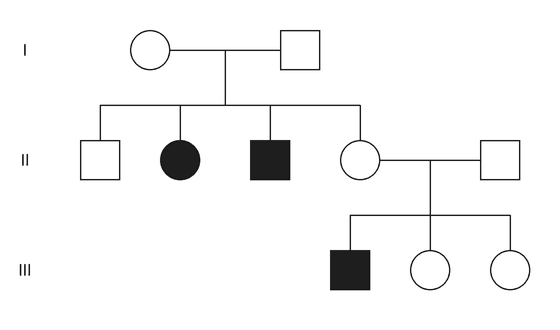
(i) Is the trait recessive or dominant?
(ii) Is the trait sex-linked or autosomal?
(iii) Give the genotypes of the parents of generation I and their third and fourth child in generation II.
- 715 marks
Question 71
(i) A true breeding pea plant, homozygous for inflated green pods is crossed with another pea plant with constricted yellow pods (ffgg). What would be the phenotype and genotype of and generations? Give the phenotypic ratio of generation.
(ii) State the generalisation proposed by Mendel on the basis of the above mentioned cross.
- 725 marks
Question 72
A true breeding pea plant homozygous for axial violet flowers is crossed with another pea plant with terminal white flowers (aavv).
(i) What would be the phenotype and genotype of and generations?
(ii) Give the phenotypic ratio of generation.
(iii) List Mendel's generalisations that can be derived from the above cross.
- 735 marks
Question 73
A homozygous tall pea plant with green seeds is crossed with a dwarf pea plant with yellow seeds.
(i) What would be the phenotype and genotype of ?
(ii) Work out the phenotypic ratio of generation with the help of Punnett square.
- 745 marks
Question 74
A tall pea plant with yellow seeds (heterozygous for both the traits) is crossed with a dwarf pea plant with green seeds. Using a Punnett square work out the cross to show the phenotypes and genotypes of generation.
- 755 marks
Question 75
A Snapdragon plant homozygous for red flower when crossed with white flowered plant of the same species produced pink flowers in generation.
(i) What is this phenotype expression called?
(ii) Work out the cross to show the generation when was self pollinated. Give the phenotypic and genotypic ratios of generation.
(iii) How do you compare phenotypic and genotypic ratios with those of Mendelian monohybrid ratio?
- 765 marks
Question 76
Inheritance pattern of flower colour in garden pea plant and snapdragon differs. Why is this difference observed? Explain it by showing the crosses in and generation. Give phenotypes and genotypes of offsprings formed.
- 775 marks
Question 77
You are given a red flower bearing pea plant and a red flower bearing snapdragon plant. How would you find the genotypes of these two plants with respect to the colour of the flower? Explain with the help of crosses. Comment upon the pattern of inheritance seen in these two plants.
- 785 marks
Question 78
A plant of Antirrhinum majus with red flowers was crossed with another plant of the same species having white flowers. The plants of generation bore pink flowers. Explain the pattern of inheritance with the help of a cross.
- 795 marks
Question 79
A woman with blood group O married a man with AB blood group. Show the possible blood groups of the progeny. List the alleles involved in this inheritance. What is this type of inheritance called?
- 805 marks
Question 80
Explain the terms: (i) Monohybrid cross (ii) Gene (iii) Phenotype.
Name the two sex-linked diseases in males. How are they inherited?
- 815 marks
Question 81
A pure tall plant (TT) is crossed with a pure dwarf plant (tt). Draw Punnett squares to show generation and generation. Give the phenotype of generation. Give the phenotypic and genotypic ratio of the and generation.
- 825 marks
Question 82
A homozygous plant having round (R) and yellow (Y) seed is crossed with a homozygous plant having wrinkled (r) and green (y) seeds.
(i) Draw a Punnett square to show generation.
(ii) Give the genotype of generation
(iii) Give the dihybrid phenotypic ratio and the phenotype of the offspring of the generation when two plants of the generation are crossed.
(iv) Name and state the law which explains the dihybrid ratio.
(v) Mention the phenotype and genotype ratios of the offsprings in generation.
What Class 12 Biology Ch 5 covers
The sections of the chapter, in the order the book takes them. Every question above comes from one of these.
- 01Important Terms Related to Genetics
- 02Mendel - The Founder of Genetics
- 03Mendel's Laws of Inheritance
- 04Monohybrid Cross - Inheritance of One Gene
- 05Dihybrid Cross - Inheritance of Two Genes
- 06Other Patterns of Inheritance and Genetic Expression
More ways to study this chapter
The same chapter asked three other ways. Practise it, revise it, and see what the board has set on Ch 5 before.
- Competency-Based Questions (CBQ)Case study questions: a situation, and the part of the chapter that answers it.40questionsOpen
- Previous Year QuestionsQuestions that have actually appeared in board papers, each tagged with its year.12questionsOpen
- Practice QuestionsExtra questions per chapter, for when one attempt at a method is not enough.136questionsOpen
Ch 5 in past ISC papers
The same chapter as the board has actually asked it. These are worded differently from the textbook exercise, which is the point of reading them.
- 11 mark
Board paper question 1
Give a brief answer for each of the following:
Define test cross.
Solve with AIWritten solution
Solution:
Key idea: A plant showing the dominant trait may be homozygous (TT) or heterozygous (Tt); the two look the same. Crossing it with the homozygous recessive reveals which it is, because the recessive parent gives only recessive alleles.
Step 1 — State what a test cross is.
A test cross is a cross between an organism showing the dominant phenotype (whose genotype is unknown) and an organism that is homozygous recessive for that character, for example a tall pea plant (TT or Tt) crossed with a dwarf plant (tt).
Step 2 — State what it shows.
If all the offspring show the dominant trait, the unknown parent is homozygous (TT). If half show the dominant and half the recessive trait (a 1 : 1 ratio), it is heterozygous (Tt).
Therefore, a test cross is the cross of an individual with the dominant phenotype with a homozygous recessive individual, to find out whether it is homozygous or heterozygous.
- 24 marks
Board paper question 2
Give any four reasons for Mendel's success.
Solve with AIWritten solution
Solution:
Key idea: Mendel succeeded where earlier workers failed because he chose a suitable plant, studied a few clear characters at a time, and counted his results and analysed them with statistics.
Step 1 — Give the first reason: the choice of the garden pea.
The garden pea (Pisum sativum) was ideal. It has many clearly contrasting characters (tall or dwarf, round or wrinkled seeds), pure-breeding varieties were available, it is normally self-pollinating but can be cross-pollinated by hand, it has a short life cycle, and each plant gives many seeds.
Step 2 — Give the second reason: one character at a time.
Mendel studied one character (or two) at a time and followed it over several generations (, and later), instead of looking at the whole plant at once. This made the pattern of inheritance easy to see.
Step 3 — Give the third reason: careful control and records.
He used pure-breeding parents, controlled the pollination by emasculating and bagging the flowers, and kept accurate records of every cross and every generation.
Step 4 — Give the fourth reason: large numbers and statistics.
He raised large numbers of plants and counted each kind of offspring, then used mathematics and statistics to find the ratios (3 : 1, 9 : 3 : 3 : 1). Large samples made chance errors small.
Note: He was also fortunate in the pairs he followed together. Some of his seven genes do lie on the same chromosome, but they are either far apart or were not followed together in his reported crosses, so linkage did not upset his ratios and each pair he tested assorted independently.
Therefore, Mendel's success came from choosing the garden pea, studying one character at a time, controlling pollination and keeping accurate records, and analysing large numbers statistically.
- 31 mark
Board paper question 3
Give scientific terms for each of the following:
Multiple effects of a gene on the phenotype of an organism.
Solve with AIWritten solution
Solution:
Key idea: Usually one gene affects one character, but sometimes a single gene affects several characters at once.
Step 1 — Identify what is described.
The stem describes one gene that produces many effects on the phenotype.
Step 2 — Name the term.
This is called pleiotropy, and such a gene is a pleiotropic gene. In phenylketonuria, for example, one mutant gene causes intellectual disability and reduced hair and skin pigmentation.
Therefore, the scientific term is pleiotropy.
- 41 mark
Board paper question 4
Give a scientific term for each of the following:
An alternative form of the single gene which influences the same character and produces different expressions in different individuals of a species.
Solve with AIWritten solution
Solution:
Key idea: A gene can exist in slightly different forms. These forms sit at the same place (locus) on homologous chromosomes and control the same character in different ways.
Step 1 — Identify what is described.
The stem describes an alternative form of a single gene that controls the same character but gives different expressions, such as the tall (T) and dwarf (t) forms of the gene for height in pea.
Step 2 — Name the term.
Such alternative forms of a gene are called alleles (allelomorphs).
Therefore, the scientific term is allele.
- 54 marks
Board paper question 5
Explain Pleiotropy with reference to phenylketonuria.
Solve with AIWritten solution
Solution:
Key idea: Pleiotropy is the effect of a single gene on two or more different characters. It happens because the gene's product, often an enzyme, is used in a pathway that affects many parts of the body.
Step 1 — Describe the gene and the disorder.
Phenylketonuria (PKU) is an inborn error of metabolism inherited as an autosomal recessive trait. A person with two mutant alleles cannot make the enzyme phenylalanine hydroxylase, which normally changes the amino acid phenylalanine into tyrosine.
Step 2 — Explain what goes wrong in the body.
Without the enzyme, phenylalanine builds up in the blood and tissues and some of it is changed into phenylpyruvic acid and related compounds, which are excreted in the urine. The high level of phenylalanine harms the developing brain. At the same time less tyrosine is made.
Step 3 — List the several effects of this one gene.
The single mutant gene therefore causes many different symptoms:
- intellectual disability, because the excess phenylalanine and its products damage the nervous system;
- reduced pigmentation of hair and skin (light hair and skin), because less tyrosine is available to make melanin;
- phenylpyruvic acid and related compounds in the urine, and one of these, phenylacetic acid, gives the urine and sweat a musty smell;
- in untreated children, often eczema and seizures.
Step 4 — Link it to pleiotropy.
Since one gene affects the brain, the pigment of the hair and skin, and the urine, PKU is a clear example of pleiotropy.
Note: Today newborn babies are screened for PKU, and a diet low in phenylalanine started early prevents most of the damage.
Therefore, in phenylketonuria a single recessive gene, by failing to make phenylalanine hydroxylase, causes several effects: intellectual disability, reduced hair and skin pigmentation and phenylpyruvic acid in the urine, which shows pleiotropy.
- 62 marks
Board paper question 6
A woman with blood group O married a man with blood group AB shows the possible blood groups of the progeny. List the alleles involved in this inheritance.
Solve with AIWritten solution
Solution:
Key idea: The ABO blood groups are controlled by one gene, , with three alleles: , and (multiple alleles). and are codominant with each other, and both are dominant over .
Step 1 — Write the genotypes of the parents.
Blood group O has only one possible genotype, so the woman is . Blood group AB has only one possible genotype, so the man is .
Step 2 — Write the gametes.
The woman forms only one kind of egg, carrying . The man forms two kinds of sperm in equal numbers, carrying or .
Step 3 — Make the Punnett square.
The cross is shown below.
Gametes of ♀ / ♂ (group A) (group B) Step 4 — Read the progeny.
Half the children are (blood group A) and half are (blood group B), so the ratio of groups A : B is 1 : 1. No child can have blood group O or AB.
Step 5 — List the alleles involved.
The alleles involved are , and .
Therefore, the possible blood groups of the progeny are A () and B () in the ratio 1 : 1, and the alleles involved are , and .
All 12 board paper questions for this chapter, solved the same way.
Class 12 Biology Ch 5 questions students ask
How many questions are there in Class 12 Biology Ch 5?
82 questions. Every one is solved step by step on this page.
Are these Class 12 Biology solutions free?
Yes. Every question and its full working is free to read, with no account needed.
Can I download the Class 12 Biology Ch 5 solutions as a PDF?
There is no PDF to download. Every solution is on this page instead, which means it is searchable, always the current syllabus, and readable on a phone. Use your browser's print option if you want it on paper.