Solution:
Key idea: In a pedigree chart, squares are males and circles are females, filled symbols are affected individuals, a horizontal line joining a male and a female is a mating, and their children hang from it in birth order from left to right. A trait that appears in a child of two unaffected parents is recessive.
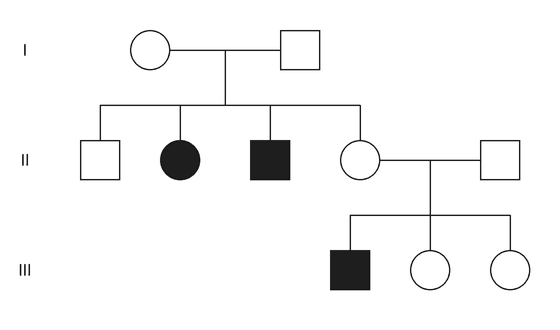
Step 1 — Read the chart. In generation I, an unaffected woman and an unaffected man have four children in generation II: an unaffected son, an affected daughter, an affected son and an unaffected daughter. The fourth child (the unaffected daughter) marries an unaffected man, and in generation III they have an affected son and two unaffected daughters.
Step 2 — Decide between dominant and recessive for part (i). Both parents in generation I are unaffected, yet two of their children are affected. A dominant trait would show in at least one parent of every affected child, so the trait must be recessive, with both parents carrying it unseen. The same happens again in generation II, where two unaffected parents have an affected son.
Step 3 — Decide between autosomal and sex-linked for part (ii). The affected daughter in generation II has an unaffected father. For an X-linked recessive trait, an affected daughter must receive a recessive X from each parent, so her father would have to be affected; he is not, so the trait is not X-linked recessive. It cannot be Y-linked either, because a female is affected. The trait is therefore autosomal recessive, which also fits with both sexes being affected.
Step 4 — Give the genotypes for part (iii). Let A be the normal allele and a the allele for the trait. The generation I parents are unaffected but have aa children, so each of them is Aa (a carrier). The third child of generation II is an affected son, so he is aa. The fourth child is an unaffected daughter whose son is affected (aa); her son received an a from her, so she is Aa, a carrier, and her husband must also be Aa.
Step 5 — Check with the cross of the generation I parents. The cross Aa × Aa shows that unaffected parents can have affected children.
| Gametes | A | a |
|---|
| A | AA (unaffected) | Aa (unaffected carrier) |
| a | Aa (unaffected carrier) | aa (affected) |
Each child has a 1/4 chance of being affected, so two affected children among four is possible.
Therefore, (i) the trait is recessive, (ii) it is autosomal, and (iii) both parents of generation I are Aa, the third child of generation II is aa and the fourth child is Aa.