
Opening your dashboard
Class 12 Biology Chapter 5 Principles of Inheritance and Variation: Practice Questions
136 questions on Chapter 5, each worked through on its own page with the AI tutor. Class 12 Biology, ICSE 2026-27.
136 questions
1–5 marks · Mixed difficulty
- 11 mark
Question 1
In a pea plant, the gene for stem height sits at one fixed position on a chromosome, and either T or t can occupy that position. What is this fixed position called?
- 22 marks
Question 2
(Hypothetical example.) Two pea plants raised from seeds of the same tall plant are both tall like their parent, but one has slightly broader leaves than the other.
(a) Which term describes the passing of tallness from the parent to these plants? Define it.
(b) Which term describes the difference in leaf breadth between the two plants? Define it.
- 32 marks
Question 3
In garden pea, the allele Y (yellow seed) is dominant over y (green seed). Three plants have the genotypes YY, Yy and yy.
(a) Which of these genotypes are homozygous and which is heterozygous?
(b) Which plants will give true-breeding forms when self-pollinated? Give a reason.
- 43 marks
Question 4
Mendel spoke of 'factors', while biologists today speak of genes and alleles.
(a) Why did Mendel use the word 'factor'?
(b) What is a gene, and where are genes situated?
(c) How are T and t related to the gene for plant height?
- 51 mark
Question 5
Mendel chose the garden pea for several reasons. Which reason depends directly on the structure of its flower?
- 61 mark
Question 6
Mendel presented his work in 1865 and it was published in 1866, but it got attention only in 1900. Which of the following scientists was not one of the three who rediscovered his work?
- 73 marks
Question 7
Draw a labelled diagram of a garden pea flower (with some petals removed) to show how it self-pollinates. Label any four parts and state in one line why the flower is normally self-pollinated.
- 83 marks
Question 8
A pea plant has pods that are constricted and green, and its flowers are axial.
(a) For each of these three forms, state whether it is the dominant or the recessive form of its trait.
(b) For which of the three traits can you be sure that the plant is homozygous? Give a reason.
- 91 mark
Question 9
Four of Mendel's F results (dominant form : recessive form) are given below. For which trait was the ratio closest to 3 : 1?
- 101 mark
Question 10
Mendel dusted pollen from dwarf plants on tall plants, and also pollen from tall plants on dwarf plants. Both crosses gave only tall F plants. What do these reciprocal crosses show?
- 113 marks
Question 11
Give reasons: Mendel was able to propose general laws of inheritance. Explain how each of the following helped him.
(a) Studying only one trait at a time and keeping accurate records
(b) A large sampling size
(c) Statistical analysis of the results
- 124 marks
Question 12
The figure shows how Mendel explained the passing of a pair of factors for height from a pure tall plant and a pure dwarf plant to their offspring.

For each row marked P, Q, R and S, state the point of Mendel's explanation that it shows.
- 133 marks
Question 13
Three steps of Mendel's experiment with tall and dwarf pea plants are given below in jumbled order.
(P) The F plants are allowed to self-pollinate, and the plants of the next generation are counted.
(Q) Each variety is allowed to self-pollinate for several generations to check that it gives the same trait every time.
(R) Pollen from tall plants is transferred to the pistil of dwarf plants.
(a) Arrange P, Q and R in the order Mendel followed and name each step.
(b) Why did step Q have to come first?
- 141 mark
Question 14
A student writes T for the tall allele and d for the dwarf allele of pea. Why is this a poor choice of symbols?
- 151 mark
Question 15
An F tall pea plant (Tt) is crossed with its dwarf parent (tt). Why is this cross both a back cross and a test cross?
- 164 marks
Question 16
(Hypothetical data.) Two tall pea plants, X and Y, of unknown genotype are each crossed with a dwarf plant (tt).
X × dwarf → 96 plants, all tall
Y × dwarf → 50 tall and 46 dwarf plants
(a) Give the genotype of X and of Y, with a reason for each.
(b) Show, using gametes, why Y's cross gives dwarf plants while X's cross gives none.
(c) If Y were self-pollinated and gave 400 plants, how many of them would be expected to be dwarf?
- 172 marks
Question 17
Give reasons:
(a) A gamete is said to be 'pure' for a trait.
(b) The dwarf plants that reappear in the F generation are just as dwarf as the original dwarf parent, even though the dwarf factor stayed with the tall factor in every F plant.
- 183 marks
Question 18
Two F tall pea plants (Tt) are crossed. One tall plant is then picked at random from their offspring and self-pollinated.
(a) What genotypes can this tall plant have, and what fraction of the tall offspring has each genotype?
(b) What is the probability that its self-pollinated progeny will include dwarf plants? Explain.
- 191 mark
Question 19
Which of the following statements is not a part of Mendel's law of dominance?
- 201 mark
Question 20
Mendel's F from a cross of round yellow × wrinkled green peas contained 315 round yellow, 101 wrinkled yellow, 108 round green and 32 wrinkled green seeds. How many of these seeds were yellow?
- 211 mark
Question 21
An F pea plant RrYy is self-pollinated. What fraction of the F plants will be homozygous for both genes (and so breed true for both traits)?
- 221 mark
Question 22
In the F of a dihybrid cross (RrYy selfed), a plant with round yellow seeds is chosen. What is the probability that it is RrYy?
- 233 marks
Question 23
An F pea plant RrYy forms the gametes RY, Ry, rY and ry, but never a gamete such as Rr or YY.
(a) Explain why a gamete cannot carry both R and r.
(b) Explain why the four kinds of gametes are formed in equal numbers.
(c) How many combinations of gametes are possible when two such plants are crossed?
- 244 marks
Question 24
(Hypothetical data.) A pea plant with round yellow seeds, of unknown genotype, is crossed with a plant having wrinkled green seeds (rryy). The progeny are 52 round yellow and 49 round green; there are no wrinkled seeds.
(a) What is the plant's genotype for seed shape? Give a reason.
(b) What is its genotype for seed colour? Give a reason.
(c) Which gametes does the plant form, and in what proportion?
(d) What phenotypic ratio is expected if this plant is self-pollinated?
- 252 marks
Question 25
A pure round yellow pea plant (RRYY) is crossed with a pure wrinkled green plant (rryy), and the F is self-pollinated.
(a) Name the F phenotypes that are new combinations (recombinants), and give the fraction of the F they make up together.
(b) Why do these phenotypes appear although neither parent showed them?
- 261 mark
Question 26
In the four o'clock plant (Mirabilis jalapa), flower colour shows incomplete dominance. A pink-flowered plant is crossed with a white-flowered plant. What is the expected phenotypic ratio of the offspring?
- 271 mark
Question 27
Tests show that the red blood cells of a person carry both antigen A and antigen B. Which statement explains this?
- 283 marks
Question 28
In a hospital, two babies got mixed up (hypothetical case). Baby X has blood group O and baby Y has blood group AB. Couple 1: mother group A, father group B. Couple 2: mother group O, father group O.
Using genotypes, decide which baby belongs to which couple. Show your reasoning.
- 292 marks
Question 29
The ABO blood group gene has three alleles, , and i.
(a) Why can a person carry at most two of these alleles?
(b) How many different genotypes can the three alleles form? Why do these give only four blood groups?
- 303 marks
Question 30
A gardener crosses a pink-flowered snapdragon with a red-flowered snapdragon and raises 120 seedlings (hypothetical data).
(a) How many red, pink and white plants are expected?
(b) Why does no white-flowered plant appear?
(c) If the pink offspring are self-pollinated, what fraction of their progeny will be pink?
- 311 mark
Question 31
In sweet pea, the colour pigment anthocyanin is made in steps: precursor P A B C, where enzymes , and are controlled by genes , and . A plant has a mutant that makes no , while and are normal. Which statement is correct?
- 321 mark
Question 32
In sweet pea, purple flowers need both dominant alleles P and C (complementary genes). An F purple plant PpCc is crossed with a white ppcc plant. What phenotypic ratio is expected in the offspring?
- 333 marks
Question 33
Two different pure-breeding white-flowered varieties of sweet pea are crossed. Surprisingly, all the F plants have purple flowers.
(a) Give the likely genotypes of the two white parents.
(b) Explain why the F plants are purple.
(c) What phenotypic ratio is expected when the F plants are self-fertilised?
- 343 marks
Question 34
In mice, coat colour is controlled by supplementary genes: A_B_ is agouti, aaB_ is black and every bb mouse is albino. An agouti mouse AaBb is mated with a black mouse aaBb. Work out the expected phenotypic ratio of the offspring with a Punnett square.
- 352 marks
Question 35
A student writes: "In snapdragon, allele R is epistatic to allele r, because Rr flowers are not white." Is the student right? Give two reasons.
- 362 marks
Question 36
In the F of an agouti AaBb × AaBb cross in mice, the ratio is 9 agouti : 3 black : 4 albino.
(a) Why do albino mice make up 4/16 of the F?
(b) What fraction of these albino mice carry at least one allele A?
- 371 mark
Question 37
Assume skin colour is controlled by two genes, A and B, each dominant allele adding a fixed amount of melanin. Two AaBb parents have a child. What is the probability that the child has exactly two dominant alleles (intermediate colour)?
- 381 mark
Question 38
Which of the following traits would you not expect to show continuous variation?
- 393 marks
Question 39
Assume skin colour is controlled by three genes, A, B and C, each dominant allele adding the same amount of melanin. A person AaBbCc marries a very light-skinned person aabbcc.
(a) How many skin-colour classes can their children show?
(b) In what ratio are these classes expected?
(c) Can any child be as dark as an AABBCC person? Give a reason.
- 402 marks
Question 40
When two extreme parents are crossed and the F is selfed, the F may be controlled by 1, 2 or 3 gene pairs with cumulative effect.
(a) For each case, what fraction of the F looks like the lightest parent?
(b) For each case, how many phenotypic classes appear in the F?
- 414 marks
Question 41
A wheat variety with the darkest red grain was crossed with a white-grained variety. The F was selfed and 160 F plants were sorted by grain colour (hypothetical data).
Colour class 1 (darkest) 2 3 4 5 (white) Number of plants 9 42 61 38 10 (a) Which simple ratio do these numbers fit?
(b) How many gene pairs control grain colour here?
(c) Write the genotypes of class 3, using A, B for the dominant alleles.
(d) Why is such a trait analysed by statistical methods rather than by simple counting of two types?
- 421 mark
Question 42
In mice, yellow coat (Y) is dominant to agouti (y), and YY embryos die before birth. A yellow mouse is mated with an agouti mouse. What ratio is expected among the pups born?
- 431 mark
Question 43
A child with phenylketonuria (PKU) has unusually light hair and skin. Which statement explains this?
- 443 marks
Question 44
Draw labelled diagrams of the red blood cells, as seen under a microscope, of persons with genotypes
(a) HbHb
(b) HbHb
(c) HbHb
Under each diagram, write one effect of the genotype on the person.
- 453 marks
Question 45
A breeder mates only yellow mice with each other. Over several litters, 12 pups are born alive (hypothetical data).
(a) How many of these pups are expected to be yellow and how many agouti?
(b) What is the genotype of every surviving yellow pup?
(c) The breeder notices that yellow × yellow litters are smaller than agouti × agouti litters. Explain why.
- 462 marks
Question 46
A pea breeder keeps only those pure-breeding lines whose seeds store a good amount of starch. When the seeds mature, every one of them is round. Explain this observation and give the genotype of these lines.
- 471 mark
Question 47
In a pedigree chart, an open square and an open circle are joined by two parallel horizontal lines, and a vertical line from them leads down to a solid square. What does this part of the chart show?
- 481 mark
Question 48
Study the pedigree of a rare disease.
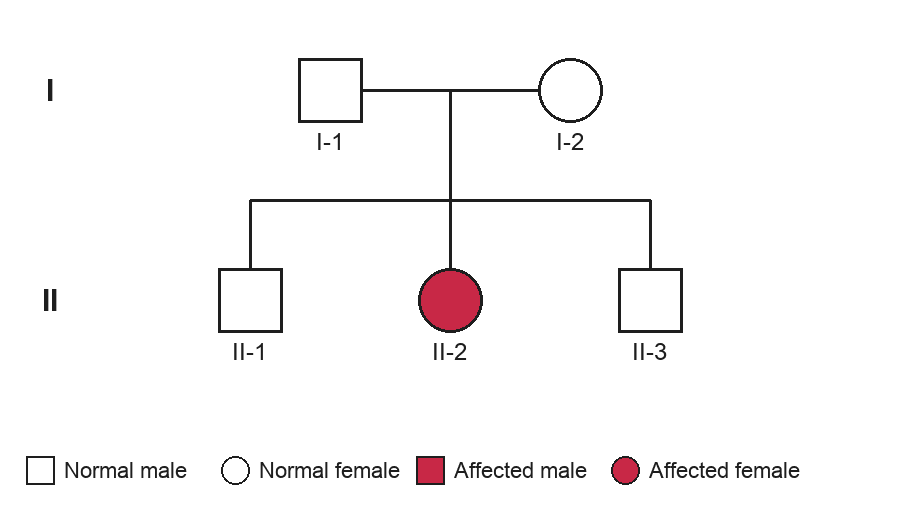
Which conclusion is correct?
- 494 marks
Question 49
Study the pedigree below. I-1 and I-2 are related to each other, and the disease gene is on an autosome.

(a) Is the disease dominant or recessive? Give a reason.
(b) Write the genotypes of I-1, I-2 and II-2, using A for the normal allele and a for the defective allele.
(c) What is the chance that the next child of I-1 and I-2 will be affected?
(d) II-3 is normal. What is the probability that she is a carrier?
- 502 marks
Question 50
Mendel worked out the rules of inheritance by planned crosses in pea. Why can a geneticist not study a human trait in the same way, and must use pedigree analysis instead? Give two reasons.
- 511 mark
Question 51
In a pea plant the gene T for tallness is dominant over the gene t for dwarfness. If two heterozygous individuals are crossed
- 521 mark
Question 52
When a hybrid of F is crossed with the homozygous recessive parent, it is called
- 531 mark
Question 53
When Aa hybrid is crossed back with the homozygous dominant parent, the phenotypic ratio of the progeny will be
- 541 mark
Question 54
Which of the following terms represent a pair of contrasting characters?
- 551 mark
Question 55
When two organisms are similar in their external form but differ in their genetic make-up, they are referred as
- 561 mark
Question 56
A character that appears in the homozygous condition only is called
- 571 mark
Question 57
A typical F 1 : 2 : 1 phenotypic ratio in a monohybrid cross is characteristic of
- 581 mark
Question 58
Blood groups in humans is an example of
- 591 mark
Question 59
Complementary genes give a characteristic ratio of
- 601 mark
Question 60
A gene that has many phenotypic effects is called
- 611 mark
Question 61
How many kinds of gametes are possible with the genotype AaBB?
- 621 mark
Question 62
What is the probability of getting the gamete ab from the genotype Aabb?
- 631 mark
Question 63
If all the offspring have the genotype Aa, most probably the parental genotypes could be
- 641 mark
Question 64
An individual with unknown genotype is crossed with homozygous recessive for the trait, all the offsprings produced showed the dominant phenotype. The unknown genotype would be
- 651 mark
Question 65
A gamete contains
- 661 mark
Question 66
If tall (T) is dominant over dwarf (t) and round seeds (R) is dominant over wrinkled seeds (r), the genotype of a true breeding tall plant with wrinkled seeds would be
- 671 mark
Question 67
In the example given above (tall, T, is dominant over dwarf, t, and round seeds, R, are dominant over wrinkled seeds, r), if the genotype is ttRr the phenotype would be
- 681 mark
Question 68
A typical phenotypic monohybrid ratio of F in Mendel's experiment is
- 691 mark
Question 69
If a pure tall plant is crossed with a dwarf plant, the offspring will be
- 701 mark
Question 70
A plant with yellow pods and wrinkled seeds with genotype Yy rr will give rise to following types of gametes
- 711 mark
Question 71
Which one of the following represents a quantitative ratio?
- 721 mark
Question 72
If the offsprings have the blood groups O and A the genotype of parents would be
- 731 mark
Question 73
In the dihybrid ratio, the homozygous dominant individuals represent
- 741 mark
Question 74
How many types of gametes are found in F progeny of cross AA BB CC and aa bb cc?
- 751 mark
Question 75
A person with blood group A possesses
- 761 mark
Question 76
9 : 3 : 3 : 1 ratio is due to
- 771 mark
Question 77
Test cross is crossing between
- 781 mark
Question 78
A test cross is
- 791 mark
Question 79
Grain colour of wheat is determined by three pairs of polygenes. In cross AABBCC × aabbcc, progeny resembling either parent in F generation is
- 801 mark
Question 80
In a plant, red fruit (R) is dominant over yellow fruit (r) and tallness (T) is dominant over dwarfness (t). If a plant with RRTt genotype is crossed with a plant that is rrtt
- 811 mark
Question 81
In pea plants, yellow seeds are dominant to green. If heterozygous yellow seeded plant is crossed with a green seeded plant, what ratio of yellow and green seeded plants, would you expect in F generation?
- 821 mark
Question 82
When a tall plant with round seeds (TTRR) crossed with a dwarf plant with wrinkle seeds (ttrr). What would be the proportion of dwarf plant with wrinkled seeds in F generation?
- 831 mark
Question 83
Genotype of hybrid is determined by
- 841 mark
Question 84
What would be blood groups of the progeny of heterozygous father with blood group A and mother homozygous for B?
- 851 mark
Question 85
In F generation of quantitative inheritance, a ratio of 1 : 4 : 6 : 4 : 1 is obtained instead of
- 861 mark
Question 86
In a monohybrid cross involving incomplete dominance the phenotypic ratio equals the genotypic ratio in F generation. The ratio is
- 871 mark
Question 87
A cross where the inheritance of pair of character studied is called ______.
- 881 mark
Question 88
The genetic expression of a gene is called ______.
- 891 mark
Question 89
The physical expression of a gene is called ______.
- 901 mark
Question 90
Scientific name of the plant chosen by Mendel for his experiments is ______.
- 911 mark
Question 91
The phenotypic ratio of F generation in monohybrid cross is ______.
- 921 mark
Question 92
______ is made to determine the unknown genotype within one breeding experiment.
- 931 mark
Question 93
ABO blood group is an example of co-dominance as well as ______.
- 941 mark
Question 94
______ are different forms of genes.
- 951 mark
Question 95
______ gene has many effects on the phenotype.
- 961 mark
Question 96
Each gamete has only one allele of a gene.
- 971 mark
Question 97
A typical Mendelian dihybrid ratio of F generation is 3:1.
- 981 mark
Question 98
A recessive factor is altered by the presence of a dominant factor.
- 991 mark
Question 99
Blood groups in humans is an example of codominance.
- 1001 mark
Question 100
Hybrid is an offspring from a cross between genetically different parents.
- 1011 mark
Question 101
Phenylketonuria exhibits itself in the homozygous recessive condition.
- 1021 mark
Question 102
Incomplete dominance is shown in the flower colour of Mirabilis jalapa.
- 1035 marks
Question 103
Match the following:
Column A Column B 1. Incomplete dominance (a) F offsprings are intermediate between both parental traits 2. Pleiotropy (b) ABO blood group system in humans 3. Co-dominance (c) Skin colour in humans 4. Dihybrid cross (d) Phenylketonuria 5. Polygenic inheritance (e) Law of independent assortment - 1041 mark
Question 104
A condition where an organism has different allelic forms of a gene.
- 1051 mark
Question 105
Physical expression of gene.
- 1061 mark
Question 106
Alternate or different forms of a gene.
- 1071 mark
Question 107
An allele that does not express when present along with a dominant allele.
- 1081 mark
Question 108
A cross between an unknown genotype and homozygous recessive of same trait.
- 1091 mark
Question 109
Assertion (A): In a monohybrid cross, at F stage, both parental traits are expressed in the proportion of 3:1.
Reason (R): At F stage, the contrasting parental traits show blending but at F stage there is no blending.
- 1101 mark
Question 110
Assertion (A): ABO blood grouping is a good example of multiple alleles.
Reason (R): When and alleles are present together in blood group, they both express their own types.
- 1111 mark
Question 111
Assertion (A): In Mirabilis jalapa, selfing of F1 pink flowers produces same phenotypic and genotypic ratio.
Reason (R): Flower colour gene shows incomplete dominance.
- 1121 mark
Question 112
Assertion (A): Phenylketonuria is a recessive hereditary disorder which leads to accumulation of phenyl pyruvic acid and other derivatives in the brain.
Reason (R): The affected individual lacks an enzyme that converts amino acid phenylalanine into tyrosine.
- 1132 marks
Question 113
Mention the steps involved in the following pea plant cross:
Removal of anthers — A
↓
Transfer of pollen — B
↓
Raising the next generation — C
- 1141 mark
Question 114
Which one from those given below is the period for Mendel's hybridisation experiments?
- 1151 mark
Question 115
The genotypes of a husband and wife are and . Among the blood types of their children, how many different genotypes and phenotypes are possible?
- 1161 mark
Question 116
Which of the following characteristics represent "Inheritance of blood groups" in humans?
(a) Dominance
(b) Co-dominance
(c) Multiple allele
(d) Incomplete dominance
(e) Polygenic inheritance
- 1171 mark
Question 117
In Antirrhinum (Snapdragon), a red flower was crossed with a white flower and in generation pink flowers were obtained. When pink flowers were selfed, the generation showed white, red and pink flowers. Choose the incorrect statement from the following:
- 1181 mark
Question 118
A gene locus has two alleles A, a. If the frequency of dominant allele A is 0.4, then what will be the frequency of homozygous dominant, heterozygous and homozygous recessive individuals in the population?
- 1191 mark
Question 119
A diploid organism is heterozygous for 4 loci, how many types of gametes can be produced?
- 1202 marks
Question 120
Explain the Law of Dominance using a monohybrid cross.
- 1212 marks
Question 121
Define and design a test cross.
- 1223 marks
Question 122
Using a Punnett Square, work out the distribution of phenotypic features in the first filial generation after a cross between a homozygous female and a heterozygous male for a single locus.
- 1233 marks
Question 123
When a cross is made between tall plant with yellow seeds (TtYy) and tall plant with green seed (Ttyy), what proportions of phenotype in the offspring could be expected to be?
(a) tall and green.
(b) dwarf and green.
- 1243 marks
Question 124
Two heterozygous parents are crossed. If the two loci are linked what would be the distribution of phenotypic features in generation for a dihybrid cross?
- 1253 marks
Question 125
What is pedigree analysis? Suggest how such an analysis can be useful.
- 1262 marks
Question 126
Explain the following terms with example:
(a) Co-dominance
(b) Incomplete dominance
- 1273 marks
Question 127
A pea plant with purple flowers was crossed with a plant with white flowers producing 40 plants with only purple flowers. On selfing, these plants produced 470 plants with purple flowers and 162 with white flowers. What genetic mechanisms account for these results?
- 1283 marks
Question 128
The plants obtained in the above question were selfed. (In that question, a pea plant with purple flowers was crossed with a plant with white flowers; the 40 plants were all purple, and on selfing they gave 470 purple-flowered and 162 white-flowered plants.) The white-flowered plants produced only white-flowered plants, some of the purple-flowered plants produced only purple-flowered while others produced both white and purple-flowered plants. Provide the genetic basis for this observation.
- 1293 marks
Question 129
In human beings blue eye colour is recessive to brown eye colour. A brown-eyed man has a blue-eyed mother.
(i) What is the genotype of the man and his mother?
(ii) What are the possible genotypes of his father?
(iii) If the man marries a blue-eyed woman, what are the possible genotypes of their offspring?
- 1303 marks
Question 130
In dogs black coat colour is dominant over white. What coloured dog will you choose to breed a given black dog in order to find its genotype? What is this type of cross known as?
- 1313 marks
Question 131
In question 5 what would be the phenotypic ratio, if dogs heterozygous for both traits, are crossed with dogs homozygous recessive for both traits? (In question 5, the barking trait is dominant over the silent trait and erect ears are dominant over drooping ears in dogs.)
- 1322 marks
Question 132
A black-coloured cock when bred with a white-coloured hen produced steel-blue coloured offspring called Andalusian (chicken). When the steel-blue coloured offspring were inbred, black, white and steel-blue coloured progeny were obtained.
(a) This result is genetically explained as ________.
(b) What will be the expected ratio of the black, steel-blue and white progeny?
- 1331 mark
Question 133
Define polygenic inheritance.
- 1341 mark
Question 134
Study the given monohybrid cross:
: TT × tt
: Tt
A test cross for this will be:
- 1351 mark
Question 135
What is emasculation?
- 1362 marks
Question 136
A woman with blood group O married a man with blood group AB. Show the possible blood groups of the progeny. List the alleles involved in this inheritance.