
Opening your dashboard
Class 12 Biology Chapter 5 Principles of Inheritance and Variation: Competency-Based Questions (CBQ)
40 questions on Chapter 5, each worked through on its own page with the AI tutor. Class 12 Biology, ICSE 2026-27.
40 questions
1–5 marks · Mixed difficulty
- 13 marks
Question 1
A seed farm near Shimla starts a new line from one pea plant with green pods that is heterozygous (Gg); green pod (G) is dominant over yellow pod (g). In every generation each plant of the line is allowed to self-pollinate, as pea flowers normally do, and the same number of seeds is raised from every plant (hypothetical data).
(a) What fraction of the plants raised from the first selfing is heterozygous?
(b) After a second round of selfing, what fraction of the plants is heterozygous and what fraction is homozygous?
(c) Use your answers to explain why a line that has undergone continuous self-pollination becomes a pure-breeding (true-breeding) line.
- 21 mark
Question 2
Assertion (A): At a nursery in Bengaluru, rose plants raised from stem cuttings of one bush all have the same flower colour and form as that bush, while seedlings raised from the seeds of the same bush differ from one another in these traits.
Reason (R): Cuttings grow by mitotic divisions only, whereas the embryo in each seed develops from a zygote formed by the fusion of gametes produced after meiosis.
- 31 mark
Question 3
A school biology club in Dehradun wants to repeat Mendel's experiments on a plant other than the garden pea. Their notes on four candidate plants are given below (hypothetical data); the hybrids of all four are fertile. Which plant is the best choice, for the same reasons for which Mendel chose the pea?
- 41 mark
Question 4
Assertion (A): Mendel chose the garden pea partly because its hybrids are sterile, so that an F plant could not be crossed again by mistake.
Reason (R): When pea hybrids are mutually crossed, they give perfectly fertile progeny.
- 53 marks
Question 5
A school biology club in Pune tries to repeat one of Mendel's crosses (hypothetical case). The members buy a yellow-seeded and a green-seeded pea plant from a market. On some flowers of the yellow-seeded plant they dust pollen from the green-seeded plant, but they do not remove the stamens of these flowers first. The pods that form on the yellow-seeded plant contain a mixture of yellow and green seeds. Yellow seed colour (Y) is dominant over green (y).
(a) Explain why the green seeds show that the yellow-seeded plant they used was not pure-breeding.
(b) Why can the club not tell which seeds came from cross-pollination? What should they have done to prevent this?
(c) How did Mendel make sure, before crossing, that the plants he used were pure-breeding?
- 63 marks
Question 6
Mendel also made crosses involving three traits at a time. Suppose a pure-breeding pea plant with round, yellow seeds and tall stem (RRYYTT) is crossed with a pure-breeding plant with wrinkled, green seeds and dwarf stem (rryytt), and the F is self-pollinated (hypothetical cross).
(a) What fraction of the F is expected to be wrinkled, green and dwarf?
(b) What fraction of the F is expected to show all three dominant forms (round, yellow, tall)?
(c) Which law of Mendel lets you work out (a) and (b) by multiplying the separate monohybrid fractions? State the law.
- 71 mark
Question 7
Assertion (A): Mendel's law of dominance does not explain the flower colour of the F when a pure red snapdragon (Antirrhinum majus) is crossed with a pure white one.
Reason (R): In snapdragon neither the red nor the white allele is completely dominant, so the F (Rr) has pink flowers, intermediate between the two parents.
- 83 marks
Question 8
A student at a school in Bhopal self-pollinates a pea plant that is known to be heterozygous tall (Tt). Only four of its seeds germinate, and all four grow into tall plants (hypothetical data).
(a) What is the chance that any one seedling from this selfing is dwarf?
(b) What is the chance that all four seedlings are tall?
(c) The student concludes, "The dwarf factor has disappeared from this plant." Explain why her result does not show this, and what she should do to test the 3 : 1 ratio.
- 91 mark
Question 9
At a seed farm in Karnal, an F axial-flowered pea plant (Aa), obtained from pure axial (AA) × pure terminal (aa), is back crossed with its axial parent. 200 seeds from this back cross are raised (hypothetical data). About how many of these plants are expected to be homozygous for the gene?
- 104 marks
Question 10
At an agricultural research station in Karnal, a pure-breeding pea plant with axial flowers and yellow pods is crossed with a pure-breeding plant with terminal flowers and green pods. The F plants are self-pollinated and 800 F plants are scored (hypothetical data):
F class Number of plants Axial flowers, green pods 446 Axial flowers, yellow pods 152 Terminal flowers, green pods 148 Terminal flowers, yellow pods 54 (a) Give the genotype and phenotype of the F, using A/a for flower position and G/g for pod colour.
(b) From the table, work out the ratio of axial to terminal plants and of green-podded to yellow-podded plants. What does each ratio show?
(c) Which two classes are new combinations not seen in either parent? How many plants of these two classes together are expected out of 800 on a 9 : 3 : 3 : 1 ratio, and how many were observed?
- 111 mark
Question 11
A seed company wants a new variety that breeds true for violet flowers and inflated pods. It crosses a pure violet-flowered, constricted-pod plant (VVff) with a pure white-flowered, inflated-pod plant (vvFF), selfs the F and raises 1600 F plants (hypothetical data). About how many F plants are expected to be true-breeding violet and inflated?
- 123 marks
Question 12
At a blood bank in Lucknow, a couple who both have blood group AB ask which blood groups their children may have (hypothetical family).
(a) Work out the possible blood groups of their children and the expected ratio.
(b) Explain why none of their children can have blood group O.
(c) A student says, "The ratio is 1 : 2 : 1, just like pink snapdragons, so and show incomplete dominance." Correct the student.
- 131 mark
Question 13
A nursery in Ooty sells snapdragon (Antirrhinum majus) seeds and wants every seed in its packets to give pink-flowered plants. Which cross should it make each season to produce such seeds?
- 141 mark
Question 14
Assertion (A): When pink-flowered F snapdragons are interbred, red-flowered and white-flowered plants reappear in the F.
Reason (R): The F snapdragon plants have a flower colour intermediate between the two parents.
- 154 marks
Question 15
A plant breeder in Darjeeling crosses a pure purple-flowered sweet pea (Lathyrus odoratus, PPCC) with a pure white-flowered one (ppcc). The F plants are self-fertilised and 512 F plants are raised: 290 purple and 222 white (hypothetical data).
(a) Show that this result fits a 9 : 7 ratio, and explain why the four classes of a 9 : 3 : 3 : 1 ratio are not seen.
(b) How many different genotypes are expected among the white F plants? What fraction of the white plants is expected to be ppcc?
(c) One purple F plant, on selfing, gives only purple-flowered offspring. Give its genotype, and the fraction of purple F plants expected to behave like this.
- 161 mark
Question 16
In a research animal house in Hyderabad, a black mouse is mated with an albino mouse over several litters, and the young are about 1 agouti : 1 albino (hypothetical data). In these mice agouti needs both A and B (A_B_), aaB_ is black, and every bb mouse is albino. What are the genotypes of the two parents?
- 171 mark
Question 17
Assertion (A): A sweet pea (Lathyrus odoratus) plant with the genotype PPcc has white flowers.
Reason (R): When F sweet pea plants (PpCc) are self-fertilised, the F shows 9 purple : 7 white flowered plants.
- 183 marks
Question 18
Assume that human skin colour is controlled by two genes, A and B, and that each dominant allele adds a fixed amount of melanin. Two couples visit a genetics clinic in Chennai (hypothetical families). All four parents have the same intermediate skin colour, each having two dominant alleles.
Couple 1: AAbb × aaBB
Couple 2: AaBb × AAbb
(a) Show that all the children of couple 1 are expected to have the same skin colour as their parents.
(b) What fraction of couple 2's children is expected to be darker than their parents, and what fraction lighter?
(c) What do the two couples show about judging a person's genotype from skin colour?
- 191 mark
Question 19
Assertion (A): In humans, skin colour is fixed only by the number of dominant alleles a person carries; the environment has no effect on it.
Reason (R): Each dominant allele for skin colour is responsible for the synthesis of a fixed amount of melanin.
- 203 marks
Question 20
At a genetic counselling clinic in Nagpur, a husband and wife are both found to be sickle-cell carriers (HbHb); neither of them has any symptoms (hypothetical case).
(a) For each child they conceive, what is the probability of each genotype?
(b) Where sickle-cell anaemia is left untreated, most affected children do not live to adulthood. Taking it that none of them does, what fraction of this couple's children who survive into adulthood is expected to be carriers? Explain.
(c) Explain why, in regions badly affected by malaria, carriers have an advantage over persons with normal haemoglobin (HbHb).
- 211 mark
Question 21
At a hospital in Kochi, a newborn's urine is found to contain phenyl pyruvic acid, and the baby is diagnosed with phenylketonuria. Both parents are healthy. Which statement is correct?
- 221 mark
Question 22
Assertion (A): Persons heterozygous for the sickle-cell gene (HbHb) are highly resistant to malaria.
Reason (R): In heterozygous persons all the red blood cells are sickle-shaped.
- 234 marks
Question 23
A genetic counsellor in Kolkata draws the pedigree of a family with a rare disease (hypothetical family). Both parents in generation I are affected.
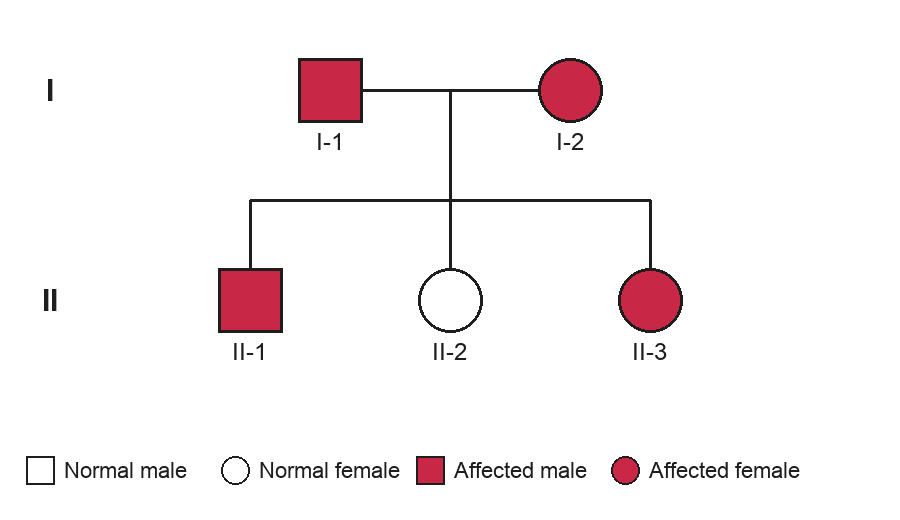
(a) Is the disease dominant or recessive? Give a reason from the chart.
(b) Using A for the allele that causes the disease and a for its normal allele, write the genotypes of I-1, I-2 and II-2.
(c) What is the chance that the next child of I-1 and I-2 will be normal? If II-2 marries a normal man, what is the chance that their child will have the disease?
- 241 mark
Question 24
A man has an autosomal dominant disease, but his mother is normal. He marries a normal woman. A counsellor in Jaipur works out the chance that their first two children will both be normal. What is it?
- 251 mark
Question 25
Assertion (A): A disease that skips a generation in a family pedigree is more likely to be recessive than dominant.
Reason (R): In a dominant disease, affected persons are usually born to two carrier parents who show no symptoms.
- 265 marks
Question 26
Read the source given and answer the questions that follow.
In human beings, the ABO blood group system is an example of multiple alleles. The inheritance of blood groups is based on three alleles namely , and i. Of these and are dominant and i is recessive. Allele is responsible for the presence of type A antigen while allele is responsible for type B antigen on the RBC. Allele i is recessive and does not produce any antigen. Out of these three alleles, only two alleles can be present at a time in any human being. Various combinations of allelic pairs result in four types of human blood groups namely A, B, AB and O. Person with blood group A can have genotype or i, blood group B can have genotypes or i and blood group AB has genotype . Blood group O has genotype ii. The pattern of inheritance follows Mendel's laws of inheritance. ABO blood group in humans is also an example of co-dominance. Co-dominance means both the alleles are equally dominant and hence both express themselves equally in the phenotype. This is the reason why a person that has both alleles and has the blood group AB as it has both the antigens A as well as B in its blood.
1. The blood group of a person is determined by the following number of alleles present in him or her
(a) two (b) three (c) four (d) many
2. A person with blood group O has
(a) two dominant alleles (b) two recessive alleles (c) one dominant and one recessive allele (d) two recessive antigens
3. Which of the following statements is true for co-dominance?
(a) When both alleles are present, both express and an intermediate type is formed (b) One allele is partially dominant over another and so shows a partial effect (c) Both alleles are equally dominant and express equally (d) Both (a) and (b)
4. Study the pedigree chart showing the pattern of inheritance of blood group in a family and answer the questions that follow.
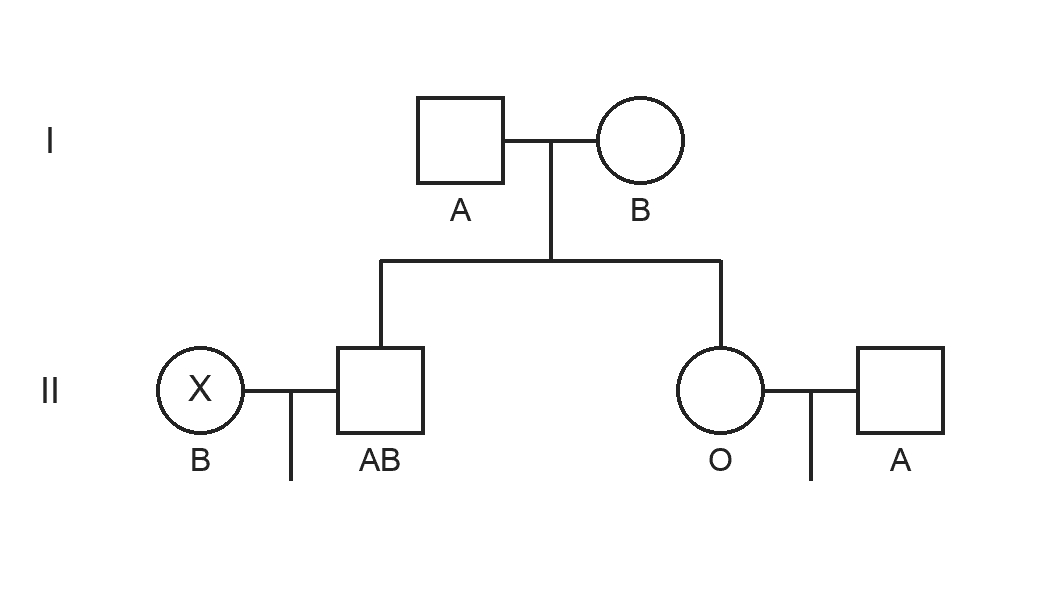
The genotypes of the parents in generation I are
(a) i and i (b) i and (c) i and (d) and i
5. From the pedigree chart given in part 4, the genotype of 'X' in generation II is
(a) I (b) (c) (d) i i
- 273 marks
Question 27
A child has blood group O. If the father has blood group A and mother blood group B, work out the genotypes of the parents and the possible genotypes of the other offspring.
- 283 marks
Question 28
In dogs, the barking trait is dominant over the silent trait and erect ears are dominant over drooping ears. What is the expected phenotypic ratio of the offspring in when dogs, heterozygous for both the traits, are crossed?
- 293 marks
Question 29
A homozygous pea plant with round seed coat and yellow cotyledons is crossed with another homozygous pea plant having wrinkled seed coat and green cotyledons.
(i) Give the type of gametes produced by plants of -generation.
(ii) Give the dihybrid phenotypic ratio with the corresponding phenotypes.
(iii) State the Mendel's principle involved in this cross.
- 301 mark
Question 30
At a potato research farm near Jalandhar, all the seed tubers come from one potato plant, so the plants raised from them are genetically identical. Half of the tubers are planted in a well-manured, irrigated plot and half in a poor, dry plot. In the next season, tubers harvested from both plots are planted side by side in one field and looked after in the same way. (Hypothetical data.)
Season Where the plants grew Average mass of a harvested tuber 1 Well-manured, irrigated plot 120 g 1 Poor, dry plot 60 g 2 One field, from tubers of the rich plot 96 g 2 One field, from tubers of the poor plot 95 g Which conclusion do these results best support?
- 311 mark
Question 31
In rice, one gene decides the kind of starch made, and the gene acts inside each pollen grain itself. Pollen grains carrying allele W make a starch called amylose and stain blue-black with iodine solution, while pollen grains carrying allele w make no amylose and stain red-brown. A student stains pollen from a rice plant of genotype Ww and counts 412 blue-black and 396 red-brown pollen grains. (Hypothetical data.)
Which statement best explains this result?
- 321 mark
Question 32
A plant breeder crosses two pure-breeding maize varieties, P with short ears and Q with long ears. The F plants are self-pollinated to raise an F. Plants of all four groups are grown together in the same field, and the ear length of every plant is measured. (Hypothetical data.)

The F and the F have the same average ear length, 13 cm, but the F is spread over a much wider range. Which statement best explains this difference?
- 331 mark
Question 33
Assertion (A): Pea seeds of genotype Bb are round, like seeds of genotype BB.
Reason (R): In pea, the same gene controls both the amount of starch stored in a seed and the shape of the seed.
- 341 mark
Question 34
Assertion (A): A rare autosomal recessive disease appears more often among the children of first cousins than among the children of unrelated parents.
Reason (R): First cousins share a pair of grandparents, so both cousins may have received the same rare recessive allele from one of those grandparents.
- 352 marks
Question 35
At a genetic counselling clinic in Raipur, tests show that a husband has blood group A with genotype and is a carrier of phenylketonuria (Pp). His wife has blood group B with genotype and is also a carrier of phenylketonuria (Pp). The ABO gene and the gene for phenylketonuria lie on different chromosomes. (Hypothetical family.)
(a) What is the probability that a child of this couple has blood group O and has phenylketonuria?
(b) What is the probability that a child of this couple has blood group AB and does not have phenylketonuria?
- 362 marks
Question 36
A genetic counsellor in Bhubaneswar draws the pedigree of a family with a rare disease caused by a gene on an autosome. II-3 has married into the family and is not related to I-1 or I-2. (Hypothetical family.)
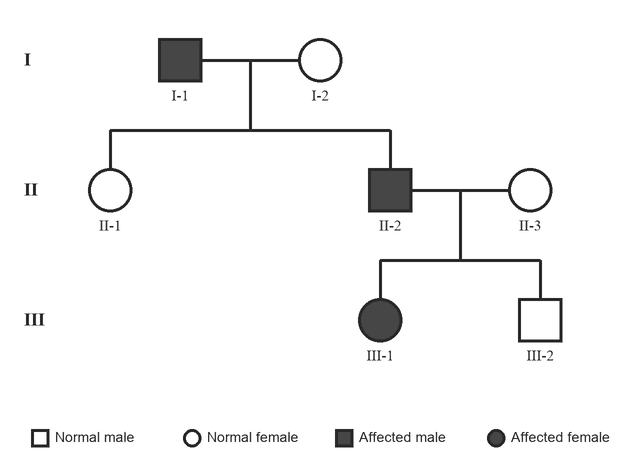
A trainee says, "This chart proves that the disease is dominant."
(a) Show that the chart can also be explained if the disease is recessive, and state what this would require.
(b) Which explanation is more likely for a rare disease? Give a reason from the chart.
- 373 marks
Question 37
A college garden in Nainital can raise only one crop of pea plants a year. A student wants to repeat two of Mendel's monohybrid crosses up to the F and count the 3 : 1 ratio in each:
- seed colour: pure yellow-seeded × pure green-seeded (yellow is dominant);
- flower colour: pure violet-flowered × pure white-flowered (violet is dominant).
Both crosses are made in year 1. In pea, seed colour is the colour of the cotyledons, which are part of the embryo inside the seed. (Hypothetical plan.)
(a) Make a year-by-year plan showing, for each cross, when the F phenotype and the F ratio can first be scored.
(b) Explain why the seed-colour cross gives its F ratio one year earlier than the flower-colour cross.
(c) Out of 400 F seeds of the seed-colour cross, about how many are expected to be green?
- 383 marks
Question 38
After crossing a tall pea plant (Tt) with a dwarf pea plant (tt), a student writes five statements in her notebook.
Statement 1: T and t are two different genes for plant height.
Statement 2: The tall parent is homozygous, because both of its alleles control height.
Statement 3: The phenotype of the tall parent is Tt.
Statement 4: T and t occupy the same locus on a pair of homologous chromosomes.
Statement 5: The dwarf parent is pure-breeding for height.
(a) Three of the statements use a genetic term wrongly. Identify them and correct each one.
(b) Give the expected genotypic and phenotypic ratios of the offspring of this cross.
- 394 marks
Question 39
Case: Onion bulbs can be red, yellow or white. In the model used here, a plant needs at least one dominant allele C to make any bulb pigment, so every cc plant has white bulbs. When pigment is made, a second gene decides its colour: R_ gives red and rr gives yellow. A breeder at a vegetable research station in Nashik crosses a pure-breeding red-bulbed variety with a pure-breeding white-bulbed variety. All the F plants have red bulbs. The F plants are self-pollinated, and the bulbs of 320 F plants are sorted. (Hypothetical data.)
F bulb colour Red Yellow White Number of plants 178 62 80 (a) Show that the F fits a 9 : 3 : 4 ratio, and explain why there are three classes instead of the four of a 9 : 3 : 3 : 1 ratio.
(b) Name the epistatic gene and the hypostatic gene, and give the genotypes possible for the yellow F plants.
(c) Use the yellow F plants to work out the genotype of the white parent, and predict the ratio of bulb colours when an F plant is crossed with the white parent.
- 405 marks
Question 40
Case: Under India's National Sickle Cell Anaemia Elimination Mission, launched in 2023, screening camps test people for the sickle-cell gene. At one camp, a laboratory test separates normal haemoglobin (Hb A, made by allele Hb) from sickle haemoglobin (Hb S, made by allele Hb), and each kind forms its own band on a test strip. The strip below shows the results for one family. All five members are healthy except Child 1, who has sickle-cell anaemia. (Hypothetical family.)
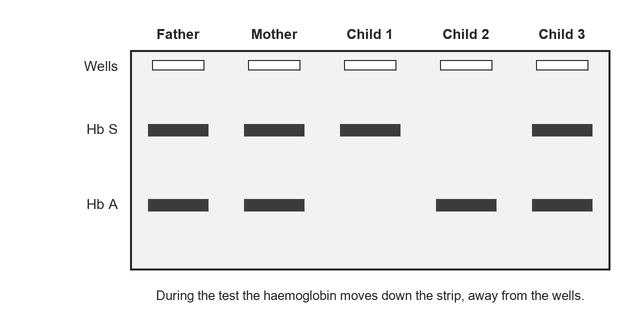
(a) Write the genotype of each of the five members.
(b) Child 3 is as healthy as Child 2, yet the camp reports Child 3 as a carrier. Explain this report, and explain why looking at Child 3's red blood cells under a microscope in ordinary conditions would usually not show it.
(c) Hb is usually called a recessive allele. Use the strip to explain what relationship Hb and Hb show at the level of the haemoglobin protein, and how both descriptions can be correct.