
Read the source given and answer the questions that follow.
In human beings, the ABO blood group system is an example of multiple alleles. The inheritance of blood groups is based on three alleles namely , and i. Of these and are dominant and i is recessive. Allele is responsible for the presence of type A antigen while allele is responsible for type B antigen on the RBC. Allele i is recessive and does not produce any antigen. Out of these three alleles, only two alleles can be present at a time in any human being. Various combinations of allelic pairs result in four types of human blood groups namely A, B, AB and O. Person with blood group A can have genotype or i, blood group B can have genotypes or i and blood group AB has genotype . Blood group O has genotype ii. The pattern of inheritance follows Mendel's laws of inheritance. ABO blood group in humans is also an example of co-dominance. Co-dominance means both the alleles are equally dominant and hence both express themselves equally in the phenotype. This is the reason why a person that has both alleles and has the blood group AB as it has both the antigens A as well as B in its blood.
1. The blood group of a person is determined by the following number of alleles present in him or her
(a) two (b) three (c) four (d) many
2. A person with blood group O has
(a) two dominant alleles (b) two recessive alleles (c) one dominant and one recessive allele (d) two recessive antigens
3. Which of the following statements is true for co-dominance?
(a) When both alleles are present, both express and an intermediate type is formed (b) One allele is partially dominant over another and so shows a partial effect (c) Both alleles are equally dominant and express equally (d) Both (a) and (b)
4. Study the pedigree chart showing the pattern of inheritance of blood group in a family and answer the questions that follow.
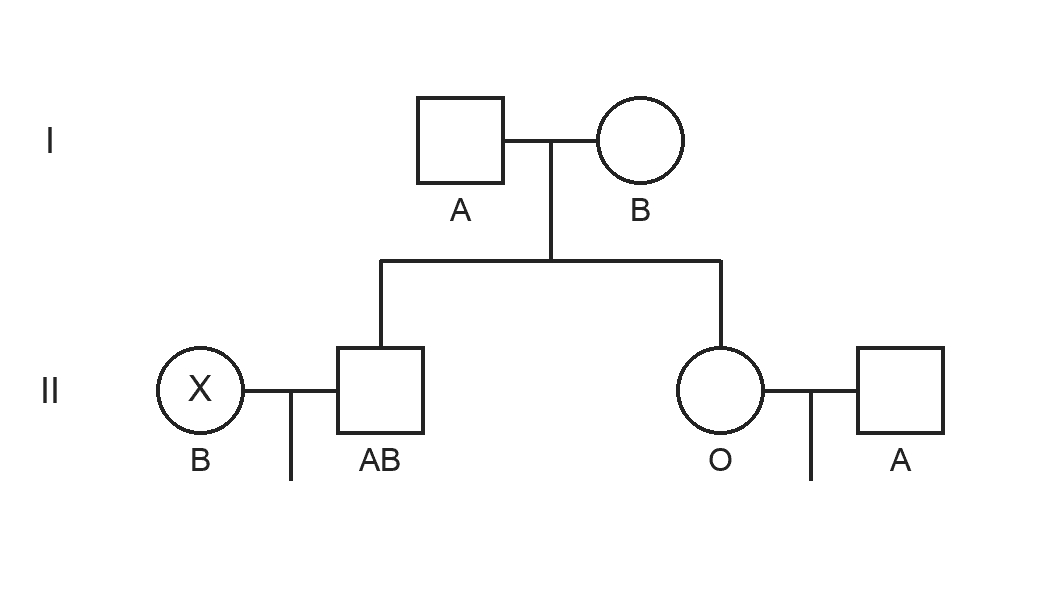
The genotypes of the parents in generation I are
(a) i and i (b) i and (c) i and (d) and i
5. From the pedigree chart given in part 4, the genotype of 'X' in generation II is
(a) I (b) (c) (d) i i