
Opening your dashboard
Class 12 Biology Chapter 1: Reproduction in Organisms Solutions
58 textbook questions with step-by-step answers, free to read, for ISC 2026-27.
Get talked through Ch 1, not just shown the answer
Reading a finished solution is not the same as being able to do it. The AI tutor takes one question at a time and works it with you, in your own words, until you can.
- Ask it out loud, in your own words
- It gives you the next step, not the answer
- Stuck on part (ii)? Start there
58 questions with solutions
1–5 marks · Mixed difficulty
- 11 mark
Question 1
Define the term life span.
Solve with AIWritten solution
Solution:
Key idea: Every organism lives only for a limited period. This period, which differs greatly from one kind of organism to another, is called its life span.
Step 1 — State the definition.
We measure the life of an organism from the time it is born until it dies a natural death. Life span is the period from the birth of an organism to its natural death.
Step 2 — See how widely life spans vary.
Life spans range from a few months to thousands of years. A rice plant lives about 3–4 months, a dog about 10–13 years, and some bristlecone pine trees are more than 4,000 years old.
Step 3 — Note that life span is not set by size.
Size does not decide how long an organism lives. A horse lives about 25–30 years, while many large parrots, such as macaws, which are far smaller, can live 50 years or more.
Therefore, life span is the period from the birth of an organism to its natural death.
- 21 mark
Question 2
What is senescence?
Solve with AIWritten solution
Solution:
Key idea: The life span of an organism passes through a juvenile phase, a reproductive (mature) phase and then ageing, a gradual decline of the body that ends in death.
Step 1 — Place senescence in the life span.
Senescence comes after the reproductive phase, as the last part of ageing, just before death.
Step 2 — Describe what happens during senescence.
During senescence the metabolism slows down, and cells, tissues and organs steadily lose their ability to work and to repair themselves. In many annual plants, for example, the leaves turn yellow and dry after the seeds are formed. These changes cannot be reversed and finally lead to death.
Therefore, senescence is the terminal, irreversible stage of ageing, which finally leads to death.
- 31 mark
Question 3
Name two plants that show vegetative propagation by (i) roots and (ii) stems.
Solve with AIWritten solution
Solution:
Key idea: In vegetative propagation a new plant grows from a root, stem or leaf of the parent. A part can do this only if it carries buds. Roots used this way are usually swollen with food and give rise to new shoots, while stems carry buds at their nodes.
Step 1 — Name plants propagated by roots (part i).
The swollen, tuberous roots of the sweet potato sprout new shoots, and a planted sweet potato grows into new plants. The tuberous roots of Dahlia are also planted to raise new plants.
Step 2 — Name plants propagated by stems (part ii).
The potato tuber is an underground stem: its "eyes" are buds at the nodes, and each grows into a new plant. The ginger rhizome is an underground stem whose buds at the nodes grow into new shoots.
Watch out: Carrot and radish store food in their roots, but they are raised from seed, so they are not examples of propagation by roots.
Therefore, (i) sweet potato and Dahlia propagate by roots, and (ii) potato and ginger propagate by stems.
- 41 mark
Question 4
Name a plant that propagates by leaves.
Solve with AIWritten solution
Solution:
Key idea: A leaf can give rise to a new plant only if buds form on it. Such buds, which arise in an unusual place, are called adventitious buds.
Step 1 — Find a plant whose leaves carry buds.
The leaves of Bryophyllum have notches along their margins. An adventitious bud in each notch grows into a small plantlet, which falls off and takes root in the soil.
Step 2 — Name the plant.
So Bryophyllum is a plant that propagates by its leaves.
Therefore, Bryophyllum is a plant that propagates by leaves.
- 51 mark
Question 5
Which kind of vegetative propagation takes place in lemon or a guava plant?
Solve with AIWritten solution
Solution:
Key idea: In layering, roots are made to form on a branch while it is still attached to the parent plant, and the rooted branch is then cut off and planted. Air layering (gootee) is used for woody plants whose branches cannot be bent down into the soil.
Step 1 — See why a special method is needed.
Lemon and guava have stiff, woody branches that grow well above the ground, so they cannot be bent down and buried in the soil as in ordinary layering.
Step 2 — Describe air layering.
A ring of bark, about 2–3 cm wide, is removed from a healthy branch, and a rooting hormone (an auxin) may be applied to the cut. The ring is covered with moist soil or moss and wrapped in polythene. When roots have formed, after a few weeks to a few months, the branch is cut below the roots and planted.
Step 3 — Name the method.
So lemon and guava are propagated by air layering.
Therefore, lemon and guava are propagated by air layering (gootee).
- 61 mark
Question 6
How does water hyacinth propagate vegetatively?
Solve with AIWritten solution
Solution:
Key idea: An offset is a short runner, only one internode long, formed by rosette-type plants such as the water hyacinth. It is a stem, so it can produce new leaves and roots.
Step 1 — Describe the offset.
An offset grows out sideways from the base of the water hyacinth plant, in the axil of a leaf. At its tip it forms a tuft of leaves above and roots below.
Step 2 — Explain how a new plant forms.
When the offset breaks, the new rosette floats away and lives on its own as a separate plant. In this way one plant quickly gives rise to many.
Step 3 — Note the result.
Because of this fast vegetative spread, water hyacinth covers ponds and lakes rapidly, which is why it is called the "terror of Bengal".
Therefore, water hyacinth propagates vegetatively by offsets, which develop a tuft of leaves above and roots below and then separate as new plants.
- 71 mark
Question 7
What is syngamy?
Solve with AIWritten solution
Solution:
Key idea: Sexual reproduction joins a male gamete and a female gamete. The joining of the two gametes is the central event of sexual reproduction.
Step 1 — Define syngamy.
Syngamy is the fusion of a male gamete and a female gamete. It is also called fertilisation.
Step 2 — State what it forms.
Each haploid () gamete brings one set of chromosomes, so syngamy forms a diploid () zygote. It may take place outside the body (external, as in frogs) or inside the body (internal, as in birds and mammals).
Therefore, syngamy is the fusion of male and female gametes to form a zygote; it is also called fertilisation.
- 81 mark
Question 8
What is external fertilisation? Give two examples where it occurs.
Solve with AIWritten solution
Solution:
Key idea: Fertilisation, the fusion of male and female gametes, can take place outside the body of the female (external) or inside it (internal).
Step 1 — Define external fertilisation.
External fertilisation is the fusion of gametes outside the body of the organism. It usually takes place in water, into which both parents release their gametes.
Step 2 — Give examples.
Frogs and toads release eggs and sperm into water, where fertilisation takes place. Most bony fishes, such as the rohu, do the same.
Therefore, external fertilisation is the fusion of gametes outside the body of the organism, as in frogs and most bony fishes such as the rohu.
- 91 mark
Question 9
Where does the development of an organism take place in viviparous animals?
Solve with AIWritten solution
Solution:
Key idea: Viviparous animals (most mammals, including humans) give birth to young ones instead of laying eggs.
Step 1 — Find where the zygote develops.
In viviparous animals fertilisation is internal, and the zygote stays inside the body of the female. It develops into the young one inside the uterus.
Step 2 — State how it is cared for.
In most mammals the embryo receives food and oxygen from the mother through the placenta. It is born when it is fully formed, so it has a better chance of survival than an embryo in an egg laid outside.
Therefore, in viviparous animals the organism develops inside the body of the female, in the uterus, and is then born as a young one.
- 101 mark
Question 10
What is parthenogenesis?
Solve with AIWritten solution
Solution:
Key idea: Normally an egg (ovum) develops only after it is fertilised by a male gamete. In some organisms an egg can develop even without fertilisation.
Step 1 — Define parthenogenesis.
Parthenogenesis is the development of an ovum (female gamete) into a new individual without being fertilised by a male gamete.
Step 2 — Give examples.
It occurs naturally in honey bees (the male drones develop from unfertilised eggs), rotifers, aphids and some lizards, and occasionally in birds such as the turkey.
Step 3 — See how it is classed.
Because it uses a female gamete, this chapter treats it as a special form of sexual reproduction. As there is no fertilisation and only one parent, some books group it with asexual reproduction.
Watch out: Do not confuse it with parthenocarpy, the formation of a seedless fruit without fertilisation in plants.
Therefore, parthenogenesis is the development of an ovum into a new individual without fertilisation.
- 111 mark
Question 11
What do you understand by the term callus?
Solve with AIWritten solution
Solution:
Key idea: In plant tissue culture, a small piece of plant tissue (an explant) is grown on a sterile nutrient medium to raise new plants.
Step 1 — Describe how callus forms.
The explant is placed on a sterile medium containing nutrients and plant hormones (an auxin and a cytokinin). Its cells divide again and again and form a soft, shapeless mass.
Step 2 — State what the mass is and what it becomes.
This mass is the callus: an unorganised, undifferentiated mass of cells. When the balance of hormones is changed, the callus forms shoots and roots and gives rise to plantlets.
Therefore, callus is an unorganised, undifferentiated mass of cells formed during tissue culture.
- 121 mark
Question 12
How does Bryophyllum propagate naturally?
Solve with AIWritten solution
Solution:
Key idea: Bryophyllum reproduces naturally by its leaves, which carry adventitious buds.
Step 1 — Find where the buds are.
The margins of a Bryophyllum leaf have notches, and an adventitious bud sits in each notch.
Step 2 — Follow how a new plant forms.
Each bud grows into a small plantlet while the leaf is still on the plant. The plantlets fall off, give out roots into the soil and grow into new plants. A leaf that falls on moist soil also sprouts plantlets from its notches.
Therefore, Bryophyllum propagates naturally by its leaves: plantlets develop from adventitious buds in the notches of the leaf margin and grow into new plants.
- 131 mark
Question 13
What are meiocytes?
Solve with AIWritten solution
Solution:
Key idea: Gametes are haploid. In a diploid organism they are made by meiosis, which halves the chromosome number.
Step 1 — Define meiocytes.
Meiocytes (gamete mother cells) are specialised diploid () cells of a diploid organism that undergo meiosis.
Step 2 — State what they produce and where.
Each meiocyte divides by meiosis into four haploid () cells. In animals the meiocytes lie in the testes and ovaries. In flowering plants they are the pollen mother cells in the anther and the megaspore mother cell in the ovule, and their haploid products later give rise to the gametes.
Therefore, meiocytes are specialised diploid cells of diploid organisms that undergo meiosis to form haploid cells that give rise to gametes.
- 141 mark
Question 14
State the number of chromosomes present as haploid or diploid in meiocytes and ova (egg cell).
Solve with AIWritten solution
Solution:
Key idea: A diploid () cell has two sets of chromosomes and a haploid () cell has one set. Meiosis turns a diploid meiocyte into haploid cells.
Step 1 — Find the state of meiocytes.
Meiocytes are the cells that undergo meiosis, and they are formed by ordinary (mitotic) divisions of a diploid body. So they are diploid. In humans a meiocyte has 46 chromosomes.
Step 2 — Find the state of ova.
An ovum is a gamete formed by meiosis, which halves the chromosome number. So it is haploid. In humans an ovum has 23 chromosomes.
Therefore, meiocytes are diploid () and ova (egg cells) are haploid ().
- 151 mark
Question 15
What is the function of gemmules in sponges?
Solve with AIWritten solution
Solution:
Key idea: Gemmules are internal (endogenous) buds formed by sponges, especially freshwater sponges such as Spongilla.
Step 1 — Describe a gemmule.
A gemmule is a small ball of food-filled cells (archaeocytes) surrounded by a tough protective coat strengthened by spicules, with one small opening.
Step 2 — State its role in hard times.
When conditions become unfavourable, for example when a pond dries up or freezes, the parent sponge dies, but its gemmules survive.
Step 3 — State its role in reproduction.
When favourable conditions return, the cells come out through the opening and grow into a new sponge. So gemmules help the sponge to survive bad seasons and to reproduce asexually.
Therefore, gemmules are internal buds of sponges that survive unfavourable conditions and then grow into new sponges, so they help in asexual reproduction.
- 162 marks
Question 16
List the main stages during the lifespan of an organism.
Solve with AIWritten solution
Solution:
Key idea: The life span of a sexually reproducing organism passes through a fixed sequence of stages, from birth to natural death.
Step 1 — Juvenility.
The first stage runs from birth until the organism can reproduce. During it the organism grows; in plants this stage is called the vegetative phase.
Step 2 — Maturity.
The second stage begins when the organism becomes able to reproduce. It is the reproductive phase.
Step 3 — Ageing and senescence.
After the reproductive phase the organs gradually deteriorate (ageing). Senescence is the terminal, irreversible stage of ageing.
Step 4 — Death.
Death is the permanent stopping of all the vital activities of the organism, and it ends the life span.
Therefore, the main stages during the life span of an organism are juvenility, maturity, ageing (ending in senescence) and death.
- 172 marks
Question 17
Give four important characteristic features of asexual reproduction.
Solve with AIWritten solution
Solution:
Key idea: Asexual reproduction produces offspring from a single parent without the formation and fusion of gametes.
Step 1 — Count the parents.
Only a single parent is involved, so there is no need to find a mate.
Step 2 — Check for gametes.
Gametes are not formed, so there is no fertilisation.
Step 3 — Name the type of cell division.
The offspring arise from body cells of the parent by mitotic or amitotic division (simple division without the steps of mitosis).
Step 4 — Describe the offspring.
The offspring are genetically identical to the parent and to one another (clones), and they are produced rapidly and in large numbers.
Note: Older books call the nuclear division in simple fission "amitosis". The nucleus of Amoeba is now known to divide by mitosis. Bacteria, which have no nucleus, divide without mitosis, and the large macronucleus of Paramecium divides amitotically while its small micronucleus divides by mitosis.
Therefore, asexual reproduction involves a single parent, forms no gametes, uses mitotic (or amitotic) division and gives rapid, genetically identical offspring.
- 182 marks
Question 18
What is sporulation? Name the types of spores formed in different organisms.
Solve with AIWritten solution
Solution:
Key idea: A spore is a small, usually single-celled reproductive unit, with a nucleus surrounded by cytoplasm, that can grow into a new individual without fusing with another cell.
Step 1 — Define sporulation.
Sporulation is asexual reproduction by spores. The parent forms many spores, which are dispersed and grow into new individuals when conditions are favourable.
Step 2 — Zoospores.
Zoospores are motile spores with flagella, which swim in water. They are formed by the green alga Chlamydomonas and by the water moulds Albugo and Phytophthora.
Step 3 — Sporangiospores.
Sporangiospores are non-motile spores formed inside a sporangium. They are formed by the moulds Rhizopus and Mucor.
Step 4 — Conidia.
Conidia are non-motile spores cut off in chains at the tips of special hyphae called conidiophores. They are formed by Penicillium and Aspergillus.
Step 5 — Pseudopodiospores.
In unfavourable conditions Amoeba forms a cyst, and its nucleus divides many times inside it. When conditions improve, the cyst wall bursts and releases many tiny amoebae called pseudopodiospores.
Note: Albugo and Phytophthora were once classed as fungi. They are now placed with the oomycetes (water moulds), which are not true fungi.
Therefore, sporulation is asexual reproduction by spores; the types are zoospores (Chlamydomonas), sporangiospores (Rhizopus, Mucor), conidia (Penicillium) and pseudopodiospores (Amoeba).
- 192 marks
Question 19
What is vegetative propagation? Give two natural methods of propagation with one example of each.
Solve with AIWritten solution
Solution:
Key idea: A new plant can arise from a part of the parent that carries buds. Such a part is called a vegetative propagule.
Step 1 — Define vegetative propagation.
Vegetative propagation is asexual reproduction in plants in which a new plant develops from a vegetative part (root, stem or leaf) of the parent plant, without flowers, fertilisation or seeds.
Step 2 — First natural method: by stem tubers.
The potato tuber is a swollen underground stem. Its "eyes" are buds at the nodes, and each eye grows into a new potato plant.
Step 3 — Second natural method: by leaves.
Adventitious buds in the notches of the leaf margin of Bryophyllum grow into plantlets, which fall off and root in the soil.
Therefore, vegetative propagation is the formation of a new plant from a vegetative part of the parent; two natural methods are by stem tubers (potato) and by leaves (Bryophyllum).
- 202 marks
Question 20
What is a clone? Why do organisms formed by asexual reproduction have remarkable similarity?
Solve with AIWritten solution
Solution:
Key idea: In asexual reproduction a single parent produces offspring by mitosis, which copies the genetic material exactly.
Step 1 — Define a clone.
A clone is an individual that is morphologically and genetically identical to its parent. The offspring of one parent are also identical to one another.
Step 2 — Trace where the offspring's genes come from.
Only one parent is involved. No gametes are formed and no fertilisation occurs, so genes from a second parent are never mixed in.
Step 3 — See how the copy is made.
The new individual is formed from the parent's body cells by mitosis. Before the division the DNA is copied, and each daughter cell receives an exact copy of it. In bacteria, which have no nucleus, the copied DNA is shared out in the same exact way by binary fission.
Step 4 — Note the exception.
The only source of difference is a rare mutation, a change in the DNA itself.
Therefore, a clone is an individual morphologically and genetically identical to its parent, and asexually formed organisms are so similar because they come from one parent by mitosis, with no gametes and no fertilisation.
- 212 marks
Question 21
What is the importance of meiosis during sexual reproduction? Where does this division occur in organisms?
Solve with AIWritten solution
Solution:
Key idea: Meiosis (reduction division) halves the chromosome number: a diploid () cell gives haploid () cells. Fertilisation then joins two haploid gametes and restores the diploid number.
Step 1 — State why halving matters.
Meiosis forms haploid gametes from diploid cells. When two gametes fuse, the zygote is diploid again, so the chromosome number stays constant from one generation to the next.
Step 2 — Check this with human numbers.
A human meiocyte has 46 chromosomes, each gamete formed by meiosis has 23, and the zygote formed by two gametes again has 46. Without meiosis the number would double in every generation.
Step 3 — Note the second importance.
Crossing over and the random sorting of chromosomes during meiosis give each gamete a new mix of genes. This adds to the variations among the offspring.
Step 4 — Where meiosis occurs in animals.
In animals meiosis occurs in the meiocytes of the gonads: in the testes (forming sperm) and in the ovaries (forming ova).
Step 5 — Where meiosis occurs in plants and haploid organisms.
In flowering plants it occurs in the pollen mother cells of the anther and in the megaspore mother cell of the ovule; the gametes form later from their haploid products. In organisms whose body is haploid, such as Chlamydomonas, Spirogyra and many fungi, the zygote itself undergoes meiosis when it germinates.
Therefore, meiosis keeps the chromosome number constant across generations and adds variation; it occurs in the meiocytes of the testes and ovaries (anther and ovule in flowering plants), and in the zygote of haploid organisms.
- 222 marks
Question 22
Give two differences between self- and cross-pollination.
Solve with AIWritten solution
Solution:
Key idea: Pollination is the transfer of pollen grains from an anther to a stigma. In self-pollination the pollen reaches the stigma of the same flower or of another flower on the same plant. In cross-pollination it reaches the stigma of a flower on a different plant of the same species.
Step 1 — Compare the source of the pollen and the plants involved.
The table below compares the two kinds of pollination.
Feature Self-pollination Cross-pollination Transfer of pollen To the stigma of the same flower or of another flower on the same plant To the stigma of a flower on a different plant Plants involved Only one plant Two different plants of the same species Effect on offspring Little new variation arises; repeated self-pollination keeps a variety pure Genes of two plants combine, so the offspring show more variations Step 2 — Note the role of pollinating agents.
Cross-pollination always needs an agent, such as wind, water, insects or other animals, to carry the pollen to another plant. Pollination within the same flower may happen without any agent, but transfer to another flower of the same plant also needs one.
Therefore, self-pollination transfers pollen within one plant, while cross-pollination transfers it to a flower of a different plant, so cross-pollination involves two plants and gives offspring with more variations.
- 232 marks
Question 23
What are scion and stock? Which one should have a strong root system?
Solve with AIWritten solution
Solution:
Key idea: In grafting, parts of two plants are joined so that they grow as one plant. Their cambium layers are placed in contact so that the tissues unite.
Step 1 — Identify the stock.
The stock is the rooted, lower part of the plant on which grafting is done. It provides the root system and supports the grafted part.
Step 2 — Identify the scion.
The scion is the bud or cutting of a desirable variety that is grafted on the stock. It forms the shoot, flowers and fruits.
Step 3 — Decide which part needs the strong root system.
Only the stock has roots, and these roots must absorb water and minerals for the whole grafted plant and anchor it in the soil. So a stock with a strong, healthy, disease-resistant root system is chosen.
Therefore, the stock is the rooted plant on which grafting is done and the scion is the grafted bud or cutting of the desired variety; the stock should have a strong root system.
- 242 marks
Question 24
Give two significance of vegetative propagation.
Solve with AIWritten solution
Solution:
Key idea: Vegetative propagation raises new plants from a root, stem or leaf of a parent plant, without seeds. The new plants are copies of the parent.
Step 1 — First significance: plants that are hard to raise from seed can be grown.
Plants that form no viable seeds, such as banana and seedless grapes, can be grown only in this way. Plants such as sugarcane, which sets very little viable seed in most growing areas, and garden roses, whose seedlings do not keep the parent's features, are also multiplied vegetatively.
Step 2 — Second significance: the qualities of a variety are kept.
The new plants are genetically identical to the parent, so the qualities of a selected variety, such as fruit taste or flower colour, are preserved. The method is also easier, cheaper and quicker: a lily raised from seed can take several years (5–7 years in some kinds) to flower, while one raised from a bulb flowers within about 2 years.
Therefore, vegetative propagation lets plants that cannot be raised well from seed be grown, and it gives genetically identical plants, so the qualities of selected varieties are preserved.
- 252 marks
Question 25
How do the following propagate naturally?
(i) Bryophyllum
(ii) Ginger
(iii) Grass
(iv) Chrysanthemum
Solve with AIWritten solution
Solution:
Key idea: In natural vegetative propagation a plant forms new plants by itself from a vegetative part (root, stem or leaf) that carries buds.
Step 1 — Propagation of Bryophyllum (part i).
Bryophyllum propagates by leaves: adventitious buds in the notches of the leaf margin grow into plantlets.
Step 2 — Propagation of ginger (part ii).
Ginger propagates by its rhizome, an underground stem whose buds at the nodes grow into new shoots.
Step 3 — Propagation of grass (part iii).
Grass, such as doob grass, propagates by runners: creeping stems that grow along the surface of the soil and form roots and new shoots at their nodes.
Step 4 — Propagation of Chrysanthemum (part iv).
Chrysanthemum propagates by suckers: branches from the underground base of the stem grow up obliquely out of the soil and form new plants.
Therefore, (i) Bryophyllum propagates by leaves, (ii) ginger by rhizome, (iii) grass by runners and (iv) Chrysanthemum by suckers.
- 262 marks
Question 26
State the number of chromosomes present as haploid or diploid in
(i) meiocytes
(ii) gametes
(iii) zygote
(iv) ova (egg)
Solve with AIWritten solution
Solution:
Key idea: A diploid () cell has two sets of chromosomes and a haploid () cell has one set. Meiosis makes haploid cells from diploid ones, and fertilisation joins two haploid gametes into a diploid zygote. In humans = 46 and = 23.
Step 1 — Meiocytes (part i).
Meiocytes are the cells of a diploid body that undergo meiosis, so they are diploid (); a human meiocyte has 46 chromosomes.
Step 2 — Gametes (part ii).
Gametes are formed by meiosis, which halves the chromosome number, so they are haploid (); a human gamete has 23 chromosomes.
Step 3 — Zygote (part iii).
The zygote is formed by the fusion of two haploid gametes, so it is diploid (); 23 + 23 gives 46 chromosomes in a human zygote.
Step 4 — Ova (part iv).
An ovum is the female gamete, so like every gamete it is haploid (), with 23 chromosomes in humans.
Therefore, (i) meiocytes are diploid, (ii) gametes are haploid, (iii) the zygote is diploid and (iv) ova are haploid.
- 272 marks
Question 27
Name the organisms which reproduce by
(i) conidia and
(ii) sporangiospores.
Solve with AIWritten solution
Solution:
Key idea: Many fungi reproduce asexually by non-motile spores. Conidia are cut off in chains at the tips of hyphae called conidiophores, while sporangiospores form inside a closed sac, the sporangium.
Step 1 — Organisms with conidia (part i).
The green mould Penicillium forms conidia at the tips of its brush-like conidiophores; Aspergillus also forms conidia.
Step 2 — Organisms with sporangiospores (part ii).
The bread moulds Rhizopus and Mucor form sporangiospores inside rounded sporangia.
Therefore, (i) Penicillium reproduces by conidia, and (ii) Rhizopus and Mucor reproduce by sporangiospores.
- 282 marks
Question 28
What is gametogenesis? Where does it occur in the body?
Solve with AIWritten solution
Solution:
Key idea: Gametes are the haploid sex cells that fuse in fertilisation. In diploid organisms they are formed through meiosis.
Step 1 — Define gametogenesis.
Gametogenesis is the formation of gametes: the formation of male gametes is spermatogenesis and that of female gametes is oogenesis.
Step 2 — Where it occurs in the human (animal) body.
It occurs in the gonads. Sperm are formed in the testes (in their seminiferous tubules) and ova in the ovaries.
Step 3 — Where it occurs in a flowering plant.
In a flowering plant the male gametes are formed inside the pollen grain, and the egg is formed in the embryo sac of the ovule.
Note: In organisms whose body is haploid, such as Chlamydomonas, gametes are formed by mitosis, because the cells already have one set of chromosomes.
Therefore, gametogenesis is the formation of gametes; it occurs in the gonads, with sperm formed in the testes and ova in the ovaries.
- 292 marks
Question 29
Give two advantages of tissue culture.
Solve with AIWritten solution
Solution:
Key idea: In plant tissue culture (micropropagation), a small piece of a plant is grown on a sterile nutrient medium to raise many new plants.
Step 1 — First advantage: many plants in a short time.
Thousands of plantlets can be raised from one small piece of tissue in a few months, so an almost unlimited number of plants can be produced in a very short time and in little space.
Step 2 — Second advantage: disease-free, identical plants.
When the culture is started from the shoot tip (meristem), which is usually free of viruses, the new plants are disease-free even if the parent was infected. All the plants are identical, so ornamental plants such as orchids, Dahlia, carnation and Chrysanthemum keep their prized features.
Therefore, two advantages of tissue culture are that an unlimited number of plants can be produced in a short time and that disease-free, identical plants can be raised.
- 302 marks
Question 30
Give two disadvantages of micro-propagation.
Solve with AIWritten solution
Solution:
Key idea: Micropropagation is the raising of many plants from small pieces of tissue by tissue culture under sterile laboratory conditions.
Step 1 — First disadvantage: it is tedious.
It is a tedious process with many steps (preparing media, sterilising, culturing and hardening the plantlets), and it needs trained workers and the utmost care, since a single microbe can spoil a culture.
Step 2 — Second disadvantage: it is expensive.
It is expensive compared with conventional farming, because it needs a laboratory, sterile conditions, chemicals, controlled light and temperature, and electricity.
Step 3 — A further limitation.
All the plants are genetically identical, so a new disease that attacks one variety can attack every plant. Occasionally, some plants grown from callus also show unwanted changes.
Therefore, two disadvantages of micropropagation are that it is a tedious process and that it is expensive, needing sterile laboratory conditions.
- 313 marks
Question 31
Name various stages in a sequence during life span. Give one characteristic feature of each one.
Solve with AIWritten solution
Solution:
Key idea: The life span of a sexually reproducing organism passes through a fixed sequence of stages, each with its own features.
Step 1 — Juvenility and its feature.
Juvenility runs from birth until the organism can reproduce. Its feature is growth: the organism grows and matures but cannot yet reproduce. In plants this stage is called the vegetative phase.
Step 2 — Maturity and its feature.
Maturity is the reproductive phase. Its feature is that the organism is able to reproduce; in plants it is marked by flowering.
Step 3 — Ageing and senescence and its feature.
Ageing is the gradual deterioration of the organs after the reproductive phase. Senescence is its terminal, irreversible stage, in which metabolism slows down.
Step 4 — Death and its feature.
Death is the inescapable end of these degenerative changes. Its feature is the permanent stopping of all vital activities.
Therefore, the stages in sequence are juvenility (growth), maturity (ability to reproduce), ageing and senescence (deterioration of organs) and death (permanent stopping of vital activities).
- 323 marks
Question 32
Define the following modes of reproduction and give one example of each mode.
(i) Multiple fission
(ii) exogenous
(iii) budding
(iv) fragmentation
Solve with AIWritten solution
Solution:
Key idea: These are modes of asexual reproduction, in which a single parent forms offspring without gametes.
Step 1 — Define multiple fission (part i).
In multiple fission the parent nucleus divides repeatedly to form many nuclei, and the parent body then divides into as many daughter organisms. For example, the malarial parasite Plasmodium divides this way inside human liver cells and red blood cells. Amoeba also does so inside a cyst in unfavourable conditions.
Step 2 — Define exogenous budding (part ii).
Here "exogenous" means exogenous budding. In exogenous budding the bud grows as an outgrowth on the external surface of the parent; it develops its organs and then detaches as a new individual. For example, Hydra.
Step 3 — Define budding (part iii).
In budding a new individual arises as a small outgrowth (bud) from the parent by an unequal division: the bud is small and the parent keeps most of its body. For example, yeast.
Step 4 — Define fragmentation (part iv).
In fragmentation the body of the organism breaks into two or more parts, and each part grows into a complete individual. For example, the filamentous alga Spirogyra; flatworms such as Planaria can also split into pieces that each regrow a whole worm.
Therefore, (i) multiple fission occurs in Plasmodium, (ii) exogenous budding in Hydra, (iii) budding in yeast and (iv) fragmentation in Spirogyra.
- 333 marks
Question 33
Name the part that undergoes vegetative propagation in the following. Give one example of each.
(i) Rhizome
(ii) runner
(iii) bulbil
Solve with AIWritten solution
Solution:
Key idea: Vegetative propagules are parts of a plant that carry buds and can grow into new plants. Most of them are modified stems or buds.
Step 1 — Rhizome (part i).
A rhizome is a horizontal underground stem swollen with food. It has nodes with scale leaves and buds, and the buds grow into new shoots and new rhizomes. Example: ginger (also turmeric).
Step 2 — Runner (part ii).
A runner is a creeping, horizontal sub-aerial stem with long internodes. Where its nodes touch the ground they form adventitious roots and a new plant. Example: doob grass; the runners of strawberry are also called stolons.
Step 3 — Bulbil (part iii).
A bulbil is a small bud swollen with food that drops off the plant and grows into a new plant. In Agave the bulbils are floral buds formed on the tall flower stalk; in the tiger lily they form in the axils of the leaves. Example: Agave.
Therefore, the propagating parts are (i) an underground stem in a rhizome (ginger), (ii) a creeping sub-aerial stem in a runner (doob grass) and (iii) a food-filled bud in a bulbil (Agave).
- 343 marks
Question 34
How does the vegetative propagation occur in the following flowering plants?
(i) Tulips
(ii) Chrysanthemum
(iii) Jasmine
Solve with AIWritten solution
Solution:
Key idea: Each of these flowering plants forms new plants naturally from a modified stem or its buds.
Step 1 — Tulips (part i).
Tulips propagate by bulbs. A bulb is a very short stem bearing fleshy, food-storing leaves (scales) in concentric layers. The buds in the axils of these scales grow into new bulbs and new plants.
Step 2 — Chrysanthemum (part ii).
Chrysanthemum propagates by suckers. These are slender branches from the underground base of the stem that grow horizontally in the soil, then turn up obliquely, form roots at their base and give rise to new plants.
Step 3 — Jasmine (part iii).
Jasmine propagates by stolons. The growing end of a shoot arches over and touches the ground; there the terminal bud turns up into a new shoot that develops adventitious roots. Jasmine is also propagated artificially by layering.
Therefore, tulips propagate by bulbs, Chrysanthemum by suckers and jasmine by stolons.
- 353 marks
Question 35
Give three main advantages of vegetative propagation. Are there any disadvantages? Name if any.
Solve with AIWritten solution
Solution:
Key idea: Vegetative propagation raises new plants from a root, stem or leaf of a parent plant. The new plants are genetically identical to the parent, which brings both gains and losses.
Step 1 — First advantage: plants that are hard to raise from seed can be grown.
Plants that form no viable seeds, such as banana and seedless grapes, can be grown only in this way. Sugarcane, which sets very little viable seed in most growing areas, and garden roses, whose seedlings do not keep the parent's features, are also multiplied vegetatively.
Step 2 — Second advantage: selected varieties are preserved.
The new plants are genetically identical to the parent, so the qualities of a selected variety, such as fruit taste or flower colour, are kept unchanged.
Step 3 — Third advantage: it is easier, cheaper and quicker.
The plants reach flowering sooner. A lily raised from seed can take several years (5–7 years in some kinds) to flower, while one raised from a bulb flowers within about 2 years.
Step 4 — First disadvantage: no variations.
Yes, there are disadvantages. Because all the plants are genetically identical, there are no variations, so the plants cannot adapt to changes in their surroundings and a disease that attacks one can attack all.
Step 5 — Second disadvantage: loss of vigour.
Plants multiplied this way over many generations may lose vigour and become more susceptible to diseases, partly because infections such as viruses pass on through the propagated parts.
Therefore, the advantages are that plants hard to raise from seed can be grown, selected varieties are preserved and the method is quick and cheap; the disadvantages are that there are no variations and the plants may lose vigour and become prone to disease.
- 363 marks
Question 36
Define the important events during sexual reproduction in the correct sequence.
Solve with AIWritten solution
Solution:
Key idea: Sexual reproduction in every organism follows the same sequence of events: events before fertilisation, fertilisation itself and events after fertilisation.
Step 1 — Pre-fertilisation events.
These are all the events before the fusion of gametes. They include gametogenesis, the formation of haploid male and female gametes, and gamete transfer, which brings the male and female gametes together, for example by pollination in flowering plants.
Step 2 — Fertilisation (syngamy).
This is the fusion of a male and a female gamete to form a diploid zygote. It may be external (outside the body, as in frogs) or internal (inside the body, as in birds, mammals and flowering plants).
Step 3 — Post-fertilisation events.
These are all the events after the zygote is formed. The zygote develops into an embryo by embryogenesis, through cell division and cell differentiation, and the embryo grows into a new individual.
Therefore, the events of sexual reproduction in sequence are pre-fertilisation events (gametogenesis and gamete transfer), fertilisation (syngamy) and post-fertilisation events (zygote and embryogenesis).
- 373 marks
Question 37
Define the following terms. Give an example of each.
(i) Bisexual animals
(ii) unisexual plants
(iii) isogamy
Solve with AIWritten solution
Solution:
Key idea: Organisms can be described by how their sex organs are shared out, and sexual reproduction by how alike the fusing gametes are.
Step 1 — Bisexual animals (part i).
Bisexual animals (hermaphrodites) possess both male and female reproductive organs in the same individual. Examples: earthworm, tapeworm and leech.
Step 2 — Unisexual plants (part ii).
Unisexual (dioecious) plants bear either only male or only female flowers, so each plant has only one kind of reproductive organ. Examples: papaya and date palm.
Step 3 — Isogamy (part iii).
Isogamy is the fusion of two gametes that look alike (isogametes), so they cannot be told apart as male and female. Example: the green alga Cladophora (also some species of Chlamydomonas).
Therefore, (i) earthworm is a bisexual animal, (ii) papaya is a unisexual plant and (iii) Cladophora shows isogamy.
- 383 marks
Question 38
Give two important differences between external and internal fertilisation. Name the type of fertilisation that occurs in
(i) frog
(ii) hen
Solve with AIWritten solution
Solution:
Key idea: Fertilisation (syngamy) is the fusion of a male gamete with a female gamete to form a diploid zygote. Whether this fusion happens outside or inside the body of the female decides whether fertilisation is external or internal.
Step 1 — Compare the two kinds of fertilisation. We compare them by where the gametes fuse and by how many gametes are released, and we add examples of each.
Feature External fertilisation Internal fertilisation Site of fusion Outside the body of the female, usually in water Inside the body of the female Number of gametes Both sperms and eggs are released in very large numbers, because most are lost in the water Very many sperms are made, but only a few eggs Examples Most bony fishes, frogs, many algae Reptiles, birds, mammals, most land plants Step 2 — Decide the type of fertilisation in the frog. A female frog lays her eggs in water and the male releases sperms over them at the same time, so the gametes fuse outside the body. The frog therefore shows external fertilisation.
Step 3 — Decide the type of fertilisation in the hen. In birds the sperms are passed into the body of the female during mating, and they fuse with the egg in the upper part of the oviduct before the albumen and the shell are added. The hen therefore shows internal fertilisation.
Therefore, two differences are the site of fusion (outside versus inside the female's body) and the number of gametes (both very many versus few eggs); (i) the frog shows external fertilisation and (ii) the hen shows internal fertilisation.
- 393 marks
Question 39
Reorganise the following terms in the correct sequence during tissue culture. Callus, plantlets, explants, shoot tip, pots. Give two advantages of tissue culture.
Solve with AIWritten solution
Solution:
Key idea: Tissue culture (micropropagation) grows a small piece of plant tissue, called an explant, on a sterile nutrient medium. The cells first form an unorganised mass, the callus, which then gives rise to small plants called plantlets.
Step 1 — Begin with the shoot tip. The shoot tip is chosen because its meristem cells are undifferentiated, divide rapidly and are usually free of viruses. It is cut from the parent plant.
Step 2 — Prepare the explants. The shoot tip is cut into small pieces and sterilised. Each piece placed on the culture medium is called an explant.
Step 3 — Grow the callus. On a medium containing minerals, sugar, vitamins and the plant hormones auxin and cytokinin, the cells of the explant divide again and again and form a callus.
Step 4 — Raise the plantlets. Pieces of callus are moved to a medium with a different balance of auxin and cytokinin. They develop shoots and roots and form plantlets.
Step 5 — Transfer the plantlets to pots. The plantlets are slowly hardened (made used to normal air) and planted in pots, where they grow to maturity before going to the field.
Step 6 — State two advantages of tissue culture. Tissue culture gives these two important advantages:
- A very large number of plants can be produced from a small piece of tissue, in a short time and in a small space.
- Healthy, disease-free plants that are genetically identical to a chosen parent can be raised; this is done commercially for orchids, Dahlia, carnation and Chrysanthemum.
Therefore, the sequence is shoot tip → explants → callus → plantlets → pots, and two advantages are rapid mass production of plants and disease-free plants identical to the chosen parent.
- 403 marks
Question 40
Define the following terms:
(i) Oviparous
(ii) Parthenogenesis
(iii) Micropropagation
Solve with AIWritten solution
Solution:
Key idea: Each term describes a different way in which new individuals arise: where the young develop (oviparous), whether fertilisation is needed (parthenogenesis), and how plants are multiplied in the laboratory (micropropagation).
Step 1 — Define oviparous. Oviparous animals lay eggs, and the young develop inside the egg, outside the body of the mother, until they hatch. Examples are most fishes, frogs, reptiles and birds; reptiles and birds lay eggs protected by a shell.
Step 2 — Define parthenogenesis. Parthenogenesis is the development of a female gamete (egg) into a new individual without fertilisation. Examples are the drones (males) of honeybees, rotifers and some lizards.
Step 3 — Define micropropagation. Micropropagation is the rapid production of a large number of plants from small pieces of plant tissue (explants) grown on a sterile artificial nutrient medium in vitro; it is also called tissue culture.
Watch out: Do not confuse parthenogenesis (an egg developing without fertilisation) with parthenocarpy (a fruit forming without fertilisation, giving a seedless fruit).
Therefore, oviparous animals lay eggs that develop and hatch outside the body, parthenogenesis is the development of an egg into a new individual without fertilisation, and micropropagation is the mass production of plants by tissue culture.
- 412 marks
Question 41
Differentiate between asexual and sexual reproduction.
Solve with AIWritten solution
Solution:
Key idea: Asexual reproduction produces new individuals from a single parent without forming gametes, while sexual reproduction involves the formation and fusion of male and female gametes.
Step 1 — Compare the parents and the gametes. Asexual reproduction needs only one parent and forms no gametes. Sexual reproduction usually involves two parents, which form haploid gametes that fuse to give a diploid zygote.
Step 2 — Compare the cell divisions. Asexual reproduction in eukaryotes uses only mitosis, with no meiosis (bacteria simply divide by binary fission). Sexual reproduction in a diploid organism uses meiosis to form the gametes, and the zygote then grows by mitosis.
Step 3 — Compare the offspring. Asexual offspring are genetically identical to the parent (clones), and many can be produced quickly. Sexual offspring differ from the parents and from one another (they show variation), and they generally take longer to produce.
Step 4 — Collect the differences in a table. The table below sums up the points above.
Feature Asexual reproduction Sexual reproduction Parents One parent only Usually two parents Gametes Not formed Formed; haploid gametes fuse to form a diploid zygote Cell division Mitosis only (fission in bacteria) Meiosis forms the gametes; the zygote grows by mitosis Offspring Genetically identical to the parent; many formed quickly Show genetic variation; formed more slowly Therefore, asexual reproduction is uniparental, forms no gametes and quickly gives clones of the parent, while sexual reproduction involves the formation and fusion of gametes and gives offspring that show variation.
- 422 marks
Question 42
Differentiate between binary fission and multiple fission.
Solve with AIWritten solution
Solution:
Key idea: Fission is the division of a unicellular organism into daughter individuals. In binary fission the parent splits into two, while in multiple fission the nucleus first divides many times and the parent then breaks up into many daughters.
Step 1 — Compare the number of daughters. Binary fission gives two daughter individuals. Multiple fission gives many daughter individuals at one time.
Step 2 — Compare the division of the nucleus. In binary fission the nucleus divides once and the cytoplasm then divides into two. In multiple fission the nucleus divides repeatedly to form many nuclei; each nucleus gathers a little cytoplasm around it, and the parent then breaks up. (Bacteria have no nucleus; their single DNA molecule is copied once and shared between the two daughters.)
Step 3 — Compare the residue and the conditions. Binary fission leaves no residue and takes place in favourable conditions. In multiple fission some residual cytoplasm may be left behind; it is a normal part of the life cycle of Plasmodium, while Amoeba uses it in unfavourable conditions, inside a protective cyst.
Step 4 — Collect the differences with examples. The table below sums up the points above.
Feature Binary fission Multiple fission Daughters formed Two Many Division of nucleus Once Repeatedly, before the cytoplasm divides Residue None Some residual cytoplasm may be left Examples Bacteria, Amoeba, Paramecium (transverse), Euglena (longitudinal) Plasmodium, Monocystis, Amoeba (inside a cyst) Therefore, binary fission splits a parent into two daughters after one division, while multiple fission forms many daughters after repeated nuclear divisions.
- 432 marks
Question 43
Differentiate between scion and stock.
Solve with AIWritten solution
Solution:
Key idea: In grafting, parts of two plants are joined so that they grow as one plant. The upper part, chosen for its flowers or fruits, is the scion; the lower, rooted part is the stock.
Step 1 — Describe the scion. The scion is the bud or short twig of the desired variety that is grafted onto another plant. It grows into the shoot of the grafted plant and bears flowers and fruits with its own qualities.
Step 2 — Describe the stock. The stock is the rooted plant on which the scion is grafted. It is chosen for a strong, vigorous root system that is often resistant to soil diseases and pests, and it supplies water and minerals to the scion.
Step 3 — Collect the differences in a table. The table below sums up the points above.
Feature Scion Stock Meaning Bud or twig that is grafted Rooted plant on which grafting is done Role Bears flowers and fruits of the desired variety Gives support and supplies water and minerals Root system Has no roots of its own; depends on the stock Strong root system, often disease resistant Therefore, the scion is the grafted upper part that gives the desired flowers and fruits, while the stock is the rooted lower part that supports it and supplies water and minerals.
- 442 marks
Question 44
Differentiate between unisexual and bisexual organisms.
Solve with AIWritten solution
Solution:
Key idea: An organism may carry both male and female reproductive organs (bisexual) or only one kind (unisexual). In plants the bisexual condition is also called monoecious and the unisexual condition dioecious (in some fungi and algae the terms homothallic and heterothallic are used).
Step 1 — Describe unisexual organisms. In a unisexual organism each individual has either male or female reproductive organs, so it forms either sperms or eggs. Examples are the cockroach and most vertebrates, and among plants papaya and date palm (dioecious plants).
Step 2 — Describe bisexual organisms. In a bisexual organism the same individual has both male and female reproductive organs and forms both kinds of gametes. Such animals are called hermaphrodites, for example earthworm, tapeworm, leech and most sponges; among plants, Chara, maize, cucurbits and coconut are monoecious.
Step 3 — Collect the differences in a table. The table below sums up the points above.
Feature Unisexual organisms Bisexual organisms Reproductive organs Only male or only female organs in an individual Both male and female organs in the same individual Gametes Only one kind, sperms or eggs Both sperms and eggs Other names Dioecious (plants) Hermaphrodite (animals); monoecious (plants) Examples Cockroach, most vertebrates; papaya, date palm Earthworm, tapeworm, leech; Chara, maize Therefore, a unisexual organism carries only male or only female reproductive organs (cockroach, papaya), while a bisexual organism carries both in the same individual (earthworm, maize).
- 452 marks
Question 45
Differentiate between microgamete and macrogamete.
Solve with AIWritten solution
Solution:
Key idea: When the two fusing gametes differ in size (anisogamy), the smaller one is called the microgamete (male gamete) and the larger one the macrogamete (female gamete).
Step 1 — Compare their nature and size. The microgamete is the male gamete, for example a sperm, and it is small. The macrogamete is the female gamete, an egg or ovum, and it is much larger.
Step 2 — Compare their movement. Microgametes are usually motile and swim with flagella, as in animal sperms and many algae. The male gametes of flowering plants are an exception: they cannot swim and are carried to the egg by the pollen tube. Macrogametes are usually non-motile.
Step 3 — Compare their food store and number. The microgamete has very little cytoplasm and almost no stored food, and it is produced in very large numbers. The macrogamete stores food for the early stages of the zygote and is produced in far smaller numbers.
Step 4 — Collect the differences in a table. The table below sums up the points above.
Feature Microgamete Macrogamete Nature Male gamete (sperm) Female gamete (egg or ovum) Size and movement Small; usually motile, with flagella Much larger; usually non-motile Food reserve Almost none Stores food Number Very large numbers Far fewer Therefore, the microgamete is the small, usually motile male gamete made in large numbers with little food, while the macrogamete is the large, usually non-motile female gamete made in small numbers with a food store.
- 462 marks
Question 46
Differentiate between gametogenesis and embryogenesis.
Solve with AIWritten solution
Solution:
Key idea: Gametogenesis is a pre-fertilisation event (the making of gametes), while embryogenesis is a post-fertilisation event (the making of the embryo from the zygote).
Step 1 — Describe gametogenesis. Gametogenesis is the formation of haploid gametes: sperms by spermatogenesis and eggs by oogenesis. In diploid organisms, such as animals and flowering plants, the gametes are formed by meiosis of diploid meiocytes. In organisms whose body is haploid, such as many algae and fungi and the gametophyte of a moss, the gametes are formed by mitosis.
Step 2 — Describe embryogenesis. Embryogenesis is the development of the embryo from the zygote. The zygote divides by mitosis (cell division), and the new cells then become specialised (cell differentiation) into tissues and organs; the formation of organs is called organogenesis.
Step 3 — Collect the differences in a table. The table below sums up the points above.
Feature Gametogenesis Embryogenesis Meaning Formation of haploid gametes Development of the embryo from the zygote Stage Before fertilisation After fertilisation Processes Spermatogenesis and oogenesis Cell division, cell growth and cell differentiation Cell division Meiosis in diploid organisms (mitosis in haploid ones) Mitosis Therefore, gametogenesis forms haploid gametes before fertilisation (by meiosis in diploid organisms), while embryogenesis forms the embryo from the zygote after fertilisation by mitosis and differentiation.
- 472 marks
Question 47
Differentiate between external and internal fertilisation.
Solve with AIWritten solution
Solution:
Key idea: Fertilisation is the fusion of a male and a female gamete. It is external when the gametes fuse outside the female's body (usually in water) and internal when they fuse inside it.
Step 1 — Compare the site of fusion. In external fertilisation the gametes are shed into the surrounding water and fuse there. In internal fertilisation the male gametes are brought to the egg inside the body of the female (or, in plants, inside the female sex organ or ovule).
Step 2 — Compare the number and timing of the gametes. In external fertilisation both partners release very large numbers of gametes into the water at the same time (in synchrony), because most of them are lost. In internal fertilisation very many sperms are made, but only a few eggs, because the sperms are delivered close to the egg.
Step 3 — Compare the risk to the offspring. Eggs fertilised outside the body, and the young that hatch from them, are exposed to predators and to changes in the water, so few survive. Internal fertilisation keeps the zygote protected inside the body, at least in its early stages.
Step 4 — Collect the differences with examples. The table below sums up the points above.
Feature External fertilisation Internal fertilisation Site Outside the body, usually in water Inside the body of the female Gametes released Both kinds in large numbers, in synchrony Sperms many, eggs few Examples Most bony fishes, frogs, many algae Reptiles, birds, mammals; most land plants (bryophytes to angiosperms) Therefore, external fertilisation takes place outside the body in water and needs very many gametes (frogs, most bony fishes), while internal fertilisation takes place inside the female's body with few eggs (reptiles, birds, mammals, most land plants).
- 482 marks
Question 48
Differentiate between isogamete and anisogamete.
Solve with AIWritten solution
Solution:
Key idea: The two fusing gametes may look alike (isogametes, also called homogametes) or differ in form and size (anisogametes, also called heterogametes).
Step 1 — Describe isogametes. Isogametes are similar in size and form, so they cannot be called male and female. They are found in some algae, for example Cladophora.
Step 2 — Describe anisogametes. Anisogametes differ in form and size. The male gamete is small (a sperm or antherozoid), and the female gamete is large (an egg). They are found in most organisms, for example the alga Fucus and human beings. In humans the egg is large and non-motile and the sperm is small and motile; this extreme form of anisogamy is called oogamy.
Step 3 — Collect the differences in a table. The table below sums up the points above.
Feature Isogamete Anisogamete Appearance Male and female gametes look alike Male and female gametes look different Size Same size; cannot be called male or female Male gamete small; female gamete large Examples Some algae, such as Cladophora Most organisms, such as Fucus and human beings Therefore, isogametes look alike and cannot be called male or female (Cladophora), while anisogametes differ in size and form, with a small male gamete and a large female gamete (Fucus, human beings).
- 495 marks
Question 49
List important characteristics of asexual reproduction.
Solve with AIWritten solution
Solution:
Key idea: Asexual reproduction is the formation of new individuals by a single parent, without the formation and fusion of gametes.
Step 1 — Note that a single parent is involved. Only one parent takes part, so one individual on its own can start a new population.
Step 2 — Note that no gametes are formed. Gametes are not produced and so there is no fertilisation. The new individuals arise from body (somatic) cells or parts of the parent.
Step 3 — Note the type of cell division. In eukaryotes only mitosis takes place, and there is no meiosis. Bacteria have no nucleus, so they divide by simple binary fission without mitosis.
Step 4 — Note that the offspring are clones. The offspring are genetically identical to the parent and to one another, and they look alike; such individuals are called clones. Variation arises only through occasional mutation.
Step 5 — Note that multiplication is rapid. No mate has to be found, so large numbers of offspring are produced in a short time when conditions are favourable.
Step 6 — Note where it occurs. It is common in unicellular organisms (bacteria, Amoeba, Paramecium), in simple animals such as Hydra, sponges and flatworms, in fungi such as yeast and Penicillium, in algae, and in many flowering plants as vegetative propagation. It is rare in complex animals, and vertebrates never reproduce by fission, budding or fragmentation.
Step 7 — Name the main modes. The main modes are binary and multiple fission, budding, spore formation (zoospores, conidia), fragmentation, gemmule formation and vegetative propagation.
Note: Some older books say the divisions may be "amitotic". Ordinary asexual reproduction in eukaryotes uses mitosis; true amitosis is seen only in special cases, such as the macronucleus of Paramecium.
Therefore, asexual reproduction involves a single parent and no gametes, uses only mitosis (simple fission in bacteria), quickly produces clones, and is common in unicellular and simple organisms and in plants.
- 505 marks
Question 50
How does binary fission occur in Amoeba?
Solve with AIWritten solution
Solution:
Key idea: Binary fission is the division of one cell into two nearly equal daughter cells. In Amoeba it is called simple binary fission, because the cell can divide in any plane.
Step 1 — State when fission occurs. In favourable conditions (enough food and water and a suitable temperature), a fully grown Amoeba stops moving, withdraws its pseudopodia and becomes rounded.
Step 2 — Describe the division of the nucleus. The nucleus elongates and divides by mitosis (karyokinesis) into two daughter nuclei, which move apart towards opposite ends of the cell.
Step 3 — Describe the constriction. A constriction appears in the cell membrane in the middle of the cell, between the two daughter nuclei.
Step 4 — Describe the division of the cytoplasm. The constriction deepens until the cytoplasm splits into two (cytokinesis). Two daughter amoebae are formed, each with one nucleus, and each feeds and grows into an adult.
Step 5 — State the result. No residue is left, because the whole body of the parent is shared between the two daughters. The parent never leaves a dead body behind, so in this sense Amoeba is said to be "immortal".
Step 6 — Show the stages in a diagram. The process is drawn as four sketches joined by arrows: (a) the parent with its nucleus and cytoplasm labelled; (b) the elongated nucleus; (c) the two daughter nuclei with the constriction labelled; (d) the two daughter amoebae.
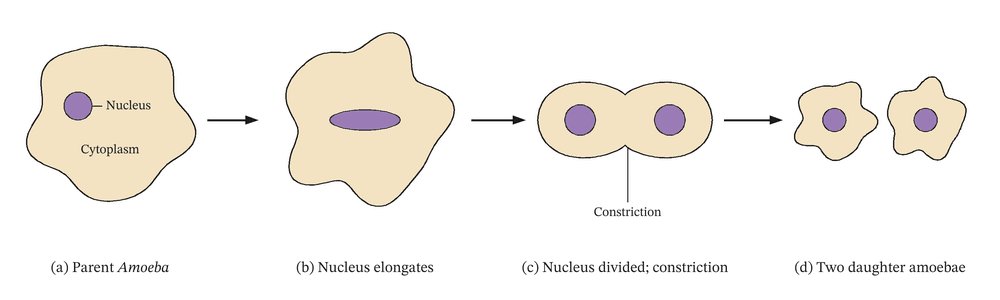
Note: Some older books describe this nuclear division as amitosis (direct division). Studies of Amoeba show that its nucleus divides by mitosis.
Therefore, in Amoeba the nucleus divides by mitosis into two, a constriction then divides the cytoplasm, and two daughter amoebae are formed with no residue left.
- 515 marks
Question 51
What are the important characteristics of vegetative propagation?
Solve with AIWritten solution
Solution:
Key idea: Vegetative propagation is asexual reproduction in plants in which a vegetative part (root, stem, leaf or bud), called a vegetative propagule, grows into a new plant.
Step 1 — Note that one parent and no gametes are involved. A single plant gives rise to the new plants, and no gametes are formed or fused.
Step 2 — Note that the offspring are identical. The new plants are genetically identical to the parent (clones), so the qualities of a chosen variety are kept.
Step 3 — Note the type of cell division. Only mitosis takes place in forming the new plant; there is no meiosis.
Step 4 — Note that it is simple and rapid. The new plant grows from a part that already has stored food and buds, so it becomes established faster than a seedling, especially under favourable conditions.
Step 5 — Note the source of variation. Since there is no recombination of genes, variation arises only through occasional mutation.
Step 6 — Note that it may be natural or artificial. It occurs naturally by roots (sweet potato), stems (runner, rhizome, tuber, bulb, offset, sucker), leaves (Bryophyllum) and bulbils (Agave). It is also done artificially by people, by cuttings, layering, grafting and tissue culture, to grow many ornamental, economic and medicinal plants.
Therefore, vegetative propagation involves one parent and no gametes, uses only mitosis, gives identical plants quickly, shows variation only through mutation, and may be natural or artificial.
- 525 marks
Question 52
Explain vegetative propagation by rhizome, tuber and offset.
Solve with AIWritten solution
Solution:
Key idea: Some stems store food and carry buds at their nodes. When such a bud grows into a separate plant, the stem acts as a vegetative propagule. A rhizome, a tuber and an offset are three such modified stems.
Step 1 — Explain propagation by a rhizome. A rhizome is an underground stem that grows horizontally and is often swollen with stored food. It has nodes with scale leaves, axillary buds and adventitious roots. The terminal bud turns upwards to form an aerial or flowering shoot, and the axillary buds grow out into new rhizome branches; when older parts die, these branches become separate plants. Examples are ginger, turmeric and banana.
Step 2 — Explain propagation by a tuber. A potato tuber is the swollen tip of an underground stem branch, full of stored starch. Its surface bears "eyes"; each eye is a node with one or more buds in the axil of a small scale leaf. When a piece of tuber with an eye is planted, the bud grows into a shoot and adventitious roots form. This is why potato crops are usually raised from tuber pieces ("seed potatoes"), not from true seeds.
Step 3 — Explain propagation by an offset. An offset is a short runner, one internode long, that grows out from the axil of a leaf in rosette plants, mostly aquatic ones. At its tip it develops a rosette of leaves above and a cluster of roots below; when it breaks away, it forms a new plant. Examples are water hyacinth (Eichhornia) and water lettuce (Pistia).
Step 4 — Show the three propagules in diagrams. Three labelled sketches illustrate them: a ginger rhizome (node, scale leaf, axillary bud, adventitious roots), a potato tuber (eyes or buds, sprouting shoot, roots) and a water hyacinth plant with its offset (offset, rosette of leaves, roots).

Therefore, a rhizome spreads by buds at its nodes (ginger), a tuber by buds in its eyes (potato) and an offset by a short runner that forms a new rosette with roots (water hyacinth); all three give plants identical to the parent.
- 535 marks
Question 53
Why is water hyacinth called the 'Terror of Bengal'?
Solve with AIWritten solution
Solution:
Key idea: Water hyacinth (Eichhornia crassipes) is a free-floating aquatic plant. It reproduces vegetatively by offsets so quickly that it can cover a whole water body in a short time.
Step 1 — State where it came from. Water hyacinth is native to South America. It was brought to India, to Bengal, in the late nineteenth century as an ornamental plant, because of its beautiful lilac flowers and shiny leaves.
Step 2 — Explain how it spreads. Each plant produces offsets, short runners that form new rosettes of leaves with roots, so the number of plants multiplies very fast; in warm water a mat can double in area in about two weeks. It also produces seeds that stay alive in the mud for years, so it is very hard to get rid of.
Step 3 — Explain the harm to the water body. The dense floating mat cuts off sunlight from the plants and algae below, so less oxygen is added to the water by photosynthesis, and it also hinders the exchange of oxygen between air and water. When parts of the mat die, the decomposers that break them down use up the dissolved oxygen, and fishes die.
Step 4 — Explain the harm to people. The mats choke ponds, rivers and canals, block boats and fishing, clog irrigation channels and paddy fields, and give shelter to mosquito larvae.
Step 5 — Explain the name. In Bengal it spread through almost every pond, river and paddy field and could not be controlled. A plant brought in for its beauty had become a serious pest, so it was called the "Terror of Bengal".
Therefore, water hyacinth is called the Terror of Bengal because, spreading very fast by offsets, it choked the water bodies of Bengal, lowered their oxygen so that fishes died, and could hardly be removed.
- 545 marks
Question 54
List various advantages and disadvantages of vegetative propagation.
Solve with AIWritten solution
Solution:
Key idea: Vegetative propagation produces new plants from a vegetative part of one parent, so the new plants are genetically identical to it. This is its main strength, and also its main weakness.
Step 1 — Advantage: plants that set few or no viable seeds can be grown. Cultivated bananas and seedless grapes form no viable seeds, and sugarcane sets very little viable seed in most regions, so these crops are multiplied only, or most easily, in this way.
Step 2 — Advantage: a chosen variety is kept unchanged. Plants raised from seed show variation because of genetic recombination. Roses and oranges, for example, do set viable seed, but their seedlings do not keep the features of the variety, and the same is true of Chrysanthemum and most mango varieties. These plants are therefore propagated vegetatively (garden jasmines too are usually grown from cuttings or layers), because vegetative propagation gives genetically identical copies and keeps the selected variety true.
Step 3 — Advantage: it is easier, cheaper and quicker. The new plant starts from a part with stored food and buds, so it grows and flowers sooner. For example, a lily can take several years (up to 5–7 years in some kinds) to flower from seed, but flowers within about 2 years when grown from bulbs or bulbils.
Step 4 — Advantage: it suits plants with poor seed. It is used where seed set is poor, seeds lose viability quickly or seeds have a long dormancy; Bermuda grass (doob grass), for example, spreads mainly by its runners.
Step 5 — Disadvantage: there is no variation. All the new plants are genetically identical, so they cannot adapt to new conditions, and a new disease or pest can destroy all of them alike.
Step 6 — Disadvantage: loss of vigour and spread of disease. Viruses and other diseases of the parent pass on to every new plant through the propagule, and plants propagated in this way again and again may lose vigour. Propagules are also bulky and harder to store and transport than seeds.
Therefore, vegetative propagation lets us grow seedless or poor-seeding plants, keeps chosen varieties unchanged and is quick and cheap, but it gives no variation, passes on diseases and may reduce vigour.
- 555 marks
Question 55
Discuss various modes of artificial vegetative propagation.
Solve with AIWritten solution
Solution:
Key idea: Artificial vegetative propagation is done by people, who use parts of a plant to raise new plants identical to it. The main methods are cuttings, layering, grafting and tissue culture.
Step 1 — Explain propagation by cuttings. A piece of the plant is cut off and planted in moist soil, where it forms adventitious roots and grows into a new plant.
- Root cuttings: pieces of root are planted, for example lemon, tamarind and primrose.
- Stem cuttings: a piece of one-year-old stem is dipped in a rooting hormone (the auxins IBA or NAA) and planted, for example rose, sugarcane, Croton and China rose.
- Leaf cuttings: a leaf, or part of a leaf with a bud at its base, is planted upright, for example Begonia, snake plant (Sansevieria), rubber plant and Mahonia.
Step 2 — Explain propagation by layering. In layering, roots are made to form on a stem while it is still attached to the parent plant, and the stem is cut off only after it has rooted.
- Ground layering: a flexible lower branch is bent down, a ring of bark is removed or a cut is made, and that part is buried in soil with its tip above ground. After it roots, it is cut off and planted, for example jasmine, grapevine and strawberry.
- Air layering (gootee): a ring of bark is removed from a woody branch, a rooting hormone is applied, and the wound is covered with moist soil or moss and wrapped in polythene. Once roots have formed, usually after some weeks to a few months, the branch is cut off and planted, for example lemon, guava, litchi and China rose.
Step 3 — Explain propagation by grafting. A scion (a bud or twig of the desired variety) is joined to a stock (a rooted plant with a strong, disease-resistant root system) so that the cambium of the two parts is in contact. The joint is tied and sealed, the two parts grow together as one plant, and the scion bears flowers and fruits of its own variety. Examples are mango, apple, citrus and rose; the types include bud, approach, tongue, crown and wedge grafting.
Step 4 — Explain tissue culture and cloning. Small pieces of tissue are grown on a sterile nutrient medium to give large numbers of identical plantlets (micropropagation). Whole carrot plants have even been raised from single somatic cells grown in culture, showing that one plant cell can form a complete plant (cloning).
Note: Many school books call ground layering "mound layering". Gardeners use mound (stool) layering for a different method, in which soil is heaped round the young shoots at the base of a plant that has been cut back.
Therefore, the main artificial methods are cuttings (root, stem and leaf), layering (ground and air layering), grafting of a scion onto a stock, and tissue culture or cloning, all of which give plants identical to the parent.
- 565 marks
Question 56
Describe in brief the various special modes of reproduction. Mention their economic significance.
Solve with AIWritten solution
Solution:
Key idea: The special modes of reproduction in plants are micropropagation (tissue culture) and cloning. Both use the fact that a single plant cell can grow into a whole plant (totipotency).
Step 1 — Name the special modes. The special modes are micropropagation, in which small pieces of tissue are grown in culture, and cloning, in which a whole plant is raised from a single cell.
Step 2 — Describe the explant used in micropropagation. A small piece of tissue (the explant) is taken, usually from the shoot tip, because its meristem cells are undifferentiated, divide rapidly and are usually free of viruses.
Step 3 — Describe the growth of the callus. The explant is grown under sterile conditions on a nutrient medium with minerals, sugar, vitamins and the hormones auxin and cytokinin. Its cells divide and form an unorganised mass called the callus.
Step 4 — Describe the formation of plantlets. Pieces of callus are moved to a medium with a different hormone balance, where they form shoots and roots, that is, plantlets. These are hardened and planted in soil or pots, where they grow to maturity.
Step 5 — Describe cloning. In cloning a whole plant is developed from a single somatic cell, which carries all the genetic information of the plant. Whole carrot plants have been raised in this way from single cells grown in culture.
Step 6 — State the economic significance. These methods are commercially important for these reasons:
- An unlimited number of plants can be produced in a short time and in a small space, at any time of the year.
- Disease-free plants can be raised (meristem culture gives virus-free plants of banana, potato and sugarcane).
- The plants are identical, so the desirable qualities of a selected variety are kept; orchids, Dahlia, carnation and Chrysanthemum are raised in this way for sale.
- Rare and endangered plants, and plants that set few seeds, can be multiplied.
Step 7 — State the limitations. The process is tedious and expensive, it needs sterile laboratory conditions and skilled workers, and a crop of identical plants can all be attacked by one new disease.
Therefore, the special modes are micropropagation and cloning; they are economically important because they give large numbers of disease-free, identical plants of chosen varieties quickly, although they are costly and need sterile conditions.
- 575 marks
Question 57
Explain the post-fertilisation events in an organism.
Solve with AIWritten solution
Solution:
Key idea: Post-fertilisation events are all the events that follow the fusion of gametes (syngamy). They include the formation and development of the zygote, embryogenesis, and, in flowering plants, the formation of the seed and the fruit.
Step 1 — Describe the formation of the zygote. Syngamy produces a diploid zygote. It is formed outside the body, usually in water, in external fertilisation and inside the body in internal fertilisation. The zygote is the link between one generation and the next.
Step 2 — Explain how the fate of the zygote depends on the life cycle. In many algae and fungi (for example Chlamydomonas, Spirogyra and Rhizopus) the zygote develops a thick, resistant wall, rests for a time, and then divides by meiosis to give haploid spores or individuals; this is a haplontic life cycle. In most animals and in seed plants the zygote divides by mitosis and grows directly into a diploid embryo; this is a diplontic life cycle.
Step 3 — Describe embryogenesis. Embryogenesis is the development of the embryo from the zygote. The zygote divides repeatedly by mitosis (cell division), and the cells become specialised into tissues and organs (cell differentiation).
Step 4 — Compare oviparous and viviparous animals. Oviparous animals, such as birds and most reptiles, lay fertilised eggs covered by a shell (hard and calcareous in birds, often leathery in reptiles), and the young hatch after a period of incubation. Viviparous animals, such as most mammals including human beings, give birth to young that have developed inside the body of the female; these young are better protected, so their chances of survival are greater.
Step 5 — Describe seed and fruit formation in flowering plants. After fertilisation the sepals, petals and stamens usually wither and fall off (the sepals stay on in some plants, such as tomato and brinjal). The zygote develops into the embryo, each ovule becomes a seed, and the ovary becomes the fruit, its wall forming a protective pericarp. Later, under favourable conditions, the seed germinates into a new plant.
Therefore, after fertilisation the zygote forms and develops according to the life cycle, the embryo forms by mitosis and differentiation, animals lay eggs or give birth to young, and in flowering plants the ovules become seeds and the ovary becomes the fruit.
- 585 marks
Question 58
Explain micropropagation in plants.
Solve with AIWritten solution
Solution:
Key idea: Micropropagation (tissue culture) is the technique of growing cells, tissues or organs of plants (explants) on a suitable sterile artificial medium in vitro, to produce a large number of plants in a short time.
Step 1 — Take the explant. A small piece of tissue, the explant, is taken, generally from the shoot tip, because its meristem cells are undifferentiated, divide rapidly and are usually free of viruses.
Step 2 — Place it on a nutrient medium. The explant is sterilised and grown on a nutrient medium containing minerals, sugar, vitamins and the hormones auxin and cytokinin, under sterile conditions.
Step 3 — Grow the callus. The cells divide again and again and form an unorganised mass called the callus.
Step 4 — Induce differentiation. Small parts of the callus are transferred to another medium with a different balance of plant hormones, which makes the cells differentiate into shoots and roots.
Step 5 — Raise the plantlets. The shoots and roots together form small plants called plantlets. They are hardened and transferred to soil or pots, where they grow to maturity.
Step 6 — State the advantages. An unlimited number of plants can be produced in a short time, and the plants are disease-free and identical to the chosen parent; orchids, Dahlia, carnation and Chrysanthemum are raised in this way.
Step 7 — State the disadvantages. The process is tedious and expensive and needs sterile conditions and skilled workers.
Step 8 — Show the process in a diagram. The process is drawn as a flow diagram: shoot tip of a plant → cells from the shoot tip on a nutrient medium → callus → a piece of callus on a medium with plant hormones → plantlet.

Therefore, in micropropagation an explant from the shoot tip is grown on a sterile nutrient medium into a callus, which is induced by hormones to form plantlets that are then grown in pots.
What Class 12 Biology Ch 1 covers
The sections of the chapter, in the order the book takes them. Every question above comes from one of these.
- 01Life Span
- 02Reproduction
- 03Asexual Reproduction
- 04Vegetative Propagation
- 05Sexual Reproduction
- 06Events in Sexual Reproduction
More ways to study this chapter
The same chapter asked three other ways. Practise it, revise it, and see what the board has set on Ch 1 before.
- Competency-Based Questions (CBQ)Case study questions: a situation, and the part of the chapter that answers it.40questionsOpen
- Previous Year QuestionsQuestions that have actually appeared in board papers, each tagged with its year.10questionsOpen
- Practice QuestionsExtra questions per chapter, for when one attempt at a method is not enough.133questionsOpen
Ch 1 in past ISC papers
The same chapter as the board has actually asked it. These are worded differently from the textbook exercise, which is the point of reading them.
- 12 marks
Board paper question 1
State two advantages of vegetative propagation.
Solve with AIWritten solution
Solution:
Key idea: Vegetative propagation is a type of asexual reproduction in which a new plant grows from a vegetative part of the parent (root, stem, leaf or bud) instead of a seed. Only mitosis is involved, so the new plant is genetically the same as its parent.
Step 1 — Recall what makes vegetative propagation special.
No gametes are formed and no fertilisation takes place. The new plant is simply a part of the parent that has grown on its own, so it carries exactly the same genes.
Step 2 — State the first advantage.
Desirable characters are preserved. Because the offspring are genetically identical to the parent (a clone), a good variety, for example a sweet mango or a disease-resistant sugarcane, keeps its qualities generation after generation.
Step 3 — State the second advantage.
It is quicker and more certain than growing plants from seed. A cutting, tuber or graft skips seed germination and the long juvenile phase, so the plant flowers and fruits sooner. It is also the only practical way to multiply plants that form few or no viable seeds, such as banana, seedless grapes and sugarcane.
Therefore, two advantages of vegetative propagation are: (1) the offspring are identical to the parent, so desirable characters are preserved, and (2) it multiplies plants faster and works even for plants that do not form viable seeds.
- 21 mark
Board paper question 2
Answer the following questions briefly and to the point:
If the haploid number of chromosomes in a plant species is 20, how many chromosomes will be present in the cells of the shoot tip?
Solve with AIWritten solution
Solution:
Key idea: The cells of the plant body (somatic cells) are diploid (); only the gametes are haploid (). The shoot tip is a meristem made of somatic cells.
Step 1 — Identify the kind of cell asked about.
The cells of the shoot tip divide by mitosis to build the stem and leaves. Mitosis keeps the chromosome number unchanged, so these cells have the same number as every other body cell, which is the diploid number .
Step 2 — Find the diploid number from the haploid number.
The haploid number is given as , so we double it.
Watch out: Do not give 20; that is the number in the gametes (male gametes and egg cells), not in the shoot tip.
Therefore, the cells of the shoot tip contain 40 chromosomes (2n = 40), taking the plant to be an ordinary diploid species.
- 31 mark
Board paper question 3
Answer the following questions briefly and to the point:
Name a plant which flowers every twelve years.
Solve with AIWritten solution
Solution:
Key idea: Some plants spend many years in the vegetative (juvenile) phase and then flower only after a long, fixed interval.
Step 1 — Recall the example of a twelve-year interval.
Strobilanthes kunthiana, called neelakurinji, grows on the hills of Kerala, Karnataka and Tamil Nadu. Its plants flower together (mass flowering) only once in about 12 years, turning large stretches of the hills blue, and the plants die after flowering and setting seed.
Step 2 — Give the answer.
The plant that flowers every twelve years is therefore neelakurinji.
Therefore, Strobilanthes kunthiana (neelakurinji) flowers once every twelve years.
- 41 mark
Board paper question 4
Answer the following questions briefly and to the point:
Name the terminal stage of ageing in the life cycle of plants.
Solve with AIWritten solution
Solution:
Key idea: The life cycle of a plant passes through a juvenile (vegetative) phase, a reproductive phase and finally a phase of ageing that ends in death.
Step 1 — Recall the phases after reproduction.
When the reproductive phase ends, the organs of the plant slowly deteriorate. This gradual, irreversible decline in the working of the body is ageing.
Step 2 — Name the last stage of ageing.
The final, irreversible stage of ageing, which leads directly to death, is called senescence.
Therefore, the terminal stage of ageing in the life cycle of plants is senescence, which ends in death.
- 52 marks
Board paper question 5
Define life span. Give the life span of an elephant.
Solve with AIWritten solution
Solution:
Key idea: Every organism lives only for a limited time. The period from its birth to its natural death is its life span, and it differs greatly from one organism to another.
Step 1 — Define life span.
The life span of an organism is the period from its birth to its natural death. Life spans vary widely: a rice plant lives only 3–4 months, while a tortoise can live for more than 100 years.
Step 2 — Give the life span of an elephant.
An elephant can live for about 60 to 90 years, which is the range textbooks give for its natural life span. Many elephants, especially in the wild, die younger, and the oldest elephant on record lived to about 86 years.
Therefore, life span is the period from birth to natural death of an organism, and the life span of an elephant is about 60–90 years.
- 61 mark
Board paper question 6
Answer the following questions briefly to the point.
What is a clone?
Solve with AIWritten solution
Solution:
Key idea: In asexual reproduction a single parent gives rise to offspring by mitosis only, without the fusion of gametes.
Step 1 — Recall how the offspring are formed.
Since only mitosis takes place and only one parent is involved, each offspring receives exactly the same set of genes as its parent.
Step 2 — Define a clone.
Such offspring are identical to each other and to the parent in form (morphology) and in their genes. An individual or a group of individuals like this is called a clone.
Therefore, a clone is an individual or a group of individuals that is morphologically and genetically identical to its single parent, formed by asexual reproduction.
All 10 board paper questions for this chapter, solved the same way.
Class 12 Biology Ch 1 questions students ask
How many questions are there in Class 12 Biology Ch 1?
58 questions. Every one is solved step by step on this page.
Are these Class 12 Biology solutions free?
Yes. Every question and its full working is free to read, with no account needed.
Can I download the Class 12 Biology Ch 1 solutions as a PDF?
There is no PDF to download. Every solution is on this page instead, which means it is searchable, always the current syllabus, and readable on a phone. Use your browser's print option if you want it on paper.