
Opening your dashboard
Class 12 Biology Chapter 1 Reproduction in Organisms: Competency-Based Questions (CBQ)
40 questions on Chapter 1, each worked through on its own page with the AI tutor. Class 12 Biology, ICSE 2026-27.
40 questions
1–5 marks · Mixed difficulty
- 13 marks
Question 1
A school eco-club in Pune makes a chart of the approximate life spans of some organisms.
Plant Approx. life span Animal Approx. life span Rice plant 3–4 months Mayfly (winged adult) 1 day Wheat plant 5 months Rabbit 13 years Rose bush 5–7 years Cow 20–25 years White oak tree 500 years Tortoise 100–150 years (a) Classify the four plants as annuals or perennials.
(b) Compare the longest-lived plant and the longest-lived animal in the chart. Which general fact about the life spans of plants and animals do they support?
(c) A club member writes: "Every plant lives longer than every animal." Use one plant and one animal from the chart to show that this statement is wrong.
- 21 mark
Question 2
A pet dog in a Kolkata household died in a road accident at the age of 6 years. Dogs have an approximate life span of 14–20 years. Which statement about this case is correct?
- 31 mark
Question 3
Assertion (A): Two plants of the same species grown in different places may take different times to reach the reproductive phase.
Reason (R): The changes during the life span of an organism are determined by its genetic constitution and are also influenced by environmental factors.
- 41 mark
Question 4
Assertion (A): Amoeba multiplies by fission, whereas a cow produces offspring only by the fusion of gametes.
Reason (R): Factors like habitat, internal physiology and environment play an important role in the way an organism reproduces.
- 51 mark
Question 5
In a marine biology lab, two organisms are studied. Organism 1 produces offspring from its somatic (body) cells, without forming gametes. Organism 2 produces offspring when an ovum from one parent fuses with a sperm from another parent. In which organism is genetic material passed on to the next generation?
- 64 marks
Question 6
A college student places a single Paramecium in a flask of fresh culture medium with plenty of food and counts the Paramecia every 8 hours. The results are shown in the graph. (Hypothetical data.)

(a) From the graph, how often does each Paramecium divide? If the same rate continues, how many Paramecia will there be at 48 hours?
(b) In which plane does a Paramecium divide in binary fission, and how do its macronucleus and micronucleus divide?
(c) The student calls all the Paramecia in the flask at 32 hours "a clone". Is the student right? Give a reason.
- 71 mark
Question 7
Assertion (A): Zoospores of Chlamydomonas are well suited for dispersal in an aquatic habitat.
Reason (R): Zoospores are produced inside zoosporangia.
- 81 mark
Question 8
In a bakery's quality-control lab, a technician sees a yeast cell with a small outgrowth that is slowly growing larger. Which event allows this outgrowth to become a new yeast cell?
- 91 mark
Question 9
Assertion (A): Dolly, a Finn Dorset lamb, was a clone.
Reason (R): Asexual reproduction occurs naturally in all vertebrates.
- 103 marks
Question 10
A pineapple farmer in Meghalaya does not raise his crop from seeds. After the harvest, he collects small leafy shoots that look like miniature pineapple plants, separates them from the mother plants and plants them in a new field.
(a) Name these propagules and state two places on the mother plant from which they can arise.
(b) Why do these shoots establish easily when they are planted soon after separation?
(c) The fruits from the new field taste the same as those of the mother plants. Explain why.
- 113 marks
Question 11
A horticulture student at an agricultural university in Himachal Pradesh makes apple grafts in two sets. (Hypothetical data.)
Set How the scion was placed on the stock Grafts made Grafts that united and grew P Cambium of scion in direct contact with cambium of stock 40 36 Q Cambium of scion not touching cambium of stock 40 4 (a) Calculate the percentage success in each set.
(b) Explain the difference in the results of the two sets.
(c) The teacher says the trial would fail with a plant that has no cambium. Why?
- 123 marks
Question 12
A nursery in Kerala wants to raise new plants of jasmine, which has flexible lower branches, and of guava, whose branches cannot be bent down to the ground. It wants the new plants to root while still attached to the parent.
(a) Suggest a suitable layering method for each plant and give a reason for each choice.
(b) How does layering differ from stem cutting in the order of rooting and separation from the parent plant?
- 131 mark
Question 13
On a farm in Punjab, a Dalbergia sissoo (shisham) tree was cut down and its stump removed. A few months later, several young shoots came up from the soil where it had stood, arising from its roots still in the ground. This is an example of
- 141 mark
Question 14
Assertion (A): A sugarcane variety raised only by vegetative propagation for many years may become more susceptible to diseases.
Reason (R): Vegetative propagation produces new gene combinations through genetic recombination.
- 153 marks
Question 15
A plant breeder at a nursery in Bengaluru works with two varieties of a flowering shrub (hypothetical example). Variety 1 has large flowers but is easily attacked by disease; Variety 2 has small flowers but resists disease. She transfers pollen of Variety 1 to the flowers of Variety 2 and sows the seeds formed. The seedlings differ: some have large flowers and resist disease, others have neither feature.
(a) Why do the seedlings differ from one another and from both parents?
(b) One seedling has large flowers and resists disease. Should she multiply it by seeds or by stem cuttings? Give two reasons.
- 161 mark
Question 16
Assertion (A): The juvenile, reproductive and senescent phases of an organism are regulated by hormones alone.
Reason (R): Along with hormones, certain environmental factors also regulate the phases in the life of sexually reproducing organisms.
- 173 marks
Question 17
On a school field trip to a pea farm in Himachal Pradesh, a student opens four pea pods and counts the ovules and the seeds in each. Ovules that did not form seeds stayed small and shrivelled. (Hypothetical data.)
Pod Ovules in the pod Seeds formed 1 8 7 2 8 6 3 7 7 4 9 5 (a) How many zygotes were formed in the four pods together? Explain.
(b) Suggest why some ovules did not develop into seeds.
(c) In which pod did the largest percentage of ovules form seeds? Calculate that percentage.
- 181 mark
Question 18
In a maize field in Bihar, pollen from a male flower of one maize plant falls on the stigma of a female flower of the same plant. Using the chapter's definitions, this is
- 191 mark
Question 19
Assertion (A): In most animals, the male gamete (microgamete) is motile.
Reason (R): The microgamete does not store nutrients.
- 203 marks
Question 20
A poultry hatchery in Namakkal, Tamil Nadu, places 500 hen eggs in an incubator. 460 of them hatch into chicks. The 40 eggs that do not hatch are all found to be unfertilised. (Hypothetical data.)
(a) Calculate the hatching percentage.
(b) On the basis of the development of the zygote, to which group of animals do hens belong? What happens inside a fertilised egg during the incubation period?
(c) Why did the 40 unfertilised eggs fail to hatch?
- 211 mark
Question 21
On a damp wall of a school building, a student observes a moss. Its male gametes swim through a thin film of water to reach the egg, which stays inside the body of the plant, and the two fuse there. What type of fertilisation is this?
- 223 marks
Question 22
A floriculture company near Bengaluru needs 1,00,000 identical carnation plants for export. It compares two methods. (Hypothetical data.)
Method Cost per plant Time to obtain 1,00,000 plants Conventional propagation Rs 4 3 years Micropropagation Rs 10 6 months (a) Calculate the extra cost of using micropropagation for 1,00,000 plants.
(b) Which disadvantage of micropropagation does this extra cost show?
(c) Which advantage of micropropagation does the time column show?
- 231 mark
Question 23
Assertion (A): Plants raised by tissue culture from one parent plant show wide genetic variation.
Reason (R): Tissue culture can be used to produce disease-free, identical ornamental plants like orchids and Dahlia.
- 241 mark
Question 24
Assertion (A): Aphids produced by parthenogenesis are diploid.
Reason (R): Whether parthenogenesis is haploid or diploid depends on the number of chromosomes present in the ovum.
- 251 mark
Question 25
In a research lab (hypothetical example), unfertilised eggs of an animal are given a temperature change and treated with chemical agents. A few eggs develop into young ones although no sperm was used. This is best described as
- 265 marks
Question 26
Oviparous animals lay eggs outside their body. As a result, the eggs of these animals are under continuous threat from various environmental factors. On the other hand, in viviparous animals, the development of the egg takes place inside the body of the female in the uterus. This keeps the embryo safe from the predators. They give birth to the young ones. The fertilisation can be external or internal in oviparous animals but is always internal in viviparous animals.
(1) The embryos of these animals are comparatively safe from environmental factors.
(a) viviparous animals
(b) oviparous animals
(c) egg-laying animals
(d) embryonic animals
(2) Viviparous animals are the ones which
(a) lay eggs without embryos
(b) lay eggs with embryos
(c) give birth to young ones
(d) keep eggs in a pouch
(3) In oviparous animals the fertilisation is
(a) always external
(b) always internal
(c) can be external or internal
(d) in water
(4) The development of embryo in viviparous animals occurs in the
(a) ovary
(b) uterus
(c) ureter
(d) embryo pouch
(5) Which statement is true for oviparous animals?
(a) eggs are laid in the sand
(b) eggs are laid in the uterus
(c) nourishment is provided by the mother
(d) eggs are laid outside the body
- 275 marks
Question 27
Higher organisms reproduce by sexual reproduction in spite of its complexity because the offspring produced have the genetic material of two parents and show variations. These variations help in the survival of species in diverse environmental conditions. Also the variations play an important role in the evolution of a species. Sexual reproduction is a complex process but certain features are common to all organisms. They all undergo sequentially three important phases in life. These are (i) juvenile phase, (ii) reproductive phase and (iii) ageing leading to death. On the other hand, organisms exhibiting asexual reproduction do not have these phases in life. The individuals formed are genetically identical. Hence the individuals are more susceptible to changes in the environment.
(1) An important feature of sexual reproduction is
(a) strong individuals
(b) new variations in offsprings
(c) juvenile phase leading to death
(d) offsprings susceptible to environment
(2) Variations help the evolution of a species in the following way
(a) offsprings produced are stronger
(b) make asexually producing individuals stronger
(c) species has better chances of survival
(d) produce different types of asexual organisms
(3) The three important phases of sexually reproducing animals in a sequence are
(a) reproductive–juvenile–ageing
(b) juvenile–reproductive–ageing
(c) ageing–reproductive–juvenile
(d) reproductive–ageing–juvenile
(4) Following type of individuals are more susceptible to changes in the environment
(a) formed as result of sexual reproduction
(b) individuals with more variations
(c) genetically different individuals
(d) formed as a result of asexual reproduction
(5) Organisms exhibiting asexual reproduction are
(a) genetically identical
(b) strong genetically
(c) have a reproductive phase
(d) haploid
- 285 marks
Question 28
Meiosis is a process of reductional division in which the amount of genetic material is reduced to half. If the parent body is diploid, the gametes are produced by meiosis. The parent organisms have specialised cells called meiocytes, also called gamete mother cells that undergo the process of meiosis. During meiosis, these cells undergo two successive nuclear and cell divisions with a single cycle of DNA replication. Gametes produced are haploid and contain only one set of chromosomes. Gametogenesis is the process of the formation of gametes. The gametes may be similar looking or may differ markedly as in higher animals. When the male and female gametes are similar in appearance and cannot be distinguished morphologically then they are called homogametes or isogametes. When the gametes are morphologically different, they are termed heterogametes or anisogametes. Male gamete is generally small and is called antherozoid or sperm. Female gamete is generally large and is called egg or ovum.
(1) When the gametes are morphologically different, they are called
(a) isogametes
(b) anisogametes
(c) homogametes
(d) both (a) and (c)
(2) A male gamete that differs from a female gamete is
(a) bigger than female gamete
(b) diploid
(c) called antherozoid
(d) undergoes DNA replication twice
(3) Meiocytes are the special cells which are
(a) also called gamete mother cells
(b) also called gametes
(c) haploid
(d) also called heterogametes
(4) Which of the following statements is not true of meiosis?
(a) cells undergo two successive nuclear divisions
(b) the chromosome number is halved
(c) haploids produced have only one set of chromosomes
(d) DNA replication occurs twice
(5) The process of formation of gametes is called
(a) meiogenesis
(b) gametogenesis
(c) heterogenetic
(d) meiocytes
- 293 marks
Question 29
Offspring formed due to sexual reproduction have better chances of survival. Why? Is this statement always true?
- 303 marks
Question 30
Distinguish between asexual and sexual reproduction. Why is vegetative reproduction also considered as a type of asexual reproduction?
- 313 marks
Question 31
How is vegetative propagation related to the following plants?

- 323 marks
Question 32
Geeta planted one papaya plant in her garden and was disheartened to see that it didn't bear papaya fruit. After 1 year, a family shifted to the next house, planted two papaya trees in their garden. Within 6 months not only one of the trees in their garden bore the fruit but the single plant in Geeta's garden also yielded papaya fruit.
(i) What type of papaya plant did Geeta have?
(ii) What is the scientific term given to the types of flowers this plant bears?
(iii) Why Geeta's plant did not bear fruit?
(iv) Give scientific terms for the flowers of plant of the neighbour that did not bear the fruit.
(v) What kind of pollination takes place in these papaya plants?
- 333 marks
Question 33
In the figure given alongside.
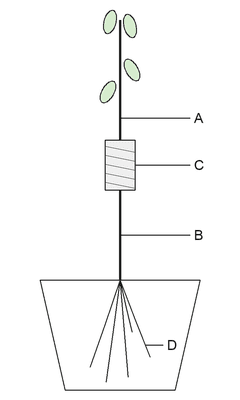
(i) What is this technique known as?
(ii) Name the parts A and B.
(iii) Do A and B belong to the same plant?
(iv) Name an important tissue involved at C.
(v) D is a part of A, B or C?
- 343 marks
Question 34
In non-primate mammals like cows, sheep, rats, deer, etc., the cyclical changes that occur during reproduction are called oestrus cycle whereas in primates it is called as menstrual cycle. How can we distinguish between them?
- 353 marks
Question 35
Study the following diagram and answer the questions given below:

(i) What does S and P denote?
(ii) Where do they develop from?
(iii) What is the term given to the point of attachment of the ovules in the fruit?
(iv) What is the ploidy of embryo and the tissues in the ovary?
(v) What is the function of fruit apart from storage of materials?
- 363 marks
Question 36
Explain why meiosis and gametogenesis are always interlinked.
- 373 marks
Question 37
Give three significant differences between asexual reproduction and sexual reproduction.
- 385 marks
Question 38
What are seasonal breeders? Give an example.
- 391 mark
Question 39
A botany student at a college in Odisha counts the pollen grains and the ovules in one flower of each of three plant species, and notes how pollen reaches a stigma in each. (Hypothetical data.)
Species How pollen reaches a stigma Pollen grains per flower Ovules per flower K Pollen of the same flower falls on its stigma before the flower opens 600 6 L Bees carry pollen to the flowers of other plants 24,000 12 M Wind carries pollen to the flowers of other plants 30,000 1 Which conclusion is best supported by these data?
- 404 marks
Question 40
A plant tissue culture laboratory in Himachal Pradesh wants to raise virus-free potato plants from a potato variety whose plants all carry a virus. Viruses spread through a plant mainly in its conducting (vascular) tissue and move only slowly from cell to cell. The cells at the extreme tip of a shoot meristem divide rapidly and have no vascular tissue yet. A very small piece of tissue has few cells and is easily damaged or dried during cutting. The laboratory cultures shoot-tip explants of three sizes and later tests every plantlet for the virus. (Hypothetical data.)
Size of shoot-tip explant Explants cultured Plantlets formed Plantlets found virus-free 0.2 mm 200 60 54 0.5 mm 200 120 72 2.0 mm 200 180 18 (a) For each size, calculate the percentage of the cultured explants that gave virus-free plantlets. Which size gave the most virus-free plantlets?
(b) Using the information given, explain why the 0.2 mm explants gave the highest proportion of virus-free plantlets but the fewest plantlets.
(c) The laboratory manager proposes: "The 2.0 mm explants gave the most plantlets, so we should use them and multiply all their plantlets by micropropagation for distribution to farmers." Evaluate this plan and suggest a better one.