
Question 505 marksMedium
How does binary fission occur in Amoeba?
Confirming your payment
Sign up now and get 250 free tokens.
Reproduction in Organisms · Question 50 of 58
How does binary fission occur in Amoeba?
Solution:
Key idea: Binary fission is the division of one cell into two nearly equal daughter cells. In Amoeba it is called simple binary fission, because the cell can divide in any plane.
Step 1 — State when fission occurs. In favourable conditions (enough food and water and a suitable temperature), a fully grown Amoeba stops moving, withdraws its pseudopodia and becomes rounded.
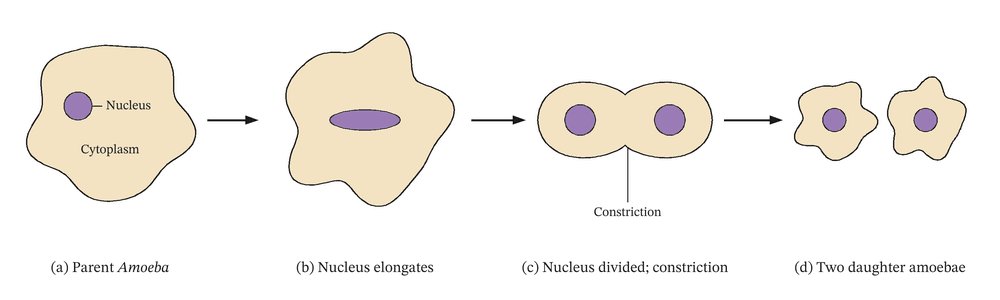
Step 2 — Describe the division of the nucleus. The nucleus elongates and divides by mitosis (karyokinesis) into two daughter nuclei, which move apart towards opposite ends of the cell.
Step 3 — Describe the constriction. A constriction appears in the cell membrane in the middle of the cell, between the two daughter nuclei.
Step 4 — Describe the division of the cytoplasm. The constriction deepens until the cytoplasm splits into two (cytokinesis). Two daughter amoebae are formed, each with one nucleus, and each feeds and grows into an adult.
Step 5 — State the result. No residue is left, because the whole body of the parent is shared between the two daughters. The parent never leaves a dead body behind, so in this sense Amoeba is said to be "immortal".
Step 6 — Show the stages in a diagram. The process is drawn as four sketches joined by arrows: (a) the parent with its nucleus and cytoplasm labelled; (b) the elongated nucleus; (c) the two daughter nuclei with the constriction labelled; (d) the two daughter amoebae.
Note: Some older books describe this nuclear division as amitosis (direct division). Studies of Amoeba show that its nucleus divides by mitosis.
Therefore, in Amoeba the nucleus divides by mitosis into two, a constriction then divides the cytoplasm, and two daughter amoebae are formed with no residue left.