
Opening your dashboard
Class 12 Biology Chapter 1 Reproduction in Organisms: Practice Questions
133 questions on Chapter 1, each worked through on its own page with the AI tutor. Class 12 Biology, ICSE 2026-27.
133 questions
1–5 marks · Mixed difficulty
- 11 mark
Question 1
Which pair of organisms best supports the statement that life span is not related to the size of an organism?
- 22 marks
Question 2
A survey of one bird species gives the following figures. (Hypothetical data.)
- The oldest bird of this species ever recorded lived for 40 years.
- In a protected sanctuary, birds of this species live for 18 years on average.
- Near a polluted town, birds of the same species live for 11 years on average.
(i) Which figure is a characteristic of the species, and which figures are characteristics of populations?
(ii) Why can the two average figures differ although all the birds belong to the same species?
- 33 marks
Question 3
Death is certain for every individual, yet an Amoeba that reproduces by binary fission is described as "immortal".
(i) Explain why it is called immortal.
(ii) Why is immortality absent in an organism that reproduces by multiple fission?
(iii) A mango tree may live for 100–200 years. Why is it still not immortal?
- 43 marks
Question 4
A gardener records the life of a shrub grown from seed. (Hypothetical data.)
- Years 1–3: it grows taller and puts out leaves but bears no flowers.
- Years 4–25: it flowers and sets seeds every year.
- Years 26–30: its leaves turn yellow, fewer flowers form and it gradually weakens; it dies in year 30.
Name the stage of the life span shown in each of the three periods and give the feature that marks it.
- 51 mark
Question 5
Every banyan tree eventually dies, yet banyan trees have existed on earth for thousands of years. The main reason is that
- 62 marks
Question 6
A Paramecium can multiply in two ways:
(i) it divides transversely into two daughter Paramecia;
(ii) it undergoes conjugation.
Classify each process as asexual or sexual reproduction, giving one reason for each.
- 71 mark
Question 7
Which of the following new individuals begins its life as a zygote?
- 81 mark
Question 8
In which of the following groups would you not expect to find asexual reproduction?
- 91 mark
Question 9
A single-celled organism divides by a furrow that runs along its length, from the front end to the rear end. This organism is most likely
- 102 marks
Question 10
The figure shows four stages of reproduction in Amoeba, drawn out of order.

(i) Arrange P, Q, R and S in the correct sequence.
(ii) Name this mode of reproduction and state how the nucleus divides in it.
- 113 marks
Question 11
Draw labelled diagrams to show how one Plasmodium inside a human red blood cell (RBC) gives rise to many parasites. Name this mode of reproduction.
- 122 marks
Question 12
Give reasons:
(i) Budding in Hydra is called exogenous, but budding in Spongilla is called endogenous.
(ii) Budding is described as an unequal division of the parent.
- 131 mark
Question 13
Four flasks of yeast are set up as below. (Hypothetical set-up.) In which flask is yeast most likely to multiply fastest by budding?
- 143 marks
Question 14
Three organisms reproduce by spores, as described below.
(i) Organism X, a fungus, forms spores inside a rounded case at the tip of an erect stalk.
(ii) Organism Y, a fungus, forms spores singly or in chains at the tips of special branches of its hyphae.
(iii) Organism Z, an alga, forms spores that have flagella and swim in water.
Name the type of spore in each, state whether it is motile, and give one example of an organism that forms it.
- 151 mark
Question 15
A starfish that loses an arm grows it back, and a separated arm that still carries a part of the central disc can grow into a complete starfish. The capacity shown here is called
- 163 marks
Question 16
Two Amoebae live in different ponds. (Hypothetical example.) Pond A has plenty of water and food. Pond B is drying up.
(i) Name the mode of reproduction the Amoeba in pond A is likely to use, and the number of daughters each parent forms.
(ii) What does the Amoeba in pond B form around itself, and how does it reproduce inside it?
(iii) How are the young Amoebae in pond B released, and when?
- 171 mark
Question 17
Which statement about vegetative propagation is not correct?
- 184 marks
Question 18
The figure shows a vertical section of an underground stem.
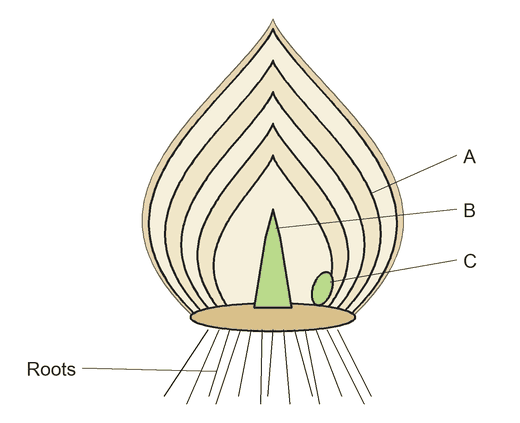
(i) Name this type of underground stem and give one plant that has it.
(ii) Name part A and state its function.
(iii) Name part B and state what it produces.
(iv) Name part C and state its role in vegetative propagation.
- 191 mark
Question 19
An underground stem is short and upright; the stem itself is swollen with food and its circular leaves form only papery scales. Each season, lateral buds at its nodes form new ones of the same kind. Which plant propagates by such a stem?
- 203 marks
Question 20
Name the part used to propagate each plant below and state whether the method is natural or artificial.
(i) In Agave, some buds on the tall flowering stalk become swollen with food, drop off and grow into new plants.
(ii) A gardener plants pieces of Begonia leaves in moist soil to raise new plants.
(iii) The swollen roots of a sweet potato plant develop adventitious buds, which grow into new plants.
- 211 mark
Question 21
In blackberry, the growing end of a shoot arches over and touches the ground; its terminal bud curves up into a new shoot that soon develops adventitious roots. This sub-aerial stem is a
- 222 marks
Question 22
A nursery worker dips the lower ends of one-year-old rose stem cuttings in a powder before planting them in soil.
(i) Name one substance the powder may contain.
(ii) Why is the cutting treated with it?
- 233 marks
Question 23
A gardener propagates a china rose by air layering. A ring of bark is removed from a healthy woody branch, and the debarked area is then treated.
(i) Why is a rooting hormone applied to the debarked area?
(ii) Why is the moist soil around it wrapped in a polythene sheet tied at both ends?
(iii) When, and how, is the new plant separated from the parent?
- 244 marks
Question 24
A fruit grower has two varieties of a fruit tree. (Hypothetical example.)
- Variety P bears large, sweet fruits but has a weak root system.
- Variety Q bears small, sour fruits but has a strong, disease-resistant root system.
(i) Which variety should be used as the scion and which as the stock? Give a reason for each.
(ii) Which tissue of the two parts must be placed in direct contact, and why?
(iii) Name the method in which a dormant bud of P is inserted into a T-shaped cut in the bark of Q.
- 251 mark
Question 25
A lily may take 5–7 years to flower when grown from seed but flowers within 2 years when grown vegetatively. This example best illustrates which advantage of vegetative propagation?
- 261 mark
Question 26
A plant bears male flowers and female flowers on the same plant. Which statement about it is correct?
- 271 mark
Question 27
A patch of Strobilanthes kunthiana (neelakurinji) in Kerala flowered in 2018. In which year is its next flowering expected, and what happens to a Bambusa tulda plant after it flowers?
- 282 marks
Question 28
Hens kept on a poultry farm lay eggs all through the year, but birds of the same kind living in the wild lay eggs only at a particular time of the year. How are birds classed on the basis of their time of breeding, and how does this example show that the class can change?
- 292 marks
Question 29
A wild mammal (hypothetical example) shows cyclic changes in its ovaries and reproductive ducts, but only during the favourable rainy season; the cycles are called oestrus cycles.
(a) Is this mammal a primate or a non-primate? Give a reason.
(b) Should it be called a continuous breeder or a seasonal breeder? Give a reason.
- 301 mark
Question 30
A mango tree in an orchard flowered in March this year and will flower again next March. To which phase of its life do the months between the two flowerings belong?
- 313 marks
Question 31
Classify each of the following with the correct term — unisexual animal, bisexual animal, monoecious plant or dioecious plant:
(i) cockroach
(ii) earthworm
(iii) Chara
(iv) Marchantia
(v) coconut
(vi) date palm
- 322 marks
Question 32
In a certain fungus, a single thallus bears both the male and the female reproductive structures. Which term is used for this condition in fungi? Which term for flowering plants describes the same condition?
- 332 marks
Question 33
A student says: "A child formed by sexual reproduction gets one set of genes from each parent, so it must be an exact copy of one of the two parents." Is the student right? Explain with two points.
- 341 mark
Question 34
The diploid number of chromosomes in a cat is 38. A cell taken from a cat is found to have 19 chromosomes. This cell is most likely a
- 353 marks
Question 35
In a housefly, a sperm with 6 chromosomes fertilises an egg.
(a) How many chromosomes will the zygote have?
(b) The zygote divides by mitosis four times in succession. How many cells are formed, and how many chromosomes does each cell have?
(c) Why does the chromosome number not double in every new generation of houseflies?
- 361 mark
Question 36
Which statement about the formation of gametes is correct?
- 372 marks
Question 37
In most organisms, male gametes are produced in numbers several thousand times greater than the female gametes. Explain why this is necessary.
- 381 mark
Question 38
Which pair of organisms both reproduce by the fusion of gametes that look alike?
- 393 marks
Question 39
Compare gamete transfer in a moss (a bryophyte) and in a flowering plant under these heads:
(a) the medium through which the male gamete travels
(b) what carries the male gamete
(c) how the male gamete finally reaches the female gamete
- 404 marks
Question 40
Compare what happens to the zygote in a fungus such as Rhizopus or an alga such as Chlamydomonas, and in most animals, under these four heads: (a) resting period, (b) first division of the zygote, (c) ploidy of the new individual, (d) name of the life cycle.
- 411 mark
Question 41
After fertilisation in a flower, which parts usually wither and fall off?
- 422 marks
Question 42
During embryogenesis, the zygote undergoes two kinds of change. Name them and state what each one achieves.
- 431 mark
Question 43
In tissue culture, the explant is generally taken from the shoot tip because
- 441 mark
Question 44
A callus has formed in a culture tube. What should be done next to make it form roots and shoots?
- 452 marks
Question 45
In a school biotechnology lab, a student's shoot-tip culture got covered with a fungal growth within a week, and the plant cells died.
(a) Which basic requirement of tissue culture was not met?
(b) Name three kinds of substances that the culture medium should have contained for the plant cells to grow.
- 464 marks
Question 46
The figure shows four stages, P, Q, R and S, in the micropropagation of a plant.

(a) What is the plant part placed in dish P called, and from which part of the plant is it usually taken?
(b) Name the structure Q.
(c) How does the medium in R differ from the medium in which Q was formed, and why?
(d) Name S and state what is done with it next.
- 471 mark
Question 47
In a honey bee colony, a fertilised egg (2n) whose larva is fed on royal jelly develops into a
- 481 mark
Question 48
Take the body cells of a queen honey bee to have 32 chromosomes. How many chromosomes are there in a sperm of a drone, and in a fertilised egg laid by the queen?
- 494 marks
Question 49
Draw a labelled flow chart to show how a queen honey bee gives rise to drones, workers and new queens. Mark the ploidy (n or 2n) of each egg and individual, and the food on which each is raised.
- 503 marks
Question 50
A tapeworm has both male and female sex organs in the same body.
(a) What are such animals called?
(b) How does a tapeworm fertilise its eggs?
(c) How do most other animals of this kind fertilise their eggs instead?
- 511 mark
Question 51
In Bryophyllum the vegetative propagation is by
- 521 mark
Question 52
A flower that has only stamens is called
- 531 mark
Question 53
A flower having both stamens and carpels is
- 541 mark
Question 54
The offspring produced through which of the following process are not exactly similar to their parents?
- 551 mark
Question 55
Which of the following plants can be vegetatively propagated by leaf?
- 561 mark
Question 56
The technique of obtaining a large number of plantlets by tissue culture method is called
- 571 mark
Question 57
Which one group of plants is propagated through underground roots?
- 581 mark
Question 58
A scion is grafted to a stock. The quality of fruits produced will be determined by the genotype of
- 591 mark
Question 59
The living organisms can be unexceptionally distinguished from the non-living things on the basis of their ability for
- 601 mark
Question 60
Which of the following is not an artificial method of propagation?
- 611 mark
Question 61
A small piece of tissue taken from the shoot tip during tissue culture is called
- 621 mark
Question 62
When a plant bears either male or female reproductive organs, it is called
- 631 mark
Question 63
Vegetative propagation in potato occurs by
- 641 mark
Question 64
Pistia (water lettuce) is an example of the following sub-aerial stems
- 651 mark
Question 65
Which of the following statement is true for meiocytes?
- 661 mark
Question 66
Life span of a horse is about ________ year.
- 671 mark
Question 67
Reproduction in Chlamydomonas by spores is called ________.
- 681 mark
Question 68
Ginger reproduces vegetatively by ________.
- 691 mark
Question 69
During grafting ________ is generally of good absorbing capacity and disease resistant variety.
- 701 mark
Question 70
A plant bearing both male and female flowers is called ________ plant.
- 711 mark
Question 71
________ is the development of fruit from an unfertilised flower, resulting in seedless fruit.
- 721 mark
Question 72
The specialised cells that are gamete mother cells are also called ________.
- 731 mark
Question 73
Antherozoid is another name for ________.
- 741 mark
Question 74
As the ovary matures, ovules develop into ________ and zygote into ________.
- 751 mark
Question 75
A plant part detached from the plant and used for the plant culture is called ________.
- 761 mark
Question 76
In ________ a single cell organism reproduces by splitting into two.
- 771 mark
Question 77
________ is a technique for producing genetically identical individuals from a single cell.
- 781 mark
Question 78
A period of growth from birth till organism attains maturity is called ________.
- 791 mark
Question 79
Cyclic changes that occur in females of non-primate mammals is called ________ cycle.
- 801 mark
Question 80
________ are haploid individuals that develop from the unfertilised ova by parthenogenesis.
- 811 mark
Question 81
During grafting, the stock is a bud or a cutting of a plant with desirable variety.
- 821 mark
Question 82
Clones can be produced by sexual reproduction.
- 831 mark
Question 83
Fungi Rhizopus reproduces by sporangiospores.
- 841 mark
Question 84
Meiocytes as well as gametes are haploid in nature.
- 851 mark
Question 85
In a plant, an ovule develops into a seed and zygote into an embryo.
- 865 marks
Question 86
Match the following:
Column A Column B 1. Yeast (a) Offsets 2. Chlamydomonas (b) Corms 3. Amoeba (c) Budding 4. Colocasia (d) Pseudopodiospores 5. Eichhornia (e) Zoospores - 871 mark
Question 87
Asexual reproduction in which a new individual arises as an outgrowth from the parent body.
- 881 mark
Question 88
Type of non-motile spores formed in Penicillium.
- 891 mark
Question 89
In grafting, the part that forms the desirable variety of fruit or flower.
- 901 mark
Question 90
A term given to unorganised mass of cells in micropropagation.
- 911 mark
Question 91
A process of formation of gametes.
- 921 mark
Question 92
Gametes that are morphologically different.
- 931 mark
Question 93
Animals that give birth to young ones.
- 941 mark
Question 94
The ability of cell to divide into several cells during reproduction in Plasmodium.
- 951 mark
Question 95
A species of bamboo that shows flowering only once in their lifetime, generally 50–100 years.
- 961 mark
Question 96
Process of development of embryo from the zygote.
- 971 mark
Question 97
Assertion (A): Algae and fungi shift to asexual method of reproduction before the onset of adverse conditions.
Reason (R): Asexual reproduction leads to the formation of many clones with some variations.
- 981 mark
Question 98
Assertion (A): Specialised plant structures such as rhizomes, tubers, corms, bulbs, etc., are excellent methods of asexual reproduction.
Reason (R): These are common means of propagation in a number of plants.
- 991 mark
Question 99
Assertion (A): Leaves of Bryophyllum, and Begonia help in vegetative propagation.
Reason (R): Leaves of these plants possess adventitious buds.
- 1001 mark
Question 100
Assertion (A): Isogametes are formed in majority of sexually reproducing organisms.
Reason (R): Morphologically distinct type of gametes are called isogametes.
- 1011 mark
Question 101
Assertion (A): Unisexual flowers are either staminate or pistillate.
Reason (R): They are found in monoecious as well as dioecious plants.
- 1021 mark
Question 102
Assertion (A): Organisms that exhibit external fertilisation, produce a large number of gametes.
Reason (R): It helps to increase the chances of syngamy and produce a large number of offsprings to ensure survival.
- 1031 mark
Question 103
Assertion (A): Zygote is a link between the two generations.
Reason (R): Zygote is a product of two gametes.
- 1041 mark
Question 104
Assertion (A): Cucurbita is a dioecious plant.
Reason (R): Both male and female flowers are present on different plants.
- 1051 mark
Question 105
Assertion (A): In flowering plants, the zygote is formed inside the ovule.
Reason (R): Zygote is formed by the fusion of a male and a female gamete.
- 1061 mark
Question 106
Assertion (A): In flowering plants, ovary matures into fruit and embryo sac into seeds.
Reason (R): Ovules contain the seeds which have the next generation, the embryo inside.
- 1072 marks
Question 107
Why is reproduction essential for organisms?
- 1082 marks
Question 108
Which is a better mode of reproduction sexual or asexual? Why?
- 1092 marks
Question 109
Why is the offspring formed by asexual reproduction referred to as clone?
- 1102 marks
Question 110
What is vegetative propagation? Give two suitable examples.
- 1113 marks
Question 111
Define:
(i) Juvenile phase
(ii) Reproductive phase
(iii) Senescent phase
- 1122 marks
Question 112
How is a nodal segment in sugarcane helpful as a reproductive unit?
- 1132 marks
Question 113
What is common among earthworm, leech and sponge with regard to reproductive organs?
- 1142 marks
Question 114
If a branch "dasheri mango" is grafted on a tree producing "desi mangoes" what type of mangoes will be borne on grafted branch and other branches of the plant?
- 1151 mark
Question 115
In a culture there is a mixture of haploid and diploid cells. It must be because of
- 1162 marks
Question 116
Rita picked up a potato from the kitchen and cut it into six pieces and placed them under the soil in the garden. She watered them and observed that after a few days only four plants emerged. Give the possible reason for this.
- 1172 marks
Question 117
Reorganise the statements given below into steps in tissue culture.
(i) Cells grow into a structure called callus.
(ii) Shoot tips are grown in a culture medium.
(iii) Plantlets are formed in culture medium.
(iv) Cells differentiate into roots and shoots.
(v) Disease-free plants formed are grown in pots.
- 1182 marks
Question 118
Fill up the number of chromosomes in the meiocytes and gametes of the following organisms:
Organism In meiocytes In gamete (i) Human beings 46 — (ii) Fruit fly 8 — (iii) Rice — 12 (iv) Potato 48 — - 1192 marks
Question 119
Fill in the missing parts in columns:
Column I Column II Penicillium A Hydra B C Gemmules D Bulbils - 1202 marks
Question 120
In a pond ecosystem you may find the plant with purple flowers that spread very fast to cover the entire pond within a short span of time. How does it spread? How does it harm the aquatic body?
- 1212 marks
Question 121
Higher organisms have resorted to sexual reproduction in spite of its complexity. Why?
- 1223 marks
Question 122
Identify each part in a flowering plant and write whether it is haploid (n) or diploid (2n).
(i) Ovary
(ii) Anther
(iii) Egg
(iv) Pollen
(v) Male gamete
(vi) Zygote
- 1233 marks
Question 123
What is a bisexual flower? Collect five bisexual flowers from your neighbourhood and with the help of your teacher find out their common and scientific names.
- 1243 marks
Question 124
Examine a few flowers of any cucurbit plant and try to identify the staminate and pistillate flowers. Do you know any other plant that bears unisexual flowers?
- 1252 marks
Question 125
Why are offspring of oviparous animals at a greater risk as compared to offspring of viviparous animals?
- 1261 mark
Question 126
How many chromosomes are present in male gamete of a rat?
- 1271 mark
Question 127
Name the vegetative propagule of Bryophyllum.
- 1281 mark
Question 128
How is the chromosome number maintained in sexually reproducing organisms?
- 1291 mark
Question 129
What is a clone?
- 1301 mark
Question 130
How many chromosomes are present in meiocytes of a fruit fly?
- 1311 mark
Question 131
Give a significant point of difference between Oestrous and Menstrual cycle.
- 1321 mark
Question 132
Name a plant which flowers every twelve years.
- 1331 mark
Question 133
If the haploid number of chromosomes in a plant species is 20, how many chromosomes will be present in the cells of the shoot tip?