
Opening your dashboard
Class 11 Physics Chapter 10: Centre of Mass Solutions
35 textbook questions with step-by-step answers, free to read, for ISC 2026-27.
Get talked through Ch 10, not just shown the answer
Reading a finished solution is not the same as being able to do it. The AI tutor takes one question at a time and works it with you, in your own words, until you can.
- Ask it out loud, in your own words
- It gives you the next step, not the answer
- Stuck on part (ii)? Start there
35 questions with solutions
1–5 marks · Mixed difficulty
The first 34 solutions are on this page. This chapter is a long one, so the rest open on their own page to keep this one quick to load.
- 11 mark
Question 1
The centre of mass of a system of particles does not depend on
Solve with AIAnswer
(A) masses of the particles
- Correct
(B) forces on the particles
(C) positions of the particles
(D) relative distance between the particles
Answer: (B) Forces on the particles
Concept: The centre of mass is at .
Step 1 — List what the formula uses. The formula contains only the masses and the positions of the particles.
Step 2 — Look for forces. No force appears in it. Forces change how the centre of mass moves, but not where it lies for a given arrangement of the particles.
- (A) The masses are the weights in the average, so changing a mass moves the centre of mass.
- (C) The positions are averaged, so moving a particle moves the centre of mass.
- (D) The relative distances fix where the centre of mass sits among the particles (for two particles it divides their separation in the inverse ratio of the masses).
Therefore, the centre of mass does not depend on the forces on the particles, option (B).
- 21 mark
Question 2
Two spheres of masses and are initially at rest at a distance apart. Due to mutual force of attraction, they approach each other. When they are at separation , the acceleration of the centre of mass of sphere would be
Solve with AIAnswer
- Correct
(A)
(B)
(C)
(D)
Answer: (A)
Concept: The centre of mass of a system moves as if the total external force acted on the total mass: . Internal forces between the parts always come in equal and opposite pairs and cancel.
Step 1 — Identify the forces. The only forces considered are the mutual gravitational pulls of the two spheres on each other. These are internal forces of the two-sphere system.
Step 2 — Add them. By Newton's third law the two pulls are equal and opposite, so they cancel in the total at every separation, including . No force from outside the two spheres acts in this problem, so the net external force is:
Step 3 — Find the acceleration of the centre of mass. Dividing this by the total mass gives the acceleration of the centre of mass:
- (B) is the acceleration of free fall near the Earth; no external pull of the Earth is part of this problem.
- (C) No enters this problem. If is called , then is the sum of the sizes of the two spheres' accelerations ( and ) at the starting separation ; that uses the wrong separation and also ignores that the accelerations point in opposite directions.
- (D) At separation the accelerations have sizes and , which add up to if is called . They point in opposite directions, and weighting each by its mass gives , so the centre of mass gains no acceleration.
Therefore, the acceleration of the centre of mass is zero, option (A).
- 31 mark
Question 3
Two particles and initially at rest, move towards each other under a mutual force of attraction. At the instant when the speed of is and the speed of is , the speed of the centre of mass of the system is
Solve with AIAnswer
- Correct
(A) zero
(B)
(C)
(D)
Answer: (A) Zero
Concept: If no external force acts on a system, its total momentum stays constant, and so does the velocity of its centre of mass, .
Step 1 — Find the starting velocity of the centre of mass. Both particles start at rest, so the total momentum is zero at the start and
Step 2 — Check that it cannot change. The mutual attraction is an internal force; the two forces are equal and opposite, so the total momentum stays zero. (This is why , moving twice as fast, must have half the mass of : .)
Step 3 — State the result. The centre of mass therefore stays at rest at every instant.
- (B) is the speed of particle alone, not of the centre of mass of both.
- (C) is the plain average of and , which ignores both the masses and the opposite directions.
- (D) is the speed of relative to (their speeds add because they move towards each other), not the speed of the centre of mass.
Therefore, the speed of the centre of mass is zero, option (A).
- 41 mark
Question 4
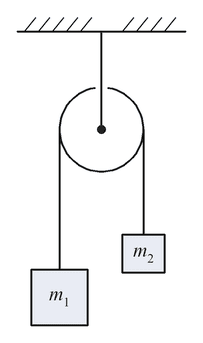
The two bodies of masses and respectively are tied to the ends of a string which passes over a light frictionless pulley. The masses are initially at rest and released. The acceleration of the centre of mass is
 Solve with AI
Answer
- Correct
(A)
(B)
(C)
(D) zero
Answer: (A)
Concept: For two particles moving along one line, , with each acceleration given its sign. For masses over a light frictionless pulley, each mass accelerates with .
Step 1 — Find the accelerations of the two masses. The heavier mass moves down and moves up, each with the size
Taking downward as positive, and .
Step 2 — Put these into the formula for . We substitute the two signed accelerations:
Step 3 — Substitute . We put in the value of from Step 1:
The centre of mass accelerates downward, because the heavier mass moves down.
- (B) This is the acceleration of each mass, not of their centre of mass; it leaves out the second factor .
- (C) would need the string tension to vanish, as in free fall; here the tension pulls both masses upward, so the net external force is less than the total weight.
- (D) Zero holds only when ; with the net external force on the two masses and the string (their total weight minus the upward pull of the pulley on the string) is not zero.
Therefore, the acceleration of the centre of mass is , option (A).
- 51 mark
Question 5
Where will be the centre of mass on combining two masses and ?
(A) towards
(B) towards
(C) between and
(D) anywhere
Solve with AIWritten solution
Solution:
Concept: The centre of mass of two point masses lies on the line joining them, between them, and divides the distance in the inverse ratio of the masses: .
Step 1 — Find which mass it is nearer. From , the distances are in the ratio . Since , , so the centre of mass is nearer . This is option (B).
Step 2 — Check the other options. The centre of mass always lies between the two masses on the line joining them, so statement (C) is also true. Statement (A) is false because the centre of mass is farther from , and (D) is false because its position is fixed by the masses and their positions.
Note: The printed key gives only "towards ", the more specific answer. The statement "between and " is also true for any two masses, so two of the printed options are correct.
Therefore, the centre of mass lies between and , nearer the heavier mass : options (B) and (C) are both correct, and (B) is the more complete answer.
- 61 mark
Question 6
The centre of mass of a body
Solve with AIAnswer
(A) lies always outside the body
- Correct
(B) may lie within, outside or on the surface of the body
(C) lies always inside the body
(D) lies always on the surface of the body
Answer: (B) May lie within, outside or on the surface of the body
Concept: The centre of mass is a point fixed by the distribution of mass; there need not be any material at that point.
Step 1 — Give a case inside. For a uniform solid sphere the centre of mass is at its centre, inside the material.
Step 2 — Give a case outside. For a ring or a hollow sphere the centre of mass is at the centre, where there is no material.
Step 3 — Give a case on the surface. For two equal uniform balls stuck together and treated as one body, the centre of mass is at their point of contact, which lies on the surface of the body.
- (A) A solid sphere has its centre of mass inside, so "always outside" is false.
- (C) A ring has its centre of mass outside its material, so "always inside" is false.
- (D) Neither the solid sphere nor the ring has its centre of mass on its surface, so "always on the surface" is false.
Therefore, the centre of mass of a body may lie within, outside or on the surface of the body, option (B).
- 71 mark
Question 7
The centre of mass of a system of two particles divides the distance between them
Solve with AIAnswer
(A) in inverse ratio of square of masses of particle
(B) in direct ratio of square of masses of particles
- Correct
(C) in inverse ratio of masses of particles
(D) in direct ratio of masses of particles
Answer: (C) In inverse ratio of masses of particles
Concept: Take the centre of mass as the origin on the line joining the particles. Then , so the particles are on opposite sides of with , where and are their distances from .
Step 1 — Write the balance of the two distances. Since is the origin, the mass-weighted distances on the two sides are equal:
Step 2 — Form the ratio. Dividing both sides by gives
So the distances are in the inverse ratio of the masses: the heavier particle is nearer .
- (A) The squares of the masses never enter; the formula is linear in each mass.
- (B) The squares of the masses never enter, and a direct ratio would also put the heavier particle farther away.
- (D) A direct ratio would place the centre of mass nearer the lighter particle, which is the wrong way round.
Therefore, the centre of mass divides the distance between them in the inverse ratio of their masses, option (C).
- 81 mark
Question 8
A body of mass while falling vertically downwards under gravity breaks into two parts, a body of mass and a body of mass . The centre of mass of bodies and taken together shifts compared to that of body towards
Solve with AIAnswer
(A) body
(B) body
(C) depends on height of breaking
- Correct
(D) does not shift
Answer: (D) Does not shift
Concept: The motion of the centre of mass is decided only by the external forces: . Forces between the parts of the body are internal and cancel in pairs.
Step 1 — Identify the force that breaks the body. The body breaks because of internal forces between its parts. These do not change the total momentum or the path of the centre of mass.
Step 2 — Compare the external force before and after. Before breaking, the external force is the weight . After breaking, it is the sum of the weights of the parts (air resistance is neglected):
So the external force is unchanged.
Step 3 — Conclude. The centre of mass of and therefore carries on along exactly the same path, with the same acceleration , as the centre of mass of would have done if it had not broken.
- (A) is the heavier part, so the centre of mass of and is nearer than ; but it is at the same place where 's centre of mass would have been, so it has not shifted towards .
- (B) For the same reason it has not shifted towards either.
- (C) The breaking can happen at any height; at every height the forces are internal, so the result does not depend on the height.
Therefore, the centre of mass does not shift, option (D).
- 91 mark
Question 9
Two objects of masses and possess velocities and respectively. The velocity of their centre of mass in m/s is
Solve with AIAnswer
(A)
(B)
- Correct
(C)
(D)
Answer: (C)
Concept: The velocity of the centre of mass of two particles is
Step 1 — Write the data. The first object has mass and velocity m/s; the second has mass and velocity m/s. The grams cancel in the ratio, so we can keep them.
Step 2 — Substitute. We put the data into the formula:
- (A) The part is right, but the part must be : only the 500 g object has a velocity, and it is positive.
- (B) Both parts are wrong: the part is , not , and the part is , not .
- (D) The part is , not , and the part is positive, .
Therefore, the velocity of the centre of mass is m/s, option (C).
- 101 mark
Question 10
Two bodies of different masses of and are moving with velocities and towards each other due to mutual gravitational attraction. What is the velocity of their centre of mass?
Solve with AIAnswer
(A)
(B)
(C)
- Correct
(D) zero
Answer: (D) Zero
Concept: The velocity of the centre of mass is , with velocities in opposite directions given opposite signs.
Step 1 — Choose signs. We take the direction of motion of the 2 kg body as positive. Then and, since the 4 kg body moves towards it, .
Step 2 — Substitute. We put the values into the formula:
This agrees with the fact that only internal (mutual) forces act: if the bodies started from rest, the centre of mass stays at rest.
- (A) is the plain average of and , which leaves out the masses.
- (B) would need a total momentum of , but the two momenta, and , cancel.
- (C) would need a total momentum of , but the total momentum is zero.
Therefore, the velocity of their centre of mass is zero, option (D).
- 111 mark
Question 11
Is it possible that the centre of gravity and centre of mass of a body occupy different positions?
Solve with AIWritten solution
Solution:
Concept: The centre of mass weights each part of a body by its mass; the centre of gravity weights it by its weight , where is the gravitational field at that part.
Step 1 — Find when they differ. If the gravitational field is not the same over the whole body, parts in a stronger field are given more weight, and the centre of gravity moves away from the centre of mass. For a very tall body, such as a very tall tower, the lower parts are pulled a little more strongly, so its centre of gravity is slightly below its centre of mass.
Therefore, yes: if the gravitational field is non-uniform over the body, its centre of mass and centre of gravity will not coincide.
- 121 mark
Question 12
How will you explain the recoil of gun using the centre of mass concept?
Solve with AIWritten solution
Solution:
Concept: With no horizontal external force, the centre of mass of a system at rest stays at rest.
Step 1 — Apply it to the gun and bullet. Before firing, the gun and bullet are at rest, so their centre of mass is at rest. The force of the exploding gases is internal to the gun–bullet system. When the bullet moves forward, the gun must move backward so that the centre of mass of the two stays where it was (the total momentum stays zero: ).
Therefore, the bullet moves forward and, to keep the centre of mass before and after firing the same, the gun must move backward (recoil).
- 131 mark
Question 13
Where does the centre of mass of a system of two particles lie, if one particle is more massive than the other?
Solve with AIWritten solution
Solution:
Concept: The centre of mass divides the line joining two particles in the inverse ratio of their masses: .
Step 1 — Compare the distances. From , if then , so the heavier particle is nearer the centre of mass.
Therefore, the centre of mass lies on the line joining them, close to the more massive particle.
- 141 mark
Question 14
Give an example each for a body where the centre of mass lies (i) inside the body and (ii) outside the body.
Solve with AIWritten solution
Solution:
Concept: For a uniform symmetric body the centre of mass is at its centre of symmetry; it is "inside" only if there is material at that point.
Step 1 — (i) Inside. A uniform solid sphere has its centre of mass at its centre, which is inside the material of the body.
Step 2 — (ii) Outside. A doughnut (ring) or an annular disc has its centre of mass at its centre, where there is a hole and no material.
Therefore, (i) a solid sphere has its centre of mass inside the body; (ii) a doughnut or an annular disc has its centre of mass outside the body.
- 151 mark
Question 15
Is it possible that the centre of mass and geometrical centre of a body coincide? Give examples.
Solve with AIWritten solution
Solution:
Concept: If a body is uniform (the same density everywhere) and symmetric about a centre, its centre of mass is at that geometrical centre.
Step 1 — Give examples. A uniform solid sphere and a uniform cube are symmetric about their geometrical centres, so their centres of mass are at those centres. (A body whose density is not uniform, such as a ball with a lead weight on one side, has its centre of mass away from its geometrical centre.)
Therefore, yes: for uniform symmetric bodies such as a sphere and a cube, the centre of mass coincides with the geometrical centre.
- 161 mark
Question 16
Where does the centre of mass of a square lie?
Solve with AIWritten solution
Solution:
Concept: The centre of mass of a uniform lamina lies on every line of symmetry of it.
Step 1 — Use the diagonals. Each diagonal of a uniform square lamina is a line of symmetry, so the centre of mass lies on both diagonals, that is, at the point where they meet.
Therefore, the centre of mass of a (uniform) square lies at the point of intersection of its diagonals.
- 171 mark
Question 17
No external force acts on a system of particles, moving with a constant velocity. What is the velocity of the centre of mass?
Solve with AIWritten solution
Solution:
Concept: The centre of mass obeys , so with no external force it has no acceleration.
Step 1 — Apply the rule. With no external force, , so the velocity of the centre of mass does not change. It keeps the value it had, which is equal to the total momentum divided by the total mass.
Therefore, the velocity of the centre of mass is also constant.
- 181 mark
Question 18
The centre of mass of a two-particle system is at the origin. What is the magnitude of the position vector of centre of mass?
Solve with AIWritten solution
Solution:
Concept: The position vector of a point is drawn from the origin to that point; its magnitude is the distance of the point from the origin.
Step 1 — Apply it. The centre of mass is at the origin itself, so its distance from the origin is zero and .
Therefore, the magnitude of the position vector of the centre of mass is zero.
- 192 marks
Question 19
What is a rigid body?
Solve with AIWritten solution
Solution:
Concept: In a real solid the particles are held by strong forces, and for many problems we can ignore the tiny changes of shape these forces allow.
Step 1 — State the definition. A rigid body is a body whose particles keep their relative positions (the distance between every pair of particles stays the same) when an external force or torque is applied on it.
Step 2 — Note that it is an ideal. No real body is perfectly rigid, since every body deforms a little under force; a rigid body is the ideal model we use when such deformation is negligible.
Therefore, a rigid body is a body whose particles preserve their relative positions when an external force or torque is applied on it.
- 202 marks
Question 20
Define centre of mass. Write down the expression for the position vector of centre of mass of a system of two particles.
Solve with AIWritten solution
Solution:
Concept: The centre of mass is the mass-weighted average position of the particles of a system.
Step 1 — Define the centre of mass. The centre of mass of a system of particles is a fixed point (for a given arrangement) at which the whole mass of the system may be considered to be concentrated.
Step 2 — Write the expression. Let particles of masses and have position vectors and from an origin , as shown in the figure.
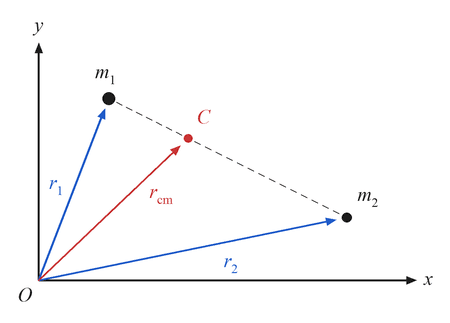
The position vector of their centre of mass is
Therefore, the centre of mass is the point where the whole mass of the system may be taken to be concentrated, and for two particles .
- 212 marks
Question 21
Show that the -coordinate of the centre of mass of a system consisting of two particles of equal masses is .
Solve with AIWritten solution
Solution:
Concept: For two particles on the -axis, .
Step 1 — Set up the two particles. Let the two particles each have mass and lie at and , as in the figure.

Step 2 — Put equal masses into the formula. We put the same mass for both particles:
Step 3 — Cancel the common mass. The factor cancels from the top and bottom:
Therefore, for two equal masses : the centre of mass is midway between them.
- 222 marks
Question 22
Prove that the centre of mass of a two-particle system is closer to the heavier particle.
Solve with AIWritten solution
Solution:
Concept: Taking the origin at the centre of mass makes the mass-weighted sum of positions zero.
Step 1 — Set up the line. Let a heavier particle and a lighter particle lie on a line, with their centre of mass as the origin. Let and be their distances from , as in the figure.
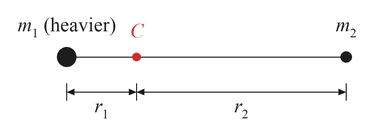
Step 2 — Use the definition. With at the origin the particles are at and , and the definition of the centre of mass gives
Step 3 — Compare the distances. Dividing by gives
Since , the right-hand side is less than 1, so .
Therefore, the distance of the centre of mass from the heavier particle is the smaller one: the centre of mass is closer to the heavier particle.
- 232 marks
Question 23
Write down the expression for the velocity of centre of mass of a system consisting of two particles.
Solve with AIWritten solution
Solution:
Concept: The velocity of the centre of mass is the rate of change of its position vector, .
Step 1 — Differentiate the position vector. The masses are constant, so differentiating with respect to time replaces each by its velocity:
Here is the velocity of the first particle of mass and that of the second particle of mass .
Therefore, .
- 242 marks
Question 24
Write down the expression for the acceleration of the centre of mass of a system consisting of two particles.
Solve with AIWritten solution
Solution:
Concept: The acceleration of the centre of mass is the rate of change of its velocity, .
Step 1 — Differentiate the velocity. The masses are constant, so differentiating with respect to time gives
Here is the acceleration of the first particle of mass and that of the second particle of mass .
Therefore, .
- 252 marks
Question 25
What is the expression for the position vector of the centre of mass of a system consisting of particles?
Solve with AIWritten solution
Solution:
Concept: The centre of mass is the mass-weighted average of the position vectors of all the particles.
Step 1 — Write the expression. For particles of masses with position vectors , the position vector of the centre of mass is the mass-weighted average of their position vectors:
Step 2 — Define the total mass. Here is the total mass of the system:
Therefore, , the sum running over all particles, where is the total mass.
- 262 marks
Question 26
Give two examples of centre of mass motion.
Solve with AIWritten solution
Solution:
Concept: Internal forces cannot change the motion of the centre of mass of a system; it moves as a single particle acted on by the external forces only.
Step 1 — Explosion of a cracker or shell. When a shell explodes in mid-air, the explosion forces are internal. The fragments fly apart, but their centre of mass carries on along the same parabolic path the shell would have followed (until a fragment hits something).
Step 2 — The Earth–Moon system. The Earth and the Moon pull on each other with internal forces. Their common centre of mass (inside the Earth, about 4700 km from its centre) is what moves smoothly round the Sun, while the Earth and the Moon both go round it.
Therefore, two examples are (i) the explosion of a cracker or shell and (ii) the motion of the Earth–Moon system.
- 272 marks
Question 27
Define centre of gravity.
Solve with AIWritten solution
Solution:
Concept: Every particle of a body is pulled by gravity; these weights can be replaced by one force, the total weight, acting at one point.
Step 1 — State the definition. The centre of gravity of a rigid body is the point through which its whole weight is supposed to act, in whatever position the body is placed.
Therefore, the centre of gravity of a rigid body is the point at which its whole weight is supposed to act.
- 282 marks
Question 28
Is it possible that the centre of gravity of a body lies outside the body?
Solve with AIWritten solution
Solution:
Concept: The centre of gravity is a point fixed by how the weight is spread through the body; there need not be any material at that point.
Step 1 — Give examples. For a uniform L-shaped sheet with thin arms (made of two narrow rectangles), the centre of gravity lies in the empty corner region between the two arms. For a ring, it is at the centre of the ring. For a compact disc (CD), it is at the centre of its central hole.
Therefore, yes: the centre of gravity of an L-shaped uniform sheet, a ring or a compact disc lies outside the body (for a CD, at the centre of its hole).
- 293 marks
Question 29
Define centre of mass. Write down the expression for the position vector of the centre of mass of a system of two particles. Also give the expression for the -coordinate and -coordinate.
Solve with AIWritten solution
Solution:
Concept: The centre of mass is the mass-weighted average position of the particles; a vector equation splits into one equation for each coordinate.
Step 1 — Define the centre of mass. The centre of mass of a system of particles is the point at which the whole mass of the system may be considered to be concentrated; it moves as if all the external forces acted on the total mass placed there.
Step 2 — Write the position vector. Let particles of masses and be at and , with position vectors and from the origin , as shown in the figure.
The centre of mass has position vector
Step 3 — Split into coordinates. We write , and . Equating the parts and then the parts on the two sides gives
Therefore, , with and .
- 303 marks
Question 30
Derive the equations for the velocity of centre of mass and also the acceleration of centre of mass of a system consisting of two particles.
Solve with AIWritten solution
Solution:
Concept: Velocity is the time derivative of position, and acceleration is the time derivative of velocity. The masses of the particles do not change with time.
Step 1 — Start from the position of the centre of mass. We begin with particles of masses and at position vectors and , shown in the figure.
The position vector of their centre of mass is
Step 2 — Differentiate once to get the velocity. We differentiate both sides with respect to time , keeping the constant masses outside the derivative:
Since , and , this becomes
Step 3 — Differentiate again to get the acceleration. We differentiate the velocity equation with respect to time in the same way:
Since , and , this becomes
Therefore, and .
- 313 marks
Question 31
Show that the total linear momentum of a system of particle is a constant, if no external force acts on the system.
Solve with AIWritten solution
Solution:
Concept: For a system of total mass , Newton's second law for the centre of mass is , because the internal forces cancel in action–reaction pairs.
Step 1 — Write the total momentum. For particles of masses with velocities , the total linear momentum is
Since , this is the total mass times the velocity of the centre of mass:
Step 2 — Find how it changes with time. We differentiate with respect to time; is constant:
Step 3 — Use the equation of motion of the centre of mass. Each internal force on particle comes with an equal and opposite on particle , so all internal forces add to zero and only the external force is left:
Step 4 — Put the external force equal to zero. If no external force acts, , so
A quantity whose rate of change is zero does not change.
Therefore, when no external force acts, is constant: the total linear momentum of the system (and the velocity of its centre of mass) stays constant.
- 323 marks
Question 32
Name the factors on which the centre of mass of a body depends. Give the position of centre of mass of (i) a thin uniform rod, (ii) a ring, (iii) a cube and (iv) a cone.
Solve with AIWritten solution
Solution:
Concept: The centre of mass is , so it depends only on the masses and their positions; for a uniform symmetric body it lies on every axis or plane of symmetry.
Step 1 — Name the factors. The centre of mass of a body depends on its shape, its size and the distribution of mass in it (it does not depend on the forces acting on it).
Step 2 — (i) Thin uniform rod. The rod is symmetric about its mid-point, so its centre of mass is at its mid-point, at a distance from either end, where is its length.
Step 3 — (ii) Ring. A uniform ring is symmetric about its centre, so its centre of mass is at the geometrical centre of the ring, where there is no material.

Step 4 — (iii) Cube. A uniform cube is symmetric about its centre, so its centre of mass is at its geometrical centre, the point where its body diagonals (the lines joining opposite corners) meet.
Step 5 — (iv) Cone. A uniform solid cone of height is symmetric about its axis, and more of its mass is near the base, so its centre of mass is on the axis at a distance from the vertex ( from the base centre ).
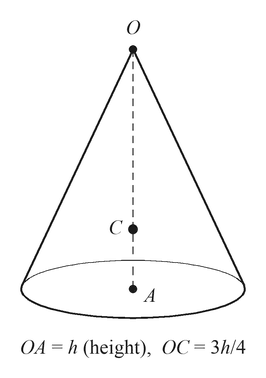
Therefore, the centre of mass depends on the size, shape and mass distribution of the body; it is at (i) the mid-point of a uniform rod, (ii) the centre of a ring, (iii) the centre of a cube (meeting point of its body diagonals) and (iv) on the axis of a solid cone at from the vertex.
- 333 marks
Question 33
Define centre of gravity. Why do we need the concept of centre of gravity? Mention the position of the centre of gravity of a metre scale. Will the centre of gravity coincide with the centre of mass in the case of extended bodies?
Solve with AIWritten solution
Solution:
Concept: The weights of all the particles of a body can be replaced by one force, the total weight, acting at a single point.
Step 1 — Define the centre of gravity. The centre of gravity of a body is the point through which the resultant of the weights of all its particles (its total weight) acts, in every position of the body.
Step 2 — Explain why we need it. Instead of handling the weight of every particle separately, we replace them by one force acting at the centre of gravity. This makes it simple to study the balance (equilibrium) and stability of bodies: a body supported at its centre of gravity balances, and a body standing on a base is stable as long as the vertical line through its centre of gravity falls within the base.
Step 3 — Locate it for a metre scale. A uniform metre scale is symmetric about its middle, so its centre of gravity is at its mid-point, the mark. It balances on a knife-edge placed there.
Step 4 — Compare with the centre of mass. For extended bodies of ordinary size near the Earth, is practically the same at every part, so the centre of gravity coincides with the centre of mass for all practical purposes. For a very large body (comparable in size with the Earth, or a very tall structure), varies over the body and the two points do not coincide exactly.
Therefore, the centre of gravity is the point where the whole weight acts; it simplifies problems of balance and stability; for a uniform metre scale it is at the 50 cm mark; and it coincides with the centre of mass for extended bodies in a uniform gravitational field, but not for very large bodies in a non-uniform field.
- 345 marks
Question 34
(a) Derive an expression for the position vector of the centre of mass of a two-particle system.
(b) Show the centre of mass of a two-particle system consisting of a heavier mass and lighter mass.
Solve with AIWritten solution
Solution:
Concept: The centre of mass of a system is the point which moves as if the whole mass were concentrated there and all the external forces acted there.
Step 1 — (a) Set up the system. Let particles of masses and be at points and , with position vectors and from a fixed origin , as in the figure. Let and be the external forces on them, and , the internal forces they exert on each other.
Step 2 — (a) Apply Newton's second law to each particle. Newton's second law for the two particles gives:
Step 3 — (a) Add the two equations. By Newton's third law , so the internal forces cancel when we add:
Step 4 — (a) Write it as the motion of one point. Let and . Multiplying and dividing the left-hand side by (the masses are constant) gives
This is the equation of a single particle of mass , acted on by the total external force, at the point whose position vector is the quantity in brackets. That point is the centre of mass:
Step 5 — (b) Place the origin at the centre of mass. Let the heavier mass and the lighter mass lie on a line, and take as the origin, so . Let and be the distances of and from ; they lie on opposite sides of , as in the figure.
Step 6 — (b) Use the expression from (a). With the particles at and along the line, the expression gives
Step 7 — (b) Compare the distances. Since , the ratio is less than 1, so . The centre of mass lies between the two particles and divides the distance between them in the inverse ratio of their masses.
Therefore, (a) ; (b) for a heavier mass and a lighter mass , , so the centre of mass lies between them, nearer the heavier mass.
- 355 marks
Question 35
(a) For a system consisting of particles, obtain an expression for (i) position vector of centre of mass, (ii) velocity of centre of mass and (iii) acceleration of centre of mass.
(b) If no external force acts on a system of particles, show that the velocity of the centre of mass of the system is a constant.
What Class 11 Physics Ch 10 covers
The sections of the chapter, in the order the book takes them. Every question above comes from one of these.
- 01Idea and Definition of Centre of Mass
- 02Centre of Mass of a Two-Particle System
- 03Motion of Centre of Mass
- 04Centre of Mass of a Rigid Body
- 05Centre of Gravity
More ways to study this chapter
The same chapter asked three other ways. Practise it, revise it, and see what the board has set on Ch 10 before.
Class 11 Physics Ch 10 questions students ask
How many questions are there in Class 11 Physics Ch 10?
35 questions. Every one is solved step by step on this page.
Are these Class 11 Physics solutions free?
Yes. Every question and its full working is free to read, with no account needed.
Can I download the Class 11 Physics Ch 10 solutions as a PDF?
There is no PDF to download. Every solution is on this page instead, which means it is searchable, always the current syllabus, and readable on a phone. Use your browser's print option if you want it on paper.