
Question 345 marksMedium
(a) Derive an expression for the position vector of the centre of mass of a two-particle system.
(b) Show the centre of mass of a two-particle system consisting of a heavier mass and lighter mass.
Confirming your payment
Sign up now and get 250 free tokens.
Centre of Mass · Question 34 of 35
(a) Derive an expression for the position vector of the centre of mass of a two-particle system.
(b) Show the centre of mass of a two-particle system consisting of a heavier mass and lighter mass.
Solution:
Concept: The centre of mass of a system is the point which moves as if the whole mass were concentrated there and all the external forces acted there.
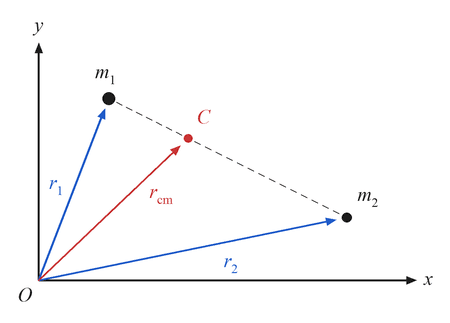
Step 1 — (a) Set up the system. Let particles of masses and be at points and , with position vectors and from a fixed origin , as in the figure. Let and be the external forces on them, and , the internal forces they exert on each other.
Step 2 — (a) Apply Newton's second law to each particle. Newton's second law for the two particles gives:
Step 3 — (a) Add the two equations. By Newton's third law , so the internal forces cancel when we add:
Step 4 — (a) Write it as the motion of one point. Let and . Multiplying and dividing the left-hand side by (the masses are constant) gives
This is the equation of a single particle of mass , acted on by the total external force, at the point whose position vector is the quantity in brackets. That point is the centre of mass:
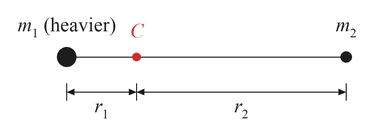
Step 5 — (b) Place the origin at the centre of mass. Let the heavier mass and the lighter mass lie on a line, and take as the origin, so . Let and be the distances of and from ; they lie on opposite sides of , as in the figure.
Step 6 — (b) Use the expression from (a). With the particles at and along the line, the expression gives
Step 7 — (b) Compare the distances. Since , the ratio is less than 1, so . The centre of mass lies between the two particles and divides the distance between them in the inverse ratio of their masses.
Therefore, (a) ; (b) for a heavier mass and a lighter mass , , so the centre of mass lies between them, nearer the heavier mass.