
Opening your dashboard
Class 11 Physics Chapter 10 Centre of Mass: Competency-Based Questions (CBQ)
40 questions on Chapter 10, each worked through on its own page with the AI tutor. Class 11 Physics, ICSE 2026-27.
40 questions
1–4 marks · Mixed difficulty
- 14 marks
Question 1
Competency: Application
A sports-science class models a standing student of mass and height as six parts, each treated as a particle at its own centre of mass. The table gives the mass of each part (left and right sides together) and the height of its centre of mass above the floor, first with the arms hanging at the sides and then with both arms stretched straight up above the head. (Hypothetical data.)
Part Mass (kg) Height, arms down (m) Height, arms up (m) Head and neck Trunk Upper arms Forearms and hands Thighs Lower legs and feet (a) Find the height of the student's centre of mass above the floor when standing with the arms down.
(b) Using only the parts that move, find how far the centre of mass rises when the student raises both arms.
(c) The hands rise by almost a metre. Explain, from the definition of the centre of mass, why the student's centre of mass rises by only a few centimetres.
- 24 marks
Question 2
Competency: Application
A warehouse loads cartons on a wooden pallet long and wide, shown from above. The pallet has a mass of , with its centre of mass at its centre. Take the origin at one corner, the -axis along the edge and the -axis along the edge. The pallet is marked out in six equal slots, and each carton's centre of mass is above the centre of its slot. (Hypothetical data.)
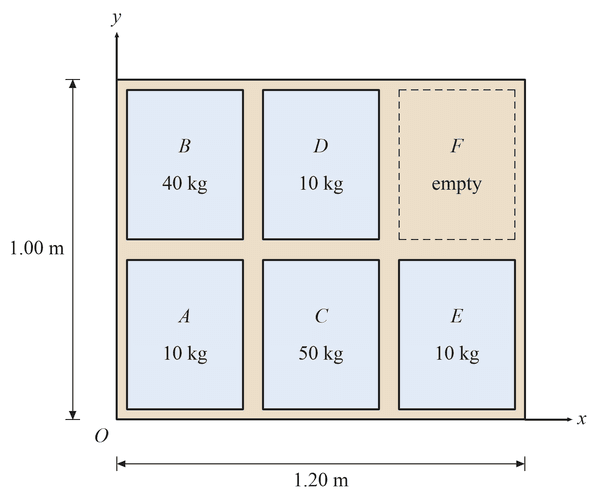
Carton A B C D E Mass (kg) Slot centre in m Slot F, centred at , is empty. The warehouse rule for lifting with a forklift is that, seen from above, the centre of mass of the loaded pallet must lie within of the pallet's centre in both the and the directions.
(a) Find the coordinates of the centre of mass of the loaded pallet, seen from above.
(b) Does the load meet the rule? Explain.
(c) A carton is to be placed in slot F. Find the mass it must have to bring exactly to , and check whether the load then meets the rule.
- 31 mark
Question 3
Competency: Application
A cargo ship, together with everything on board, has a total mass of t. One of its own deck cranes lifts a t container and sets it down m across the deck, towards the starboard (right-hand) side. (Hypothetical data.) Relative to the ship's hull, the centre of mass of the ship and everything on board moves
- 41 mark
Question 4
Competency: Analysis & Evaluation
Four lanterns hang from a straight horizontal wire: ( kg) at , ( kg) at m, ( kg) at m and ( kg) at m. Treat each lantern as a particle. (Hypothetical data.) Which single lantern, if it is taken down, moves the centre of mass of the remaining three lanterns through the greatest distance?
- 51 mark
Question 5
Competency: Analysis & Evaluation
A jeweller places several small beads of different masses on a flat, horizontal glass tray, so that every bead rests on the top surface of the glass. Treat the beads as particles.
Assertion (A): The centre of mass of the beads lies in the plane of the top surface of the tray, whatever their masses and positions on it.
Reason (R): Each coordinate of the centre of mass is a weighted average of the particles' coordinates, with the masses as weights, so if every particle is at the same height , the centre of mass is also at height .
- 63 marks
Question 6
Competency: Application
A tower crane on a building site has a jib m long on one side of its mast and a shorter counter-jib on the other. A concrete counterweight of t sits on the counter-jib with its centre of mass m from the axis of the mast. The trolley on the jib carries a t load hanging m from the axis, as shown. To keep the bending of the mast small, the operator tries to keep the combined centre of mass of the load and the counterweight close to the mast's axis. Treat the load and the counterweight as particles, and ignore the masses of the jib, the counter-jib, the trolley and the cable. (Hypothetical data.)

(a) Find the position of the centre of mass of the load and the counterweight, measured from the axis of the mast.
(b) How far from the axis should the trolley carry the t load for this centre of mass to lie exactly on the axis?
(c) The counterweight is made of identical t concrete blocks. How many blocks are needed for the combined centre of mass to lie on the axis when a t load is carried m from the axis?
- 74 marks
Question 7
Competency: Analysis & Evaluation
In a physics video, two pucks are joined by a light rigid rod so that their centres are m apart. Puck A has a mass of kg and puck B a mass of kg. The pair is set sliding and spinning across smooth, level ice; friction and air resistance are negligible. (Hypothetical data.)
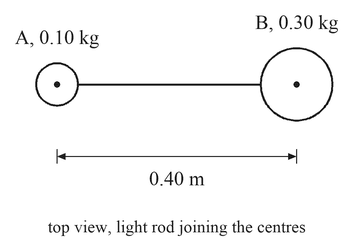
(a) Every point of the rod traces a wavy path except one, which moves along a straight line at constant speed. Which point is it, and how far is it from the centre of B?
(b) In the video this point moves m in s. Find its speed and the total linear momentum of the pair.
(c) At one instant the rod lies at right angles to the path of that point, and both pucks are then moving parallel to that path, in its direction of motion. Puck A moves at . Find the speed of puck B at that instant.
- 81 mark
Question 8
Competency: Application
A hammer thrower of mass kg spins with the kg hammer at arm's length, its ball about m horizontally from the thrower's own centre of mass. (Hypothetical data.) To keep balance, the thrower leans back, so that the combined centre of mass of the thrower and the hammer stays above the thrower's feet. Treating the thrower and the hammer as two particles, how far from the thrower's own centre of mass is this combined centre of mass?
- 91 mark
Question 9
Competency: Analysis & Evaluation
Two blocks, P of mass kg and Q of mass kg, are joined by a light spring and lie on a smooth horizontal floor. A student pulls them apart, stretching the spring, and lets go of both at the same instant, so that they start from rest. The blocks then oscillate to and fro along the line of the spring, and Q moves cm on either side of its middle position. (Hypothetical data.) How far on either side of its middle position does P move?
- 101 mark
Question 10
Competency: Analysis & Evaluation
Two skaters glide across a smooth ice rink holding the ends of a light pole m long, so that the distance between them stays the same.
Assertion (A): Because the distance between the two skaters does not change, their centre of mass must be at rest.
Reason (R): The centre of mass of two particles lies on the straight line joining them, between the two particles.
- 114 marks
Question 11
Competency: Analysis & Evaluation
On a level air track, where friction is negligible, glider A of mass kg moves towards glider B of mass kg, which is at rest. The gliders have spring bumpers and collide. A video gives the positions of the gliders' centres along the track, measured from the left end of the track, at equal time intervals. (Hypothetical data.)
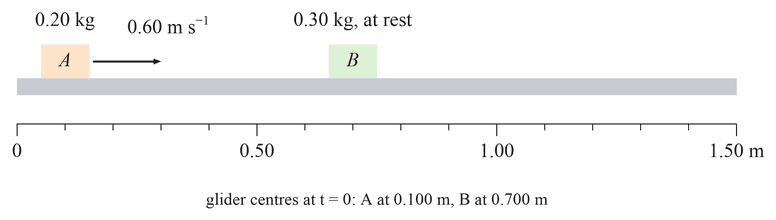
(s) (m) (m) (a) Find the position of the centre of mass of the two gliders at each of the five times.
(b) Show that the centre of mass moves with a constant velocity, and find that velocity.
(c) Use the table to find the velocities of A and B after the collision. Show that the total momentum is the same before and after the collision, and explain why the collision does not change the motion of the centre of mass.
- 123 marks
Question 12
Competency: Analysis & Evaluation
In a school tug of war on level grass, team A (total mass kg) pulls against team B (total mass kg) with a rope of mass kg. At one moment the ground exerts a total horizontal friction force of N on the feet of team A, pointing away from team B, and N on the feet of team B, pointing away from team A. (Hypothetical data.)
(a) Treating both teams and the rope as one system, find the acceleration of its centre of mass and state its direction.
(b) At this moment both teams and the rope move together with this acceleration. Find the tension at each end of the rope.
(c) A student says, “The rope pulls each team with almost the same force, so neither team can win.” Explain what really decides which team wins.
- 131 mark
Question 13
Competency: Analysis & Evaluation
A uniform pencil is balanced upright on its sharpened tip on a sheet of perfectly smooth (frictionless) glass lying flat on a table. Released from rest, it topples over until it lies flat on the glass. Which path does the centre of mass of the pencil follow while it falls?
- 141 mark
Question 14
Competency: Analysis & Evaluation
A rocket coasts in deep space, far from any star or planet, and then fires its engine, throwing hot gas out backwards.
Assertion (A): While the engine fires, the centre of mass of the rocket together with all the gas it has thrown out keeps moving with the same constant velocity as before.
Reason (R): The forces between the rocket and its exhaust gas are internal forces of the rocket–gas system, and they cancel in pairs by Newton's third law.
- 151 mark
Question 15
Competency: Analysis & Evaluation
A car slides along a perfectly frictionless sheet of ice, and the driver presses the brakes hard. Ignore air resistance.
Assertion (A): Pressing the brakes cannot slow down the centre of mass of the car.
Reason (R): When the brakes are applied, friction between the brake pads and the brake discs turns kinetic energy into heat.
- 164 marks
Question 16
Competency: Application
A robot arm in a factory has a shoulder joint S fixed to a stand, an upper link SE and a forearm EG joined at the elbow E, and a gripper at G. The upper link is a uniform bar m long of mass kg, the forearm is a uniform bar m long of mass kg, and the gripper (mass kg) can be treated as a particle at G. Take . (Hypothetical data.)
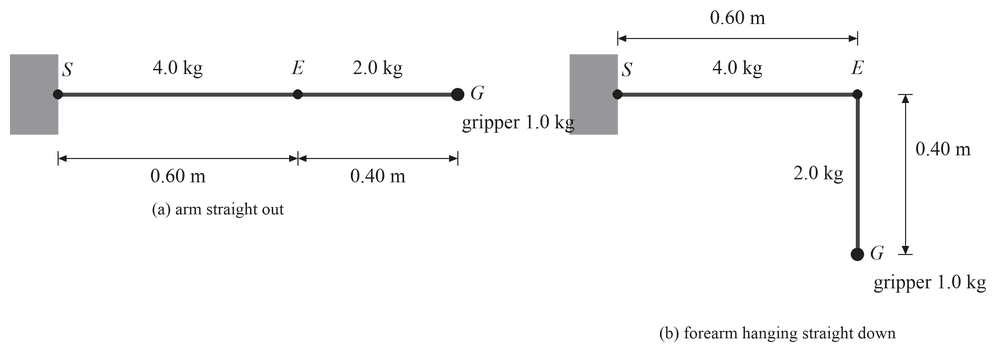
(a) With the whole arm held straight out horizontally, as in (a), find the distance of the centre of mass of the arm from S.
(b) The upper link stays horizontal and the forearm hangs straight down, as in (b). Taking S as the origin, the -axis along SE and the -axis vertically up, find the coordinates of the centre of mass of the arm.
(c) The motor at S must hold the arm still against the turning effect of its weight. Find this turning effect (torque) about S in each position, and say which position is easier for the motor to hold.
- 174 marks
Question 17
Competency: Application
A designer studies a simple metal chair, shown from the side. Its square seat, cm by cm, is a uniform plate of mass kg, cm above the floor. Its back is a uniform flat plate cm wide and cm tall, of mass kg, standing vertically up from the back edge of the seat. Each of its four legs is a uniform rod cm long, of mass kg, standing vertically under a corner of the seat. Treat the seat and the back as thin plates. Take the origin on the floor at the foot of a front leg, the -axis horizontal from front to back and the -axis vertically up. The chair is symmetrical about its middle plane, so its centre of mass lies in that plane. (Hypothetical data.)
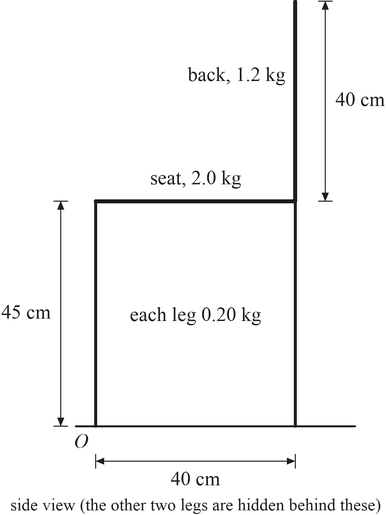
(a) Find the -coordinate (the horizontal distance behind the front legs) of the centre of mass of the chair.
(b) Find the height of the centre of mass of the chair above the floor.
(c) A bag is hung on the back of the empty chair so that the bag's centre of mass is cm behind the front legs. What is the largest mass of bag the chair can hold without tipping over backwards about its back legs?
- 181 mark
Question 18
Competency: Application
A uniform wooden rule m long has a hinge at its cm mark. It is folded at the hinge H until its two halves make an angle of with each other, as shown.
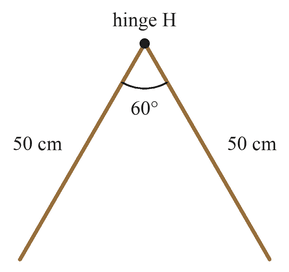
How far from the hinge is the centre of mass of the folded rule?
- 191 mark
Question 19
Competency: Analysis & Evaluation
A thin hollow plastic ball is half filled with dry sand and placed on a table, where the sand settles in the bottom half of the ball.
Assertion (A): The centre of mass of the ball and the sand lies below the centre of the ball.
Reason (R): The centre of mass of every body lies at its geometric centre.
- 201 mark
Question 20
Competency: Analysis & Evaluation
A uniform steel rod is bent into the shape of a semicircle to make the handle of a basket.
Assertion (A): The centre of mass of the handle lies on its line of symmetry, but not on the steel itself.
Reason (R): Bending the rod does not change its mass.
- 214 marks
Question 21
Competency: Application
A two-in-one laptop has a thin keyboard base, cm deep from front to back, of mass kg, and a heavy touch-screen cm long, of mass kg. The lower edge of the screen is hinged to the back edge of the base, and the screen can be tilted back by an angle beyond the vertical, as shown. The laptop rests on a level table on feet at the front and back edges of the base. Treat the base and the screen as uniform, and ignore the thickness of the base. (Hypothetical data.)
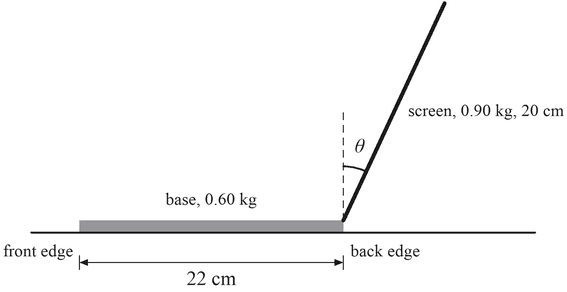
(a) With the screen upright (), find the horizontal distance of the centre of gravity of the laptop from its front edge.
(b) Find the largest angle to which the screen can be tilted back before the laptop tips over backwards.
(c) The maker wants the laptop to stay standing for any tilt up to by fixing a thin steel strip along the front edge of the base. Find the least mass of the strip.
- 223 marks
Question 22
Competency: Application
A student makes a hanging mobile from two light rods, strings and three ornaments. Rod 1, cm long, carries a g star at its left end and a g moon at its right end. Rod 2, cm long, carries a g bird at its right end, and rod 1 with its ornaments hangs from the left end of rod 2. Each rod hangs from a string tied to it, and the whole mobile hangs from a hook in the ceiling by the string tied to rod 2. The masses of the rods and strings are negligible. (Hypothetical data.)
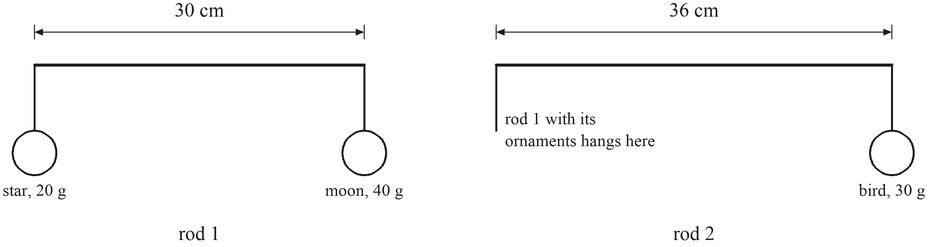
(a) Where on rod 1 must its string be tied for rod 1 to hang horizontally?
(b) Where on rod 2 must its string be tied for rod 2 to hang horizontally?
(c) Show that, when the mobile is balanced, the centre of gravity of the three ornaments lies vertically below the hook.
- 231 mark
Question 23
Competency: Analysis & Evaluation
A self-righting toy has a base that is a uniform solid hemisphere of radius cm and mass kg. A light hollow plastic figure of mass is fixed on its flat face. When the toy stands upright, the centre of mass of the hemisphere is cm ( of the radius) below the centre of the flat face, and the centre of mass of the figure is cm above , as shown. (Hypothetical data.) The toy rights itself after being tipped only if the centre of gravity of the whole toy lies below .
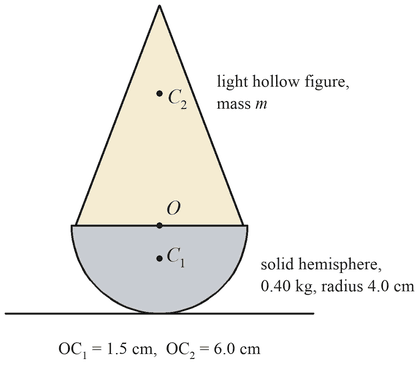
Above what value of will the toy no longer right itself?
- 241 mark
Question 24
Competency: Analysis & Evaluation
A student carries a heavy bucket of water in the right hand.
Assertion (A): To keep balance, the student leans the upper part of the body towards the left.
Reason (R): Leaning to the left moves the combined centre of gravity of the student and the bucket farther to the right, away from the student's feet.
- 251 mark
Question 25
Competency: Analysis & Evaluation
A toy bird is balanced on its beak on a fingertip, and a pencil is balanced on its sharpened tip on a table.
Assertion (A): A body balanced on a single point of support is always in stable equilibrium.
Reason (R): When a body rests balanced on a single point of support, its centre of gravity lies on the vertical line through that point.
- 263 marks
Question 26
A uniform sheet is cut in the shape of a house: a square of side , with an isosceles triangle of base and height standing on its top edge, as shown.

Find if the centre of mass of the whole sheet lies exactly on the line where the triangle meets the square. (The centre of mass of a uniform triangular sheet lies on its medians, one-third of its height above its base.)
- 274 marks
Question 27
(Hypothetical data.) A thin-walled metal tumbler, tall, has mass , and when empty its centre of gravity is above its base. The inside area of its base is , and the base is thin enough for the water to be taken as starting at height . Water (density ) is poured in to a depth , as shown.

(a) Find the height of the centre of gravity of the tumbler and water when it is filled to the brim.
(b) As water is poured in, the centre of gravity first falls and then rises. Explain why, and find the depth of water at which it is lowest.
- 283 marks
Question 28
A system consists of 3 particles each of mass located at , and respectively. Find the coordinates of the centre of mass.
- 293 marks
Question 29
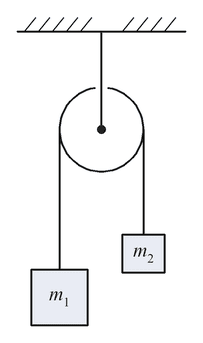
Two bodies of masses and respectively are tied to the ends of a string which passes over a light frictionless pulley. The masses are initially at rest and released. What is the acceleration of the centre of mass?
- 303 marks
Question 30
Find the centre of mass of the CO molecule. Given that the atoms are apart and the ratio of the masses of the two atoms .
- 313 marks
Question 31
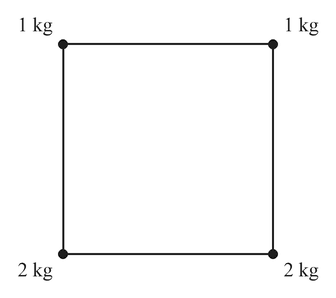
Four point masses , , and are placed at the corners of a square of side m as shown in the given figure. Find the centre of mass of the system.
- 323 marks
Question 32
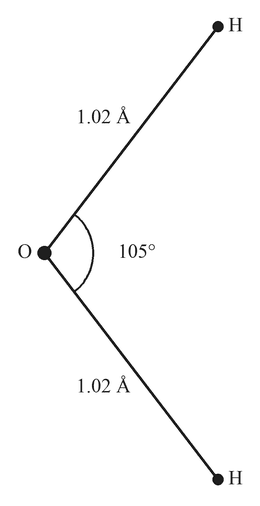
Find the centre of mass of the water molecule. Given that the , the distance between the oxygen atom and hydrogen atom is Å and the angle made by the two hydrogen atoms with the oxygen atom is .
- 333 marks
Question 33
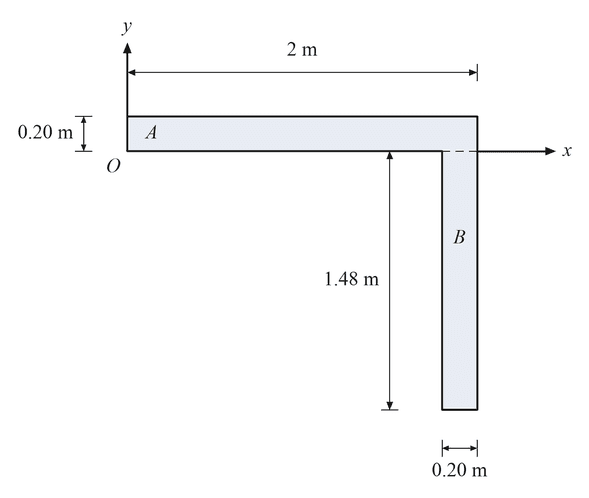
Locate the centre of mass of the uniform -shaped body as shown in the given figure. Assume its thickness to be and density .
- 343 marks
Question 34
A body falling vertically downwards explodes into two equal fragments when it is at a height of and has a downward velocity of . Just after the explosion one of the fragments is seen to move downward with a velocity of . Calculate the position of the centre of mass of the system after the explosion.
- 353 marks
Question 35
Two particles and are initially separated by a distance of and are at rest. The mass of is and that of is and they move under a constant mutual attractive force of . At what distance from 's original position do the particles collide?
- 363 marks
Question 36
Determine the and coordinates of the centre of mass of the system shown in the given figure. The system consists of masses , and placed at the vertices of an equilateral triangle of side .

- 373 marks
Question 37
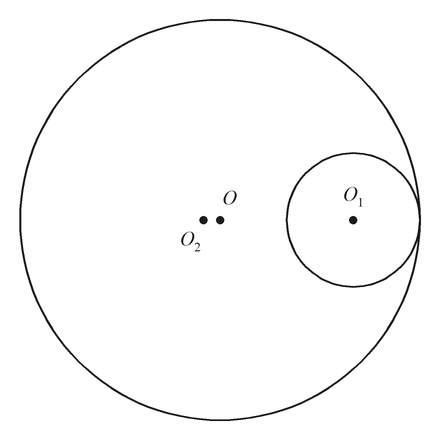
From a disc of mass and radius , another disc of radius is cut as shown in the given figure. Calculate the shift in the centre of mass i.e., .
- 381 mark
Question 38
Competency: Analysis & Evaluation
At a testing range, a dummy shell of mass kg is fired over level ground. Without any burst, it would land m from the gun. At the highest point of its path, a small charge splits it into two pieces of masses kg and kg. Just after the split, the kg piece is momentarily at rest, so it falls straight down. Ignore air resistance and the mass of the gas from the charge. (Hypothetical data.) How far from the gun does the kg piece land?
- 393 marks
Question 39
Competency: Application
A bat maker wants to find where the centre of gravity of a new cricket bat lies, and how heavy the bat is, without using a weighing scale. The bat is m long. She lays it flat on a knife edge and slides it until it balances, with the knife edge m from the top of the handle. She then tapes a g weight round the handle, m from its top, and the bat now balances with the knife edge m from the top of the handle. (Hypothetical data.)
(a) Explain why the bat balances only when the knife edge is directly below its centre of gravity.
(b) Find the mass of the bat.
- 404 marks
Question 40
Competency: Analysis & Evaluation
Before every flight, the pilot of a small four-seat training aircraft works out where its centre of gravity lies. Positions along the aircraft are measured as arms, in metres behind a reference line near the nose. The aircraft is safe to fly only if its centre of gravity lies between m and m behind this line. The loads for one flight are listed in the table. Treat each item as a particle at its own arm, and take to be the same for every item. (Hypothetical data.)
Item Mass (kg) Arm (m) Empty aircraft Pilot and front passenger Two rear passengers Baggage Fuel (a) Find the arm of the centre of gravity at take-off, and state whether the aircraft is safe to fly.
(b) The pilot decides to leave some of the baggage behind. Find the least mass of baggage that must be removed so that the centre of gravity is no farther back than m.
(c) With this baggage removed, the aircraft burns kg of fuel during the flight. Predict whether the centre of gravity moves forward or backward as the fuel is used, and find its arm at landing.