
Competency: Application
A designer studies a simple metal chair, shown from the side. Its square seat, cm by cm, is a uniform plate of mass kg, cm above the floor. Its back is a uniform flat plate cm wide and cm tall, of mass kg, standing vertically up from the back edge of the seat. Each of its four legs is a uniform rod cm long, of mass kg, standing vertically under a corner of the seat. Treat the seat and the back as thin plates. Take the origin on the floor at the foot of a front leg, the -axis horizontal from front to back and the -axis vertically up. The chair is symmetrical about its middle plane, so its centre of mass lies in that plane. (Hypothetical data.)
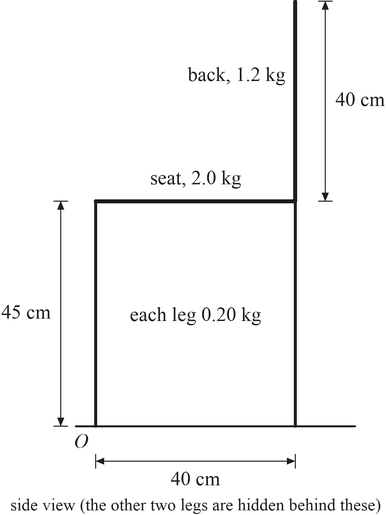
(a) Find the -coordinate (the horizontal distance behind the front legs) of the centre of mass of the chair.
(b) Find the height of the centre of mass of the chair above the floor.
(c) A bag is hung on the back of the empty chair so that the bag's centre of mass is cm behind the front legs. What is the largest mass of bag the chair can hold without tipping over backwards about its back legs?