
Opening your dashboard
Class 11 Physics Chapter 10 Centre of Mass: Practice Questions
80 questions on Chapter 10, each worked through on its own page with the AI tutor. Class 11 Physics, ICSE 2026-27.
80 questions
1–4 marks · Mixed difficulty
- 11 mark
Question 1
In one coordinate frame, the centre of mass of a system of particles is at the point m. (Hypothetical data.) The origin is now moved to the point m of the old frame, and the axes keep their directions. What are the coordinates of the centre of mass in the new frame?
- 23 marks
Question 2
The figure shows the top view of a small quadcopter drone. (Hypothetical data.) Take the centre of its frame as the origin, with the -axis to the right and the -axis towards the front. Each of the four motors to has a mass of , the frame (with its arms) has a mass of with its centre of mass at , and the battery has a mass of . The coordinates in the figure are in centimetres.
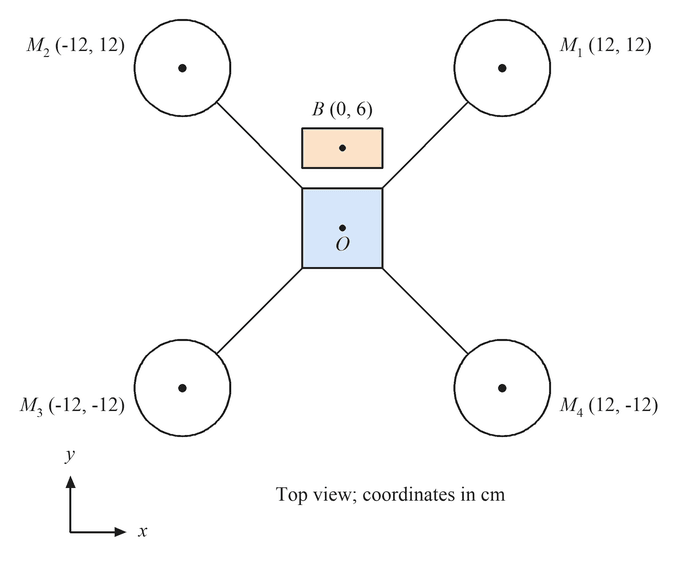
(a) Find the coordinates of the centre of mass of the drone.
(b) All four motors give the same upward thrust. Which side of the drone tends to dip, and why?
- 31 mark
Question 3
A system is made of three particles. Without moving any particle, the mass of every particle is doubled. What happens to the centre of mass of the system?
- 43 marks
Question 4
The particles of a system are split into two groups. Group P has a total mass and its centre of mass at ; group Q has a total mass and its centre of mass at .
(a) Show that the centre of mass of the whole system can be found by treating each group as a single particle of mass at and of mass at .
(b) Group P has a mass of with its centre of mass at m, and group Q has a mass of with its centre of mass at m. (Hypothetical data.) Find the centre of mass of the whole system.
- 51 mark
Question 5
Three particles lie on the -axis at m, m and m. (Hypothetical data.) Their masses are not known, except that each mass is positive. Which of the following can NOT be the -coordinate of their centre of mass?
- 63 marks
Question 6
A small space station is modelled as three modules, each treated as a particle at its own centre of mass. (Hypothetical data.) Module 1 has a mass of t at the origin, module 2 has a mass of t at m, and module 3 has a mass of t at m.
(a) Find the position vector of the centre of mass of the station.
(b) How far is the centre of mass from module 1?
- 71 mark
Question 7
Four particles are placed in the -plane: kg at m, kg at m, kg at m and kg at m. (Hypothetical data.) Where is their centre of mass?
- 83 marks
Question 8
Six identical beads, each of mass , are fixed at the corners of a regular hexagon of side made of very light wire. (Hypothetical data.) is the centre of the hexagon.
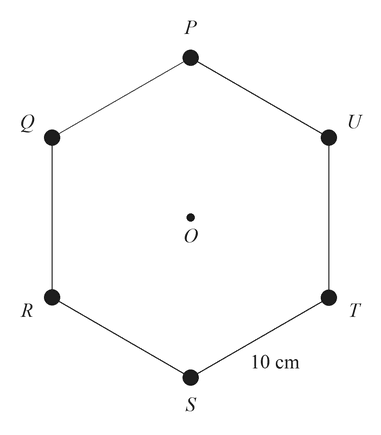
(a) Where is the centre of mass of the six beads?
(b) The bead at is removed. Find the position of the centre of mass of the remaining five beads.
- 91 mark
Question 9
The centre of mass of a two-particle system is at the origin. A particle of the system is at m. (Hypothetical data.) Where is the other particle, whose mass is ?
- 101 mark
Question 10
Particle 1, of fixed mass , is at point , and particle 2 is at point , a distance away. The mass of particle 2 is increased steadily from a very small value to a very large value, while both particles stay where they are. How does the centre of mass of the pair move?
- 113 marks
Question 11
In a binary star system, two stars and move in circles about their common centre of mass , which stays at rest. (Hypothetical data.) Star moves in a circle of radius AU and star in a circle of radius AU, as shown. The total mass of the two stars is solar masses. Treat the stars as particles.
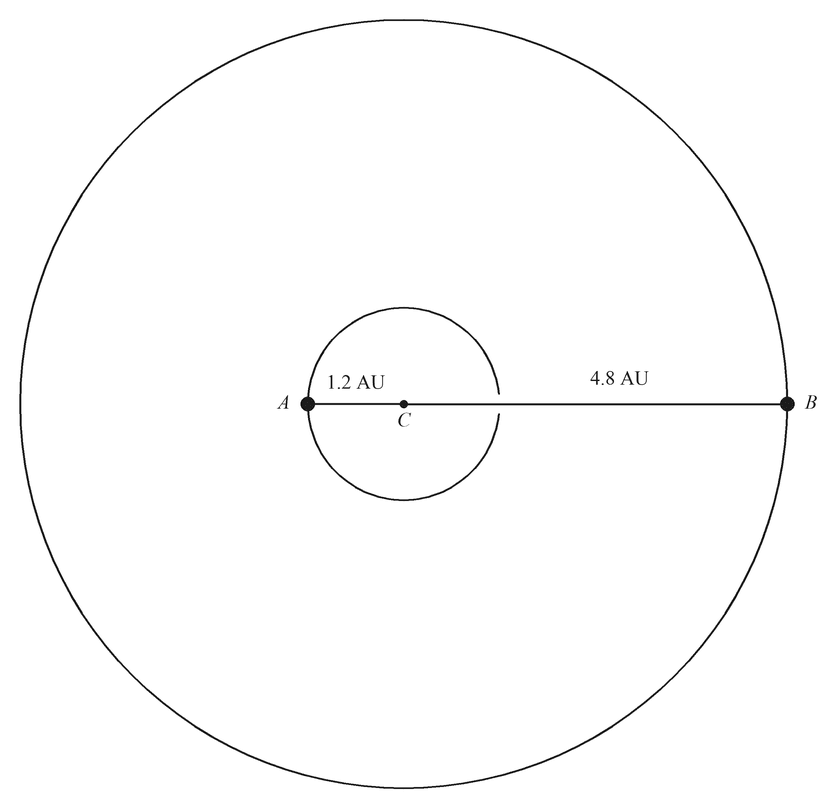
(a) Which star is heavier, and what is the ratio of their masses?
(b) Find the mass of each star in solar masses.
(c) Explain why both stars take the same time to complete one orbit.
- 123 marks
Question 12
Two uniform solid spheres made of the same material touch each other. The larger sphere has a radius of and centre ; the smaller has a radius of and centre . (Hypothetical data.)
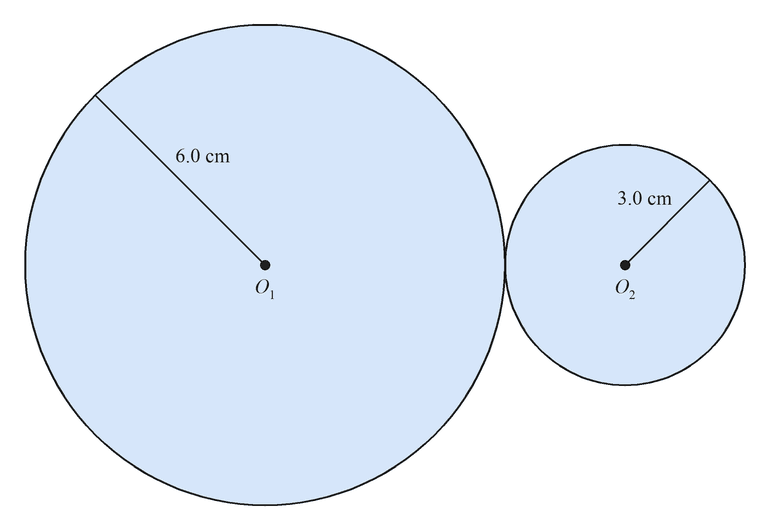
(a) Find the ratio of their masses.
(b) Find the distance of the centre of mass of the pair from .
(c) Does the centre of mass lie inside the larger sphere?
- 132 marks
Question 13
A particle is at the origin and a particle is at m. (Hypothetical data.) What extra mass must be added to the particle, at the same place, so that the centre of mass of the system moves to m?
- 143 marks
Question 14
A particle is at m and a particle is at m. (Hypothetical data.)
(a) Find the coordinates of their centre of mass .
(b) Show that lies on and divides it in the inverse ratio of the masses.
- 151 mark
Question 15
A diver leaves a springboard and spins and twists, bending and straightening the body in the air before entering the water. Air resistance is negligible. Which point follows a simple parabolic path from the board to the water?
- 163 marks
Question 16
Two trolleys move along a straight, level track in the same direction: trolley A () at and trolley B () at , with A catching up with B. (Hypothetical data.)
(a) Find the velocity of the centre of mass of the two trolleys.
(b) Find the velocity of each trolley as seen by an observer moving with the centre of mass.
(c) Show that, as seen by this observer, the total momentum of the two trolleys is zero.
- 173 marks
Question 17
A person of mass stands at point on a boat of mass floating at rest on still water. (Hypothetical data.) The person walks to point , along the deck, and stops. The resistance of the water is negligible.
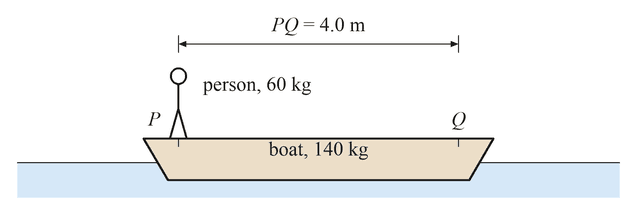
(a) How far does the boat move, and in which direction?
(b) How far does the person move relative to the water?
- 183 marks
Question 18
On a smooth ice rink, skater A () glides east at and skater B () glides north at , as shown. (Hypothetical data.) They meet, hold on to each other and move on together. Friction with the ice is negligible.

(a) Find their common velocity after they hold on (magnitude and direction).
(b) Find their total kinetic energy before and after, and explain why it changes although the velocity of their centre of mass does not.
- 191 mark
Question 19
Block B () and block A () are joined by a light spring and rest on a smooth floor. A steady horizontal force of is applied to A, pulling it away from B, as shown. (Hypothetical data.) At one instant the acceleration of A is in the direction of the force. What is the acceleration of B at that instant?

- 203 marks
Question 20
An astronaut, whose mass together with the spacesuit is , floats at rest beside a satellite of mass far out in space. (Hypothetical data.) The astronaut pushes off the satellite and moves away at . Treat the astronaut and the satellite as particles that start at the same point.
(a) Find the velocity of the satellite after the push.
(b) How far apart are they s later?
(c) Where is the centre of mass of the astronaut and the satellite at that time?
- 211 mark
Question 21
The centre of mass of a system of particles is seen to move with a constant velocity. Which of the following must be true?
- 224 marks
Question 22
Two particles move along the -axis. Particle 1 () has position and particle 2 () has position , with in metres and in seconds. (Hypothetical data.)
(a) Find the position of the centre of mass as a function of .
(b) Find the velocity of the centre of mass at s.
(c) Find the acceleration of the centre of mass and the net external force on the system.
(d) At what time is the centre of mass momentarily at rest, and where is it then?
- 233 marks
Question 23
From the top of a tower high, ball A () is thrown vertically upward at , and at the same instant ball B () is released from rest, as shown. (Hypothetical data.) Take and neglect air resistance.
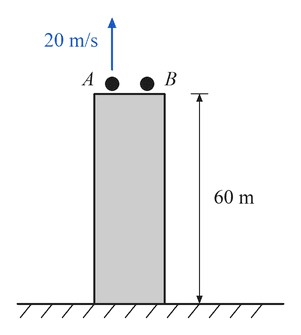
(a) Find the acceleration of the centre of mass of the two balls while both are in the air.
(b) Find the velocity of the centre of mass at s.
(c) Find the height of the centre of mass above the ground at s.
- 243 marks
Question 24
The Earth (mass , radius ) and the Moon (mass ) are on average apart, centre to centre. Treat them as particles at their centres.
(a) Find the distance of the centre of mass of the Earth–Moon system from the centre of the Earth. Does it lie inside the Earth?
(b) The Earth and the Moon both go round this centre of mass once every days. Find the speed of the Earth's centre in this monthly motion.
- 251 mark
Question 25
Three particles of total mass have momenta , and , all in . (Hypothetical data.) What is the velocity of their centre of mass?
- 261 mark
Question 26
A uniform wire is bent into a right-angled triangular frame with sides , and . The frame lies in the -plane with the right-angled corner at the origin , the side along the -axis and the side along the -axis, as shown.
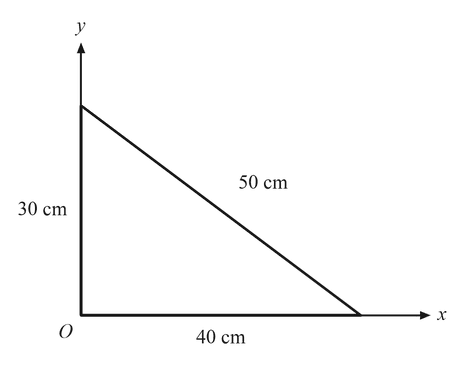
The coordinates of the centre of mass of the wire frame are
- 273 marks
Question 27
(Hypothetical data.) The body of a model rocket is made of one uniform material. It is a solid cylinder of radius and length , with a solid cone of the same radius and height fixed on its top end, as shown.
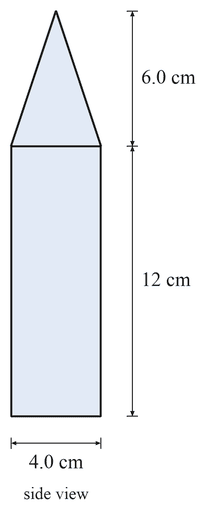
Find the height of the centre of mass of the rocket body above its flat base. (Volume of a cone ; the centre of mass of a uniform solid cone lies on its axis, one-quarter of its height above its base.)
- 281 mark
Question 28
(Hypothetical data.) A rod long has a uniform cross-section. One half is aluminium (density ) and the other half is steel (density ), joined end to end. How far from the aluminium end is the centre of mass of the rod?
- 293 marks
Question 29
(Hypothetical data.) A uniform square steel plate has side and centre . A circular hole of radius is to be cut with its centre on the line through parallel to one side, so that the centre of mass of the remaining plate lies from , as shown.
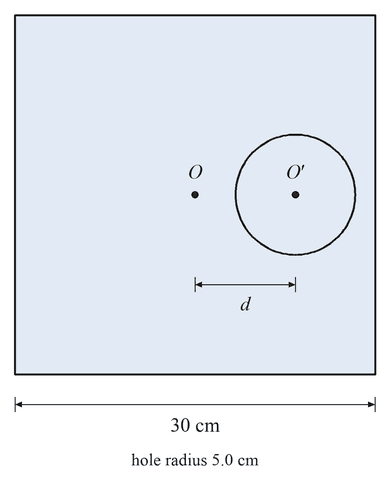
(a) Find the distance .
(b) On which side of does the centre of mass of the remaining plate lie? Check that the hole lies wholly inside the plate.
- 301 mark
Question 30
(Hypothetical data.) A car wheel is perfectly balanced, so its centre of mass is on the axle . A lump of mud then sticks to it at , from the axle, as shown. A mechanic can clip a balancing weight onto the rim, from the axle.
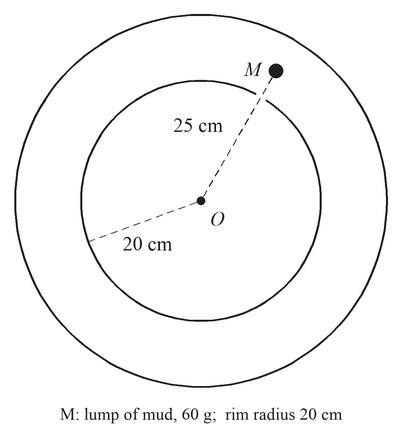
To bring the centre of mass back onto the axle, the balancing weight should be
- 311 mark
Question 31
A uniform plate in the shape of a regular hexagon of side is made of six equal equilateral triangles meeting at its centre . One of these triangles is cut away, as shown.
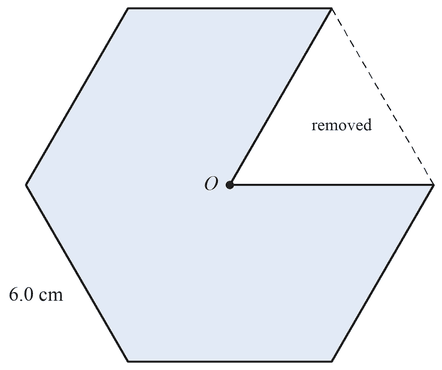
How far does the centre of mass of the remaining plate lie from , and in which direction?
- 321 mark
Question 32
In the Fosbury flop, a high jumper goes over the bar head first and face up, arching the body into a curve around the bar. Coaches say that in a good jump the jumper's centre of mass can pass at, or even slightly below, the height of the bar while every part of the body goes over it. Which statement explains how this is possible?
- 332 marks
Question 33
(Hypothetical data.) A hammer has a uniform wooden handle long of mass . Its iron head has mass , and the head's centre of mass lies on the axis of the handle, from the grip end, as shown.

Find the distance of the centre of mass of the whole hammer from the grip end.
- 341 mark
Question 34
For which of these can the centre of mass be treated as a point fixed in the body, as it is for a rigid body?
- 353 marks
Question 35
A uniform triangular metal plate has corners at , and .
(a) Using the fact that the centre of mass of a uniform triangular plate is the point where its medians meet, find the coordinates of by finding where the medians from and from cross.
(b) Show that divides the median from in the ratio .
- 363 marks
Question 36
(Hypothetical data.) An open cubical box (no lid) of edge is made from a thin uniform metal sheet, as shown.
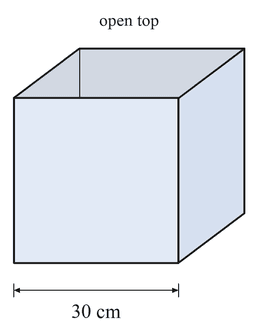
(a) How high above the base is the centre of mass of the box?
(b) A lid made of the same sheet is now put on the box. How high is the centre of mass now?
- 372 marks
Question 37
(Hypothetical data.) A uniform metre rule of mass has an mass hung from its mark, as shown.
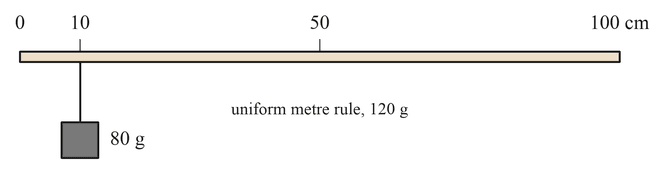
(a) Find the position of the centre of gravity of the rule together with the hung mass.
(b) Where must a knife edge be placed for the rule to rest horizontally on it, and why?
- 383 marks
Question 38
(Hypothetical data.) To find the centre of gravity of a person, a uniform board long of mass is laid with its ends on knife edges standing on two scales and . A person tall lies on the board with the soles of the feet exactly above . The scales then read at and at , as shown.
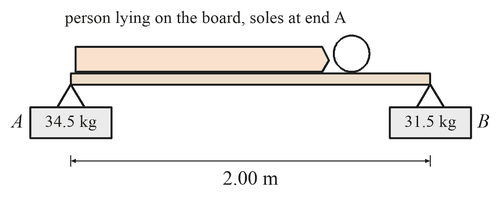
(a) Find the mass of the person.
(b) Find the distance of the person's centre of gravity from the soles of the feet.
(c) Express this distance as a percentage of the person's height.
- 391 mark
Question 39
(Hypothetical data.) A uniform rectangular card by is shown lying flat, with one corner marked .
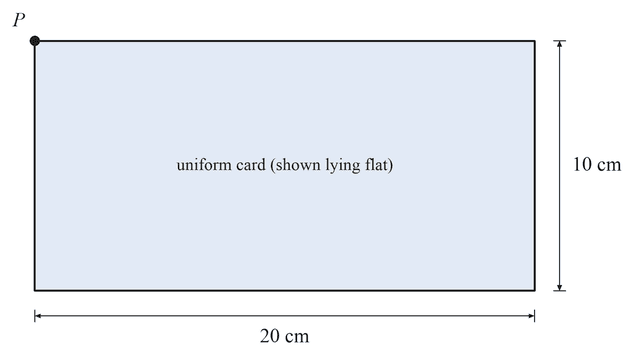
The card is hung freely from a pin through and comes to rest. The angle between the edge through and the vertical is
- 403 marks
Question 40
Describe how you would find the centre of gravity of an irregular, flat piece of cardboard using a pin held in a clamp stand and a plumb line. Explain why the method works.
- 413 marks
Question 41
(Hypothetical data.) In a safety test a bus stands on a platform that is slowly tilted. To pass, the bus must not tip over before the platform reaches to the horizontal. The outer tyres on the two sides touch the platform along lines and , apart, and the centre of gravity is midway between them at height above the platform, as shown. Treat the bus as rigid (ignore the squashing of tyres and springs) and assume that it does not slide.
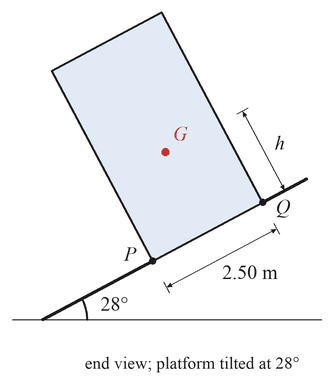
(a) Find the greatest value of for which the bus passes the test.
(b) A bus whose centre of gravity is above the platform is tested. At what angle of tilt would it begin to tip over?
- 423 marks
Question 42
(Hypothetical data.) Two identical uniform bricks, each long, are stacked at the edge of a table with their long edges at right angles to the table edge. The upper brick overhangs the lower brick by , and the lower brick overhangs the table edge by , as shown.

(a) What is the largest value of for which the upper brick does not topple off the lower one?
(b) With at this largest value, what is the largest value of for which the pair does not topple off the table?
(c) How far beyond the table edge can the outer end of the upper brick then reach?
- 431 mark
Question 43
A very tall, uniform vertical tower, high, stands on the ground. Taking into account that becomes smaller with height above the Earth's surface, its centre of gravity
- 443 marks
Question 44
(Hypothetical data.) A uniform pole long and of mass is fixed horizontally into a wall at one end. A lamp of mass hangs from its free end, as shown. Take .

(a) Find the total torque of the two weights about the end of the pole fixed in the wall.
(b) Find the position of the centre of gravity of the pole and lamp together.
(c) Show that the total weight acting at this centre of gravity gives the same torque as in (a).
- 451 mark
Question 45
A student stands with heels and back against a wall and tries to bend forward to touch the toes, keeping the legs straight. The student finds that they start to fall forward. Which statement best explains this?
- 463 marks
Question 46
(Hypothetical data.) A uniform chain long and of mass lies on a smooth table, with on the table and hanging straight down over the edge, held at rest, as shown. Take the origin at the table edge marked in the figure, the -axis horizontal and pointing away from the table, and the -axis vertically up. Ignore the thickness of the chain and take .
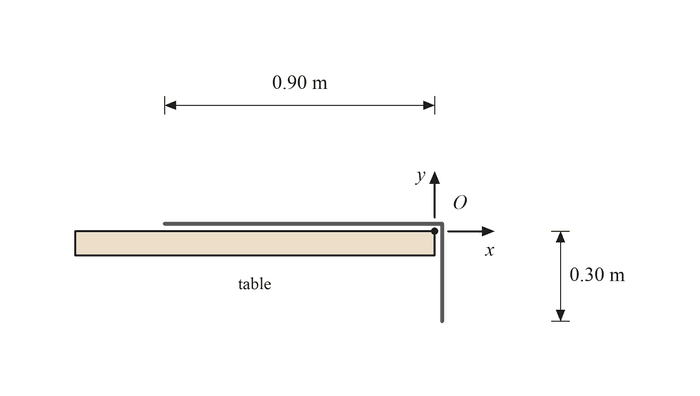
(a) Find the coordinates of the centre of mass of the chain.
(b) Using the centre of mass, find the work needed to pull the hanging part slowly back onto the table.
- 472 marks
Question 47
(Hypothetical data.) A uniform barrier arm at a level crossing is long, has mass and turns about a pivot at one end. It is shown raised to above the horizontal. Take .

(a) Find the torque of the arm's weight about the pivot in this position.
(b) Find the torque when the arm is horizontal, and explain why it is smaller in the raised position.
- 481 mark
Question 48
(Hypothetical data.) A loaded wheelbarrow has a total mass of . Its centre of gravity is horizontally behind the axle of the wheel, and the gardener holds the handles horizontally behind the axle, as shown. Take .
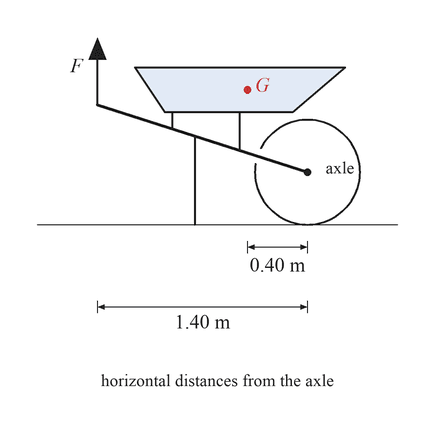
The vertical force the gardener must apply at the handles to just hold the legs off the ground is about
- 491 mark
Question 49
Define centre of mass.
- 501 mark
Question 50
Name the factors on which the centre of mass of a body depends.
- 512 marks
Question 51
Give one example each for (i) the centre of mass of a body lies inside the body and (ii) outside the body.
- 522 marks
Question 52
Is there any difference between centre of mass and centre of gravity?
- 532 marks
Question 53
Is it possible that the centre of mass of a body and centre of gravity coincide?
- 541 mark
Question 54
Where is the position of centre of mass of (i) a plane rectangular lamina and (ii) a square lamina?
- 551 mark
Question 55
Where does the centre of mass of a two-particle system lie, if one particle is more massive than the other?
- 562 marks
Question 56
Where is the centre of mass of a uniform cone located?
- 571 mark
Question 57
Distance of the centre of mass of a solid uniform cone from the vertex is . If the radius of its base is and its height is , then is equal to
- 581 mark
Question 58
The distance between the carbon atom and the oxygen atom in a carbon monoxide molecule is 1.1 Å. Given, mass of carbon atom is 12 amu and mass of oxygen atom is 16 amu. Calculate the position of the centre of mass of the carbon monoxide molecule.
- 591 mark
Question 59
A rod of mass and length is made to stand at an angle of with the vertical. Potential energy of the rod in this position is
- 601 mark
Question 60
Identify the correct statement for the rotational motion of a rigid body.
- 611 mark
Question 61
A system consists of 3 particles each of mass located at points (1, 1), (2, 2) and (3, 3). The coordinates of the centre of mass are
- 621 mark
Question 62
Two particles of masses and initially at rest start moving towards each other under their mutual force of attraction. The speed of the centre of mass at any time , when they are at a distance apart, is
- 631 mark
Question 63
Three masses are placed on the x-axis. 300 g at origin, 500 g at cm and 400 g at cm. The distance of the centre of mass from the origin is
- 641 mark
Question 64
Centre of mass of 3 particles 10 kg, 20 kg and 30 kg is at (0, 0, 0). Where should a particle of mass 40 kg be placed so that the combination centre of mass will be at (3, 3, 3)?
- 651 mark
Question 65
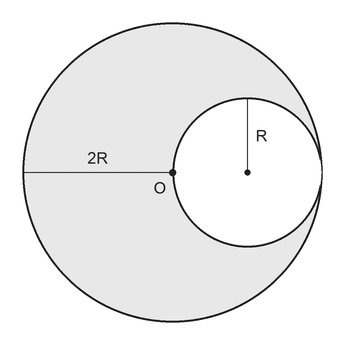
A circular disc of radius is removed from a bigger circular disc of radius such that the circumferences of the discs coincide. The centre of mass of the new disc is from the centre of the bigger disc. The value of is
- 661 mark
Question 66
A system consisting of two masses connected by a massless rod lies along the x-axis. A 0.4 kg mass is at a distance m while a 0.6 kg mass is at a distance m. The x-coordinate of the centre of mass is
- 671 mark
Question 67
Two point objects of masses 1.5 g and 2.5 g respectively are at a distance of 16 cm apart, the centre of gravity is at a distance from the object of mass 1.5 g where is
- 681 mark
Question 68
Two bodies of mass 1 kg and 3 kg have position vectors and , respectively. The centre of mass of this system has a position vector
- 691 mark
Question 69
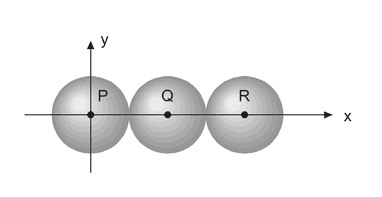
Three identical spheres, each of mass 1 kg are kept as shown in the given figure, touching each other, with their centres on a straight line. If their centres are marked , , respectively, the distance of centre of mass of the system from is
(A)
(B)
(C)
(D)
- 701 mark
Question 70
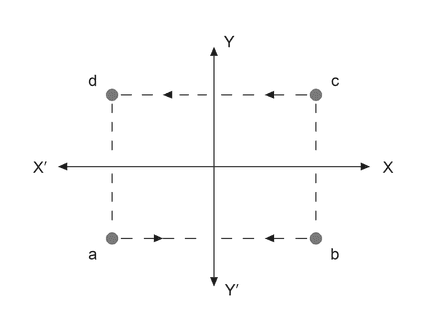
Four bodies of equal mass start moving with same speed as shown in the given figure. In which of the following combination the centre of mass will remain at origin
- 711 mark
Question 71
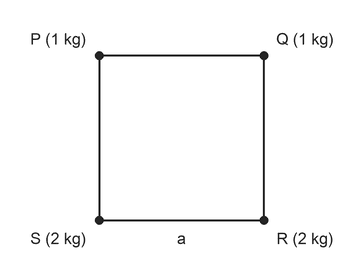
Four point masses , , and with respective masses 1 kg, 1 kg, 2 kg and 2 kg form the corners of a square of side . The centre of mass of the system will be farthest from
- 721 mark
Question 72
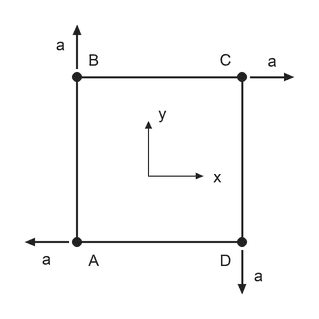
Four particles , , and with masses , , and are at the corners of a square. They have accelerations of equal magnitude with direction as shown in the given figure. The acceleration of the centre of mass of the particles is
- 731 mark
Question 73
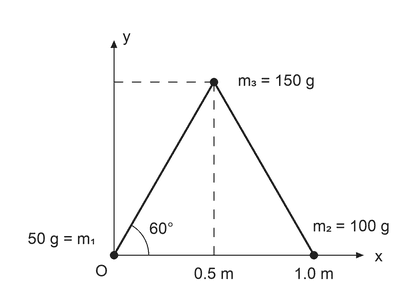
Three particles of masses 50 g, 100 g and 150 g are placed at the vertices of an equilateral triangle of side 1 m as shown in the given figure. The coordinates of the centre of mass will be
- 741 mark
Question 74
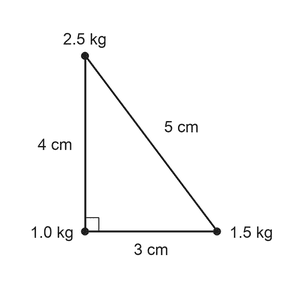
Three point particles of masses 1.0 kg, 1.5 kg and 2.5 kg are placed at three corners of a right-angled triangle of sides 4.0 cm, 3.0 cm and 5.0 cm as shown in the given figure. The centre of mass of the system is at a point
- 751 mark
Question 75
Two particles of mass 5 kg and 10 kg respectively are attached to the two ends of a rigid rod of length 1 m with negligible mass. The centre of mass of the system from the 5 kg particle is nearly at a distance of
- 761 mark
Question 76
A rod of length has non-uniform linear mass density given by , where and are constants and . The value of for the centre of mass of the rod is at
- 771 mark
Question 77
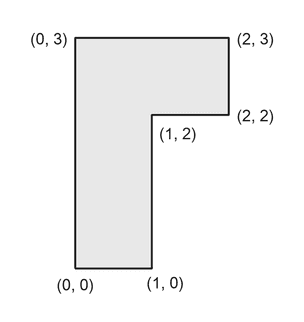
The coordinates of centre of mass of a uniform flag shaped lamina (thin flat plate) of mass 4 kg (the coordinates of the same are shown in the given figure) are
- 781 mark
Question 78
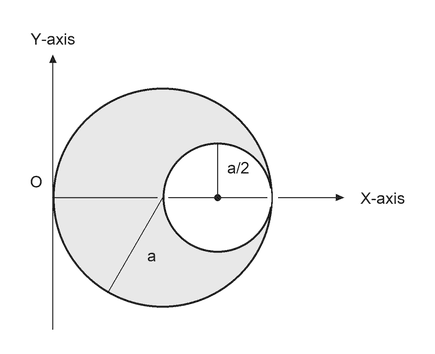
A circular hole of radius is cut out of a circular disc of radius '' as shown in the given figure. The centroid of the remaining circular portion with respect to point '' will be
- 791 mark
Question 79
Two blocks of masses 10 kg and 30 kg are placed on the same straight line with coordinates (0, 0) cm and cm respectively. The block of 10 kg is moved on the same line through a distance of 6 cm towards the other block. The distance through which the block of 30 kg must be moved to keep the position of centre of mass of the system unchanged is
- 801 mark
Question 80
What is the centre of gravity of semi-circular disc of radius ?