
Opening your dashboard
Class 11 Maths Chapter 8: Inequalities Solutions
92 textbook questions with step-by-step answers, free to read, for ISC 2026-27.
Get talked through Ch 8, not just shown the answer
Reading a finished solution is not the same as being able to do it. The AI tutor takes one question at a time and works it with you, in your own words, until you can.
- Ask it out loud, in your own words
- It gives you the next step, not the answer
- Stuck on part (ii)? Start there
92 questions with solutions
1–3 marks · Mixed difficulty
The first 13 solutions are on this page. This chapter is a long one, so the rest open on their own page to keep this one quick to load.
- 13 marks
Question 1
(i) List the solution set of , given that is a positive integer.
(ii) If is a negative integer, find the solution set of .
Solve with AIWritten solution
Solution:
Concept: A linear inequation is solved like an equation, with one extra rule. Adding or subtracting the same number on both sides, and multiplying or dividing both sides by a positive number, keep the sign as it is. Multiplying or dividing both sides by a negative number reverses the sign ( becomes , becomes ). At the end we keep only the values allowed by the given set (, integers, or ).
(i) Step 1 — Expand the bracket. Multiply into : and .
Step 2 — Subtract 34 from both sides. Subtracting a number keeps the sign.
Step 3 — Divide both sides by . We divide by a negative number, so the sign turns into .
Step 4 — Keep only positive integers. The positive integers bigger than are (every positive integer works).
Solution set .
(ii) Step 1 — Clear the fractions. Multiply both sides by , which is positive, so the sign stays.
Step 2 — Subtract 3 from both sides. Subtracting the same number from both sides keeps the sign as it is, and it leaves alone on the left.
Step 3 — Keep only negative integers. The negative integers bigger than are and .
Watch out: itself is not included, because the sign is strict (, not ).
Solution set .
- 23 marks
Question 2
is the solution set of and is the solution set of , where . Find the set .
Solve with AIWritten solution
Solution:
Concept: A linear inequation is solved like an equation, with one extra rule. Adding or subtracting the same number on both sides, and multiplying or dividing both sides by a positive number, keep the sign as it is. Multiplying or dividing both sides by a negative number reverses the sign ( becomes , becomes ). At the end we keep only the values allowed by the given set (, integers, or ). contains the natural numbers that satisfy both inequations.
Step 1 — Solve the inequation for . Take the -terms to the left and the numbers to the right.
So (natural numbers bigger than 1).
Step 2 — Solve the inequation for . First expand .
So (here is included because of ).
Step 3 — Take the common elements. Every natural number that is at least is also bigger than , so the common part is just .
.
- 33 marks
Question 3
Find the solution of the inequality , .
Hence, graph the solution set on the number line.
Solve with AIWritten solution
Solution:
Concept: A double inequation means and together. We may do the same operation to all three parts at once: add or subtract the same number, or multiply or divide by a positive number, and the signs stay; multiplying or dividing by a negative number reverses both signs. On a number line a filled dot means the end point is included (, ) and a hollow dot means it is not (, ).
Step 1 — Add 3 to all three parts. This removes the from the middle.
Step 2 — Divide all three parts by 2. is positive, so both signs stay.
Step 3 — Graph. Both end points are included (), so we put a filled dot at and a filled dot at , and draw a thick line between them.
Solution set .
In interval notation, the solution set is .
Note: the printed answer writes this set with the letter ; the variable in the question is , so the same set is written here in .

- 43 marks
Question 4
Solve the inequality: , given that .
Solve with AIWritten solution
Solution:
Concept: A linear inequation is solved like an equation, with one extra rule. Adding or subtracting the same number on both sides, and multiplying or dividing both sides by a positive number, keep the sign as it is. Multiplying or dividing both sides by a negative number reverses the sign ( becomes , becomes ). At the end we keep only the values allowed by the given set (, integers, or ).
Step 1 — Collect the -terms on one side. Subtract from both sides and subtract from both sides.
Step 2 — Divide both sides by . We divide by a negative number, so becomes .
Step 3 — Keep only natural numbers. The natural numbers that are at most are .
The solution set is .
- 53 marks
Question 5
Find the range of values of which satisfies
Graph these values of on the number line.
Solve with AIWritten solution
Solution:
Concept: A double inequation means and together. We may do the same operation to all three parts at once: add or subtract the same number, or multiply or divide by a positive number, and the signs stay; multiplying or dividing by a negative number reverses both signs. On a number line a filled dot means the end point is included (, ) and a hollow dot means it is not (, ).
Step 1 — Write the mixed numbers as fractions. A mixed number is easier to work with as an improper fraction: multiply the whole number by the denominator and add the numerator.
So the inequation is
Step 2 — Subtract from all three parts. Subtracting the same number from all three parts keeps both signs as they are, and it leaves alone in the middle.
Step 3 — Graph. is included (): filled dot. is not included (): hollow dot. Every real number in between is a solution, so we join them with a thick line.
Range: , .

- 63 marks
Question 6
, . Represent
(i)
(ii) , on different number lines.
Solve with AIWritten solution
Solution:
Concept: is the set of numbers that lie in both and . (the complement of ) is the set of real numbers not in . For an interval, the complement is everything to the left of it together with everything to the right of it; an end point that was excluded from the interval is included in the complement, and the other way round.
(i) Step 1 — Write each set as an interval.
is . In interval notation, .
is . In interval notation, .
Step 2 — Find the overlap. The overlap starts at the larger left end and stops at the smaller right end. The larger left end is (excluded, because excludes it). The smaller right end is (excluded, because excludes it).
Step 3 — Graph. Hollow dots at and , thick line between them.

(ii) Step 1 — Write the complements. Everything outside is: (now is included) or .
Everything outside is: or .
Step 2 — Intersect the left pieces. A number with and must satisfy the stricter one, so we get .
Step 3 — Intersect the right pieces. A number with and must satisfy .
Step 4 — Check the mixed pieces. together with is impossible, and together with is impossible, so nothing else is added.
Step 5 — Graph. A thick ray going left from a hollow dot at , and a thick ray going right from a hollow dot at .
Answer: (i) ; (ii) .
Note: the printed answer gives for part (ii); that set is , not the that is asked, so it is incorrect for this question.

- 73 marks
Question 7
Find the range of values of , which satisfy the inequality:
Graph the solution set on the number line.
Solve with AIWritten solution
Solution:
Concept: A double inequation means and together. We may do the same operation to all three parts at once: add or subtract the same number, or multiply or divide by a positive number, and the signs stay; multiplying or dividing by a negative number reverses both signs. On a number line a filled dot means the end point is included (, ) and a hollow dot means it is not (, ).
Step 1 — Clear the fractions. The L.C.M. of and is . Multiply all three parts by (positive, so the signs stay).
Step 2 — Subtract 10 from all three parts. We want alone in the middle, and subtracting the same number from all three parts keeps both signs as they are.
Step 3 — Divide all three parts by 3. Dividing by , a positive number, keeps both signs as they are and leaves alone in the middle.
Step 4 — Graph. Filled dot at (included), hollow dot at (not included), thick line between them.
Range: , .

- 83 marks
Question 8
Find the range of values of which satisfy
Graph these values of on the real number line.
Solve with AIWritten solution
Solution:
Concept: A double inequation means and together. We may do the same operation to all three parts at once: add or subtract the same number, or multiply or divide by a positive number, and the signs stay; multiplying or dividing by a negative number reverses both signs. On a number line a filled dot means the end point is included (, ) and a hollow dot means it is not (, ).
Step 1 — Write the mixed number as a fraction. , so the inequation is
Step 2 — Clear the fractions. The L.C.M. of , and is . Multiply all three parts by .
Step 3 — Add 8 to all three parts. We want alone in the middle, and adding the same number to all three parts keeps both signs as they are.
Step 4 — Divide all three parts by 3. Dividing by , a positive number, keeps both signs as they are and leaves alone in the middle.
Step 5 — Graph. Filled dot at , hollow dot at , thick line between them.
Range: , .

- 93 marks
Question 9
Solve the following inequation, and graph the solution set, on the number line.
Solve with AIWritten solution
Solution:
Concept: A chain with in all three parts cannot be solved all at once. We split it into two inequations, and , solve each, and keep the numbers that satisfy both. Dividing by a negative number reverses the sign.
Step 1 — Solve the left part, . Subtract and add on both sides.
Step 2 — Solve the right part, . Subtract and subtract on both sides.
Divide by ; the sign reverses.
Step 3 — Combine. Both must hold, so
Step 4 — Graph. Filled dot at , hollow dot at , thick line between them.
Solution set: .

- 103 marks
Question 10
Solve the inequation: , .
Solve with AIWritten solution
Solution:
Concept: A double inequation means and together. We may do the same operation to all three parts at once: add or subtract the same number, or multiply or divide by a positive number, and the signs stay; multiplying or dividing by a negative number reverses both signs. On a number line a filled dot means the end point is included (, ) and a hollow dot means it is not (, ).
Step 1 — Subtract 3 from all three parts. We want the term alone in the middle, and subtracting the same number from all three parts keeps both signs as they are.
Step 2 — Divide all three parts by . Dividing by a negative number reverses both signs.
Step 3 — Rewrite from the smaller number to the larger. The pair of signs says the same thing when read from the other side, so we turn it round to put the smaller number on the left.
Watch out: after reversing, the strict sign now sits next to , so is excluded and is included.
Solution: , . On the number line: hollow dot at , filled dot at , thick line between.

- 113 marks
Question 11
Find the value of which satisfies the inequation
Graph the solution on a number line.
Solve with AIWritten solution
Solution:
Concept: A double inequation means and together. We may do the same operation to all three parts at once: add or subtract the same number, or multiply or divide by a positive number, and the signs stay; multiplying or dividing by a negative number reverses both signs. On a number line a filled dot means the end point is included (, ) and a hollow dot means it is not (, ). Since , only natural numbers in the range are solutions, so the graph shows separate dots, not a thick line.
Step 1 — Write the mixed number as a fraction. .
Step 2 — Clear the fractions. The L.C.M. of , and is . Multiply all three parts by .
Step 3 — Subtract 3 from all three parts. We want the term alone in the middle, and subtracting the same number from all three parts keeps both signs as they are.
Step 4 — Divide all three parts by . The signs reverse.
Step 5 — Keep only natural numbers. The natural numbers from up to are .
Step 6 — Check . The middle part is
and is true, so is a solution. ( gives , which is less than , so is not.)
Solution: . In set notation, the solution set is . The graph shows filled dots at , and only.
Note: the printed answer is incorrect; Step 6 shows that also satisfies the inequation.

- 123 marks
Question 12
Write down the range of real values of for which the inequation and are both true. [Hint: Clearly, you have to find the common values of the solution sets, which you can easily do by drawing the graphs.]
Solve with AIWritten solution
Solution:
Concept: When two inequations must be true together, the answer is the intersection (common part) of their solution sets. Drawing both on number lines with the same scale makes the common part easy to see.
Step 1 — Graph . Hollow dot at (not included) and a thick ray to the right.

Step 2 — Graph . Filled dot at , hollow dot at , thick line between.

Step 3 — Read off the common part. The numbers shaded in both graphs start just after (since fails ) and stop just before (since fails ).
The required range is .

- 133 marks
Question 13
Solve and graph the solution set of or .
Solve with AIWritten solution
Solution:
Concept: The word or means a number is a solution if it satisfies at least one of the two inequations, so the answer is the union of the two solution sets. (With and we would take the common part instead.)
Step 1 — Solve . Add to both sides, then divide by .
Step 2 — Solve . Subtract from both sides.
Divide by ; the sign reverses.
Step 3 — Join the two sets. The question allows a value that satisfies either inequation, so we take every value from Step 1 together with every value from Step 2.
Step 4 — Graph. A thick ray to the left from a filled dot at , and a thick ray to the right from a hollow dot at .
Solution set: .

- 143 marks
Question 14
The following diagram represents two inequations and on number lines.
(i) Write down , and in set builder form.
(ii) Represent and on two different number lines.


- 153 marks
Question 15
is the solution set of and is the solution set of ; where . Represent
(i)
(ii)
(iii) on different lines.
- 163 marks
Question 16
Solve the following system of inequalities ().
(i) ,
(ii) ,
(iii)
- 173 marks
Question 17
Solve and graph the solution set.
(i)
(ii)
(iii)
(iv)
(v)
- 183 marks
Question 18
- 193 marks
Question 19
- 203 marks
Question 20
- 213 marks
Question 21
- 223 marks
Question 22
- 233 marks
Question 23
- 243 marks
Question 24
,
- 253 marks
Question 25
Find all pairs of consecutive even positive integers, both of which are larger than 8, such that their sum is less than 25.
- 263 marks
Question 26
A solution is to be kept between 68°F and 77°F. What is the range in temperature in degree celsius (°C) if the Celsius, Fahrenheit conversion formula is given by ?
- 273 marks
Question 27
In the first four papers each of 100 marks, Rishi got 95, 72, 73, 83, marks. If he wants an average of greater than or equal to 75 marks and less than 80 marks, find the range of marks he should score in the fifth paper.
- 283 marks
Question 28
In drilling world's deepest hole it was found that the temperature in degree celsius, km below the earth's surface was given by , . At what depth will the temperature be between 155°C and 205°C?
- 293 marks
Question 29
A solution of 9% acid is to be diluted by adding 3% acid solution to it. The resulting mixture is to be more than 5% but less than 7% acid. If there is 460 L of the 9% solution, how many litres of 3% solution will have to be added?
[Hint: Let L of 3% solution be added to 460 L of 9% solution of acid. Then, total quantity of mixture L and total acid content in this mixture .
As per question, the acid content must be more than 5% and less than 7%.
You may now solve it. You will obtain and .]
- 303 marks
Question 30
A man wants to cut three lengths from a single piece of board of length 91 cm. The second length is to be 3 cm longer than the shortest and third length is to be twice as long as the shortest. What are the possible lengths for the shortest board, if third piece is to be at least 5 cm longer than the second?
- 313 marks
Question 31
Graph the solution set of the following system in a coordinate plane.
- 323 marks
Question 32
Graph the solution set of the following system in a coordinate plane.
- 333 marks
Question 33
Graph the solution set of the following system in a coordinate plane.
- 343 marks
Question 34
Graph the solution set of the following system in a coordinate plane.
- 353 marks
Question 35
Graph the solution set of the following system in a coordinate plane.
- 363 marks
Question 36
Graph the solution set of the following system in a coordinate plane.
- 373 marks
Question 37
Graph the solution set of the following system in a coordinate plane.
- 383 marks
Question 38
Graph the solution set of the following system in a coordinate plane.
- 393 marks
Question 39
Graph the solution set of the following system in a coordinate plane.
- 403 marks
Question 40
Graph the solution set of the following system in a coordinate plane.
- 413 marks
Question 41
Graph the solution set of the following system in a coordinate plane.
- 423 marks
Question 42
Graph the solution set of the following system in a coordinate plane.
- 433 marks
Question 43
Find the linear constraints for which the shaded area in the figure given below is the solution set.
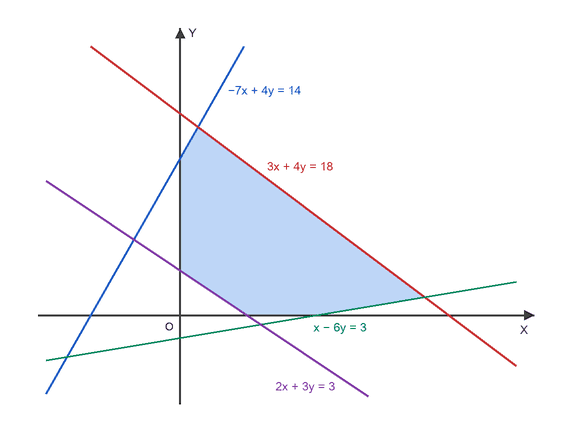
- 443 marks
Question 44
Find the linear constraints for which the shaded area in the figure given below is the solution set.

- 453 marks
Question 45
Find the range of in the following inequality:
- 463 marks
Question 46
Find the range of in the following inequality:
- 473 marks
Question 47
Find the range of in the following inequality:
- 483 marks
Question 48
Find the range of in the following inequality:
- 493 marks
Question 49
Find the range of in the following inequality:
- 503 marks
Question 50
Find the range of in the following inequality:
- 513 marks
Question 51
Find the range of in the following inequality:
- 523 marks
Question 52
Find the range of in the following inequality:
- 533 marks
Question 53
Find the range of in the following inequality:
- 543 marks
Question 54
Find the range of in the following inequality:
- 553 marks
Question 55
Find the range of in the following inequality:
- 563 marks
Question 56
Find the range of in each of the following inequalities:
(i)
(ii)
- 573 marks
Question 57
Find all real values of which satisfy and .
- 581 mark
Question 58
The set of values of for which the inequalities , hold simultaneously is
- 593 marks
Question 59
Solve the following inequality:
- 603 marks
Question 60
Solve the following inequality:
- 613 marks
Question 61
Solve the following inequality:
- 623 marks
Question 62
Solve the following inequality:
- 633 marks
Question 63
Solve the following inequality:
- 641 mark
Question 64
Solve the following inequality: .
- 651 mark
Question 65
Solve the following inequality: when
(i)
(ii)
- 661 mark
Question 66
Solve the following inequality: when .
- 671 mark
Question 67
Solve the following inequality: when is a natural number.
- 681 mark
Question 68
Solve the following inequality: .
- 691 mark
Question 69
Solve the following inequality: .
- 701 mark
Question 70
Solve the following inequality:
- 711 mark
Question 71
Solve the following inequality:
- 721 mark
Question 72
Solve the following inequality: .
- 731 mark
Question 73
Solve the inequality graphically in the two-dimensional plane.
- 741 mark
Question 74
The set of all real numbers satisfying the inequality is
- 751 mark
Question 75
If , then
- 761 mark
Question 76
If , then
- 771 mark
Question 77
If , then
- 781 mark
Question 78
If , then
- 791 mark
Question 79
Solve the inequality ,
- 801 mark
Question 80
The solution of is
- 811 mark
Question 81
The solution set of the inequality is
- 821 mark
Question 82
If , then
- 831 mark
Question 83
If , then lies in the interval
- 841 mark
Question 84
If and , then lies in the interval
- 851 mark
Question 85
Number of integral solutions of is
- 861 mark
Question 86
The region represented by the inequation system , , is
- 871 mark
Question 87
Let . If lies between and , then
- 881 mark
Question 88
The solution set of is
- 891 mark
Question 89
If and , then lies in the interval
- 901 mark
Question 90
The set of values of satisfying is
- 911 mark
Question 91
A manufacturer has L of a solution of acid. Find the range of acid to be added to it such that the acid content in the resultant mixture will be more than but less than .
- 921 mark
Question 92
The solution set of the following linear inequations ; ; , is given by
What Class 11 Maths Ch 8 covers
The sections of the chapter, in the order the book takes them. Every question above comes from one of these.
- 01Linear Inequations in One Variable
- 02Systems of Linear Inequations in One Variable
- 03Linear Inequalities in Two Variables
- 04Systems of Linear Inequalities in Two Variables
- 05Inequalities Involving Rational Expressions
More ways to study this chapter
The same chapter asked three other ways. Practise it, revise it, and see what the board has set on Ch 8 before.
Class 11 Maths Ch 8 questions students ask
How many questions are there in Class 11 Maths Ch 8?
92 questions. Every one is solved step by step on this page.
Are these Class 11 Maths solutions free?
Yes. Every question and its full working is free to read, with no account needed.
Can I download the Class 11 Maths Ch 8 solutions as a PDF?
There is no PDF to download. Every solution is on this page instead, which means it is searchable, always the current syllabus, and readable on a phone. Use your browser's print option if you want it on paper.