
Question 921 markMCQMedium
The solution set of the following linear inequations ; ; , is given by
Confirming your payment
Sign up now and get 250 free tokens.
Inequalities · Question 92 of 92
The solution set of the following linear inequations ; ; , is given by
(A)
(B) null set
(C)
(D) set of real numbers
Answer: (B) null set
Concept: Each linear inequality in and is a half-plane (solid boundary for , ). The solution of the system is the region common to all of them; a test point decides the side of each line. If no point satisfies every inequality together, the solution set is the null set .
Two readings. The stem prints , but the book's own hint works with , so the sign in the stem is a misprint. Both readings are solved below: Steps 1 to 4 for the stem as printed, and Steps 5 to 7 for the intended stem.
Step 1 — Stem as printed: draw the boundary lines.
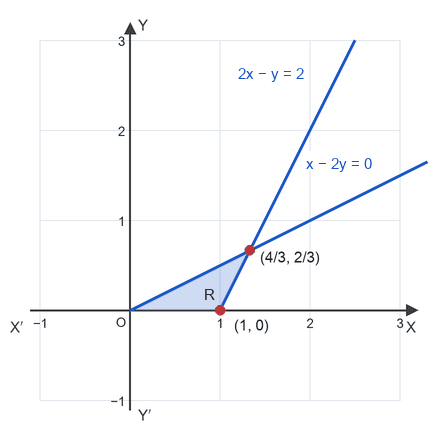
passes through and . passes through and . Both are solid, since the signs are and .
Step 2 — Stem as printed: choose the correct sides.
For , the test point gives , true: the region is below the line . For , the test point gives , true: the region is on the origin's side. , keep us in the first quadrant.
Step 3 — Stem as printed: find the corner where the two lines meet.
Take and put it into .
Then is twice , so .
Step 4 — Stem as printed: describe the region.
The common region is the triangle with corners , and , shaded in the figure below. It is not empty: for example satisfies all four inequalities. So, read exactly as printed, none of the four options describes the solution set.
Step 5 — Intended stem: rewrite the changed inequality.
With the hint's sign the second inequality is . Add to both sides, so that stands alone.
Similarly, gives .
Step 6 — Intended stem: look for a common point.
A common point needs to be at least and at most , so must not be bigger than .
Multiply both sides by the positive number to clear the fraction; the sign is kept.
Subtract and from both sides.
Divide both sides by the positive number ; the sign is kept.
But the system also needs , and no number is both and .
Step 7 — Intended stem: conclude.
No point satisfies all four inequalities together, so the solution set is the null set , which is option (B).
Note: the printed key, null set, fits the hint's version , so the printed key (B) is kept.