Question 393 marksMedium
Graph the solution set of the following system in a coordinate plane.
Confirming your payment
Sign up now and get 250 free tokens.
Inequalities · Question 39 of 92
Graph the solution set of the following system in a coordinate plane.
Solution:
Concept: To graph a linear inequality such as , first replace the inequality sign by an equals sign and draw the boundary line . Draw it solid when the sign is or (points on the line are included) and dashed when the sign is or (points on the line are not included). Then test one point that is not on the line, usually the origin : if the point satisfies the inequality, the solution is the side of the line containing that point; if not, it is the other side. The solution set of a system is the region common to all these half-planes.
Step 1 — Split the double inequality.
means that both of these hold:
Step 2 — Draw the boundary line of .
Replacing the inequality sign by an equals sign gives the boundary line .
It is the vertical line through .
The sign is strict, so points on the line do not satisfy the inequality and the line is drawn dashed.
Step 3 — Draw the boundary line of .
Replacing the inequality sign by an equals sign gives the boundary line .
It is the vertical line through .
The sign is strict, so points on the line do not satisfy the inequality and the line is drawn dashed.
Step 4 — Shade for .
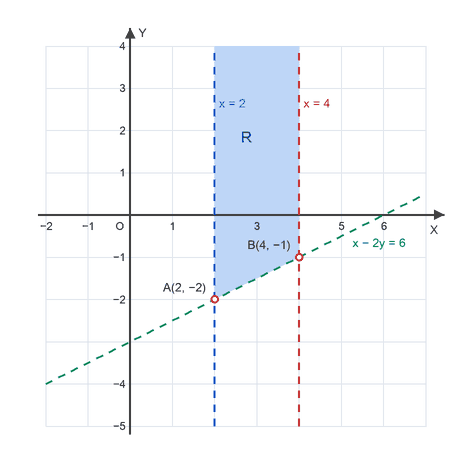
Points with lie to the right of , and points with lie to the left of . Together they give the vertical strip between the two dashed lines.
Step 5 — Draw the boundary line of .
Replacing the inequality sign by an equals sign gives the boundary line .
In the form , two points on it are shown in the table.
The sign is strict, so points on the line do not satisfy the inequality and the line is drawn dashed.
Step 6 — Decide which side of to shade.
Test the point , which is not on this line, in :
This is true, so the solution of is the side of the line that contains this point: the half-plane above the line .
Step 7 — Find the corners of the common region.
Put in the equation of the slanting line:
So the first corner is . Now put in the same equation:
So the second corner is . The common region is the part of the strip above the segment ; it is open upwards. All three lines are dashed, so no boundary point (and neither nor ) is included.
Step 8 — Check with a point inside the region.
Take the point from the shaded region and test every inequality:
All the inequalities hold, so the shading is correct.
Therefore, the solution set is the part of the vertical strip (between two dashed lines) lying above the dashed line , with corners and excluded.
In the graph, the shaded region R is the solution set. A solid line belongs to the solution set, a dashed line does not, and a hollow dot marks a corner point that is not included.